Recognition: unknown
Probing τ lepton dipole moments at future Lepton Colliders
Pith reviewed 2026-05-10 12:42 UTC · model grok-4.3
The pith
Future lepton colliders can extend current bounds on tau dipole moments by several orders of magnitude
A machine-rendered reading of the paper's core claim, the machinery that carries it, and where it could break.
Core claim
The central claim is that the e+e- Future Circular Collider and a multi-TeV muon collider are highly complementary and, through channels such as ℓ+ℓ- → τ+τ-, μ+μ- → τ+τ- H, H → τ+τ- γ, and vector-boson scattering processes, can extend existing experimental bounds on the tau electric and magnetic dipole moments by several orders of magnitude.
What carries the argument
The projected experimental sensitivities obtained by simulating the listed production and decay channels at the planned collider energies and luminosities, treating the tau dipole moments as effective couplings that modify the rates and distributions.
Load-bearing premise
The projections assume the colliders reach their design luminosities and that backgrounds and tau identification efficiencies can be controlled at the levels needed to achieve the calculated sensitivities.
What would settle it
If the actual tau-pair or Higgs-plus-tau event yields at these colliders show backgrounds or efficiencies that prevent reaching the projected sensitivity improvements, the claim that bounds can be extended by several orders of magnitude would not hold.
Figures


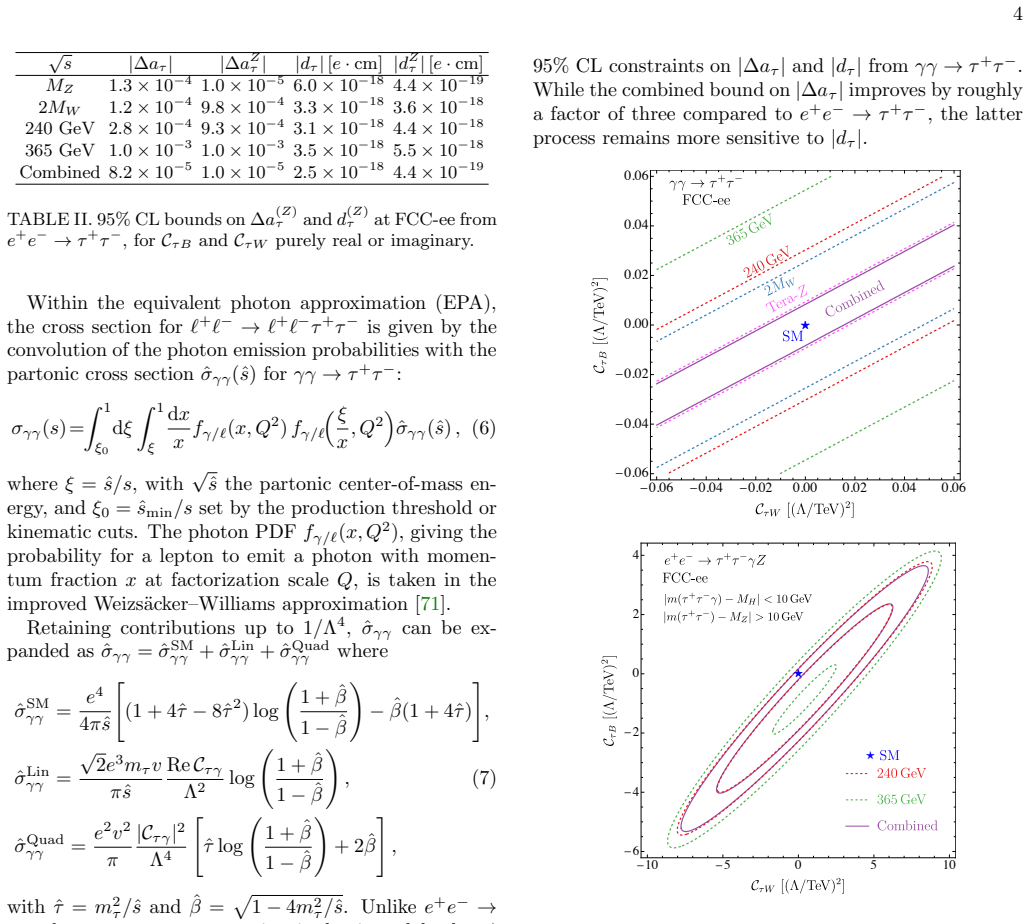

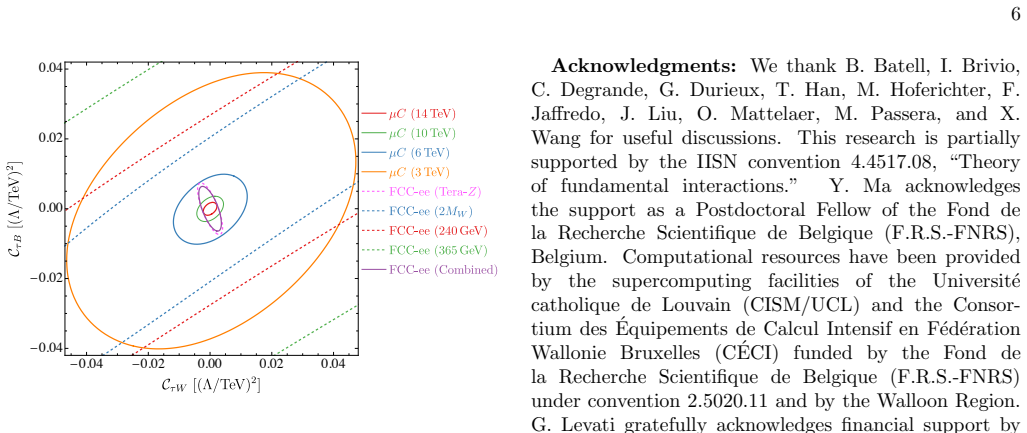
read the original abstract
The electric and magnetic dipole moments of the electron and of the muon provide stringent tests of the Standard Model and sensitive probes of new physics. By contrast, the corresponding dipole moments of the $\tau$ lepton remain weakly constrained. This study explores the potential of future lepton colliders, focusing on the $e^+e^-$ Future Circular Collider and a multi-TeV muon collider, to probe $\tau$ dipole moments. We consider multiple channels, including $\ell^+\ell^- \to \tau^+\tau^-$ ($\ell=e,\mu$), associated Higgs production $\mu^+\mu^- \to \tau^+\tau^- H$, radiative Higgs decays $H \to \tau^+\tau^-\gamma$, and vector-boson scattering $\ell^+\ell^- \to \ell^+\ell^-\tau^+\tau^-$ and $\mu^+\mu^- \to \bar\nu\nu\tau^+\tau^-$. Our results show that these facilities are highly complementary and can extend existing bounds by several orders of magnitude.
Editorial analysis
A structured set of objections, weighed in public.
Referee Report
Summary. The paper investigates the potential of future lepton colliders (FCC-ee and a multi-TeV muon collider) to constrain the electric and magnetic dipole moments of the tau lepton. It considers multiple channels including ℓ⁺ℓ⁻ → τ⁺τ⁻ (ℓ = e, μ), associated Higgs production μ⁺μ⁻ → τ⁺τ⁻H, radiative Higgs decays H → τ⁺τ⁻γ, and vector-boson scattering processes ℓ⁺ℓ⁻ → ℓ⁺ℓ⁻τ⁺τ⁻ and μ⁺μ⁻ → ν̄ντ⁺τ⁻. The central claim is that these facilities are highly complementary and can extend existing bounds by several orders of magnitude.
Significance. If the projections hold, the work is significant for highlighting how future colliders can substantially improve constraints on tau dipole moments, which remain weakly bounded relative to the electron and muon. The multi-channel, multi-collider approach demonstrates complementarity between e⁺e⁻ and μ⁺μ⁻ machines and provides a useful phenomenological roadmap for new-physics searches. The use of standard collider phenomenology for forward-looking estimates is a clear strength.
minor comments (2)
- The abstract states the main conclusion but supplies no information on the underlying calculations, statistical methods, systematic uncertainties, or background modeling. A brief summary of these elements (e.g., luminosity assumptions, efficiency tables, or background rejection strategies) should be added to the abstract or introduction for completeness.
- A summary table comparing the projected 95% CL bounds on d_τ and a_τ across all channels and both colliders would improve readability and allow direct assessment of the complementarity claim.
Simulated Author's Rebuttal
We thank the referee for the positive evaluation of our manuscript and for recommending minor revision. We appreciate the acknowledgment of the significance of our multi-channel, multi-collider study in improving constraints on the tau lepton dipole moments.
Circularity Check
No significant circularity detected
full rationale
The paper's central results consist of forward-looking sensitivity projections for tau dipole moments at future colliders (FCC-ee and multi-TeV muon collider) across listed channels such as dilepton production, associated Higgs production, radiative Higgs decays, and vector-boson scattering. These projections rely on standard collider phenomenology, cross-section calculations, and external design parameters (luminosities, efficiencies, backgrounds) rather than any derivation that reduces by the paper's own equations to quantities fitted from the same data or self-referential definitions. No load-bearing step equates a prediction to an input by construction, imports uniqueness via self-citation, or renames a known result as a new unification. The derivation chain is therefore self-contained against external benchmarks.
Axiom & Free-Parameter Ledger
Forward citations
Cited by 2 Pith papers
-
Four-fermion operators, $Z$-boson exchange, and $\tau$ lepton dipole moments
Z-boson exchange contributes ~3e-6 to the relevant asymmetries while four-fermion operators can reach ~1e-5 times Wilson coefficients, with loop insertions offering an additional path to a_tau without beam polarization.
-
Probing the Tau Anomalous Magnetic Moment at Colliders: From Ultra-Peripheral Collisions to the Precision Frontier
The paper reviews collider-based measurements of the tau anomalous magnetic moment, highlighting LHC ultra-peripheral collisions and projected sensitivities at future facilities like Belle II and FCC.
Reference graph
Works this paper leans on
- [1]
- [2]
- [3]
-
[4]
Morel, Z
L. Morel, Z. Yao, P. Clad´ e, and S. Guellati-Kh´ elifa, De- termination of the fine-structure constant with an accu- racy of 81 parts per trillion, Nature588, 61 (2020)
2020
- [5]
-
[6]
R. Alibertiet al., The anomalous magnetic moment of the muon in the Standard Model: an update, Phys. Rept. 7 1143, 1 (2025), arXiv:2505.21476 [hep-ph]
-
[7]
D. W. Hertzog and M. Hoferichter, The anomalous magnetic moment of the muon: status and perspec- tives, arxiv 10.1146/annurev-nucl-102422-040841 (2025), arXiv:2512.16980 [hep-ph]
- [8]
- [9]
-
[10]
S. Eidelman and M. Passera, Theory of the tau lepton anomalous magnetic moment, Mod. Phys. Lett. A22, 159 (2007), arXiv:hep-ph/0701260
-
[11]
S. Eidelman, D. Epifanov, M. Fael, L. Mercolli, and M. Passera,τdipole moments via radiative leptonicτ decays, JHEP03, 140, arXiv:1601.07987 [hep-ph]
-
[12]
L. Di Luzio, A. Keshavarzi, A. Masiero, and P. Paradisi, Model-Independent Tests of the Hadronic Vacuum Polar- ization Contribution to the Muon g-2, Phys. Rev. Lett. 134, 011902 (2025), arXiv:2408.01123 [hep-ph]
-
[13]
M. Hoferichter, P. Stoffer, and M. Zillinger, Hadronic light-by-light scattering in the anomalous magnetic mo- ments of electron andτ, Phys. Lett. B866, 139565 (2025), arXiv:2504.10582 [hep-ph]
-
[14]
Lepton anomalous magnetic moments: Theory
H. Wittig, Lepton anomalous magnetic moments: The- ory, arxiv (2025), arXiv:2512.18382 [hep-ph]
work page internal anchor Pith review Pith/arXiv arXiv 2025
-
[15]
R. Barbieri, G. R. Dvali, and L. J. Hall, Predictions from a U(2) flavor symmetry in supersymmetric theories, Phys. Lett. B377, 76 (1996), arXiv:hep-ph/9512388
-
[16]
R. Barbieri and L. J. Hall, A Grand unified supersym- metric theory of flavor, Nuovo Cim. A110, 1 (1997), arXiv:hep-ph/9605224
work page internal anchor Pith review arXiv 1997
-
[17]
R. Barbieri, L. J. Hall, S. Raby, and A. Romanino, Uni- fied theories with U(2) flavor symmetry, Nucl. Phys. B 493, 3 (1997), arXiv:hep-ph/9610449
-
[18]
R. Barbieri, L. J. Hall, and A. Romanino, Consequences of a U(2) flavor symmetry, Phys. Lett. B401, 47 (1997), arXiv:hep-ph/9702315
- [19]
-
[20]
R. Barbieri, D. Buttazzo, F. Sala, and D. M. Straub, Flavour physics from an approximateU(2) 3 symmetry, JHEP07, 181, arXiv:1203.4218 [hep-ph]
-
[21]
G. Panico and A. Wulzer,The Composite Nambu- Goldstone Higgs, Vol. 913 (Springer, 2016) arXiv:1506.01961 [hep-ph]
-
[22]
G. Panico and A. Pomarol, Flavor hierarchies from dy- namical scales, JHEP07, 097, arXiv:1603.06609 [hep- ph]
-
[23]
R. Barbieri, D. Buttazzo, F. Sala, D. M. Straub, and A. Tesi, A 125 GeV composite Higgs boson versus flavour and electroweak precision tests, JHEP05, 069, arXiv:1211.5085 [hep-ph]
- [24]
-
[25]
M. Bordone, C. Cornella, J. Fuentes-Martin, and G. Isidori, A three-site gauge model for flavor hierar- chies and flavor anomalies, Phys. Lett. B779, 317 (2018), arXiv:1712.01368 [hep-ph]
-
[26]
J. Fuentes-Martin, G. Isidori, J. M. Lizana, N. Selimovic, and B. A. Stefanek, Flavor hierarchies, flavor anomalies, and Higgs mass from a warped extra dimension, Phys. Lett. B834, 137382 (2022), arXiv:2203.01952 [hep-ph]
-
[27]
J. Davighi and G. Isidori, Non-universal gauge interac- tions addressing the inescapable link between Higgs and flavour, JHEP07, 147, arXiv:2303.01520 [hep-ph]
-
[28]
Buchmuller and D
W. Buchmuller and D. Wyler, Effective Lagrangian Anal- ysis of New Interactions and Flavor Conservation, Nucl. Phys. B268, 621 (1986)
1986
-
[29]
J. Abdallahet al.(DELPHI), Study of tau-pair produc- tion in photon-photon collisions at LEP and limits on the anomalous electromagnetic moments of the tau lepton, Eur. Phys. J. C35, 159 (2004), arXiv:hep-ex/0406010
- [30]
-
[31]
A. Hayrapetyanet al.(CMS), Observation ofγγ→τ τ in proton-proton collisions and limits on the anomalous electromagnetic moments of theτlepton, Rept. Prog. Phys.87, 107801 (2024), arXiv:2406.03975 [hep-ex]
-
[32]
K. Inamiet al.(Belle), An improved search for the electric dipole moment of theτlepton, JHEP04, 110, arXiv:2108.11543 [hep-ex]
-
[33]
J. Bernabeu, G. A. Gonzalez-Sprinberg, and J. Vidal, CP violation and electric-dipole-moment at low energy tau production with polarized electrons, Nucl. Phys. B 763, 283 (2007), arXiv:hep-ph/0610135
-
[34]
J. Bernabeu, G. A. Gonzalez-Sprinberg, J. Papavassiliou, and J. Vidal, Tau anomalous magnetic moment form- factor at super B/flavor factories, Nucl. Phys. B790, 160 (2008), arXiv:0707.2496 [hep-ph]
-
[35]
J. Bernabeu, G. A. Gonzalez-Sprinberg, and J. Vidal, Tau spin correlations and the anomalous magnetic mo- ment, JHEP01, 062, arXiv:0807.2366 [hep-ph]
-
[36]
A. Crivellin, M. Hoferichter, and J. M. Roney, To- ward testing the magnetic moment of the tau at one part per million, Phys. Rev. D106, 093007 (2022), arXiv:2111.10378 [hep-ph]
-
[37]
D. M. Asneret al.(US Belle II Group, Belle II/SuperKEKB e- Polarization Upgrade Working Group), Snowmass 2021 White Paper on Upgrading SuperKEKB with a Polarized Electron Beam: Discovery Potential and Proposed Implementation, inSnowmass 2021(2022) arXiv:2205.12847 [physics.acc-ph]
-
[38]
H. Aiharaet al., The Belle II Detector Upgrades Framework Conceptual Design Report (2024), arXiv:2406.19421 [hep-ex]
-
[39]
J. Gogniat, M. Hoferichter, and Y. Ulrich, Towards test- ing (g−2) τ in e+e− →τ +τ −: radiative corrections and projections for Belle II, JHEP07, 172, arXiv:2505.09678 [hep-ph]
-
[40]
Light new physics and the $\tau$ lepton dipole moments
M. Hoferichter and G. Levati, Light new physics and the τlepton dipole moments (2025), arXiv:2511.03786 [hep- ph]
work page internal anchor Pith review Pith/arXiv arXiv 2025
-
[41]
Light new physics and the $\tau$ lepton dipole moments: prospects at Belle II
M. Hoferichter and G. Levati, Light new physics and the τlepton dipole moments: prospects at Belle II (2025), arXiv:2510.13966 [hep-ph]
work page internal anchor Pith review Pith/arXiv arXiv 2025
-
[42]
W. Altmannshoferet al.(Belle II), The Belle II Physics Book, PTEP2019, 123C01 (2019), [Erratum: PTEP 2020, 029201 (2020)], arXiv:1808.10567 [hep-ex]
-
[43]
Abadaet al.(FCC), FCC-ee: The Lepton Collider: Future Circular Collider Conceptual Design Report Vol- ume 2, Eur
A. Abadaet al.(FCC), FCC-ee: The Lepton Collider: Future Circular Collider Conceptual Design Report Vol- ume 2, Eur. Phys. J. ST228, 261 (2019)
2019
-
[44]
The Future Circular Collider: a Summary for the US 2021 Snowmass Process
G. Bernardiet al., The Future Circular Collider: a 8 Summary for the US 2021 Snowmass Process, (2022), arXiv:2203.06520 [hep-ex]
-
[45]
M. Benediktet al.(FCC), Future Circular Collider Feasibility Study Report: Volume 1, Physics, Exper- iments, Detectors, Eur. Phys. J. C85, 1468 (2025), arXiv:2505.00272 [hep-ex]
-
[46]
Altmannet al.,ECFA Higgs, electroweak, and top Fac- tory Study, CERN Yellow Reports: Monographs, Vol
J. Altmannet al.,ECFA Higgs, electroweak, and top Fac- tory Study, CERN Yellow Reports: Monographs, Vol. 5/2025 (2025) arXiv:2506.15390 [hep-ex]
-
[47]
J. de Blaset al.(Muon Collider), The physics case of a 3 TeV muon collider stage, arxiv (2022), arXiv:2203.07261 [hep-ph]
-
[48]
Aime et al.,Muon Collider Physics Summary,2203.07256
C. Aimeet al., Muon Collider Physics Summary, arxiv (2022), arXiv:2203.07256 [hep-ph]
- [49]
-
[50]
Accettura et al.,Towards a muon collider,Eur
C. Accetturaet al., Towards a muon collider, Eur. Phys. J. C83, 864 (2023), [Erratum: Eur.Phys.J.C 84, 36 (2024)], arXiv:2303.08533 [physics.acc-ph]
-
[51]
J. P. Delahaye, M. Diemoz, K. Long, B. Man- souli´ e, N. Pastrone, L. Rivkin, D. Schulte, A. Skrin- sky, and A. Wulzer, Muon Colliders, arxiv (2019), arXiv:1901.06150 [physics.acc-ph]
work page Pith review arXiv 2019
-
[52]
Detector and Physics Performance at a Muon Collider,
N. Bartosiket al., Detector and Physics Perfor- mance at a Muon Collider, JINST15(05), P05001, arXiv:2001.04431 [hep-ex]
-
[53]
Schulte, J.-P
D. Schulte, J.-P. Delahaye, M. Diemoz, K. Long, B. Mansouli´ e, N. Pastrone, L. Rivkin, A. Skrinsky, and A. Wulzer, Prospects on Muon Colliders, PoS ICHEP2020, 703 (2021)
2021
- [54]
-
[55]
Stratakiset al.[Muon Collider], [arXiv:2203.08033 [physics.acc-ph]]
D. Stratakiset al.(Muon Collider), A Muon Col- lider Facility for Physics Discovery, arxiv (2022), arXiv:2203.08033 [physics.acc-ph]
-
[56]
N. Bartosiket al.(Muon Collider), Simulated Detec- tor Performance at the Muon Collider, arxiv (2022), arXiv:2203.07964 [hep-ex]
-
[57]
Aaltonenet al.(CDF), Science376, 170 (2022), arXiv:2203.07224 [hep-ex]
S. Jindarianiet al.(Muon Collider), Promising Technolo- gies and R&D Directions for the Future Muon Collider Detectors, arxiv (2022), arXiv:2203.07224 [physics.ins- det]
-
[58]
Accetturaet al.[International Muon Collider], [arXiv:2504.21417 [physics.acc-ph]]
C. Accetturaet al.(International Muon Collider), The Muon Collider, arxiv (2025), arXiv:2504.21417 [physics.acc-ph]
-
[59]
D. Buttazzo and P. Paradisi, Probing the muong−2 anomaly with the Higgs boson at a muon collider, Phys. Rev. D104, 075021 (2021), arXiv:2012.02769 [hep-ph]
-
[60]
Dimension-Six Terms in the Standard Model Lagrangian
B. Grzadkowski, M. Iskrzynski, M. Misiak, and J. Rosiek, Dimension-Six Terms in the Standard Model Lagrangian, JHEP10, 085, arXiv:1008.4884 [hep-ph]
work page internal anchor Pith review arXiv
-
[61]
L. Allwicher, L. Di Luzio, M. Fedele, F. Mescia, and M. Nardecchia, What is the scale of new physics be- hind the muon g-2?, Phys. Rev. D104, 055035 (2021), arXiv:2105.13981 [hep-ph]
- [62]
- [63]
- [64]
-
[65]
R. Alonso, E. E. Jenkins, A. V. Manohar, and M. Trott, Renormalization Group Evolution of the Stan- dard Model Dimension Six Operators III: Gauge Cou- pling Dependence and Phenomenology, JHEP04, 159, arXiv:1312.2014 [hep-ph]
- [66]
-
[67]
J. Aebischer, W. Dekens, E. E. Jenkins, A. V. Manohar, D. Sengupta, and P. Stoffer, Effective field theory inter- pretation of lepton magnetic and electric dipole moments, JHEP07, 107, arXiv:2102.08954 [hep-ph]
- [68]
- [69]
- [70]
-
[71]
Improving the Weizs\"acker-Williams Approximation in Electron-Proton Collisions
S. Frixione, M. L. Mangano, P. Nason, and G. Ridolfi, Im- proving the Weizsacker-Williams approximation in elec- tron - proton collisions, Phys. Lett. B319, 339 (1993), arXiv:hep-ph/9310350
work page Pith review arXiv 1993
-
[72]
J. M. Cornwall, D. N. Levin, and G. Tiktopoulos, Deriva- tion of Gauge Invariance from High-Energy Unitarity Bounds on the s Matrix, Phys. Rev. D10, 1145 (1974), [Erratum: Phys.Rev.D 11, 972 (1975)]
1974
-
[73]
B. W. Lee, C. Quigg, and H. B. Thacker, Weak Inter- actions at Very High-Energies: The Role of the Higgs Boson Mass, Phys. Rev. D16, 1519 (1977)
1977
-
[74]
M. S. Chanowitz and M. K. Gaillard, The TeV Physics of Strongly Interacting W’s and Z’s, Nucl. Phys. B261, 379 (1985)
1985
- [75]
discussion (0)
Sign in with ORCID, Apple, or X to comment. Anyone can read and Pith papers without signing in.