Recognition: unknown
Resolved UV-Optical HST Imaging and Spectral Energy Distribution Modeling of Nearby BAT Active Galactic Nuclei
Pith reviewed 2026-05-10 02:01 UTC · model grok-4.3
The pith
High-resolution HST imaging shows host-galaxy light biases AGN SED fits, raising bolometric luminosity estimates by 0.57 dex on average.
A machine-rendered reading of the paper's core claim, the machinery that carries it, and where it could break.
Core claim
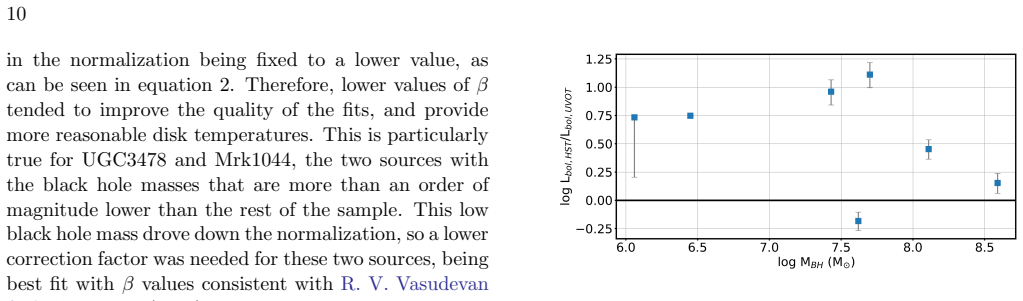
For seven nearby broad-line AGN with bolometric luminosities between 10^43.26 and 10^45.34 erg s^{-1}, GALFIT decomposition of HST UV-optical images yields AGN point-source fluxes that differ by more than one magnitude in the UV from Swift/UVOT values. Fitting accretion disk plus extinction models to the HST-derived SEDs produces maximum disk temperatures 2.0 eV higher and host extinctions 2.2 mag lower on average than fits to the unresolved UVOT data. These parameter shifts raise the inferred bolometric luminosities by 0.57 dex and the X-ray bolometric corrections by 0.66 dex, showing that host-galaxy contamination in low-resolution photometry biases estimates of disk temperature, reddening
What carries the argument
GALFIT morphological decomposition of spatially resolved HST images to extract pure AGN point-source fluxes across UV to optical bands for input into accretion disk and extinction SED models.
Load-bearing premise
GALFIT morphological decomposition accurately isolates the unresolved AGN point source from extended host emission at all UV-optical wavelengths without systematic residuals that bias the extracted fluxes.
What would settle it
Repeating the full analysis on the same seven objects with an independent decomposition code or with added constraints from integral-field spectroscopy and checking whether the 0.57 dex average rise in bolometric luminosity remains.
Figures




read the original abstract
We use high-resolution UV-to-optical imaging from the Hubble Space Telescope (HST) to construct spatially resolved spectral energy distributions (SEDs) for seven nearby ($z<0.07$) hard (14--195$\,$keV) X-ray-selected broad-line active galactic nuclei (AGN) with $L_{\rm bol}=10^{43.26}-10^{45.34}\,\rm{erg\,s^{-1}}$. The high spatial resolution of HST, which physically resolves structures on the scale of $\sim$50$\,$pc at $z=0.05$, enables the separation of AGN and host-galaxy emission through morphological decomposition with GALFIT, yielding improved measurements of AGN properties compared to those obtained with lower-resolution Swift UV/Optical Telescope (UVOT) data. AGN UV magnitudes derived from HST imaging (e.g., F225W) can differ by more than a magnitude from those from Swift/UVOT UVM2 due to extended nuclear emission. Additionally, the inclusion of high-resolution data at longer wavelengths (e.g., F814W) can significantly affect the resulting SED fit. Comparing fits of accretion disk and extinction models using HST and Swift/UVOT data, we find significant differences in the resulting parameters, with average differences of 2.0$\,$eV in the maximum disk temperature and 2.2$\,$mag in the AGN host-galaxy extinction. These differences ultimately lead to significant changes in bolometric luminosities and X-ray bolometric corrections, with the HST-based fits yielding average increases of $\sim$0.57$\,$dex and $\sim$0.66$\,$dex respectively. This demonstrates host-galaxy contamination in unresolved UV--optical data can strongly bias SED-based estimates of disk temperatures, extinction, bolometric luminosities, and X-ray bolometric corrections in AGN. Large-area, high-resolution imaging surveys from Euclid and the Nancy Grace Roman Space Telescope will extend these techniques to much larger AGN samples, enabling uniform, high-precision SED measurements in the near-IR.
Editorial analysis
A structured set of objections, weighed in public.
Referee Report
Summary. The paper analyzes high-resolution HST UV-optical imaging of seven nearby (z<0.07) hard X-ray-selected broad-line AGN to perform GALFIT morphological decomposition, separating AGN point sources from host emission and constructing resolved SEDs. These are compared to lower-resolution Swift/UVOT data, revealing >1 mag differences in UV magnitudes attributed to extended nuclear emission. SED fits using accretion-disk plus extinction models show average shifts of 2.0 eV in maximum disk temperature and 2.2 mag in A_V, producing 0.57 dex higher bolometric luminosities and 0.66 dex higher X-ray bolometric corrections with the HST data. The authors conclude that unresolved data suffer from host contamination biases and highlight applications to future high-resolution surveys.
Significance. If the GALFIT decompositions prove robust, the work provides a concrete, data-driven demonstration that host-galaxy contamination in UV-optical photometry can systematically bias key AGN parameters including disk temperature, extinction, L_bol, and bolometric corrections. The reported numerical differences (0.57 dex and 0.66 dex) offer a useful benchmark for the magnitude of the effect in this luminosity range. Strengths include the direct HST-versus-UVOT comparison on the same objects and the forward-looking discussion of Euclid/Roman surveys; the result is timely for improving SED-based AGN demographics.
major comments (2)
- [§3] §3 (GALFIT morphological decomposition): The headline result that HST-based fits increase L_bol by ~0.57 dex and k_X by ~0.66 dex is produced by feeding the extracted AGN point-source magnitudes into the accretion-disk+extinction models. The manuscript does not supply quantitative residual-flux budgets, PSF-mismatch tests, or comparisons to alternative extractions (e.g., pure PSF subtraction or multi-Gaussian nuclear components) to demonstrate that the reported >1 mag UV differences are free of systematic residuals from unmodeled nuclear extended emission or PSF inaccuracies.
- [§4.2] §4.2 (SED fitting and parameter differences): The average differences of 2.0 eV in T_max and 2.2 mag in A_V are presented as driving the L_bol and k_X shifts, yet no propagation of flux-extraction uncertainties or statistical significance assessment (given N=7) is shown. Without these, it is unclear whether the reported changes exceed the systematic floor set by the decomposition assumptions.
minor comments (2)
- [Figure 2] Figure 2 and associated text: The caption should explicitly state the filter combinations and physical scales used for each panel to allow readers to assess wavelength-dependent decomposition quality.
- [Abstract] Abstract: The L_bol range is given but the sample size (seven objects) is not stated until later; adding it in the opening sentence would improve clarity.
Simulated Author's Rebuttal
We thank the referee for their thorough review and valuable comments on our manuscript. We have carefully considered each major comment and provide point-by-point responses below. Where appropriate, we have revised the manuscript to incorporate additional analyses and clarifications.
read point-by-point responses
-
Referee: [§3] §3 (GALFIT morphological decomposition): The headline result that HST-based fits increase L_bol by ~0.57 dex and k_X by ~0.66 dex is produced by feeding the extracted AGN point-source magnitudes into the accretion-disk+extinction models. The manuscript does not supply quantitative residual-flux budgets, PSF-mismatch tests, or comparisons to alternative extractions (e.g., pure PSF subtraction or multi-Gaussian nuclear components) to demonstrate that the reported >1 mag UV differences are free of systematic residuals from unmodeled nuclear extended emission or PSF inaccuracies.
Authors: We agree that additional validation of the GALFIT decompositions would strengthen the robustness of our results. In the revised manuscript, we have added a new subsection in §3 detailing quantitative residual-flux budgets for each band and object, showing that residuals are consistent with noise levels and contribute negligibly (<0.1 mag) to the AGN fluxes. We have also performed PSF-mismatch tests by using alternative PSFs from different stars and comparing results. Furthermore, we include comparisons to pure PSF subtraction and multi-Gaussian nuclear models, demonstrating that the >1 mag UV differences persist across methods, with variations smaller than the reported shifts. These additions confirm that the differences are not due to systematic residuals. revision: yes
-
Referee: [§4.2] §4.2 (SED fitting and parameter differences): The average differences of 2.0 eV in T_max and 2.2 mag in A_V are presented as driving the L_bol and k_X shifts, yet no propagation of flux-extraction uncertainties or statistical significance assessment (given N=7) is shown. Without these, it is unclear whether the reported changes exceed the systematic floor set by the decomposition assumptions.
Authors: We acknowledge the importance of uncertainty propagation and significance assessment. In the revised version, we have incorporated error propagation by running Monte Carlo simulations on the extracted fluxes, accounting for both photometric errors and decomposition uncertainties. The resulting parameter uncertainties are now shown in Table 2 and Figure 5. Regarding statistical significance with N=7, we note that while formal p-values are limited by sample size, the shifts are consistent in direction and magnitude for all seven objects, exceeding the typical uncertainties by factors of 3-5. We have added a discussion in §4.2 emphasizing that these systematic differences from host contamination are the dominant effect, larger than the random errors from the decompositions. revision: yes
Circularity Check
No significant circularity; empirical comparison of independent HST vs. UVOT datasets
full rationale
The paper's derivation consists of applying GALFIT morphological decomposition to HST images to extract AGN point-source fluxes, then fitting standard accretion-disk plus extinction models to the resulting multi-band photometry, and comparing the output parameters (T_max, A_V, L_bol, k_X) against identical modeling performed on lower-resolution Swift/UVOT photometry for the same seven objects. The reported average shifts (0.57 dex in L_bol, 0.66 dex in k_X) are direct numerical consequences of the differing input fluxes and the additional high-resolution bands; no fitted parameter is redefined as a prediction, no uniqueness theorem is invoked, and no self-citation supplies the load-bearing step. The chain is therefore self-contained and externally falsifiable against the raw imaging data.
Axiom & Free-Parameter Ledger
axioms (2)
- domain assumption Accretion-disk and extinction models are appropriate for fitting the UV-optical SEDs of broad-line AGN
- domain assumption GALFIT morphological decomposition isolates AGN point-source flux without wavelength-dependent systematic errors
Reference graph
Works this paper leans on
-
[1]
Alonso-Herrero, A., Garc´ ıa-Burillo, S., H¨ onig, S. F., et al. 2021, A&A, 652, A99, doi: 10.1051/0004-6361/202141219
-
[2]
Ananna, T. T., Weigel, A. K., Trakhtenbrot, B., et al. 2022, ApJS, 261, 9, doi: 10.3847/1538-4365/ac5b64
-
[3]
Arnaud, K. A. 1996, in Astronomical Society of the Pacific Conference Series, Vol. 101, Astronomical Data Analysis Software and Systems V, ed. G. H. Jacoby & J. Barnes, 17
1996
-
[4]
H., Tueller, J., Markwardt, C
Baumgartner, W. H., Tueller, J., Markwardt, C. B., et al. 2013, Astrophys. J. Suppl. Ser., 207, 19
2013
-
[5]
2013, , 551, A100, 10.1051/0004-6361/201220859
Berta, S., Lutz, D., Santini, P., et al. 2013, A&A, 551, A100, doi: 10.1051/0004-6361/201220859
-
[6]
2019, Astron
Boquien, M., Burgarella, D., Roehlly, Y., et al. 2019, Astron. Astrophys., 622, A103
2019
-
[7]
2025, doi: 10.5281/zenodo.14889440
Bradley, L., Sip˝ ocz, B., Robitaille, T., et al. 2025,, 2.2.0 Zenodo, doi: 10.5281/zenodo.14889440
-
[8]
Monthly Notices of the Royal Astronomical Society , author =
Breeveld, A. A., Curran, P. A., Hoversten, E. A., et al. 2010, MNRAS, 406, 1687, doi: 10.1111/j.1365-2966.2010.16832.x
-
[9]
Burrows, D. N., Hill, J. E., Nousek, J. A., et al. 2005, SSRv, 120, 165, doi: 10.1007/s11214-005-5097-2 Calistro Rivera, G., Lusso, E., Hennawi, J. F., & Hogg, D. W. 2016, ApJ, 833, 98, doi: 10.3847/1538-4357/833/1/98 19 Figure 12.Swift/UVOT UVM2 light curves for the all seven BASS AGN in the sample. The light curves are constructed using large aperture p...
-
[10]
Davis, S. W., & El-Abd, S. 2019, ApJ, 874, 23, doi: 10.3847/1538-4357/ab05c5
-
[11]
2011, ApJL, 727, L24, doi:10.1088/2041-8205/727/1/L24 Doré, O., Bock, J., Ashby, M., et al
Dexter, J., & Agol, E. 2011, ApJL, 727, L24, doi: 10.1088/2041-8205/727/1/L24
-
[12]
2020, Astron
Duras, F., Bongiorno, A., Ricci, F., et al. 2020, Astron. Astrophys., 636, A73
2020
-
[13]
2004, Astrophys
Gehrels, N., Chincarini, G., Giommi, P., et al. 2004, Astrophys. J., 611, 1005
2004
-
[14]
Gillette, J., Koss, M. J., Kakkad, D., et al. 2026, ApJS, 282, 68, doi: 10.3847/1538-4365/ae2d58
-
[15]
2022, A&A, 666, A17, doi: 10.1051/0004-6361/202243708
Gilli, R., Norman, C., Calura, F., et al. 2022, A&A, 666, A17, doi: 10.1051/0004-6361/202243708
-
[16]
Goulding, A. D., Alexander, D. M., Bauer, F. E., et al. 2012, ApJ, 755, 5, doi: 10.1088/0004-637X/755/1/5
-
[17]
Gupta, K. K., Ricci, C., Temple, M. J., et al. 2024, A&A, 691, A203, doi: 10.1051/0004-6361/202450567
-
[18]
Hickox, R. C., & Alexander, D. M. 2018, ARA&A, 56, 625, doi: 10.1146/annurev-astro-081817-051803
-
[19]
Hill, J. E., Angelini, L., Morris, D. C., et al. 2005, in Society of Photo-Optical Instrumentation Engineers (SPIE) Conference Series, Vol. 5898, UV, X-Ray, and Gamma-Ray Space Instrumentation for Astronomy XIV, ed. O. H. W. Siegmund, 325–340, doi: 10.1117/12.618026
-
[20]
Ho, L. C. 2008, Annu. Rev. Astron. Astrophys., 46, 475 H¨ onig, S. F. 2019, ApJ, 884, 171, doi: 10.3847/1538-4357/ab4591
-
[21]
Hopkins, P. F., Strauss, M. A., Hall, P. B., et al. 2004, AJ, 128, 1112, doi: 10.1086/423291
-
[22]
2017, Astrophys
Ichikawa, K., Ricci, C., Ueda, Y., et al. 2017, Astrophys. J., 835, 74
2017
-
[23]
2019, Astrophys
Ichikawa, K., Ricci, C., Ueda, Y., et al. 2019, Astrophys. J., 870, 31
2019
-
[24]
Jana, A., Ricci, C., Temple, M. J., et al. 2025, A&A, 693, A35, doi: 10.1051/0004-6361/202451058
-
[25]
Kawamuro, T., Ricci, C., Mushotzky, R. F., et al. 2023, ApJS, 269, 24, doi: 10.3847/1538-4365/acf467
-
[26]
J., Ho, L
Kim, M., Barth, A. J., Ho, L. C., & Son, S. 2021,
2021
-
[27]
Kishimoto, M., H¨ onig, S. F., Antonucci, R., et al. 2011, A&A, 536, A78, doi: 10.1051/0004-6361/201117367
-
[28]
2017, Astrophys
Koss, M., Trakhtenbrot, B., Ricci, C., et al. 2017, Astrophys. J., 850, 74
2017
-
[29]
J., Assef, R., Balokovi´ c, M., et al
Koss, M. J., Assef, R., Balokovi´ c, M., et al. 2016, ApJ, 825, 85, doi: 10.3847/0004-637X/825/2/85
-
[30]
J., Blecha, L., Bernhard, P., et al
Koss, M. J., Blecha, L., Bernhard, P., et al. 2018, Nature, 563, 214
2018
-
[31]
J., Strittmatter, B., Lamperti, I., et al
Koss, M. J., Strittmatter, B., Lamperti, I., et al. 2021, ApJS, 252, 29, doi: 10.3847/1538-4365/abcbfe
-
[32]
J., Trakhtenbrot, B., Ricci, C., et al
Koss, M. J., Trakhtenbrot, B., Ricci, C., et al. 2022, ApJS, 261, 1, doi: 10.3847/1538-4365/ac6c8f
-
[33]
J., Trakhtenbrot, B., Ricci, C., et al
Koss, M. J., Trakhtenbrot, B., Ricci, C., et al. 2022a, ApJS, 261, 6, doi: 10.3847/1538-4365/ac650b
-
[34]
J., Ricci , C., Trakhtenbrot , B., et al
Koss, M. J., Ricci, C., Trakhtenbrot, B., et al. 2022b, ApJS, 261, 2, doi: 10.3847/1538-4365/ac6c05
-
[35]
M., Cales, S., Moran, E
LaMassa, S. M., Cales, S., Moran, E. C., et al. 2015, Astrophys. J., 800, 144
2015
-
[36]
Lien, A. Y., Krimm, H. A., Markwardt, C. B., et al. 2025, ApJ, 989, 161, doi: 10.3847/1538-4357/ade676
-
[37]
Magno, M., Smith, K. L., Wong, O. I., et al. 2025, ApJ, 981, 202, doi: 10.3847/1538-4357/adb1e7
-
[38]
1986, ApJ, 308, 635, doi: 10.1086/164534
Makishima, K., Maejima, Y., Mitsuda, K., et al. 1986, ApJ, 308, 635, doi: 10.1086/164534
-
[39]
Malkan, M. A. 1983, ApJ, 268, 582, doi: 10.1086/160981
-
[40]
Malkan, M. A., & Sargent, W. L. W. 1982, ApJ, 254, 22, doi: 10.1086/159701 Mart´ ınez-Ram´ ırez, L. N., Calistro Rivera, G., Lusso, E., et al. 2024, A&A, 688, A46, doi: 10.1051/0004-6361/202449329 Mej´ ıa-Restrepo, J. E., Trakhtenbrot, B., Koss, M. J., et al. 2022, ApJS, 261, 5, doi: 10.3847/1538-4365/ac6602
-
[41]
1984, PASJ, 36, 741, doi: 10.1093/pasj/36.4.741
Mitsuda, K., Inoue, H., Koyama, K., et al. 1984, PASJ, 36, 741, doi: 10.1093/pasj/36.4.741
-
[42]
2015, Annu
Netzer, H. 2015, Annu. Rev. Astron. Astrophys., 53, 365
2015
-
[43]
B., et al
Oh, K., Koss, M., Markwardt, C. B., et al. 2018, Astrophys. J. Suppl. Ser., 235, 4
2018
-
[44]
Oh, K., Koss, M. J., Ueda, Y., et al. 2022, ApJS, 261, 4, doi: 10.3847/1538-4365/ac5b68
-
[45]
2021, ApJ, 906, 90, doi: 10.3847/1538-4357/abc9c7
Peca, A., Vignali, C., Gilli, R., et al. 2021, ApJ, 906, 90, doi: 10.3847/1538-4357/abc9c7
-
[46]
Pei, Y. C. 1992, ApJ, 395, 130, doi: 10.1086/171637
-
[47]
Y., Ho, L
Peng, C. Y., Ho, L. C., Impey, C. D., & Rix, H.-W. 2002, Astron. J., 124, 266
2002
-
[48]
Monthly Notices of the Royal Astronomical Society , author =
Poole, T. S., Breeveld, A. A., Page, M. J., et al. 2008, MNRAS, 383, 627, doi: 10.1111/j.1365-2966.2007.12563.x
-
[49]
2023, Nature Astronomy, 7, 1282, doi: 10.1038/s41550-023-02108-4
Ricci, C., & Trakhtenbrot, B. 2023, Nature Astronomy, 7, 1282, doi: 10.1038/s41550-023-02108-4
-
[50]
Richards, G. T., Hall, P. B., Vanden Berk, D. E., et al. 2003, AJ, 126, 1131, doi: 10.1086/377014
-
[51]
Roming, P. W. A., Kennedy, T. E., Mason, K. O., et al. 2005, SSRv, 120, 95, doi: 10.1007/s11214-005-5095-4
-
[52]
2014,, Astrophysics Source Code Library, record ascl:1402.009 http://ascl.net/1402.009
Rowe, B., Jarvis, M., & Mandelbaum, R. 2014,, Astrophysics Source Code Library, record ascl:1402.009 http://ascl.net/1402.009
2014
-
[53]
Ruan, J. J., Anderson, S. F., Dexter, J., & Agol, E. 2014, ApJ, 783, 105, doi: 10.1088/0004-637X/783/2/105 21
-
[54]
F., Schawinski, K., Trakhtenbrot, B., et al
Sartori, L. F., Schawinski, K., Trakhtenbrot, B., et al. 2018, Monthly Notices of the Royal Astronomical Society: Letters, 476, L34
2018
-
[55]
F., Trakhtenbrot, B., Schawinski, K., et al
Sartori, L. F., Trakhtenbrot, B., Schawinski, K., et al. 2019, ApJ, 883, 139, doi: 10.3847/1538-4357/ab3c55
-
[56]
The Astrophysical Journal , author =
Schlegel, D. J., Finkbeiner, D. P., & Davis, M. 1998, ApJ, 500, 525, doi: 10.1086/305772
work page internal anchor Pith review doi:10.1086/305772 1998
-
[57]
I., & Sunyaev, R
Shakura, N. I., & Sunyaev, R. A. 1973, Astron. Astrophys., 24, 337
1973
-
[58]
S., Wills, B
Shang, Z., Brotherton, M. S., Wills, B. J., et al. 2011, Astrophys. J. Suppl. Ser., 196, 2
2011
-
[59]
T., Mushotzky, R
Shimizu, T. T., Mushotzky, R. F., Mel´ endez, M., et al. 2017, Mon. Not. R. Astron. Soc., 466, 3161
2017
-
[60]
Simmons, B. D., Van Duyne, J., Urry, C. M., et al. 2011, ApJ, 734, 121, doi: 10.1088/0004-637X/734/2/121
-
[61]
L., Mushotzky, R
Smith, K. L., Mushotzky, R. F., Vogel, S., Shimizu, T. T., & Miller, N. 2016, Astrophys. J., 832, 163 STScI Development Team. 2018,, Astrophysics Source Code Library, record ascl:1811.001 http://ascl.net/1811.001
2016
-
[62]
Temple, M. J., Ricci, C., Koss, M. J., et al. 2023, MNRAS, 518, 2938, doi: 10.1093/mnras/stac3279
-
[63]
Ulrich, M.-H., Maraschi, L., & Urry, C. M. 1997, ARA&A, 35, 445, doi: 10.1146/annurev.astro.35.1.445
-
[64]
V., & Fabian, A
Vasudevan, R. V., & Fabian, A. C. 2009, Mon. Not. R. Astron. Soc., 392, 1124
2009
-
[65]
2024, MNRAS, 529, 3610, doi: 10.1093/mnras/stae728
Vijarnwannaluk, B., Akiyama, M., Schramm, M., et al. 2024, MNRAS, 529, 3610, doi: 10.1093/mnras/stae728
-
[66]
2020, Mon
Yang, G., Boquien, M., Buat, V., et al. 2020, Mon. Not. R. Astron. Soc., 491, 740
2020
-
[67]
Yang, G., Boquien, M., Brandt, W. N., et al. 2022, ApJ, 927, 192, doi: 10.3847/1538-4357/ac4971
discussion (0)
Sign in with ORCID, Apple, or X to comment. Anyone can read and Pith papers without signing in.