Recognition: unknown
MMControl: Unified Multi-Modal Control for Joint Audio-Video Generation
Pith reviewed 2026-05-10 02:49 UTC · model grok-4.3
The pith
MMControl routes visual and acoustic conditions through bypass branches into a joint audio-video diffusion transformer to enable independent control of identity, voice, pose, and layout.
A machine-rendered reading of the paper's core claim, the machinery that carries it, and where it could break.
Core claim
By injecting reference images, reference audio, depth maps, and pose sequences through dedicated bypass branches into a joint audio-video Diffusion Transformer, and by applying independent guidance scaling per modality at inference time, the model generates videos whose visual identity and structural layout follow the visual inputs while the accompanying audio follows the timbre and content of the reference audio, all within one forward pass.
What carries the argument
The dual-stream conditional injection mechanism, which passes visual controls (images, depth, pose) and acoustic controls (audio) through separate bypass branches into the shared audio-video Diffusion Transformer backbone so each condition can influence generation without overwriting the others.
If this is right
- Each visual or acoustic condition can be strengthened or weakened independently at inference without retraining.
- Character identity from a reference image remains consistent across frames while body pose follows an input sequence.
- Voice timbre from a reference audio clip is preserved even when the visual scene or pose changes.
- Scene layout can be constrained by depth maps without breaking audio-video alignment.
Where Pith is reading between the lines
- The same bypass-branch pattern might let future models add text prompts or music stems as additional controllable streams without redesigning the core architecture.
- Because all conditions meet inside one transformer, the method could reduce the cumulative error that appears when audio is generated separately and then aligned to video.
- In production pipelines this would allow animators to lock only the elements they care about (voice, pose, or background) while leaving others free.
Load-bearing premise
Adding visual and acoustic conditions through bypass branches will preserve generation quality and cross-modal synchronization without creating artifacts or requiring full retraining of the underlying transformer.
What would settle it
Run the model on a test set where a reference audio clip is paired with a reference image whose apparent speaker does not match the audio timbre, then measure whether lip synchronization and voice consistency degrade below the baseline joint-generation scores.
Figures


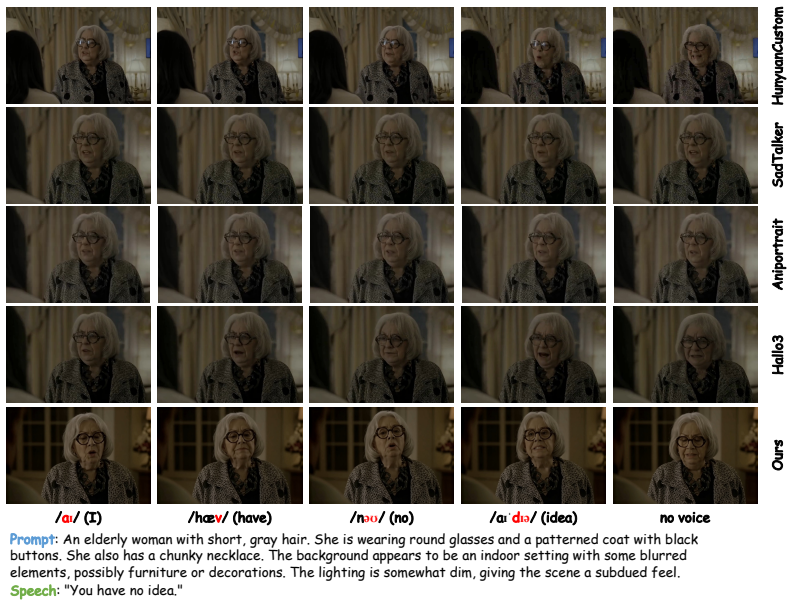
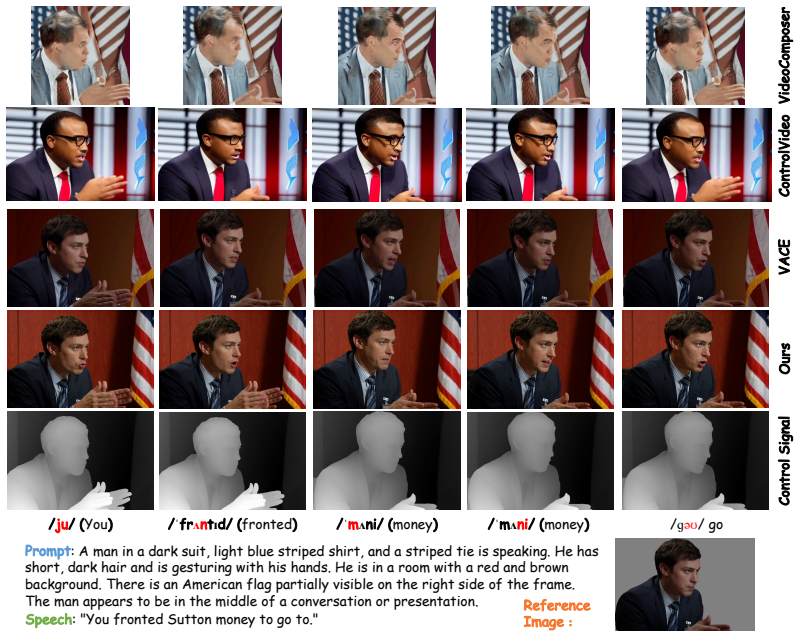


read the original abstract
Recent advances in Diffusion Transformers (DiTs) have enabled high-quality joint audio-video generation, producing videos with synchronized audio within a single model. However, existing controllable generation frameworks are typically restricted to video-only control. This restricts comprehensive controllability and often leads to suboptimal cross-modal alignment. To bridge this gap, we present MMControl, which enables users to perform Multi-Modal Control in joint audio-video generation. MMControl introduces a dual-stream conditional injection mechanism. It incorporates both visual and acoustic control signals, including reference images, reference audio, depth maps, and pose sequences, into a joint generation process. These conditions are injected through bypass branches into a joint audio-video Diffusion Transformer, enabling the model to simultaneously generate identity-consistent video and timbre-consistent audio under structural constraints. Furthermore, we introduce modality-specific guidance scaling, which allows users to independently and dynamically adjust the influence strength of each visual and acoustic condition at inference time. Extensive experiments demonstrate that MMControl achieves fine-grained, composable control over character identity, voice timbre, body pose, and scene layout in joint audio-video generation.
Editorial analysis
A structured set of objections, weighed in public.
Referee Report
Summary. The paper introduces MMControl, a framework for multi-modal control in joint audio-video generation using a joint audio-video Diffusion Transformer. It proposes a dual-stream conditional injection mechanism that incorporates visual conditions (reference images, depth maps, pose sequences) and acoustic conditions (reference audio) via bypass branches, along with modality-specific guidance scaling to independently adjust each condition's influence at inference time. The central claim is that this enables fine-grained, composable control over character identity, voice timbre, body pose, and scene layout while producing identity-consistent video, timbre-consistent audio, and precise temporal alignment without artifacts.
Significance. If the results hold, the work would advance controllable generation beyond video-only methods by unifying audio-video control in a single DiT model. The bypass-branch design and dynamic per-modality scaling provide a practical mechanism for composable multi-modal conditioning, which could benefit applications in synchronized multimedia synthesis such as virtual avatars and video editing. The approach is novel in its explicit handling of cross-modal conditions within a shared generative backbone.
major comments (2)
- [Section 3] Section 3 (Method), dual-stream injection description: the architecture implies fused conditioning in the main DiT stream, but no equations, derivation, or analysis is provided showing that bypass paths avoid destructive interference in the shared latent space when multiple controls (e.g., pose + reference audio) are active simultaneously. This directly bears on the claim of preserved lip-sync and motion-audio coupling.
- [Section 4] Section 4 (Experiments): while the abstract states that extensive experiments demonstrate the claims, no ablation results are referenced that isolate the effect of simultaneous multi-modal inputs on cross-modal alignment metrics (e.g., lip-sync error or audio-video synchronization scores) under varying guidance scales. Without such targeted evaluation, the stress-test concern about cross-talk remains unaddressed.
minor comments (1)
- The abstract would be strengthened by including one or two key quantitative metrics (e.g., FID or synchronization scores) that support the claimed improvements over baselines.
Simulated Author's Rebuttal
We thank the referee for the constructive feedback on MMControl. The comments highlight important areas for strengthening the presentation of the dual-stream mechanism and the experimental validation of multi-modal interactions. We address each point below and will incorporate revisions in the next version of the manuscript.
read point-by-point responses
-
Referee: [Section 3] Section 3 (Method), dual-stream injection description: the architecture implies fused conditioning in the main DiT stream, but no equations, derivation, or analysis is provided showing that bypass paths avoid destructive interference in the shared latent space when multiple controls (e.g., pose + reference audio) are active simultaneously. This directly bears on the claim of preserved lip-sync and motion-audio coupling.
Authors: We agree that a formal analysis would better support the claims. In the revised manuscript we add explicit equations for the dual-stream injection in Section 3, modeling each bypass branch as an independent projection that is added to the main DiT stream after modality-specific scaling. We include a short derivation showing that the separate streams limit interference by keeping acoustic and visual features in distinct subspaces until the final fusion step, which is further controlled by the per-modality guidance scales. This formulation directly explains why lip-sync and motion-audio alignment are preserved under simultaneous conditioning. revision: yes
-
Referee: [Section 4] Section 4 (Experiments): while the abstract states that extensive experiments demonstrate the claims, no ablation results are referenced that isolate the effect of simultaneous multi-modal inputs on cross-modal alignment metrics (e.g., lip-sync error or audio-video synchronization scores) under varying guidance scales. Without such targeted evaluation, the stress-test concern about cross-talk remains unaddressed.
Authors: We acknowledge that the original experiments did not isolate the simultaneous multi-modal case with the requested metrics. In the revised Section 4 we add a dedicated ablation table that evaluates combined conditions (pose + reference audio, depth + timbre, etc.) across a range of guidance scales. We report lip-sync error (LSE), audio-video synchronization scores, and identity/timbre consistency metrics, showing that cross-talk remains low and alignment holds. These new results directly address the stress-test concern. revision: yes
Circularity Check
No circularity: architecture description with no derivations or fitted predictions
full rationale
The paper describes a new dual-stream conditional injection mechanism and modality-specific guidance scaling for a joint audio-video DiT, but presents no equations, first-principles derivations, or quantitative predictions. All claims rest on the architectural design and experimental validation rather than any reduction to self-defined quantities, fitted parameters renamed as predictions, or self-citation chains. No load-bearing steps match the enumerated circularity patterns.
Axiom & Free-Parameter Ledger
Reference graph
Works this paper leans on
-
[1]
Philip Anastassiou, Jiawei Chen, Jitong Chen, Yuanzhe Chen, Zhuo Chen, Ziyi Chen, Jian Cong, Lelai Deng, Chuang Ding, Lu Gao, et al. Seed-tts: A family of high-quality versatile speech generation models.arXiv preprint arXiv:2406.02430,
-
[2]
Stable Video Diffusion: Scaling Latent Video Diffusion Models to Large Datasets
Andreas Blattmann, Tim Dockhorn, Sumith Kulal, Daniel Mendelevitch, Maciej Kilian, Dominik Lorenz, Yam Levi, Zion English, Vikram V oleti, Adam Letts, et al. Stable video diffusion: Scaling latent video diffusion models to large datasets.arXiv preprint arXiv:2311.15127, 2023a. Andreas Blattmann, Robin Rombach, Huan Ling, Tim Dockhorn, Seung Wook Kim, Sanj...
work page internal anchor Pith review arXiv
-
[3]
arXiv preprint arXiv:2305.13840 (2023)
Weifeng Chen, Yatai Ji, Jie Wu, Hefeng Wu, Pan Xie, Jiashi Li, Xin Xia, Xuefeng Xiao, and Liang Lin. Control-a-video: Controllable text-to-video diffusion models with motion prior and reward feedback learning.arXiv preprint arXiv:2305.13840,
-
[4]
Brecht Desplanques, Jenthe Thienpondt, and Kris Demuynck. Ecapa-tdnn: Emphasized chan- nel attention, propagation and aggregation in tdnn based speaker verification.arXiv preprint arXiv:2005.07143,
-
[5]
Skyreels-a2: Compose anything in video diffusion transformers
13 Zhengcong Fei, Debang Li, Di Qiu, Jiahua Wang, Yikun Dou, Rui Wang, Jingtao Xu, Mingyuan Fan, Guibin Chen, Yang Li, et al. Skyreels-a2: Compose anything in video diffusion transformers. arXiv preprint arXiv:2504.02436,
-
[6]
LTX-2: Efficient Joint Audio-Visual Foundation Model
Yoav HaCohen, Benny Brazowski, Nisan Chiprut, Yaki Bitterman, Andrew Kvochko, Avishai Berkowitz, Daniel Shalem, Daphna Lifschitz, Dudu Moshe, Eitan Porat, et al. Ltx-2: Efficient joint audio-visual foundation model.arXiv preprint arXiv:2601.03233,
-
[7]
Id-animator: Zero-shot identity- preserving human video generation,
Xuanhua He, Quande Liu, Shengju Qian, Xin Wang, Tao Hu, Ke Cao, Keyu Yan, and Jie Zhang. Id- animator: Zero-shot identity-preserving human video generation.arXiv preprint arXiv:2404.15275,
-
[8]
Teng Hu, Zhentao Yu, Zhengguang Zhou, Sen Liang, Yuan Zhou, Qin Lin, and Qinglin Lu. Hun- yuancustom: A multimodal-driven architecture for customized video generation.arXiv preprint arXiv:2505.04512,
-
[9]
Yuzhou Huang, Ziyang Yuan, Quande Liu, Qiulin Wang, Xintao Wang, Ruimao Zhang, Pengfei Wan, Di Zhang, and Kun Gai. Conceptmaster: Multi-concept video customization on diffusion transformer models without test-time tuning.arXiv preprint arXiv:2501.04698,
-
[10]
HunyuanVideo: A Systematic Framework For Large Video Generative Models
Weijie Kong, Qi Tian, Zijian Zhang, Rox Min, Zuozhuo Dai, Jin Zhou, Jiangfeng Xiong, Xin Li, Bo Wu, Jianwei Zhang, et al. Hunyuanvideo: A systematic framework for large video generative models.arXiv preprint arXiv:2412.03603,
work page internal anchor Pith review Pith/arXiv arXiv
-
[11]
Kai Liu, Wei Li, Lai Chen, Shengqiong Wu, Yanhao Zheng, Jiayi Ji, Fan Zhou, Rongxin Jiang, Jiebo Luo, Hao Fei, et al. Javisdit: Joint audio-video diffusion transformer with hierarchical spatio-temporal prior synchronization.arXiv preprint arXiv:2503.23377, 2025a. Lijie Liu, Tianxiang Ma, Bingchuan Li, Zhuowei Chen, Jiawei Liu, Gen Li, Siyu Zhou, Qian He, ...
-
[12]
SAM 2: Segment Anything in Images and Videos
Nikhila Ravi, Valentin Gabeur, Yuan-Ting Hu, Ronghang Hu, Chaitanya Ryali, Tengyu Ma, Haitham Khedr, Roman Rädle, Chloe Rolland, Laura Gustafson, et al. Sam 2: Segment anything in images and videos.arXiv preprint arXiv:2408.00714,
work page internal anchor Pith review arXiv
-
[13]
Utmos: Utokyo-sarulab system for voicemos challenge 2022.arXiv preprint arXiv:2204.02152, 2022
Takaaki Saeki, Detai Xin, Wataru Nakata, Tomoki Koriyama, Shinnosuke Takamichi, and Hi- roshi Saruwatari. Utmos: Utokyo-sarulab system for voicemos challenge 2022.arXiv preprint arXiv:2204.02152,
-
[14]
Difftalk: Crafting diffusion models for generalized audio-driven portraits animation
Shuai Shen, Wenliang Zhao, Zibin Meng, Wanhua Li, Zheng Zhu, Jie Zhou, and Jiwen Lu. Difftalk: Crafting diffusion models for generalized audio-driven portraits animation. InProceedings of the IEEE/CVF conference on computer vision and pattern recognition, pages 1982–1991,
1982
-
[15]
Corresponding authors: Xie Chen and Xipeng Qiu
OpenMOSS Team, Donghua Yu, Mingshu Chen, Qi Chen, Qi Luo, Qianyi Wu, Qinyuan Cheng, Ruixiao Li, Tianyi Liang, Wenbo Zhang, et al. Mova: Towards scalable and synchronized video- audio generation.arXiv preprint arXiv:2602.08794,
-
[16]
Wan: Open and Advanced Large-Scale Video Generative Models
Team Wan, Ang Wang, Baole Ai, Bin Wen, Chaojie Mao, Chen-Wei Xie, Di Chen, Feiwu Yu, Haiming Zhao, Jianxiao Yang, et al. Wan: Open and advanced large-scale video generative models. arXiv preprint arXiv:2503.20314,
work page internal anchor Pith review Pith/arXiv arXiv
-
[17]
Duomin Wang, Wei Zuo, Aojie Li, Ling-Hao Chen, Xinyao Liao, Deyu Zhou, Zixin Yin, Xili Dai, Daxin Jiang, and Gang Yu. Universe-1: Unified audio-video generation via stitching of experts. arXiv preprint arXiv:2509.06155,
-
[18]
Mocha: Towards movie-grade talking character synthesis.arXiv preprint arXiv:2503.23307,
Cong Wei, Bo Sun, Haoyu Ma, Ji Hou, Felix Juefei-Xu, Zecheng He, Xiaoliang Dai, Luxin Zhang, Kunpeng Li, Tingbo Hou, et al. Mocha: Towards movie-grade talking character synthesis.arXiv preprint arXiv:2503.23307,
-
[19]
Aniportrait: Audio-driven synthesis of photorealistic portrait animation
Huawei Wei, Zejun Yang, and Zhisheng Wang. Aniportrait: Audio-driven synthesis of photorealistic portrait animation.arXiv preprint arXiv:2403.17694,
-
[20]
Hunyuanvideo 1.5 technical report.arXiv preprint arXiv:2511.18870, 2025a
Bing Wu, Chang Zou, Changlin Li, Duojun Huang, Fang Yang, Hao Tan, Jack Peng, Jianbing Wu, Jiangfeng Xiong, Jie Jiang, et al. Hunyuanvideo 1.5 technical report.arXiv preprint arXiv:2511.18870, 2025a. Tao Wu, Yong Zhang, Xintao Wang, Xianpan Zhou, Guangcong Zheng, Zhongang Qi, Ying Shan, and Xi Li. Customcrafter: Customized video generation with preserving...
-
[21]
Jin Xu, Zhifang Guo, Jinzheng He, Hangrui Hu, Ting He, Shuai Bai, Keqin Chen, Jialin Wang, Yang Fan, Kai Dang, et al. Qwen2. 5-omni technical report.arXiv preprint arXiv:2503.20215,
work page internal anchor Pith review arXiv
-
[22]
Mingwang Xu, Hui Li, Qingkun Su, Hanlin Shang, Liwei Zhang, Ce Liu, Jingdong Wang, Yao Yao, and Siyu Zhu. Hallo: Hierarchical audio-driven visual synthesis for portrait image animation. arXiv preprint arXiv:2406.08801,
-
[23]
CogVideoX: Text-to-Video Diffusion Models with An Expert Transformer
Zhuoyi Yang, Jiayan Teng, Wendi Zheng, Ming Ding, Shiyu Huang, Jiazheng Xu, Yuanming Yang, Wenyi Hong, Xiaohan Zhang, Guanyu Feng, et al. Cogvideox: Text-to-video diffusion models with an expert transformer.arXiv preprint arXiv:2408.06072, 2024b. Shenghai Yuan, Jinfa Huang, Xianyi He, Yunyuan Ge, Yujun Shi, Liuhan Chen, Jiebo Luo, and Li Yuan. Identity-pr...
work page internal anchor Pith review arXiv
-
[24]
Han Zhu, Wei Kang, Zengwei Yao, Liyong Guo, Fangjun Kuang, Zhaoqing Li, Weiji Zhuang, Long Lin, and Daniel Povey. Zipvoice: Fast and high-quality zero-shot text-to-speech with flow matching. arXiv preprint arXiv:2506.13053,
-
[25]
A higher score indicates better speaker identity preservation
front-end, and similarity is measured by cosine distance. A higher score indicates better speaker identity preservation. • UTMOS (Objective MOS): An automated speech quality estimator based on UT- MOS22Strong Saeki et al. [2022], which predicts perceptual naturalness scores from 16 kHz audio without human listeners. Higher scores indicate better perceived...
2022
discussion (0)
Sign in with ORCID, Apple, or X to comment. Anyone can read and Pith papers without signing in.