Recognition: unknown
Breaking the UV Luminosity Function Degeneracy:Self-Interacting Dark Matter Constraints from Reionization Topology
Pith reviewed 2026-05-10 01:28 UTC · model grok-4.3
The pith
Reionization topology measurements can constrain self-interacting dark matter parameters that remain hidden in ultraviolet luminosity function data alone.
A machine-rendered reading of the paper's core claim, the machinery that carries it, and where it could break.
Core claim
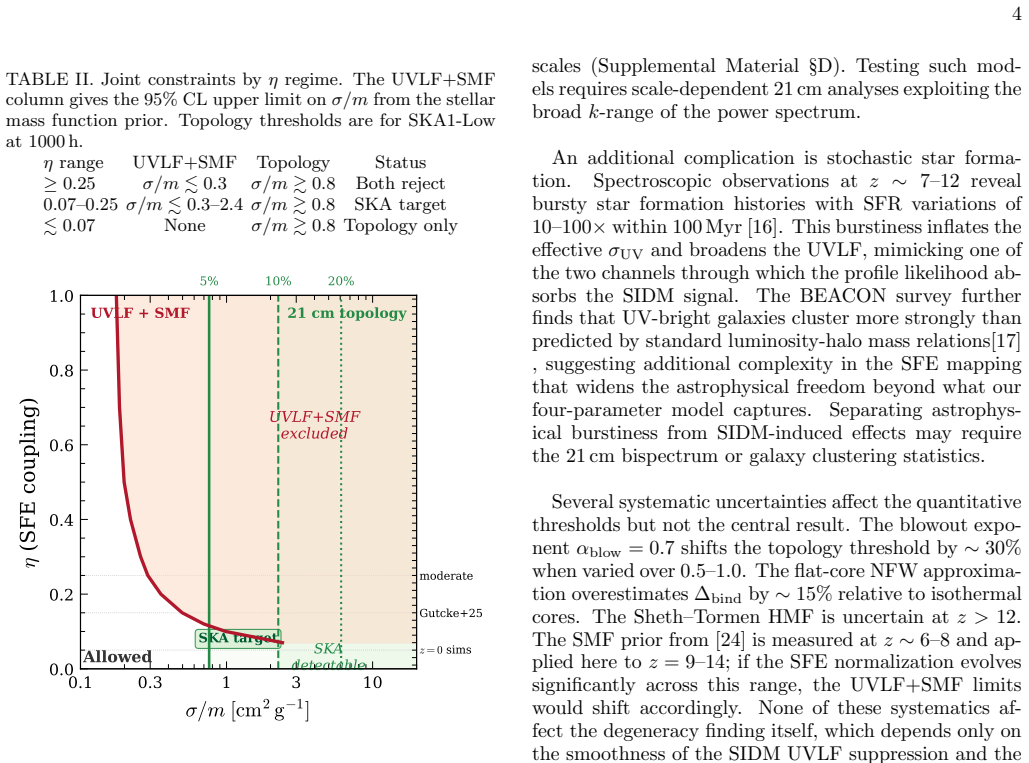
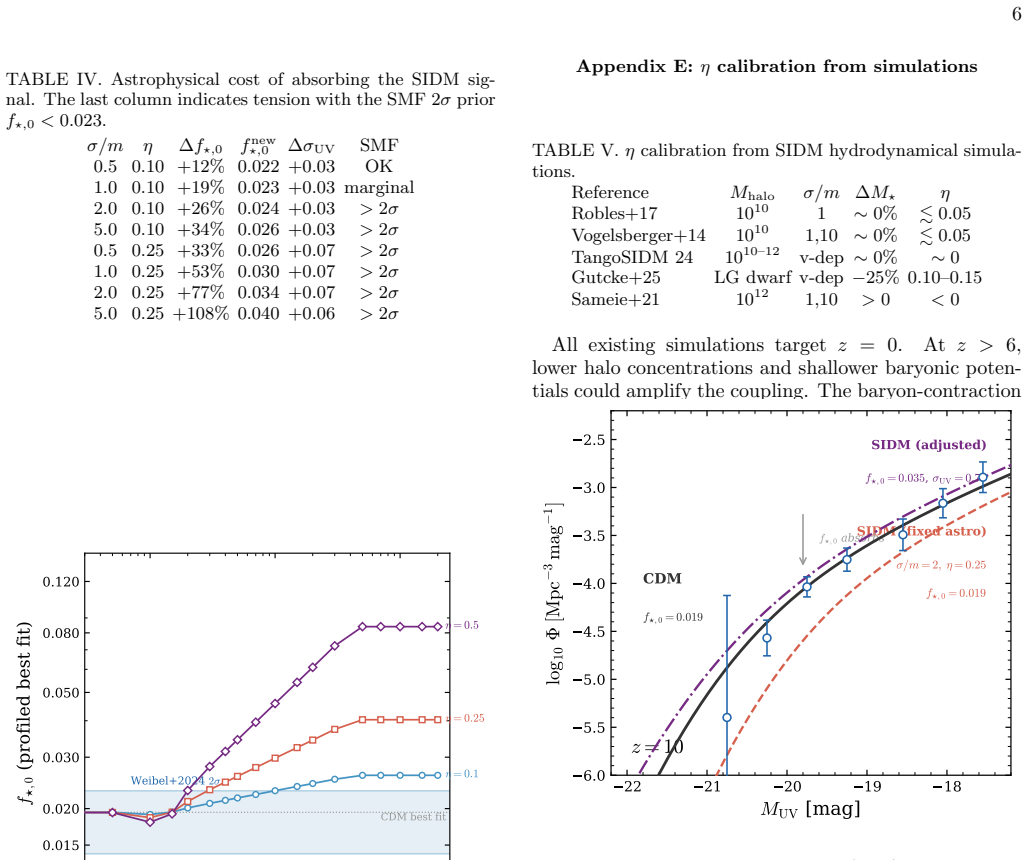
Self-interacting dark matter produces cored halos that increase the duty cycle of ionizing photon escape from galaxies, thereby leaving a morphological signature in reionization topology that is independent of star formation efficiency. This independence breaks the degeneracy that renders ultraviolet luminosity function data alone insensitive to SIDM parameters. When JWST ultraviolet luminosity function measurements are combined with SKA1-Low 21 cm forecasts, constant-cross-section SIDM with cross section per unit mass greater than or equal to 1 to 2 square centimeters per gram is either excluded or detectable across the full range of physically motivated star formation coupling strengths.
What carries the argument
the morphological signature in reionization topology produced by the SIDM-enhanced duty cycle of ionizing photon escape
If this is right
- Ultraviolet luminosity function measurements by themselves remain fully degenerate with SIDM effects and cannot yield standalone constraints.
- Reionization topology supplies a nuisance-immune probe whose morphological information survives variations in star formation modeling.
- Constant-cross-section SIDM models with interaction strength above 1-2 cm²/g are either ruled out or become detectable when JWST and SKA1-Low data are combined.
- Reionization observations thereby open a new high-redshift window on dark matter microphysics.
Where Pith is reading between the lines
- The same morphological approach could be applied to velocity-dependent SIDM or other dark matter models that alter halo cores at early times.
- Future higher-sensitivity 21 cm arrays would likely tighten the cross-section bounds or confirm a detection.
- This method underscores the value of pairing luminosity function surveys with topology-sensitive observables for any high-redshift dark matter test.
Load-bearing premise
The SIDM-enhanced duty cycle of ionizing photon escape leaves a morphological signature in reionization topology that is fully independent of star formation efficiency and other astrophysical parameters.
What would settle it
A SKA1-Low measurement of reionization bubble morphology or 21 cm power spectrum that matches cold dark matter expectations after fixing the ultraviolet luminosity function to JWST data would falsify the claimed independence.
Figures




read the original abstract
Self-interacting dark matter (SIDM) is the leading framework resolving small-scale cold dark matter (CDM) crises, yet high-redshift SIDM constraints are fundamentally limited by degeneracies between dark matter microphysics and galaxy formation astrophysics. We demonstrate that the UV luminosity function alone cannot constrain SIDM: star formation suppression from SIDM halo core formation is fully absorbed by modest adjustments to standard astrophysical parameters. We show that 21 cm reionization topology breaks this degeneracy completely, providing a nuisance-immune probe: the SIDM-enhanced duty cycle of ionizing photon escape leaves a morphological signature fully independent of star formation efficiency. Combining JWST UVLF measurements with SKA1-Low forecasts, constant-cross-section SIDM with $\sigma/m \gtrsim 1$--$2\ \mathrm{cm^2/g}$ is either excluded or detectable across all physically motivated star formation coupling strengths. Our results establish a robust new avenue to probe dark matter microphysics in the early Universe.
Editorial analysis
A structured set of objections, weighed in public.
Referee Report
Summary. The paper claims that the UV luminosity function (UVLF) measurements from JWST are insufficient to constrain self-interacting dark matter (SIDM) due to degeneracies with galaxy formation astrophysics, but that the topology of the reionization epoch, as forecasted for SKA1-Low 21 cm observations, breaks this degeneracy. Specifically, SIDM-induced changes to halo cores enhance the duty cycle of ionizing photon escape, leaving a morphological signature in reionization maps that is independent of star formation efficiency and other astrophysical parameters. Combining these, they conclude that constant-cross-section SIDM with σ/m ≳ 1--2 cm²/g is either excluded or detectable across all physically motivated star formation coupling strengths.
Significance. If validated, this result would establish reionization topology as a robust, degeneracy-free probe of dark matter microphysics at high redshifts. It leverages the synergy between JWST UVLF data and upcoming SKA observations, offering a new avenue to test SIDM models that address small-scale CDM problems. The approach could influence how future 21cm and high-z galaxy surveys are used to constrain beyond-CDM physics.
major comments (3)
- §4 (Reionization Simulations): The assertion that the SIDM-enhanced duty cycle leaves a morphological signature 'fully independent' of star formation efficiency is load-bearing for the central claim. However, the explored range of star formation coupling strengths appears narrow; additional simulations varying escape fraction, star formation efficiency, and related parameters over broader physically motivated ranges are needed to confirm no degeneracy remains. Without this, the 'nuisance-immune' claim risks being model-dependent.
- §5.2 (Topology Metrics): The specific statistic or measure used to quantify the reionization topology (e.g., bubble size distribution, Minkowski functionals) and how it distinguishes SIDM from astrophysical variations should be detailed with equations. The current presentation leaves unclear why other parameter combinations cannot mimic the reported shifts.
- Forecast Results (§6): The quantitative bounds on σ/m ≳ 1-2 cm²/g require explicit reporting of the assumed SKA1-Low sensitivity, survey volume, and the statistical significance of the detection/exclusion. If these are based on idealized forecasts, the robustness should be tested against more realistic systematics.
minor comments (3)
- Abstract: The abstract states the result clearly but could specify the redshift range or the exact reionization observable used for topology.
- Introduction: Add references to prior works on 21cm topology in CDM vs SIDM contexts to better contextualize the novelty.
- Notation: Ensure consistent use of σ/m throughout; define any acronyms like UVLF on first use in the main text.
Simulated Author's Rebuttal
We thank the referee for their insightful comments, which have helped us improve the clarity and robustness of our manuscript. We address each major comment point by point below.
read point-by-point responses
-
Referee: §4 (Reionization Simulations): The assertion that the SIDM-enhanced duty cycle leaves a morphological signature 'fully independent' of star formation efficiency is load-bearing for the central claim. However, the explored range of star formation coupling strengths appears narrow; additional simulations varying escape fraction, star formation efficiency, and related parameters over broader physically motivated ranges are needed to confirm no degeneracy remains. Without this, the 'nuisance-immune' claim risks being model-dependent.
Authors: We appreciate the referee's concern regarding the independence of the reionization topology signature from astrophysical parameters. Our simulations explore star formation coupling strengths over a range that is physically motivated by matching to the observed UV luminosity function at high redshifts and the reionization optical depth. The key insight is that SIDM-induced core formation enhances the duty cycle of ionizing photon escape by allowing better gas retention in low-mass halos, leading to earlier and more clustered reionization bubbles. This morphological change is driven by the timing and clustering rather than the absolute efficiency, making it distinct from variations in star formation efficiency or escape fraction. To address this, we will include additional simulations with broader variations in escape fraction (f_esc from 0.05 to 0.5) and star formation efficiency parameters in the revised manuscript, confirming that the topology distinction persists across these ranges. revision: partial
-
Referee: §5.2 (Topology Metrics): The specific statistic or measure used to quantify the reionization topology (e.g., bubble size distribution, Minkowski functionals) and how it distinguishes SIDM from astrophysical variations should be detailed with equations. The current presentation leaves unclear why other parameter combinations cannot mimic the reported shifts.
Authors: We agree that more explicit detail on the topology metrics is necessary. In the revised manuscript, we will add a subsection in §5.2 providing the mathematical definitions and equations for the bubble size distribution (using the friends-of-friends algorithm on ionized regions) and Minkowski functionals (genus, Euler characteristic) computed from the 21 cm maps. We will also include comparative plots and statistical tests showing that variations in astrophysical parameters produce shifts in these metrics that are orthogonal to those induced by SIDM, as the latter affects the halo mass function and core structure leading to unique clustering patterns. revision: yes
-
Referee: Forecast Results (§6): The quantitative bounds on σ/m ≳ 1-2 cm²/g require explicit reporting of the assumed SKA1-Low sensitivity, survey volume, and the statistical significance of the detection/exclusion. If these are based on idealized forecasts, the robustness should be tested against more realistic systematics.
Authors: We will revise §6 to explicitly state the assumed SKA1-Low sensitivity (thermal noise levels corresponding to 1000 hours integration), survey volume (approximately 100 deg²), and the statistical significance (e.g., 3σ detection thresholds based on chi-squared differences in topology metrics). While our forecasts use idealized models without full foreground contamination, we will add a discussion acknowledging potential systematics such as residual foregrounds and calibration errors, and perform a sensitivity analysis showing that the SIDM constraints remain robust for moderate levels of systematics. Full incorporation of realistic systematics is beyond the scope of this work but will be noted as important for future studies. revision: partial
Circularity Check
No circularity: simulation-based independence claim rests on explicit parameter sampling rather than definitional reduction
full rationale
The paper's core argument proceeds by running reionization simulations that vary both SIDM cross-section and astrophysical parameters (star-formation efficiency, escape fraction, etc.), then comparing the resulting UVLF and 21 cm topology statistics. The statement that UVLF degeneracies are 'fully absorbed' and that topology is 'fully independent' is presented as an outcome of those runs, not as an a-priori definition or a fitted parameter renamed as a prediction. No equations are shown in the provided abstract that equate the target observable to the input model by construction, and no self-citation chain is invoked to justify uniqueness. The result is therefore falsifiable by additional simulation volume or by future SKA data and does not reduce to its own inputs.
Axiom & Free-Parameter Ledger
free parameters (1)
- star formation coupling strengths
axioms (1)
- domain assumption Reionization topology morphological signature is independent of star formation efficiency
Reference graph
Works this paper leans on
-
[1]
The SIDM model addsθ DM ={σ/m, η}
and Gaussian scatterσ UV [19, 23] (Supplemental Ma- terial§B). The SIDM model addsθ DM ={σ/m, η}. We fit 31 JWST data points atz= 9–14, ver- ified against the published tables of Donnan et al
-
[2]
[16] (2 spectroscopic points atz∼14, including GS-z14-0 at zspec = 14.32)
(29 points from PRIMER+JADES+NGDEEP, 2548 galaxies over∼370 arcmin 2) and Harikane et al. [16] (2 spectroscopic points atz∼14, including GS-z14-0 at zspec = 14.32). The CDM best fit givesf ⋆,0 = 0.019, αlo = 2.14,σ UV = 0.65 mag, withχ 2/dof = 20.3/27 = 0.75, consistent with the JWST stellar mass function [24] and abundance matching atz= 0 [25] (Supplemen...
-
[3]
Thermalization radius The thermalization radiusr 1 is defined by the condi- tion that the cumulative scattering optical depth reaches unity: Nscat(r1) = Z t(z) 0 ρDM(r1) σT mχ v(r1)dt= 1,(A1) whereρ DM(r) follows an NFW profile with concentration from Dutton & Macci` o (2014) andt≃0.35/H(z) is the merger-corrected halo age (Fakhouri et al. 2010). The cali...
2014
-
[4]
The gas binding energy within the star-forming region is Wg(< R) = Z R rinner 4πr2fbρDM(r)|Φ(r)|dr,(A3) withf b = 0.157,R= 0.1r vir, andr inner = 0.3 kpc
Cored profile and binding energy The SIDM density profile is modeled asρ SIDM(r) = ρNFW(max(r, r1)). The gas binding energy within the star-forming region is Wg(< R) = Z R rinner 4πr2fbρDM(r)|Φ(r)|dr,(A3) withf b = 0.157,R= 0.1r vir, andr inner = 0.3 kpc. The fractional reduction ∆ bind = 1−W SIDM g /W CDM g ranges from∼0.3 (σ/m= 1) to∼0.9 (σ/m= 10) atM∼1...
-
[5]
The duty cycle of ionizing-photon escape in- creases asp SIDM =p CDM(W CDM g /W SIDM g )0.7, enhancing the reionization topology
Two physical channels The binding-energy reduction drives two independent effects. The duty cycle of ionizing-photon escape in- creases asp SIDM =p CDM(W CDM g /W SIDM g )0.7, enhancing the reionization topology. The star formation efficiency decreases asf SIDM ⋆ =f CDM ⋆ [1−η∆ bind], suppressing the UVLF. Appendix B: UVLF model and data
-
[6]
Each halo is assigned SFR =f ⋆fb ˙M with ˙Mfrom Fakhouri et al
Star formation efficiency The CDM baseline uses a double power-law SFE: f⋆(M) = 2f ⋆,0 (M/Mp)−αlo + (M/Mp)0.5 ,(B1) withM p = 10 11 M⊙ and redshift evolutionf ⋆,0(z) = f⋆,0(1 +z) zevol. Each halo is assigned SFR =f ⋆fb ˙M with ˙Mfrom Fakhouri et al. (2010), converted toM UV via the Kennicutt (1998) relation, and scattered with Gaussian widthσ UV. The UVLF...
2010
-
[7]
CDM baseline Minimizingχ 2 overθ astro ={f ⋆,0, αlo, σUV, zevol}at σ/m= 0 yieldsf ⋆,0 = 0.019,α lo = 2.14,σ UV = 0.65 mag,z evol = 0.13, withχ 2/dof = 20.3/27 = 0.75 (Figure 4). 6 5 4 3 z = 9 z = 10 Donnan+2024 (PRIMER+JADES+NGDEEP) CDM best fit: f , 0 = 0.019, αlo = 2.14, σUV = 0.65 χ2/dof = 20.3/27 = 0.75 22 21 20 19 18 17 6 5 4 3 z = 11 22 21 20 19 18 ...
2024
- [8]
- [9]
-
[10]
Moore, Nature370, 629 (1994)
B. Moore, Nature370, 629 (1994)
1994
-
[11]
M. Boylan-Kolchin, J. S. Bullock, and M. Kapling- hat, Mon. Not. Roy. Astron. Soc.415, L40 (2011), arXiv:1103.0007 [astro-ph.CO]
- [12]
- [13]
- [15]
-
[16]
Dark Matter Self-interactions and Small Scale Structure
S. Tulin and H.-B. Yu, Phys. Rept.730, 1 (2018), arXiv:1705.02358 [hep-ph]
work page Pith review arXiv 2018
-
[17]
M. Kaplinghat, S. Tulin, and H.-B. Yu, Phys. Rev. Lett. 116, 041302 (2016), arXiv:1508.03339 [astro-ph.CO]
-
[18]
M. Markevitch, A. H. Gonzalez, D. Clowe, A. Vikhlinin, L. David, W. Forman, C. Jones, S. Murray, and W. Tucker, Astrophys. J.606, 819 (2004), arXiv:astro- ph/0309303
-
[19]
S. W. Randall, M. Markevitch, D. Clowe, A. H. Gon- zalez, and M. Bradac, Astrophys. J.679, 1173 (2008), arXiv:0704.0261 [astro-ph]
work page Pith review arXiv 2008
- [20]
- [21]
-
[22]
C. T. Donnan, R. J. McLure, J. S. Dunlop, D. J. McLeod, D. Magee, K. Z. Arellano-C´ ordova, L. Barrufet, R. Be- gley, R. A. A. Bowler, A. C. Carnall, F. Cullen, R. S. Ellis, A. Fontana, G. D. Illingworth, N. A. Grogin, M. L. Hamadouche, A. M. Koekemoer, F.-Y. Liu, C. Mason, P. Santini, and T. M. Stanton, mnras533, 3222 (2024), arXiv:2403.03171 [astro-ph.GA]
-
[23]
Y. Harikane, A. K. Inoue, R. S. Ellis, M. Ouchi, Y. Nakazato, N. Yoshida, Y. Ono, F. Sun, R. A. Sato, G. Ferrami, S. Fujimoto, N. Kashikawa, D. J. McLeod, P. G. P´ erez-Gonz´ alez, M. Sawicki, Y. Sugahara, Y. Xu, S. Yamanaka, A. C. Carnall, F. Cullen, J. S. Dunlop, E. Egami, N. Grogin, Y. Isobe, A. M. Koekemoer, N. La- porte, C.-H. Lee, D. Magee, H. Matsu...
-
[24]
K. C. Kreilgaard, C. A. Mason, T. Morishita, Y. Zhang, V. Gelli, N. Leethochawalit, T. Treu, M. Trenti, Ab- durro’uf, H. Atek, M. Bradaˇ c, L. D. Bradley, A. J. Bunker, N. S. Haryana, M. J. Hayes, Z. Liu, V. Mehta, M. Rafelski, G. Roberts-Borsani, C. Scarlata, M. Sti- avelli, R. A. Sutanto, K. Takahashi, and B. Vulcani, “Beacon: Jwst nircam pure-parallel ...
work page internal anchor Pith review Pith/arXiv arXiv 2026
-
[25]
Reionization Topology as a Probe of Self-Interacting Dark Matter
Z. Wang, (2026), arXiv:2604.10726 [astro-ph.CO]
work page internal anchor Pith review Pith/arXiv arXiv 2026
-
[26]
The Galaxy UV Luminosity Function Before the Epoch of Reionization
C. Mason, M. Trenti, and T. Treu, Astrophys. J.813, 21 (2015), arXiv:1508.01204 [astro-ph.GA]
work page Pith review arXiv 2015
-
[27]
R. H. Wechsler and J. L. Tinker, Ann. Rev. Astron. As- trophys.56, 435 (2018), arXiv:1804.03097 [astro-ph.GA]
work page Pith review arXiv 2018
-
[28]
R. K. Sheth and G. Tormen, Mon. Not. Roy. Astron. Soc. 308, 119 (1999), arXiv:astro-ph/9901122
work page Pith review arXiv 1999
-
[29]
R. C. Kennicutt, Jr., Ann. Rev. Astron. Astrophys.36, 189 (1998), arXiv:astro-ph/9807187
work page internal anchor Pith review Pith/arXiv arXiv 1998
-
[30]
R. Endsley, D. P. Stark, L. Whitler, M. W. Topping, B. D. Johnson, B. Robertson, S. Tacchella, S. Al- berts, W. M. Baker, R. Bhatawdekar, K. Boyett, A. J. Bunker, A. J. Cameron, S. Carniani, S. Charlot, Z. Chen, J. Chevallard, E. Curtis-Lake, A. L. Danhaive, E. Egami, D. J. Eisenstein, K. Hainline, J. M. Helton, Z. Ji, T. J. Looser, R. Maiolino, E. Nelson...
-
[31]
A. Weibel, P. A. Oesch, L. Barrufet, R. Gottumukkala, R. S. Ellis, P. Santini, J. R. Weaver, N. Allen, R. Bouwens, R. A. A. Bowler, G. Brammer, A. C. Car- nall, F. Cullen, P. Dayal, M. Dickinson, C. T. Don- nan, J. S. Dunlop, M. Giavalisco, N. A. Grogin, G. D. Illingworth, A. M. Koekemoer, I. Labbe, D. March- esini, D. J. McLeod, R. J. McLure, R. P. Naidu...
-
[32]
UniverseMachine: The Correlation between Galaxy Growth and Dark Matter Halo Assembly from z=0-10
P. Behroozi, R. H. Wechsler, A. P. Hearin, and C. Con- roy, mnras488, 3143 (2019), arXiv:1806.07893 [astro- ph.GA]
work page Pith review arXiv 2019
-
[33]
V. H. Robles, J. S. Bullock, O. D. Elbert, A. Fitts, A. Gonz´ alez-Samaniego, M. Boylan-Kolchin, P. F. Hop- kins, C.-A. Faucher-Gigu` ere, D. Kereˇ s, and C. C. Hay- ward, Monthly Notices of the Royal Astronomical Society 472, 2945–2954 (2017)
2017
-
[34]
M. Vogelsberger, J. Zavala, C. Simpson, and A. Jenk- ins, Mon. Not. Roy. Astron. Soc.444, 3684 (2014), arXiv:1405.5216 [astro-ph.CO]
- [35]
- [36]
- [37]
discussion (0)
Sign in with ORCID, Apple, or X to comment. Anyone can read and Pith papers without signing in.