Recognition: unknown
BEACON: JWST NIRCam Pure-parallel Imaging Survey. III. Constraints on the UV LF and the Clustering of z~7-14 Galaxies
Pith reviewed 2026-05-10 04:23 UTC · model grok-4.3
The pith
Bright galaxies at redshifts 7 to 10 appear in overdense sky regions three times more often than average, implying they form inside the most massive dark matter halos.
A machine-rendered reading of the paper's core claim, the machinery that carries it, and where it could break.
Core claim
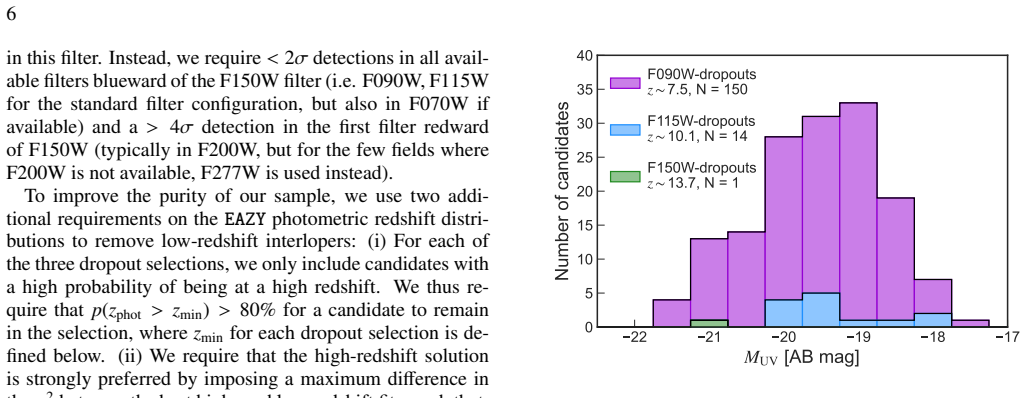
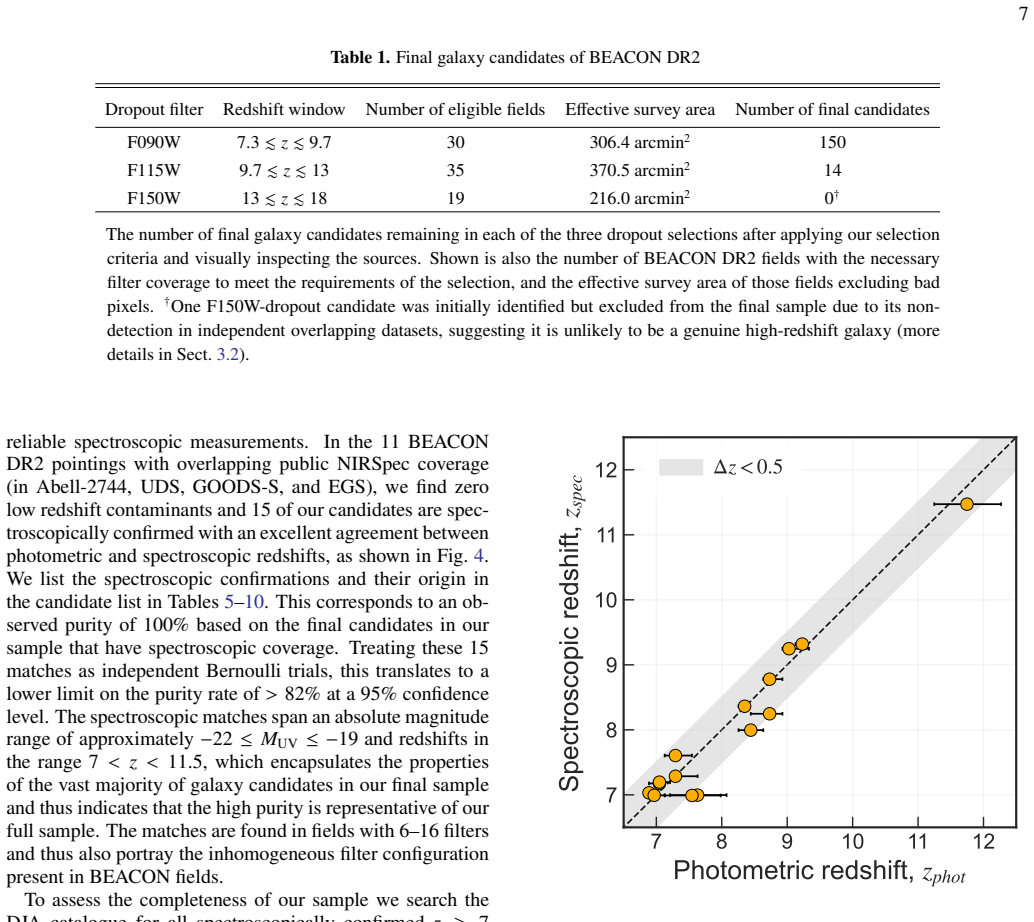
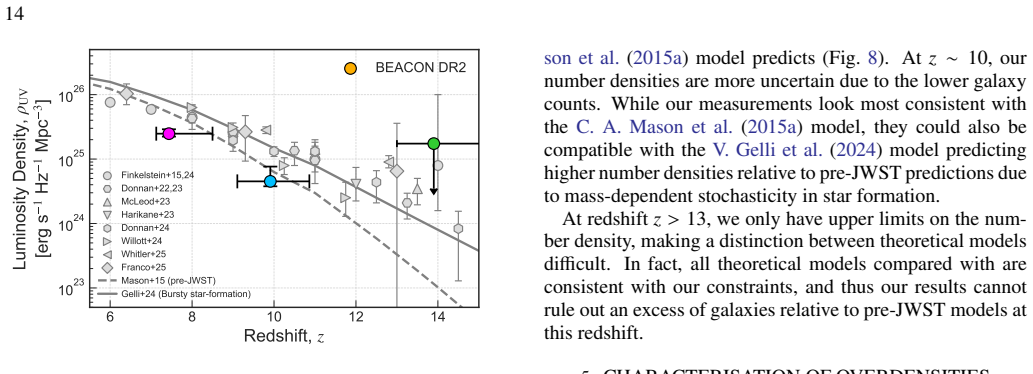
Across 400 arcmin squared in 36 independent sightlines, 164 galaxy candidates are identified at 7 less than z less than 12, with 100 percent purity confirmed in 11 fields with public spectroscopy. The z approximately 7.5 and z approximately 10 ultraviolet luminosity functions align with pre-JWST models while lying below most prior photometric JWST results at z approximately 10. Bright galaxies with absolute magnitude brighter than -20.5 exhibit significant clustering, such that their host fields are approximately three times more likely to be overdense than the survey average. This implies these sources reside in the most massive halos, with inferred halo masses 0.9 dex lower at z~11 than at
What carries the argument
The ratio of overdensity probability in fields that contain bright ultraviolet sources versus the full survey area, which traces the preference of luminous galaxies for the highest-mass halos.
If this is right
- The luminosity function measurements supply direct tests for theoretical models of early galaxy assembly.
- Clustering statistics require updates to the assumed relation between ultraviolet luminosity and host halo mass at these redshifts.
- The absence of robust sources beyond redshift 13 supplies upper bounds on the abundance of the brightest objects at those epochs.
- Simulations must accommodate both a redshift-dependent halo mass shift and excess clustering strength relative to older luminosity-halo mass prescriptions.
Where Pith is reading between the lines
- The observed clustering excess may indicate that some bright galaxies share the same halo rather than occupying separate massive halos.
- Extending the same multi-field approach to other redshift windows could tighten constraints on how galaxy bias evolves over time.
- Deeper follow-up spectroscopy on the brightest candidates would directly test whether the inferred halo masses continue to rise at still higher redshifts.
- If confirmed, the results would push models to include stronger feedback or burstier star formation in the densest early environments.
Load-bearing premise
The dropout selection and photometric redshift assignments correctly identify all sources in the stated magnitude and redshift ranges with negligible contamination or bias.
What would settle it
A spectroscopic campaign that finds a substantial fraction of the bright candidates lie at redshifts below 7 or show spectral features inconsistent with the claimed distances.
Figures





read the original abstract
The James Webb Space Telescope (JWST) has extended the frontier of galaxy detection to redshifts z>11, finding a high abundance of UV-bright sources that challenge theoretical models. However, most current results come from just a few fields, introducing uncertainties due to cosmic variance. Here, we constrain z~7-14 UV luminosity functions (LFs) over ~400 arcmin^2 across 36 independent sightlines from DR2 of BEACON, a JWST pure-parallel NIRCam multi-band imaging survey. We identify 164 7<z<12 galaxy candidates: 150 F090W-, 14 F115W-, and no robust F150W-dropouts. Based on 11 pointings overlapping with public JWST spectroscopy, we observe 100% purity. Our z~7.5 UV LF agrees with previous bright-end measurements but yields lower number densities at $-21\leq M_\mathrm{UV}\leq-19$. At z~10, our measurements are lower than most photometric JWST results but match spectroscopic constraints, consistent with the high purity of our selection. The LFs at z~7.5 and z~10 are consistent with pre-JWST models, while our limits at z>13 do not rule out a possible excess. We measure significant clustering of bright ($M_\mathrm{UV}<-20.5$) galaxies at 7<z<10. Fields hosting such sources are approximately three times more likely to be overdense relative to the full survey, implying that UV-bright galaxies preferentially reside in the most massive halos at these redshifts. Comparing with semi-numerical simulations, we estimate that $M_{\mathrm{UV}} < -20.5$ galaxies inhabit halos ~0.9 dex less massive at z~11 than at z~7, consistent with a shift to higher star formation rates. However, their observed clustering exceeds predictions from pre-JWST luminosity-halo mass relations, suggesting these sources reside in more massive halos than previously modelled and/or multiple halo occupation.
Editorial analysis