Recognition: 2 theorem links
· Lean TheoremTstars-Tryon 1.0: Robust and Realistic Virtual Try-On for Diverse Fashion Items
Pith reviewed 2026-05-12 01:46 UTC · model grok-4.3
The pith
Tstars-Tryon 1.0 delivers robust photorealistic virtual try-on for diverse fashion items even under extreme poses and lighting.
A machine-rendered reading of the paper's core claim, the machinery that carries it, and where it could break.
Core claim
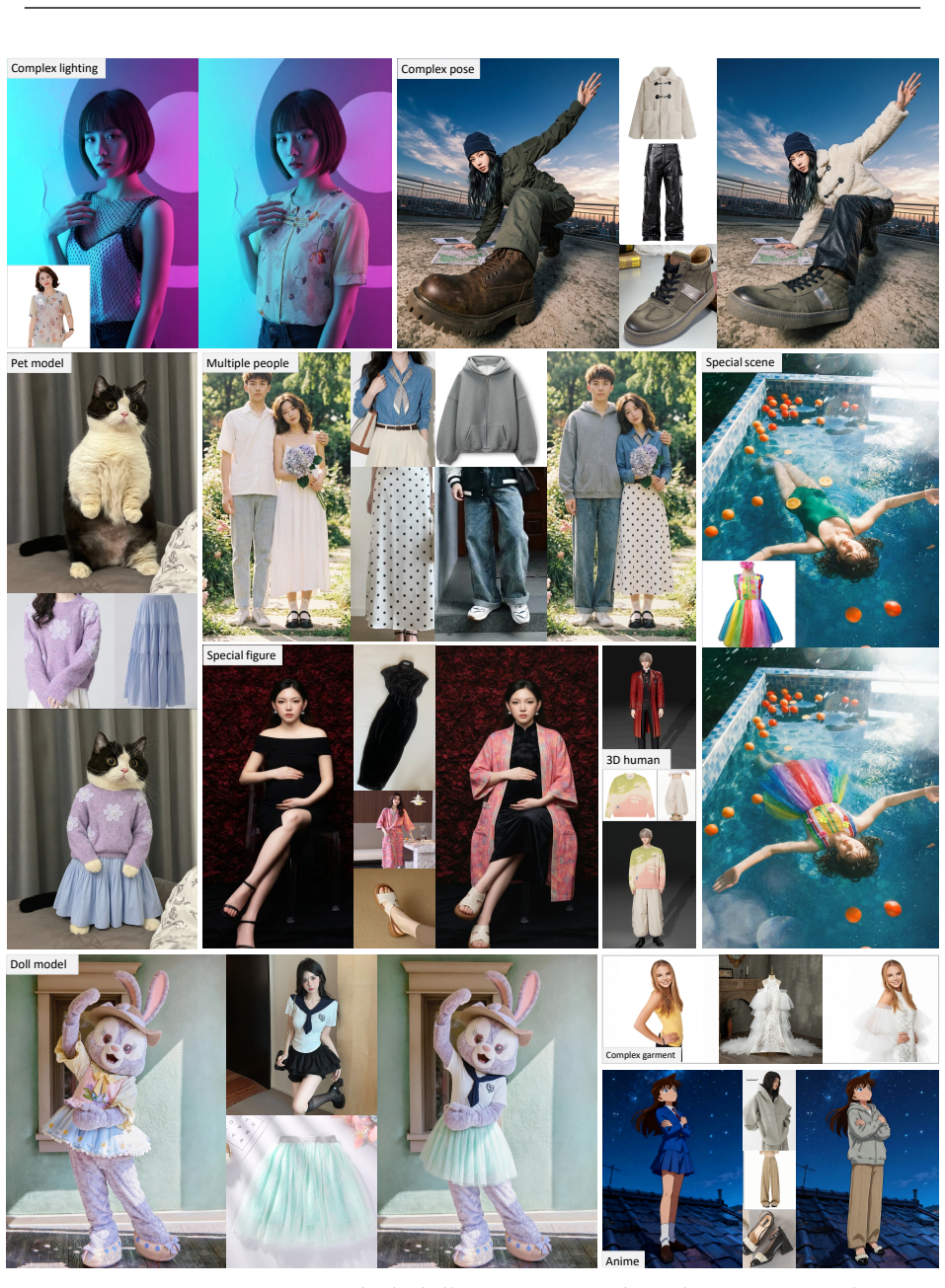
Tstars-Tryon 1.0 is an integrated virtual try-on system that achieves high success rates in challenging in-the-wild conditions, generates photorealistic garment details without common artifacts, supports multi-image composition across eight fashion categories with up to six references, and runs at near real-time speeds through its end-to-end architecture, scalable data engine, robust infrastructure, and multi-stage training paradigm, as demonstrated by large-scale deployment serving millions of users.
What carries the argument
The end-to-end model architecture combined with a scalable data engine, robust infrastructure, and multi-stage training paradigm that together enable robustness, detail preservation, and inference speed.
If this is right
- Virtual try-on works reliably on everyday photos with extreme poses, illumination shifts, and blur.
- Users can combine up to six reference images to control multiple garments and the background in one generation.
- Generation runs near real-time, removing latency barriers for mobile shopping apps.
- Large-scale deployment on Taobao shows the system serves millions of users with leading overall performance.
- The released benchmark allows direct comparison of future methods on the same challenging cases.
Where Pith is reading between the lines
- Lower return rates in online fashion could follow if buyers gain accurate previews of how clothes fit their actual body and pose.
- The multi-reference control approach may extend to other editing tasks such as virtual makeup or home decor placement with similar training.
- Industrial usage logs from millions of requests could later reveal patterns in user preferences that laboratory tests miss.
Load-bearing premise
That the described end-to-end architecture and training actually produce the claimed success rates and photorealism across all cases without undisclosed post-processing or example selection.
What would settle it
Quantitative results on the released benchmark that measure failure rates or visible artifacts when inputs contain extreme poses, severe lighting changes, or motion blur would confirm or refute the robustness claims.
Figures






read the original abstract
Recent advances in image generation and editing have opened new opportunities for virtual try-on. However, existing methods still struggle to meet complex real-world demands. We present Tstars-Tryon 1.0, a commercial-scale virtual try-on system that is robust, realistic, versatile, and highly efficient. First, our system maintains a high success rate across challenging cases like extreme poses, severe illumination variations, motion blur, and other in-the-wild conditions. Second, it delivers highly photorealistic results with fine-grained details, faithfully preserving garment texture, material properties, and structural characteristics, while largely avoiding common AI-generated artifacts. Third, beyond apparel try-on, our model supports flexible multi-image composition (up to 6 reference images) across 8 fashion categories, with coordinated control over person identity and background. Fourth, to overcome the latency bottlenecks of commercial deployment, our system is heavily optimized for inference speed, delivering near real-time generation for a seamless user experience. These capabilities are enabled by an integrated system design spanning end-to-end model architecture, a scalable data engine, robust infrastructure, and a multi-stage training paradigm. Extensive evaluation and large-scale product deployment demonstrate that Tstars-Tryon1.0 achieves leading overall performance. To support future research, we also release a comprehensive benchmark. The model has been deployed at an industrial scale on the Taobao App, serving millions of users with tens of millions of requests.
Editorial analysis
A structured set of objections, weighed in public.
Referee Report
Summary. The manuscript presents Tstars-Tryon 1.0, a commercial-scale virtual try-on system for fashion items. It claims robustness to extreme poses, severe illumination changes, motion blur and other in-the-wild conditions; photorealistic output that preserves garment texture, material and structure while avoiding AI artifacts; support for flexible multi-image composition using up to 6 reference images across 8 categories with coordinated control of identity and background; near real-time inference; and leading overall performance shown by extensive evaluation plus industrial deployment on Taobao serving millions of users. The system is enabled by an integrated end-to-end architecture, scalable data engine, robust infrastructure and multi-stage training. A comprehensive benchmark is released to support future research.
Significance. If the performance claims hold with supporting quantitative evidence, the work would constitute a meaningful applied contribution by demonstrating a deployed, scalable virtual try-on solution that addresses practical robustness and efficiency gaps in prior methods. The multi-reference composition capability and benchmark release could benefit the broader research community. Without reported metrics, ablations or comparisons, however, the significance remains prospective rather than established.
major comments (2)
- [Abstract] Abstract: The text asserts a 'high success rate across challenging cases', 'highly photorealistic results', 'leading overall performance' and 'extensive evaluation' yet supplies no numerical results (success rates, artifact rates, FID/SSIM/LPIPS scores, user-study percentages), error bars, ablation tables or direct comparisons to prior methods. This absence is load-bearing because the central claim is that the architecture plus multi-stage training produces the stated robustness and realism.
- [Evaluation / Experiments] No evaluation section or tables are referenced in the provided text; the mapping from the claimed end-to-end design, data engine and training paradigm to the reported outcomes therefore remains an untested assertion rather than a demonstrated result.
Simulated Author's Rebuttal
We thank the referee for the constructive feedback emphasizing the need for quantitative evidence to support our performance claims. We will revise the manuscript to include a dedicated evaluation section with metrics, comparisons, and ablations, while preserving the focus on the deployed system.
read point-by-point responses
-
Referee: [Abstract] Abstract: The text asserts a 'high success rate across challenging cases', 'highly photorealistic results', 'leading overall performance' and 'extensive evaluation' yet supplies no numerical results (success rates, artifact rates, FID/SSIM/LPIPS scores, user-study percentages), error bars, ablation tables or direct comparisons to prior methods. This absence is load-bearing because the central claim is that the architecture plus multi-stage training produces the stated robustness and realism.
Authors: We agree that the abstract claims require numerical backing to be fully substantiated. The current manuscript supports the claims via qualitative results, the released benchmark, and real-world deployment metrics on Taobao (millions of users and tens of millions of requests). In revision we will add concrete numbers: success rates on challenging in-the-wild cases, FID/SSIM/LPIPS scores, user-study percentages, error bars where applicable, ablation tables isolating the data engine and multi-stage training, and direct comparisons against prior virtual try-on methods. revision: yes
-
Referee: [Evaluation / Experiments] No evaluation section or tables are referenced in the provided text; the mapping from the claimed end-to-end design, data engine and training paradigm to the reported outcomes therefore remains an untested assertion rather than a demonstrated result.
Authors: We acknowledge the referee's observation that the provided text does not clearly reference an evaluation section. Although the manuscript describes the end-to-end architecture, data engine, and training paradigm along with deployment outcomes, we will add a prominent 'Evaluation' section containing tables that explicitly map design choices to quantitative results, robustness tests, and comparisons. This will make the connection between components and performance demonstrable rather than asserted. revision: yes
Circularity Check
No derivations, equations, or fitted parameters; system description contains no circular steps
full rationale
The manuscript is a high-level system description of an industrial virtual try-on pipeline. It contains no equations, no first-principles derivations, no parameter-fitting procedures, and no quantitative predictions that could reduce to their own inputs. Claims of robustness, photorealism, and deployment success are asserted on the basis of evaluation and Taobao usage rather than derived from any internal mathematical chain. Because no load-bearing derivation exists, none of the enumerated circularity patterns (self-definitional, fitted-input-called-prediction, self-citation load-bearing, etc.) can be instantiated. The absence of metrics or ablations is a separate evidentiary concern, not a circularity issue.
Axiom & Free-Parameter Ledger
Lean theorems connected to this paper
-
IndisputableMonolith.Cost.FunctionalEquationwashburn_uniqueness_aczel unclearTstars-Tryon 1.0 utilizes a unified MMDiT architecture... multi-stage training paradigm... progressive resolution continuous training... reinforcement learning with multi-reward... CFG and Step Distillation... 5B parameters
-
IndisputableMonolith.Foundation.RealityFromDistinctionreality_from_one_distinction unclearTstars-VTON Benchmark... VLM-driven evaluation... Identity Consistency, Garment Fidelity, Background Preservation, Physical and Structural Logic
Reference graph
Works this paper leans on
-
[1]
URL https://bfl.ai/blog/ flux2-klein-towards-interactive-visual-intelligence. Accessed: 2026-03-18. ByteDance. Deeper thinking, more accurate generation: Introduc- ing seedream 5.0 lite,
work page 2026
-
[2]
Hunyuanimage 3.0 technical report.arXiv preprint arXiv:2509.23951, 2025
URL https://seed.bytedance.com/en/blog/ deeper-thinking-more-accurate-generation-introducing-seedream-5-0-lite. Siyu Cao, Hangting Chen, Peng Chen, Yiji Cheng, Yutao Cui, Xinchi Deng, Ying Dong, Kipper Gong, Tianpeng Gu, Xiusen Gu, et al. Hunyuanimage 3.0 technical report. arXiv preprint arXiv:2509.23951,
-
[3]
URLhttps://arxiv.org/abs/2407.15886. Zheng Chong, Yanwei Lei, Shiyue Zhang, Zhuandi He, Zhen Wang, Xujie Zhang, Xiao Dong, Yiling Wu, Dongmei Jiang, and Xiaodan Liang. Fastfit: Accelerating multi-reference virtual try-on via cacheable diffusion models,
-
[4]
URLhttps://arxiv.org/abs/2508.20586. Mostafa Dehghani, Basil Mustafa, Josip Djolonga, Jonathan Heek, Matthias Minderer, Mathilde Caron, Andreas Steiner, Joan Puigcerver, Robert Geirhos, Ibrahim M Alabdulmohsin, et al. Patch n’pack: Navit, a vision transformer for any aspect ratio and resolution. Advances in Neural Information Processing Systems, 36:2252–2274,
-
[5]
URL https://blog.google/innovation-and-ai/ products/nano-banana-pro/. Accessed: 2026-03-18. Martin Heusel, Hubert Ramsauer, Thomas Unterthiner, Bernhard Nessler, and Sepp Hochreiter. Gans trained by a two time-scale update rule converge to a local nash equilibrium. In Advances in neural information processing systems (NIPS), volume 30,
work page 2026
-
[6]
arXiv preprint arXiv:2411.10499 , year =
Boyuan Jiang, Xiaobin Hu, Donghao Luo, Qingdong He, Chengming Xu, Jinlong Peng, Jiangning Zhang, Chengjie Wang, Yunsheng Wu, and Yanwei Fu. Fitdit: Advancing the authentic garment details for high-fidelity virtual try-on. arXiv preprint arXiv:2411.10499,
-
[7]
Dress code: High-resolution multi-category virtual try-on
Davide Morelli, Matteo Fincato, Marcella Cornia, Federico Landi, Fabio Cesari, and Rita Cucchiara. Dress code: High-resolution multi-category virtual try-on. In Computer Vision – ECCV 2022: 17th European Conference, Tel Aviv,Israel, October 23–27, 2022, Proceedings, Part VIII, pp. 345–362, Berlin, Heidelberg,
work page 2022
-
[8]
Springer-Verlag. ISBN 978-3-031-20073-1. doi: 10.1007/978-3-031-20074-8_20. URL https://doi.org/10.1007/978-3-031-20074-8_20. OpenAI. Gpt-image-1.5 model card,
-
[9]
Seedream 4.0: Toward Next-generation Multimodal Image Generation
Team Seedream, Yunpeng Chen, Yu Gao, Lixue Gong, Meng Guo, Qiushan Guo, Zhiyao Guo, Xiaoxia Hou, Weilin Huang, Yixuan Huang, et al. Seedream 4.0: Toward next-generation multimodal image generation. arXiv preprint arXiv:2509.20427,
work page internal anchor Pith review arXiv
-
[10]
URL https://arxiv.org/abs/ 2602.13344. 23 Chenfei Wu, Jiahao Li, Jingren Zhou, Junyang Lin, Kaiyuan Gao, Kun Yan, Sheng-ming Yin, Shuai Bai, Xiao Xu, Yilei Chen, et al. Qwen-image technical report. arXiv preprint arXiv:2508.02324,
-
[11]
DiffusionNFT: Online Diffusion Reinforcement with Forward Process
Kaiwen Zheng, Huayu Chen, Haotian Ye, Haoxiang Wang, Qinsheng Zhang, Kai Jiang, Hang Su, Stefano Ermon, Jun Zhu, and Ming-Yu Liu. Diffusionnft: Online diffusion reinforcement with forward process. arXiv preprint arXiv:2509.16117,
work page internal anchor Pith review arXiv
-
[12]
Learning flow fields in attention for controllable person image generation
Zijian Zhou, Shikun Liu, Xiao Han, Haozhe Liu, Kam Woh Ng, Tian Xie, Yuren Cong, Hang Li, Mengmeng Xu, Juan-Manuel Pérez-Rúa, Aditya Patel, Tao Xiang, Miaojing Shi, and Sen He. Learning flow fields in attention for controllable person image generation. arXiv preprint arXiv:2412.08486,
discussion (0)
Sign in with ORCID, Apple, or X to comment. Anyone can read and Pith papers without signing in.