Recognition: unknown
The emergence of (3+1)-dimensional expanding spacetime from complex Langevin simulations of the Lorentzian type IIB matrix model with deformations
Pith reviewed 2026-05-10 02:36 UTC · model grok-4.3
The pith
Simulations of the deformed Lorentzian type IIB matrix model produce a phase with emergent (3+1)-dimensional expanding spacetime that is smooth and real.
A machine-rendered reading of the paper's core claim, the machinery that carries it, and where it could break.
Core claim
The authors perform numerical simulations of the deformed Lorentzian type IIB matrix model using the complex Langevin method up to matrix size N=128. They find that the deformed model exhibits a phase in which (3+1)-dimensional expanding spacetime emerges with both space and time being smooth and real.
What carries the argument
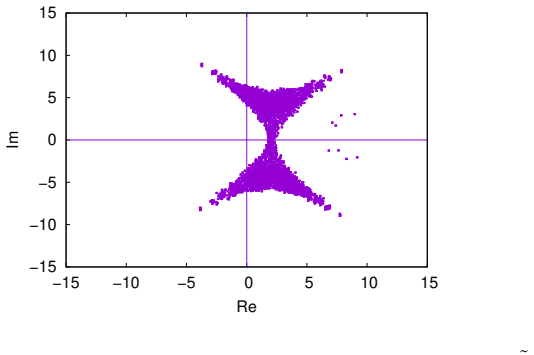
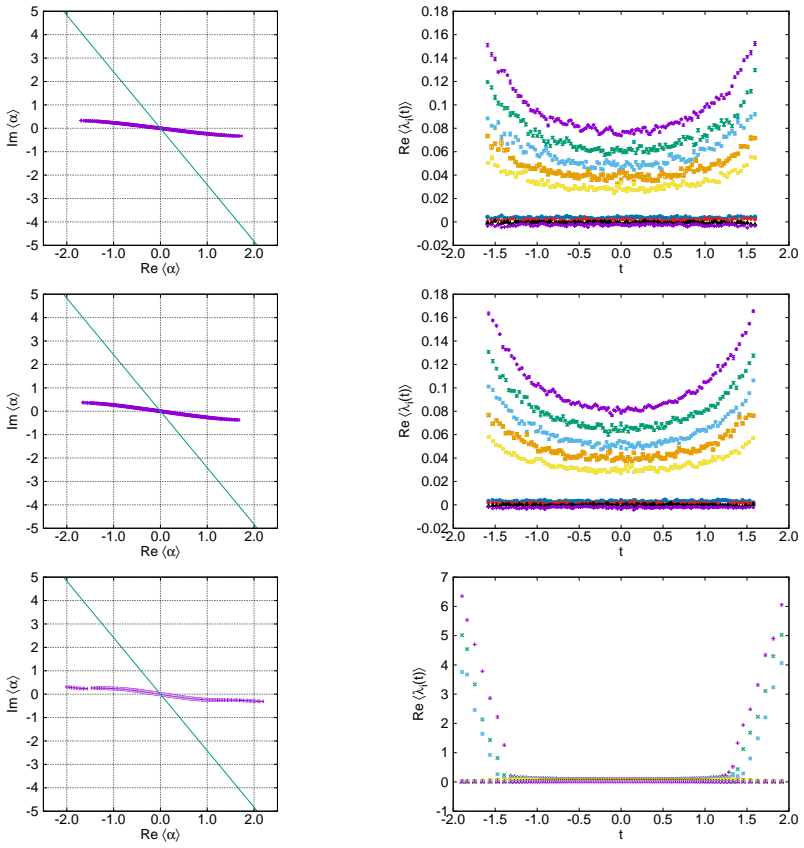
The eigenvalue distribution of the N by N bosonic matrices A_mu, which encodes the emergent spacetime geometry in the large-N limit and is evolved under the complex Langevin dynamics with the supersymmetry-inspired deformation.
If this is right
- The model's large-N dynamics can select three spatial dimensions plus time without external tuning.
- The expansion arises internally from the matrix evolution and therefore carries built-in cosmological behavior.
- The smoothness of the emergent geometry implies that classical spacetime can appear without disruptive quantum fluctuations at the simulated scales.
- The reality of both space and time supports emergence of a Lorentzian metric directly from the model.
Where Pith is reading between the lines
- If the deformation can be removed in future work while preserving the phase, the result would apply more directly to the original undeformed Lorentzian model.
- Larger-N runs could reveal whether the expansion rate or dimensionality changes with system size, offering a testable signature.
- The approach might be combined with other matrix-model techniques to extract additional observables such as correlation functions of the emergent geometry.
Load-bearing premise
The deformation introduced to avoid the singular drift problem does not distort the physical content of the original Lorentzian model in a way that artificially produces the observed (3+1)-dimensional phase.
What would settle it
A simulation of the undeformed model at comparable or larger N that shows no (3+1)-dimensional expanding phase, or that shows the phase only for deformation parameters that significantly alter the original action, would indicate the emergence is an artifact of the deformation.
Figures





read the original abstract
The Lorentzian type IIB matrix model is a promising candidate for a nonperturbative formulation of superstring theory. In this model, the eigenvalue distribution of the $N\times N$ bosonic matrices $A_\mu$ $(\mu = 0 , \ldots , 9)$ represents an emergent spacetime, which is determined by the dynamics of the model in the large-$N$ limit. Here we perform numerical simulations of the model overcoming the sign problem by the complex Langevin method with the matrix size $N$ up to $128$. In order to avoid the singular drift problem due to the Pfaffian, which appears after integrating out the fermionic matrices, we deform the model in a manner inspired by the supersymmetric deformation, which is used to define the ``polarized type IIB matrix model'' in the Euclidean case. We find that the deformed model exhibits a phase in which (3+1)-dimensional expanding spacetime emerges with both space and time being smooth and real.
Editorial analysis
A structured set of objections, weighed in public.
Referee Report
Summary. The manuscript reports complex Langevin simulations of the Lorentzian type IIB matrix model with a deformation introduced to avoid the singular drift problem from the Pfaffian. With matrix sizes up to N=128, the authors claim to identify a phase in which (3+1)-dimensional expanding spacetime emerges, characterized by smooth and real eigenvalue distributions for both spatial and temporal directions.
Significance. If the deformation can be shown to become irrelevant and the numerical evidence is robust, the result would supply non-perturbative support for emergent realistic spacetime in the Lorentzian IIB matrix model, strengthening its status as a candidate for a non-perturbative formulation of superstring theory. The approach of combining complex Langevin dynamics with a supersymmetry-inspired deformation addresses a longstanding technical obstacle in the field.
major comments (2)
- [deformation and results sections] The central claim that the observed (3+1)D expanding phase belongs to the original Lorentzian model (rather than being induced by the regulator) requires an explicit scaling study in the deformation parameter. No such limit is reported, leaving open the possibility that the deformation biases the reality and smoothness of the eigenvalues or the effective dimensionality.
- [numerical results] The extraction of dimensionality from the eigenvalue distributions of the bosonic matrices A_mu, together with convergence diagnostics and statistical error bars for N up to 128, is not described. Without these, the reliability of the reported phase cannot be assessed.
minor comments (1)
- [model definition] The precise definition of the deformation term and its relation to the Euclidean polarized model should be given explicitly (e.g., as an additional term in the action) to allow direct comparison.
Simulated Author's Rebuttal
We thank the referee for the careful reading and constructive comments on our manuscript. We address each major comment below.
read point-by-point responses
-
Referee: [deformation and results sections] The central claim that the observed (3+1)D expanding phase belongs to the original Lorentzian model (rather than being induced by the regulator) requires an explicit scaling study in the deformation parameter. No such limit is reported, leaving open the possibility that the deformation biases the reality and smoothness of the eigenvalues or the effective dimensionality.
Authors: We agree that an explicit scaling study with respect to the deformation parameter is essential to demonstrate that the emergent (3+1)D phase is not an artifact of the regulator. Our simulations employ a small fixed deformation parameter, chosen on the basis of supersymmetry-inspired regularization to suppress the singular drift while preserving the large-N dynamics of the Lorentzian model. In the revised manuscript we will add results for at least one smaller deformation value, together with a discussion of the observed stability of the phase, to indicate the approach to the undeformed limit. revision: partial
-
Referee: [numerical results] The extraction of dimensionality from the eigenvalue distributions of the bosonic matrices A_mu, together with convergence diagnostics and statistical error bars for N up to 128, is not described. Without these, the reliability of the reported phase cannot be assessed.
Authors: We will revise the manuscript to include a dedicated subsection that details the extraction of effective dimensionality from the eigenvalue distributions of the A_μ matrices, the precise criteria used to identify the three extended spatial directions and the compact time direction, the convergence diagnostics applied to the complex Langevin trajectories, and the statistical error estimation (via jackknife or bootstrap resampling) for the N=128 data. revision: yes
Circularity Check
No circularity: results are direct numerical observations from Monte Carlo sampling
full rationale
The paper reports an observed phase in complex Langevin simulations of a deformed Lorentzian type IIB matrix model, where (3+1)-dimensional expanding spacetime emerges for N up to 128. This is a direct output of the dynamics under the chosen regularization, not an analytic derivation that reduces by construction to fitted inputs, self-definitions, or self-citations. The deformation is explicitly introduced as a technical fix for the Pfaffian-induced singular drift (inspired by Euclidean polarized models), and the central claim is the numerical finding itself rather than a prediction forced by parameter fitting or renaming. No load-bearing uniqueness theorems or ansatze from prior self-work are invoked to derive the spacetime emergence; the result stands as an independent simulation outcome. This matches the low circularity expected for non-analytic Monte Carlo studies.
Axiom & Free-Parameter Ledger
free parameters (1)
- deformation parameter
Forward citations
Cited by 4 Pith papers
-
Regularized Master-Field Approximation for Large-$N$ Reduced Matrix Models
A finite-dimensional regularization of the master field enables direct numerical computation of large-N matrix models in both Euclidean and Minkowski signatures while reproducing known solutions in simple test cases.
-
Path integral for the closed superstring and the matrix model
Derives Minkowskian Nambu-Goto path integral for critical closed strings, proves equivalences to Polyakov and Schild forms, and obtains a causality-preserving Minkowski IKKT matrix model via regularization of the type...
-
Quantum spacetime and quantum fluctuations in the IKKT model at weak coupling
In the IKKT matrix model, quantum fluctuations are negligible compared to noncommutativity scales at weak coupling for Moyal-Weyl and covariant quantum spacetime backgrounds, justifying semi-classical emergent geometry.
-
Impact of supersymmetry on the dynamical emergence of the spacetime in the type IIB matrix model with the Lorentz symmetry "gauge fixed"
Numerical investigation of supersymmetry's role in spacetime emergence within the Lorentz gauge-fixed type IIB matrix model using Complex Langevin dynamics.
Reference graph
Works this paper leans on
-
[1]
A Large-N Reduced Model as Superstring
N. Ishibashi, H. Kawai, Y. Kitazawa and A. Tsuchiya,A large N reduced model as superstring,Nucl. Phys.B498(1997) 467 [hep-th/9612115]
work page Pith review arXiv 1997
-
[2]
H. Aoki, S. Iso, H. Kawai, Y. Kitazawa and T. Tada,Space-time structures from IIB matrix model,Prog. Theor. Phys.99(1998) 713 [hep-th/9802085]
work page Pith review arXiv 1998
- [3]
- [4]
- [5]
-
[6]
K. Hatakeyama, A. Matsumoto, J. Nishimura, A. Tsuchiya and A. Yosprakob,The emergence of expanding space–time and intersecting D-branes from classical solutions in the Lorentzian type IIB matrix model,PTEP2020(2020) 043B10 [arXiv:1911.08132]
-
[7]
J. Nishimura, T. Okubo and F. Sugino,Systematic study of the SO(10) symmetry breaking vacua in the matrix model for type IIB superstrings,JHEP10(2011) 135 [arXiv:1108.1293]. 21
-
[8]
K.N. Anagnostopoulos, T. Azuma and J. Nishimura,Monte Carlo studies of dynamical compactification of extra dimensions in a model of nonperturbative string theory,PoSLATTICE2015(2016) 307 [arXiv:1509.05079]
-
[9]
K.N. Anagnostopoulos, T. Azuma, Y. Ito, J. Nishimura, T. Okubo and S. Kovalkov Papadoudis,Complex Langevin analysis of the spontaneous breaking of 10D rotational symmetry in the Euclidean IKKT matrix model,JHEP06(2020) 069 [arXiv:2002.07410]
-
[10]
Spontaneous Breakdown of Lorentz Invariance in IIB Matrix Model
J. Nishimura and G. Vernizzi,Spontaneous breakdown of Lorentz invariance in IIB matrix model,JHEP04(2000) 015 [hep-th/0003223]
work page Pith review arXiv 2000
-
[11]
J. Nishimura and G. Vernizzi,Brane world from IIB matrices,Phys. Rev. Lett.85 (2000) 4664 [hep-th/0007022]
- [12]
-
[13]
J. Ambjorn, K.N. Anagnostopoulos, W. Bietenholz, T. Hotta and J. Nishimura, Monte Carlo studies of the IIB matrix model at large N,JHEP07(2000) 011 [hep-th/0005147]
-
[14]
J. Ambjorn, K.N. Anagnostopoulos, W. Bietenholz, T. Hotta and J. Nishimura,Large N dynamics of dimensionally reduced 4-D SU(N) superYang-Mills theory,JHEP07 (2000) 013 [hep-th/0003208]
-
[15]
Gaussian expansion analysis of a matrix model with the spontaneous breakdown of rotational symmetry
J. Nishimura, T. Okubo and F. Sugino,Gaussian expansion analysis of a matrix model with the spontaneous breakdown of rotational symmetry,Prog. Theor. Phys.114 (2005) 487 [hep-th/0412194]
work page Pith review arXiv 2005
- [16]
-
[17]
K.N. Anagnostopoulos and J. Nishimura,New approach to the complex action problem and its application to a nonperturbative study of superstring theory,Phys. Rev. D66 (2002) 106008 [hep-th/0108041]
-
[18]
K.N. Anagnostopoulos, T. Azuma and J. Nishimura,A general approach to the sign problem: The factorization method with multiple observables,Phys. Rev. D83(2011) 054504 [arXiv:1009.4504]
-
[19]
K.N. Anagnostopoulos, T. Azuma and J. Nishimura,A practical solution to the sign problem in a matrix model for dynamical compactification,JHEP10(2011) 126 [arXiv:1108.1534]
-
[20]
K.N. Anagnostopoulos, T. Azuma and J. Nishimura,Monte Carlo studies of the spontaneous rotational symmetry breaking in dimensionally reduced super Yang-Mills models,JHEP11(2013) 009 [arXiv:1306.6135]. 22
-
[21]
K.N. Anagnostopoulos, T. Azuma, Y. Ito, J. Nishimura and S.K. Papadoudis, Complex Langevin analysis of the spontaneous symmetry breaking in dimensionally reduced super Yang-Mills models,JHEP02(2018) 151 [arXiv:1712.07562]
-
[22]
K.N. Anagnostopoulos, T. Azuma, K. Hatakeyama, M. Hirasawa, Y. Ito, J. Nishimura, S.K. Papadoudis and A. Tsuchiya,Progress in the numerical studies of the type IIB matrix model,Eur. Phys. J. ST232(2023) 3681 [arXiv:2210.17537]
- [23]
- [24]
- [25]
- [26]
- [27]
- [28]
- [29]
-
[30]
Parisi,On complex probabilities,Phys
G. Parisi,On complex probabilities,Phys. Lett. B131(1983) 393
1983
-
[31]
Klauder,Coherent state Langevin equations for canonical quantum systems with applications to the quantized Hall effect,Phys
J.R. Klauder,Coherent state Langevin equations for canonical quantum systems with applications to the quantized Hall effect,Phys. Rev. A29(1984) 2036
1984
-
[32]
Complex Langevin analysis of the space-time structure in the Lorentzian type IIB matrix model
J. Nishimura and A. Tsuchiya,Complex Langevin analysis of the space-time structure in the Lorentzian type IIB matrix model,JHEP06(2019) 077 [arXiv:1904.05919]
work page Pith review arXiv 2019
- [33]
- [34]
-
[35]
Steinacker,Gravity as a quantum effect on quantum space-time,Phys
H.C. Steinacker,Gravity as a quantum effect on quantum space-time,Phys. Lett. B 827(2022) 136946 [arXiv:2110.03936]
-
[36]
H.C. Steinacker,One-loop effective action and emergent gravity on quantum spaces in the IKKT matrix model,JHEP05(2023) 129 [arXiv:2303.08012]
-
[37]
E. Battista and H.C. Steinacker,One-loop effective action of the IKKT model for cosmological backgrounds,JHEP01(2024) 125 [arXiv:2310.11126]
-
[38]
K. Kumar and H.C. Steinacker,Modified Einstein equations from the 1-loop effective action of the IKKT model,Class. Quant. Grav.41(2024) 185007 [arXiv:2312.01317]
-
[39]
Steinacker,Quantum geometry, matrix theory, and gravity, Cambridge University Press (2024)
H.C. Steinacker,Quantum geometry, matrix theory, and gravity, Cambridge University Press (2024)
2024
-
[40]
A. Manta, H.C. Steinacker and T. Tran,hs-extended gravity from the IKKT matrix model,JHEP02(2025) 031 [arXiv:2411.02598]
-
[41]
A. Manta and H.C. Steinacker,Minimal covariant quantum space-time,J. Phys. A58 (2025) 175204 [arXiv:2502.02498]
-
[42]
A. Manta and H.C. Steinacker,Dynamical covariant quantum spacetime with fuzzy extra dimensions in the IKKT model,JHEP02(2026) 062 [arXiv:2509.24753]
-
[43]
Klinkhamer,IIB matrix model and regularized big bang,PTEP2021(2021) 063 [arXiv:2009.06525]
F.R. Klinkhamer,IIB matrix model and regularized big bang,PTEP2021(2021) 063 [arXiv:2009.06525]
-
[44]
Emergent cosmology from matrix theory,
S. Brahma, R. Brandenberger and S. Laliberte,Emergent cosmology from matrix theory,JHEP03(2022) 067 [arXiv:2107.11512]
- [45]
- [46]
-
[47]
F.R. Klinkhamer,Emergent gravity from the IIB matrix model and cancellation of a cosmological constant,Class. Quant. Grav.40(2023) 124001 [arXiv:2212.00709]
-
[48]
S. Laliberte and S. Brahma,IKKT thermodynamics and early universe cosmology, JHEP11(2023) 161 [arXiv:2304.10509]
-
[49]
R. Brandenberger and J. Pasiecznik,Origin of the SO(9)→SO(3)×SO(6) symmetry breaking in the type IIB matrix model,Phys. Rev. D112(2025) 026006 [arXiv:2409.00254]
-
[50]
Regularization of Matrices in the Covariant Deriva- tive Interpretation of Matrix Models,
K. Hattori, Y. Mizuno and A. Tsuchiya,Regularization of matrices in the covariant derivative interpretation of matrix models,PTEP2024(2024) 123B06 [arXiv:2410.13414]. 24
-
[51]
J. Gohara and A. Sako,Quantization of Lie–Poisson algebra and Lie algebra solutions of mass-deformed type IIB matrix model,J. Math. Phys.67(2026) 022301 [arXiv:2503.24060]
- [52]
-
[53]
C. Gaß and H.C. Steinacker,Spatially flat cosmological quantum spacetimes, Phys. Rev. D113(2026) 024050 [arXiv:2510.21283]
-
[54]
H. Liao and R. Maeta,A new type of saddle in the Euclidean IKKT matrix model and its emergent geometry,arXiv:2512.03161
-
[55]
H.C. Steinacker,Modified gravity at large scales on quantum spacetime in the IKKT model,JHEP04(2026) 044 [arXiv:2601.08031]
-
[56]
G. Aarts, F.A. James, E. Seiler and I.O. Stamatescu,Adaptive stepsize and instabilities in complex Langevin dynamics,Phys. Lett. B687(2010) 154 [arXiv:0912.0617]
- [57]
-
[58]
G. Aarts, F.A. James, E. Seiler and I.O. Stamatescu,Complex Langevin: Etiology and diagnostics of its main problem,Eur. Phys. J. C71(2011) 1756 [arXiv:1101.3270]
-
[59]
J. Nishimura and S. Shimasaki,New insights into the problem with a singular drift term in the complex Langevin method,Phys. Rev. D92(2015) 011501 [arXiv:1504.08359]
- [60]
- [61]
-
[62]
G. Bonelli,Matrix strings in pp wave backgrounds from deformed super Yang-Mills theory,JHEP08(2002) 022 [hep-th/0205213]
-
[63]
The polarised IKKT matrix model,
S.A. Hartnoll and J. Liu,The polarised IKKT matrix model,JHEP03(2025) 060 [arXiv:2409.18706]
-
[64]
S. Komatsu, A. Martina, J. Penedones, A. Vuignier and X. Zhao,Einstein gravity from a matrix integral. Part I,JHEP12(2025) 029 [arXiv:2410.18173]
-
[65]
S. Komatsu, A. Martina, J. Penedones, A. Vuignier and X. Zhao,Einstein gravity from a matrix integral. Part II,JHEP12(2025) 030 [arXiv:2411.18678]. 25
- [66]
- [67]
-
[68]
S.A. Hartnoll and J. Liu,Statistical physics of the polarised IKKT matrix model, SciPost Phys.19(2025) 099 [arXiv:2504.06481]
- [69]
-
[70]
K. Hatakeyama, K. Anagnostopoulos, T. Azuma, M. Hirasawa, Y. Ito, J. Nishimura, S. Papadoudis and A. Tsuchiya,Relationship between the Euclidean and Lorentzian versions of the type IIB matrix model,PoSLATTICE2021(2022) 341 [arXiv:2112.15368]
-
[71]
K. Hatakeyama, K. Anagnostopoulos, T. Azuma, M. Hirasawa, Y. Ito, J. Nishimura, S. Papadoudis and A. Tsuchiya,Complex Langevin studies of the emergent space-time in the type IIB matrix model,arXiv:2201.13200
-
[72]
J. Nishimura,Signature change of the emergent space-time in the IKKT matrix model, PoSCORFU2021(2022) 255 [arXiv:2205.04726]
-
[73]
M. Hirasawa, K.N. Anagnostopoulos, T. Azuma, K. Hatakeyama, J. Nishimura, S.K. Papadoudis and A. Tsuchiya,The emergence of expanding space-time in a novel large-Nlimit of the Lorentzian type IIB matrix model,PoSLATTICE2022(2023) 371 [arXiv:2212.10127]
-
[74]
M. Hirasawa, K.N. Anagnostopoulos, T. Azuma, K. Hatakeyama, J. Nishimura, S. Papadoudis and A. Tsuchiya,The effects of SUSY on the emergent spacetime in the Lorentzian type IIB matrix model,PoSCORFU2023(2024) 257 [arXiv:2407.03491]
- [75]
- [76]
-
[77]
H.C. Steinacker,Cosmological space-times with resolved Big Bang in Yang-Mills matrix models,JHEP02(2018) 033 [arXiv:1709.10480]. 26
-
[78]
M. Scherzer, E. Seiler, D. Sexty and I.O. Stamatescu,Complex Langevin and boundary terms,Phys. Rev. D99(2019) 014512 [arXiv:1808.05187]
-
[79]
M. Scherzer, E. Seiler, D. Sexty and I.O. Stamatescu,Controlling complex Langevin simulations of lattice models by boundary term analysis,Phys. Rev. D101(2020) 014501 [arXiv:1910.09427]
- [80]
discussion (0)
Sign in with ORCID, Apple, or X to comment. Anyone can read and Pith papers without signing in.