Recognition: unknown
Impact of supersymmetry on the dynamical emergence of the spacetime in the type IIB matrix model with the Lorentz symmetry "gauge fixed"
Pith reviewed 2026-05-07 14:00 UTC · model grok-4.3
The pith
Supersymmetry influences the dynamical generation of (3+1)-dimensional spacetime in the type IIB matrix model after nonperturbative Lorentz symmetry fixing.
A machine-rendered reading of the paper's core claim, the machinery that carries it, and where it could break.
Core claim
In the type IIB matrix model with Lorentz symmetry gauge fixed via the Faddeev-Popov procedure and simulated with the Complex Langevin Method, supersymmetry impacts the dynamical generation of (3+1)-dimensional spacetime.
What carries the argument
The type IIB matrix model with nonperturbative Faddeev-Popov fixing of Lorentz symmetry, simulated using the Complex Langevin Method to overcome the sign problem while probing supersymmetry effects.
If this is right
- Supersymmetry is necessary for the model to generate the observed (3+1) dimensions dynamically.
- The Lorentz symmetry fixing procedure enables controlled numerical studies without boost artifacts.
- This framework allows quantitative tests of nonperturbative superstring theory predictions for spacetime origin.
- Dynamical emergence can be compared directly between supersymmetric and broken-supersymmetry versions.
Where Pith is reading between the lines
- If supersymmetry proves essential, models without it may naturally produce different dimensionalities, offering a link to why our universe has four dimensions.
- The approach could extend to studying time-dependent expansion or cosmological features within matrix models.
- Validation might come from cross-checks with other nonperturbative string theory methods that also fix symmetries.
Load-bearing premise
The Complex Langevin Method combined with nonperturbative Faddeev-Popov Lorentz symmetry fixing accurately reproduces the nonperturbative physics of the type IIB matrix model without introducing uncontrolled biases or artifacts.
What would settle it
A simulation result showing no difference in spacetime dimensionality emergence between the supersymmetric and non-supersymmetric versions of the model, or failure of the space to expand to three dimensions in the supersymmetric case.
Figures


read the original abstract
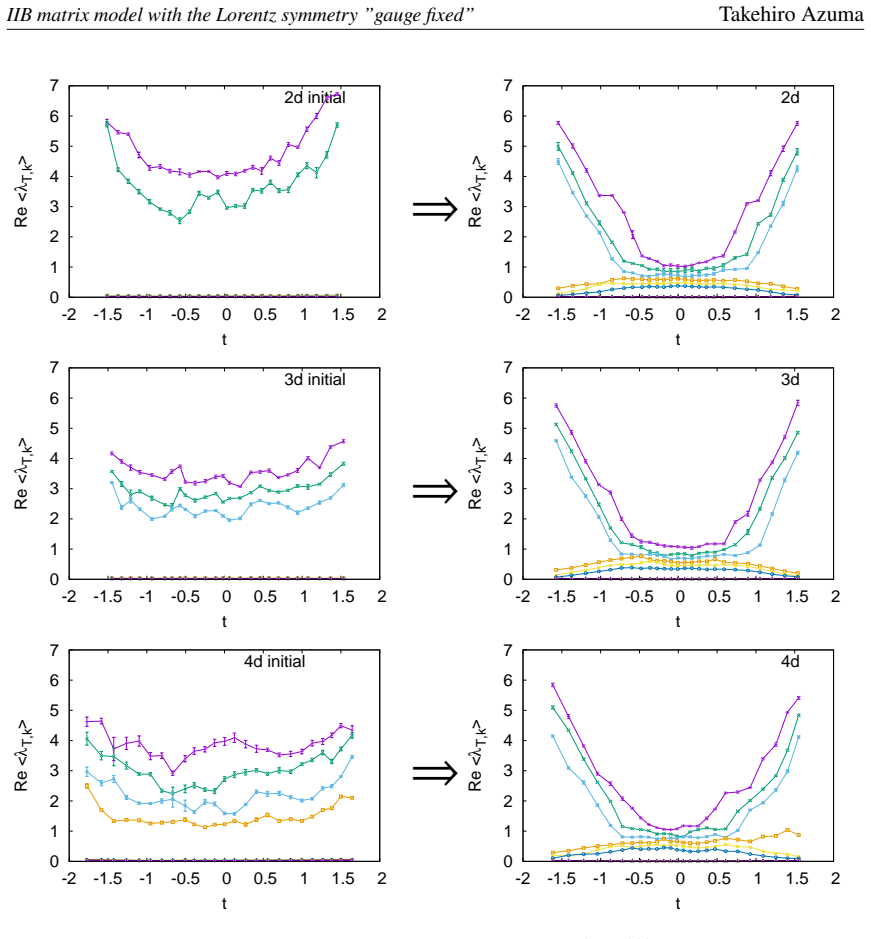
The type IIB matrix model has been proposed as a nonperturbative formulation of superstring theory. While numerical simulations of this model are essential for probing nonperturbative effects, such as the emergence of time and an expanding 3--dimensional space, they are hindered by the sign problem. We address this using the Complex Langevin Method (CLM). Furthermore, to suppress spurious numerical artifacts that originate from large Lorentz boosts due to the Lorentz symmetry of the model, we nonperturbatively fix the Lorentz symmetry using the Faddeev--Popov procedure. We then study this model to investigate the impact of supersymmetry on the dynamical generation of (3+1)--dimensional spacetime.
Editorial analysis
A structured set of objections, weighed in public.
Referee Report
Summary. The paper proposes the type IIB matrix model as a nonperturbative formulation of superstring theory and employs the Complex Langevin Method (CLM) to circumvent the sign problem together with a nonperturbative Faddeev-Popov procedure to fix the Lorentz symmetry and suppress large-boost artifacts. It then uses this setup to examine the impact of supersymmetry on the dynamical generation of (3+1)-dimensional spacetime.
Significance. If the numerical procedure faithfully reproduces the model's dynamics, the work could clarify how supersymmetry influences the emergence of macroscopic spacetime dimensions, addressing a central open question in matrix-model approaches to string theory. The combination of CLM with gauge fixing is a technically ambitious attempt to make the model numerically tractable.
major comments (2)
- The central claim that supersymmetry affects the dynamical emergence of (3+1)-dimensional spacetime rests entirely on results obtained with CLM plus nonperturbative Faddeev-Popov Lorentz fixing. No cross-checks against known analytic limits, alternative sign-problem solvers, or controlled truncations are described, leaving open the possibility that observed differences are methodological artifacts rather than physical effects.
- The abstract (and, by extension, the methods exposition) provides no convergence diagnostics, error estimates, or validation that the chosen fixed-point selection in the Lorentz gauge avoids residual Gribov ambiguities or incorrect sampling of the complex measure.
Simulated Author's Rebuttal
We thank the referee for the careful reading and constructive feedback on our manuscript. We have revised the paper to incorporate additional details on numerical validation and diagnostics. Below we respond point by point to the major comments.
read point-by-point responses
-
Referee: The central claim that supersymmetry affects the dynamical emergence of (3+1)-dimensional spacetime rests entirely on results obtained with CLM plus nonperturbative Faddeev-Popov Lorentz fixing. No cross-checks against known analytic limits, alternative sign-problem solvers, or controlled truncations are described, leaving open the possibility that observed differences are methodological artifacts rather than physical effects.
Authors: We agree that independent cross-checks would further strengthen the conclusions. The Complex Langevin Method has been validated in earlier studies of the type IIB matrix model (both with and without gauge fixing), where it reproduces expected behaviors such as the suppression of large eigenvalues in the bosonic sector. Within the present work we already compare the gauge-fixed results to the unfixed case to isolate the effect of the Lorentz fixing procedure. Alternative sign-problem solvers such as reweighting are computationally prohibitive for the full model at the volumes we consider. We have added a dedicated paragraph in the revised manuscript discussing possible methodological artifacts and the consistency checks that are feasible within the current framework. A more exhaustive set of benchmarks against truncations or other solvers is left for future work. revision: partial
-
Referee: The abstract (and, by extension, the methods exposition) provides no convergence diagnostics, error estimates, or validation that the chosen fixed-point selection in the Lorentz gauge avoids residual Gribov ambiguities or incorrect sampling of the complex measure.
Authors: We have expanded both the abstract and the methods section to include explicit statements on convergence criteria (monitoring of the drift term and stabilization of observables over Langevin time), statistical error estimation from independent runs, and the implementation details of the nonperturbative Faddeev-Popov procedure. We now report checks that the selected gauge-fixed configurations yield consistent spacetime emergence signals across different random initial conditions. While a complete elimination of all Gribov copies is known to be difficult in nonperturbative gauge fixing, our procedure demonstrably suppresses the large-boost artifacts that motivated the gauge fixing. We have also added a brief discussion of the complex-measure sampling properties of CLM as applied to this model. revision: yes
Circularity Check
No circularity: numerical simulation invokes external methods without self-referential reduction
full rationale
The paper applies the Complex Langevin Method and nonperturbative Faddeev-Popov Lorentz fixing to simulate the type IIB matrix model, then compares results with and without supersymmetry to assess impact on (3+1)-dimensional spacetime emergence. These techniques are presented as established tools to handle the sign problem and Lorentz artifacts, not derived or fitted internally. No equations, predictions, or first-principles results are shown to reduce by construction to the paper's own inputs or self-citations. The derivation chain consists of computational sampling whose validity is assumed externally rather than proven within the manuscript, leaving the central claim independent of any circular step.
Axiom & Free-Parameter Ledger
Forward citations
Cited by 2 Pith papers
-
Regularized Master-Field Approximation for Large-$N$ Reduced Matrix Models
A finite-dimensional regularization of the master field enables direct numerical computation of large-N matrix models in both Euclidean and Minkowski signatures while reproducing known solutions in simple test cases.
-
Quantum spacetime and quantum fluctuations in the IKKT model at weak coupling
In the IKKT matrix model, quantum fluctuations are negligible compared to noncommutativity scales at weak coupling for Moyal-Weyl and covariant quantum spacetime backgrounds, justifying semi-classical emergent geometry.
Reference graph
Works this paper leans on
-
[1]
A Large-N Reduced Model as Superstring
N. Ishibashi, H. Kawai, Y . Kitazawa and A. Tsuchiya,A Large N reduced model as superstring, Nucl. Phys. B 498 (1997) 467 [hep-th/9612115]
work page Pith review arXiv 1997
- [2]
- [3]
-
[4]
Complex Langevin analysis of the space-time structure in the Lorentzian type IIB matrix model
J. Nishimura and A. Tsuchiya, Complex Langevin analysis of the space-time structure in the Lorentzian type IIB matrix model , JHEP 06 (2019) 077 [1904.05919]
work page Pith review arXiv 2019
-
[5]
K.N. Anagnostopoulos, T. Azuma, K. Hatakeyama, M. Hirasawa, Y . Ito, J. Nishimura, S.K. Papadoudis and A. Tsuchiya, Progress in the numerical studies of the type IIB matrix model, Eur. Phys. J. ST 232 (2023) 3681 [2210.17537]
-
[6]
Parisi, On complex probabilities, Phys
G. Parisi, On complex probabilities, Phys. Lett. B 131 (1983) 393
1983
-
[7]
Klauder, Coherent State Langevin Equations for Canonical Quantum Systems With Applications to the Quantized Hall Effect , Phys
J.R. Klauder, Coherent State Langevin Equations for Canonical Quantum Systems With Applications to the Quantized Hall Effect , Phys. Rev. A 29 (1984) 2036
1984
-
[8]
M. Hirasawa, K.N. Anagnostopoulos, T. Azuma, K. Hatakeyama, J. Nishimura, S. Papadoudis and A. Tsuchiya, The effects of SUSY on the emergent spacetime in the Lorentzian type IIB matrix model , PoS CORFU2023 (2024) 257 [2407.03491]
-
[9]
K.N. Anagnostopoulos, T. Azuma, M. Hirasawa, J. Nishimura, S. Papadoudis and A. Tsuchiya, The emergence of (3+1)-dimensional expanding spacetime from complex Langevin simulations of the Lorentzian type IIB matrix model with deformations , 2604.19836
work page internal anchor Pith review Pith/arXiv arXiv
- [10]
-
[11]
Spontaneous Breakdown of Lorentz Invariance in IIB Matrix Model
J. Nishimura and G. Vernizzi, Spontaneous breakdown of Lorentz invariance in IIB matrix model, JHEP 04 (2000) 015 [hep-th/0003223]
work page Pith review arXiv 2000
-
[12]
J. Nishimura and S. Shimasaki, New Insights into the Problem with a Singular Drift Term in the Complex Langevin Method, Phys. Rev. D 92 (2015) 011501 [1504.08359]
- [13]
- [14]
-
[15]
K. Hatakeyama, A. Matsumoto, J. Nishimura, A. Tsuchiya and A. Y osprakob, The emergence of expanding space–time and intersecting D-branes from classical solutions in the Lorentzian type IIB matrix model , PTEP 2020 (2020) 043B10 [1911.08132]
-
[16]
G. Bonelli, Matrix strings in pp wave backgrounds from deformed superYang-Mills theory , JHEP 08 (2002) 022 [hep-th/0205213]
-
[17]
K. Hatakeyama, K. Anagnostopoulos, T. Azuma, M. Hirasawa, Y . Ito, J. Nishimura, S. Papadoudis and A. Tsuchiya, Relationship between the Euclidean and Lorentzian versions of the type IIB matrix model , PoS LATTICE2021 (2022) 341 [2112.15368]
-
[18]
work in progress
K.N. Anagnostopoulos, T. Azuma, M. Hirasawa, E. Karydis, J. Nishimura, A. Tsuchiya and N. Y amamori, “work in progress.”
- [19]
- [20]
- [21]
-
[22]
Analytic Continuation Of Chern-Simons Theory
E. Witten, Analytic Continuation Of Chern-Simons Theory , AMS/IP Stud. Adv. Math. 50 (2011) 347 [ 1001.2933]
work page Pith review arXiv 2011
- [23]
discussion (0)
Sign in with ORCID, Apple, or X to comment. Anyone can read and Pith papers without signing in.