Recognition: unknown
Practical HPCQC Integration with QDMI: A Real-Hardware Case Study with IQM Systems
Pith reviewed 2026-05-10 02:39 UTC · model grok-4.3
The pith
Standardizing the quantum-HPC boundary with QDMI makes integration reusable across hardware providers.
A machine-rendered reading of the paper's core claim, the machinery that carries it, and where it could break.
Core claim
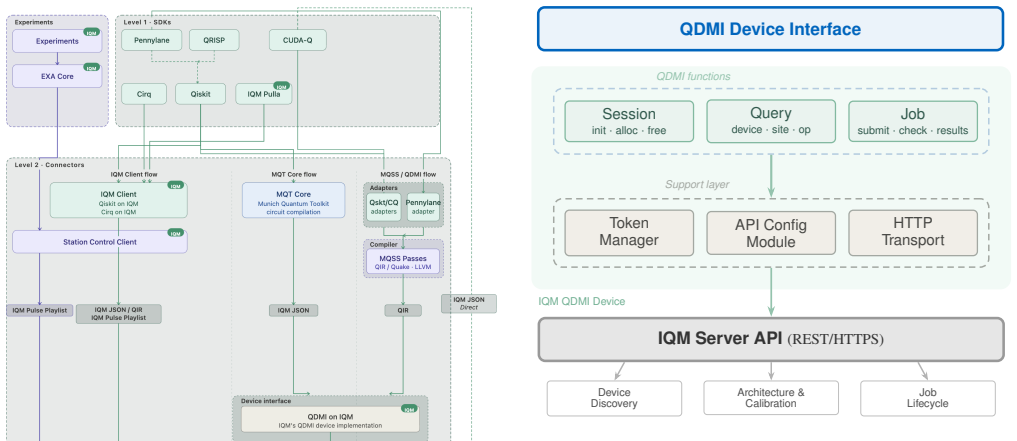
The authors present an IQM-backed QDMI layer that integrates with Slurm-based execution and Qiskit workflows. They argue that once the software-hardware boundary is standardized through QDMI, large parts of the integration stack become reusable across providers and deployment styles, as shown in their real-hardware case study with publicly available code.
What carries the argument
The Quantum Device Management Interface (QDMI), which acts as a standardized boundary layer between quantum hardware backends and higher-level HPC software components such as schedulers and user SDKs.
If this is right
- Quantum hardware from different vendors can share the same integration code for HPC environments.
- Existing Slurm workflows can schedule quantum jobs without vendor-specific modifications.
- Qiskit users can access new hardware backends through the standardized interface.
- The development effort for new quantum systems in HPC decreases as reusable components increase.
Where Pith is reading between the lines
- Adoption of QDMI by more vendors would allow HPC centers to treat quantum resources more like classical accelerators.
- This standardization might enable higher-level optimizations like dynamic scheduling or resource sharing across quantum and classical nodes.
- Future work could extend QDMI to include metrics for error rates or calibration data to improve job placement.
Load-bearing premise
That the QDMI specification is complete enough to support all necessary operations for real quantum hardware in production HPC settings and that vendors will implement it consistently.
What would settle it
Observing that the implemented QDMI layer cannot correctly translate or execute a standard quantum circuit from Qiskit on the IQM hardware, or that Slurm jobs fail to allocate resources properly due to missing functionality in the interface.
Figures



read the original abstract
Quantum computers are moving into HPC centers, and the main challenge is now integration rather than pure hardware access. Many current software paths still depend on vendor-specific adapter chains between user SDKs, schedulers, and backend APIs. This pattern makes operations more complex than necessary and slows the transition from pilots to production workflows. We present a practical integration path centered on the Quantum Device Management Interface (QDMI). Using IQM superconducting systems as a hardware case study, we implement an IQM-backed QDMI layer and connect it to two software layers that HPC centers working with quantum computers already care about: Slurm-based job execution and Qiskit-facing user workflows. The implementation is publicly available at https://github.com/iqm-finland/QDMI-on-IQM. The key message is simple: integrating quantum hardware into HPC does not have to be a bespoke engineering effort for each backend. Once the software-hardware boundary is standardized, large parts of the stack become reusable across providers and deployment styles. Our results do not claim that standardization eliminates all HPCQC challenges. They show that this specific boundary can already be standardized today in a way that is practical for users, operators, and vendors.
Editorial analysis
A structured set of objections, weighed in public.
Referee Report
Summary. The paper presents a practical case study of integrating IQM superconducting quantum hardware into HPC environments through the Quantum Device Management Interface (QDMI). It describes the development of an IQM-backed QDMI layer connected to Slurm-based job execution and Qiskit user workflows, with the full implementation released as open-source code at https://github.com/iqm-finland/QDMI-on-IQM. The central message is that standardizing the software-hardware boundary via QDMI makes large parts of the integration stack reusable across providers and deployment styles, without claiming to solve all HPCQC challenges.
Significance. If the demonstrated QDMI integration holds and the interface sees broader adoption, the work could meaningfully reduce the engineering overhead for incorporating quantum accelerators into production HPC systems. The public code repository is a clear strength, supporting reproducibility and community extension of the Slurm and Qiskit bindings.
major comments (1)
- [Abstract] Abstract: The key claim that 'large parts of the stack become reusable across providers and deployment styles' is load-bearing yet rests on a single-vendor (IQM) implementation. No second backend is shown, no interface conformance tests across providers are reported, and no discussion is given of whether the upper-layer Slurm or Qiskit code would remain unchanged under a different vendor's QDMI realization.
Simulated Author's Rebuttal
We thank the referee for the constructive review and the recommendation for major revision. The comment correctly identifies a point where the abstract's phrasing could be clarified to better reflect the scope of a single-vendor case study. We address this below and have made targeted revisions to qualify our claims without altering the core contribution.
read point-by-point responses
-
Referee: [Abstract] Abstract: The key claim that 'large parts of the stack become reusable across providers and deployment styles' is load-bearing yet rests on a single-vendor (IQM) implementation. No second backend is shown, no interface conformance tests across providers are reported, and no discussion is given of whether the upper-layer Slurm or Qiskit code would remain unchanged under a different vendor's QDMI realization.
Authors: We agree that the empirical demonstration is confined to a single vendor, consistent with the paper's framing as a practical case study of IQM hardware integration rather than a multi-vendor benchmark. The reusability argument rests on the architectural separation: both the Slurm job plugin and the Qiskit provider are implemented exclusively against the QDMI API, with no IQM-specific code in those layers. Consequently, any future vendor-supplied QDMI backend that adheres to the interface specification would allow the upper-layer components to operate without modification. We have revised the abstract to state this more precisely, replacing the original phrasing with language that ties the reusability claim directly to the standardized boundary and the case-study illustration. We have also added a new paragraph in the Discussion section that explicitly addresses portability, including the conditions under which the Slurm and Qiskit integrations would transfer unchanged to another compliant QDMI realization. Cross-provider conformance testing and a second backend implementation lie outside the scope of this work, as only one production QDMI backend currently exists; the released open-source code is intended to enable such extensions by the community. These changes preserve the paper's central message while addressing the concern about overstatement. revision: partial
Circularity Check
Implementation report with no derivations, predictions or fitted quantities
full rationale
The manuscript reports a concrete QDMI implementation for one hardware backend (IQM) and its bindings to Slurm and Qiskit. It contains no equations, no parameter fitting, no predictions of new quantities, and no derivation chain. The reusability statement is presented as an engineering observation from the demonstrated case rather than a result derived from prior inputs or self-citations. No load-bearing self-citation, ansatz smuggling, or renaming of known results occurs. The paper is therefore self-contained as an implementation study.
Axiom & Free-Parameter Ledger
Reference graph
Works this paper leans on
-
[1]
OpenMP: An industry standard API for shared-memory programming,
L. Dagum and R. Menon, “OpenMP: An industry standard API for shared-memory programming,”IEEE Computational Science and Engineering, 1998.DOI: 10.1109/99.660313
-
[2]
RAJA: Portable performance for large-scale scientific applications,
D. Beckingsale et al., “RAJA: Portable performance for large-scale scientific applications,” inInternational Workshop on Performance, Portability and Productivity in HPC (P3HPC), 2019.DOI: 10.1109/P3HPC49587. 2019.00012
-
[3]
A. B. Yoo, M. A. Jette, and M. Grondona, “SLURM: Simple linux utility for resource management,” inJob Scheduling Strategies for Parallel Processing, Springer, 2003.DOI: 10.1007/10968987_3
-
[4]
Integrating quantum computing resources into scientific HPC ecosystems,
T. Beck et al., “Integrating quantum computing resources into scientific HPC ecosystems,”Future Generation Computer Systems, 2024.DOI: 10.1016/j.future.2024.06. 058
-
[5]
A. Elsharkawy et al., “Integration of quantum acceler- ators with high-performance computing—a review of quantum programming tools,”ACM Transactions on Quantum Computing, 2025.DOI: 10.1145/3743149
-
[6]
Integrating quantum computing into workflow modeling and execution,
B. Weder, U. Breitenbucher, F. Leymann, and K. Wild, “Integrating quantum computing into workflow modeling and execution,” inInternational Conference on Utility and Cloud Computing (UCC), 2020.DOI: 10 . 1109 / UCC48980.2020.00046
-
[7]
E. Kaya et al., “A software platform to support dis- aggregated quantum accelerators,” inWorkshops of the International Conference for High Performance Computing, Networking, Storage and Analysis, 2024. DOI: 10.1109/SCW63240.2024.00205
-
[8]
XACC: A system-level soft- ware infrastructure for heterogeneous quantum-classical computing,
A. J. McCaskey, D. I. Lyakh, E. F. Dumitrescu, S. S. Powers, and T. S. Humble, “XACC: A system-level soft- ware infrastructure for heterogeneous quantum-classical computing,”Quantum Science and Technology, 2020. DOI: 10.1088/2058-9565/ab6bf6
-
[9]
Accelerating HPC With Quantum Computing: It Is a Software Challenge Too
M. Schulz, M. Ruefenacht, D. Kranzlmueller, and L. B. Schulz, “Accelerating HPC with quantum computing: It is a software challenge too,”Computing in Science & Engineering, 2022.DOI: 10.1109/MCSE.2022.3221845
-
[10]
E. Mansfield et al., “First practical experiences inte- grating quantum computers with HPC resources: A case study with a 20-qubit superconducting quantum computer,” inWorkshops of the International Conference for High Performance Computing, Networking, Storage and Analysis, 2025.DOI: 10.1145/3731599.3767551
- [11]
-
[12]
Referencearchitectureofaquantum-centric supercomputer.arXiv preprint arXiv:2603.10970(2026)
S. Seelam et al.,Reference architecture of a quantum- centric supercomputer, 2026. arXiv: 2603.10970
-
[13]
Quantum resources in resource management systems,
U. Bacher et al.,Quantum resources in resource man- agement systems, 2025. arXiv: 2506.10052
-
[14]
Bridging paradigms: Designing for HPC-quantum convergence,
A. Shehata et al., “Bridging paradigms: Designing for HPC-quantum convergence,”Future Generation Computer Systems, 2026.DOI: 10.1016/j.future.2025. 107980
-
[15]
R. Wille et al., “QDMI - quantum device management interface: Hardware-software interface for the munich quantum software stack,” inIEEE International Confer- ence on Quantum Computing and Engineering, 2024. DOI: 10.1109/QCE60285.2024.10411
-
[16]
L. Burgholzer et al., “The Munich Quantum Software Stack: Connecting end users, integrating diverse quan- tum technologies, accelerating HPC,” inInternational Conference on High Performance Computing in Asia Pacific Region, 2026.DOI: 10.1145/3773656.3773669
-
[17]
P. Hopf, S. Stern, R. Wille, and L. Burgholzer,Stan- dardizing access to heterogeneous quantum backends: A case study on cloud service integration with QDMI,
-
[18]
Technology and performance benchmarks of IQM’s 20-qubit quantum computer
L. Abdurakhimov et al.,Technology and performance benchmarks of IQM’s 20-qubit quantum computer, 2024. arXiv: 2408.12433
-
[19]
On-premises superconducting quantum computer for education and research,
J. Rönkkö et al., “On-premises superconducting quantum computer for education and research,”EPJ Quantum Technology, 2024.DOI: 10 . 1140 / epjqt / s40507 - 024 - 00243-z
2024
-
[20]
Javadi-Abhari et al.,Quantum computing with Qiskit,
A. Javadi-Abhari et al.,Quantum computing with Qiskit,
-
[21]
MQT Core: The backbone of the Munich Quantum Toolkit (MQT),
L. Burgholzer, Y . Stade, T. Peham, and R. Wille, “MQT Core: The backbone of the Munich Quantum Toolkit (MQT),”Journal of Open Source Software, 2025.DOI: 10.21105/joss.07478
-
[22]
P. V . Sriluckshmy, F. Jamet, and F. Š. IV,Quantum assisted ghost Gutzwiller ansatz, 2025. arXiv: 2506 . 21431
2025
-
[23]
T. Shirakawa et al.,Closed-loop calculations of elec- tronic structure on a quantum processor and a classical supercomputer at full scale, 2025. arXiv: 2511.00224
- [24]
-
[25]
AI Feynman: A physics-inspired method for symbolic regression.Science Advances, 6(16):eaay2631, 2020
J. Robledo-Moreno et al., “Chemistry beyond the scale of exact diagonalization on a quantum-centric supercom- puter,”Science Advances, 2025.DOI: 10.1126/sciadv. adu9991
discussion (0)
Sign in with ORCID, Apple, or X to comment. Anyone can read and Pith papers without signing in.