Melting temperature shifts from quantum fluctuations in generalized Wigner crystals
Pith reviewed 2026-05-10 01:04 UTC · model grok-4.3
The pith
Quantum fluctuations can raise the melting temperature of generalized Wigner crystals instead of always lowering it.
A machine-rendered reading of the paper's core claim, the machinery that carries it, and where it could break.
Core claim
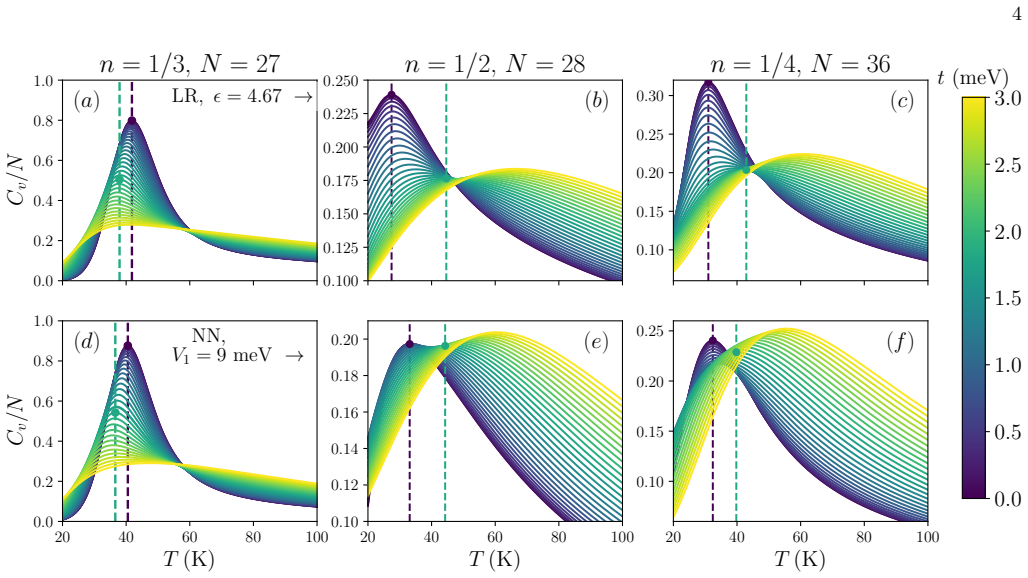
We show that quantum effects capture the shift relative to the classical estimates, which in some cases are more than 50 percent off from the experimental values. Then building on these numerical findings, we provide a qualitative picture that clarifies that while quantum melting of GWC (by increasing the bandwidth) naturally softens the ground state order parameter, it does not always decrease the melting temperature; conversely it can increase it. Our predictions should be observable in future experiments where the bandwidth can be tuned.
What carries the argument
Finite temperature Lanczos calculations on the extended Hubbard model (with double-gate screened or nearest-neighbor interactions) on the triangular lattice, supplemented by finite temperature perturbation theory that treats kinetic energy perturbatively around a classical Wigner crystal.
Load-bearing premise
The extended Hubbard model on the triangular lattice accurately represents the physics of generalized Wigner crystals in WS2/WSe2 moiré heterobilayers so that the calculated shifts apply directly to experiment.
What would settle it
Tuning the bandwidth in a WS2/WSe2 moiré system and measuring whether the generalized Wigner crystal melting temperature increases or decreases in the density regimes predicted by the perturbation theory.
Figures




read the original abstract
It is generally believed that quantum fluctuations collaborate with thermal fluctuations, effectively reducing transition temperatures (e.g. for melting of charge order). We show that this is not always the case and that the interplay between quantum and thermal fluctuations can be competitive. We find excellent motivation for addressing this thanks to the discovery of correlated insulating "generalized Wigner crystal" (GWC) states in hetero-bilayer transition metal dichalcogenide (WS$_2$/WSe$_2$) moir\'e systems [Y. Xu, et al., Nature 587, 214-218 (2020)]. We account for the impact of quantum effects on the melting temperature of GWCs, carrying out finite temperature Lanczos calculations on an extended Hubbard model on the triangular lattice (both with a double-gate screened potential, and the nearest neighbor model) for multiple electron densities. We show that quantum effects capture the shift relative to the classical estimates, which in some cases are more than 50 percent off from the experimental values. Then building on these numerical findings, we provide a qualitative picture that clarifies that while quantum melting of GWC (by increasing the bandwidth) naturally softens the ground state order parameter, it does not always decrease the melting temperature; conversely it can increase it. To do so we employ a finite temperature perturbation theory, treating the kinetic energy perturbatively on top of a classical Wigner crystal. Our predictions should be observable in future experiments where the bandwidth can be tuned.
Editorial analysis
A structured set of objections, weighed in public.
Referee Report
Summary. The paper claims that quantum fluctuations do not always collaborate with thermal fluctuations to lower the melting temperature Tm of generalized Wigner crystals (GWCs) in WS2/WSe2 moiré systems; instead, they can compete and raise Tm. Using finite-temperature Lanczos on the extended Hubbard model (triangular lattice, double-gate screened or nearest-neighbor interactions) at multiple fillings, the authors show quantum shifts relative to classical estimates that reach >50% and better match experiment. They then employ finite-temperature perturbation theory (kinetic term expanded around a classical Wigner-crystal background) to argue that increasing bandwidth softens the ground-state order parameter yet can still increase Tm.
Significance. If the central claim holds, the result is significant: it provides a counter-example to the conventional expectation that quantum fluctuations always suppress charge-ordering temperatures and supplies a concrete mechanism (competitive quantum-thermal interplay) that could be tested by bandwidth tuning in moiré devices. The combination of unbiased Lanczos numerics with an analytic perturbative picture is a methodological strength, and the direct comparison to experimental Tm values adds falsifiability.
major comments (2)
- [finite-temperature perturbation theory section] § on finite-temperature perturbation theory (the qualitative picture following the Lanczos results): the expansion assumes a small kinetic-energy perturbation around the classical Wigner crystal. Yet the same manuscript reports Lanczos shifts >50% for several densities; such shifts imply t/V ratios that are no longer perturbatively small, undermining the controlled use of the expansion to explain why Tm can increase. A direct comparison of the perturbative Tm shift against Lanczos data at the same parameters where the shift exceeds ~30% is required to establish the regime of validity.
- [Lanczos results] Lanczos results paragraph (the >50% shift claim): the manuscript states that quantum effects capture the experimental discrepancy, but does not report the precise filling factors, interaction strengths, or error bars on the extracted Tm values. Without these, it is impossible to judge whether the 50% figure is robust or an artifact of finite-size extrapolation or the specific choice of double-gate vs. nearest-neighbor potential.
minor comments (2)
- [abstract/introduction] The abstract and introduction refer to 'classical estimates' without citing the specific classical Monte Carlo or mean-field calculation used for the reference Tm; adding that reference would clarify the baseline.
- [figures] Figure captions for the Lanczos data should explicitly state the system sizes employed and the extrapolation procedure to the thermodynamic limit.
Simulated Author's Rebuttal
We thank the referee for the careful reading of our manuscript and the constructive comments. The positive assessment of the significance is appreciated. We address each major comment below and outline the revisions we will make.
read point-by-point responses
-
Referee: [finite-temperature perturbation theory section] § on finite-temperature perturbation theory (the qualitative picture following the Lanczos results): the expansion assumes a small kinetic-energy perturbation around the classical Wigner crystal. Yet the same manuscript reports Lanczos shifts >50% for several densities; such shifts imply t/V ratios that are no longer perturbatively small, undermining the controlled use of the expansion to explain why Tm can increase. A direct comparison of the perturbative Tm shift against Lanczos data at the same parameters where the shift exceeds ~30% is required to establish the regime of validity.
Authors: We thank the referee for this important point on the controlled use of perturbation theory. The finite-temperature perturbative expansion is employed to furnish a qualitative mechanism illustrating how quantum fluctuations can compete with thermal fluctuations and raise Tm, rather than to yield quantitative predictions at large t/V. We acknowledge that shifts exceeding 50% indicate parameters outside the strictly perturbative regime. To address the concern directly, we will add to the revised manuscript a side-by-side comparison of the perturbative Tm shift versus the Lanczos results at parameters where the shift is approximately 30%, thereby clarifying the expansion's regime of validity while preserving its role in providing physical insight. revision: partial
-
Referee: [Lanczos results] Lanczos results paragraph (the >50% shift claim): the manuscript states that quantum effects capture the experimental discrepancy, but does not report the precise filling factors, interaction strengths, or error bars on the extracted Tm values. Without these, it is impossible to judge whether the 50% figure is robust or an artifact of finite-size extrapolation or the specific choice of double-gate vs. nearest-neighbor potential.
Authors: We apologize for the insufficient detail in the reporting of parameters. In the revised manuscript we will explicitly list the filling factors (e.g., ν = 1/3, 1/4, and additional densities examined), the corresponding interaction strengths (V/t ratios), and the error bars obtained from finite-size extrapolations of Tm. We will also state clearly for each density whether the double-gate screened Coulomb potential or the nearest-neighbor interaction was employed, enabling an unambiguous evaluation of the robustness of the reported shifts. revision: yes
Circularity Check
No significant circularity; Lanczos numerics and perturbation theory are independent calculations.
full rationale
The paper's central results derive from direct finite-temperature Lanczos diagonalization on the extended Hubbard model (with screened or nearest-neighbor interactions) at multiple fillings, which are compared to classical estimates and experiment. A separate finite-temperature perturbation theory (kinetic term treated perturbatively around a classical Wigner crystal background) is introduced only afterward to supply qualitative intuition for why Tm can increase. Neither step reduces to the other by construction, no parameters are fitted to data and then relabeled as predictions, and no self-citations or imported uniqueness theorems appear as load-bearing elements. The model-to-experiment comparison is external validation rather than an internal fit, leaving the derivation chain self-contained.
Axiom & Free-Parameter Ledger
axioms (1)
- domain assumption The extended Hubbard model on the triangular lattice with double-gate screened potential or nearest neighbor interactions describes the generalized Wigner crystals in WS2/WSe2 moiré systems.
Reference graph
Works this paper leans on
-
[1]
library and our custom codes. We thank the Re- search Computing Center (RCC) and the Planck cluster at Florida State University for computational resources. This work also used Bridges-2 at Pittsburgh Super- computing Center through allocation PHY240324 (To- wards predictive modeling of strongly correlated quan- tum matter) from the Advanced Cyberinfrastr...
-
[2]
Wigner, On the interaction of electrons in metals, Phys
E. Wigner, On the interaction of electrons in metals, Phys. Rev.46, 1002 (1934)
work page 1934
-
[3]
D. M. Ceperley and B. J. Alder, Ground state of the electron gas by a stochastic method, Phys. Rev. Lett. 45, 566 (1980)
work page 1980
- [4]
-
[5]
B. Tanatar and D. M. Ceperley, Ground state of the two- dimensional electron gas, Phys. Rev. B39, 5005 (1989)
work page 1989
-
[6]
A. C. Mehta, C. J. Umrigar, J. S. Meyer, and H. U. Baranger, Zigzag phase transition in quantum wires, Phys. Rev. Lett.110, 246802 (2013)
work page 2013
- [7]
-
[8]
Y.-C. Tsui, M. He, Y. Hu, E. Lake, T. Wang, K. Watan- abe, T. Taniguchi, M. P. Zaletel, and A. Yazdani, Direct observation of a magnetic-field-induced wigner crystal, Nature628, 287 (2024)
work page 2024
-
[9]
Y. Xu, S. Liu, D. A. Rhodes, K. Watanabe, T. Taniguchi, J. Hone, V. Elser, K. F. Mak, and J. Shan, Correlated in- sulating states at fractional fillings of moir´ e superlattices, Nature587, 214–218 (2020)
work page 2020
-
[10]
H. Li, S. Li, E. C. Regan, D. Wang, W. Zhao, S. Kahn, K. Yumigeta, M. Blei, T. Taniguchi, K. Watanabe, S. Tongay, A. Zettl, M. F. Crommie, and F. Wang, Imag- ing two-dimensional generalized wigner crystals, Nature 597, 650 (2021)
work page 2021
-
[11]
C. Jin, Z. Tao, T. Li, Y. Xu, Y. Tang, J. Zhu, S. Liu, K. Watanabe, T. Taniguchi, J. C. Hone, L. Fu, J. Shan, and K. F. Mak, Stripe phases in wse2/ws2 moir´ e super- lattices, Nature Materials20, 940–944 (2021)
work page 2021
-
[12]
E. C. Regan, D. Wang, C. Jin, M. I. Bakti Utama, B. Gao, X. Wei, S. Zhao, W. Zhao, Z. Zhang, K. Yu- migeta, M. Blei, J. D. Carlstr¨ om, K. Watanabe, T. Taniguchi, S. Tongay, M. Crommie, A. Zettl, and F. Wang, Mott and generalized wigner crystal states in wse2/ws2 moir´ e superlattices, Nature579, 359–363 (2020)
work page 2020
- [13]
-
[14]
H. Pan, F. Wu, and S. Das Sarma, Quantum phase dia- gram of a moir´ e-hubbard model, Physical Review B102, 201104 (2020)
work page 2020
-
[15]
F. Wu, T. Lovorn, E. Tutuc, and A. H. MacDonald, Hub- bard model physics in transition metal dichalcogenide moir´ e bands, Phys. Rev. Lett.121, 026402 (2018)
work page 2018
-
[16]
N. Morales-Dur´ an, P. Potasz, and A. H. MacDon- ald, Magnetism and quantum melting in moir´ e-material wigner crystals, Phys. Rev. B107, 235131 (2023)
work page 2023
-
[17]
S. F. Ung, J. Lee, and D. R. Reichman, Competing gen- eralized wigner crystal states in moir´ e heterostructures, Phys. Rev. B108, 245113 (2023)
work page 2023
- [18]
- [19]
-
[20]
Y. Tan, P. K. H. Tsang, V. Dobrosavljevi´ c, and L. Rade- maker, Doping a wigner-mott insulator: Exotic charge orders in transition metal dichalcogenide moir´ e heterobi- layers, Phys. Rev. Res.5, 043190 (2023)
work page 2023
- [21]
- [22]
-
[23]
Y. Yang, M. A. Morales, and S. Zhang, Metal-insulator transition in a semiconductor heterobilayer model, Phys. Rev. Lett.132, 076503 (2024)
work page 2024
-
[25]
M. Matty and E.-A. Kim, Melting of generalized wigner crystals in transition metal dichalcogenide het- erobilayer moir´ e systems, Nature Communications13, 10.1038/s41467-022-34683-x (2022)
-
[26]
N. Morales-Dur´ an, A. H. MacDonald, and P. Potasz, Metal-insulator transition in transition metal dichalco- genide heterobilayer moir´ e superlattices, Phys. Rev. B 103, L241110 (2021)
work page 2021
- [27]
-
[28]
A. Biborski and M. Zegrodnik, Charge and spin proper- ties of a generalized wigner crystal realized in the moir´ e wse2/ws2 heterobilayer, arXiv preprint arXiv:2409.11202 (2024)
- [29]
-
[30]
Y. Tang, J. Gu, S. Liu, K. Watanabe, T. Taniguchi, J. C. Hone, K. F. Mak, and J. Shan, Dielectric catastrophe at the wigner-mott transition in a moir´ e superlattice, Na- ture Communications13, 4271 (2022)
work page 2022
-
[32]
J. Jakliˇ c and P. Prelovˇ sek, Lanczos method for the calcu- lation of finite-temperature quantities in correlated sys- tems, Phys. Rev. B49, 5065 (1994)
work page 1994
-
[33]
P. Prelovˇ sek and J. Bonˇ ca, Ground state and finite tem- perature lanczos methods, inStrongly Correlated Sys- tems: Numerical Methods, edited by A. Avella and F. Mancini (Springer Berlin Heidelberg, Berlin, Heidel- berg, 2013) pp. 1–30
work page 2013
-
[34]
K. Lee, P. Sharma, O. Vafek, and H. J. Changlani,Trian- gular lattice Hubbard model physics at intermediate tem- peratures, Physical Review B107, 235105 (2023)
work page 2023
-
[35]
A more detailed analysis of the physics associated with the ground state phase transitions, with spin incorpo- rated, will be addressed elsewhere
-
[36]
M. Sch¨ uler, M. R¨ osner, T. O. Wehling, A. I. Lichten- stein, and M. I. Katsnelson, Optimal Hubbard Mod- els for Materials with Nonlocal Coulomb Interactions: 13 Graphene, Silicene, and Benzene, Physical Review Let- ters111, 036601 (2013)
work page 2013
-
[37]
H. J. Changlani, H. Zheng, and L. K. Wag- ner, Density-matrix based determination of low- energy model Hamiltonians from ab initio wave- functions, The Journal of Chemical Physics143, 102814 (2015), https://pubs.aip.org/aip/jcp/article- pdf/doi/10.1063/1.4927664/15502754/102814 1 online.pdf
-
[38]
H. Zheng, H. J. Changlani, K. T. Williams, B. Buse- meyer, and L. K. Wagner, From real materials to model hamiltonians with density matrix downfolding, Frontiers in Physics6, 10.3389/fphy.2018.00043 (2018)
-
[39]
Y. Zhou, D. N. Sheng, and E.-A. Kim, Quantum melt- ing of generalized wigner crystals in transition metal dichalcogenide moir´ e systems, Phys. Rev. Lett.133, 156501 (2024)
work page 2024
-
[40]
C. Hotta and N. Furukawa, Strong coupling theory of the spinless charges on triangular lattices: Possible for- mation of a gapless charge-ordered liquid, Phys. Rev. B 74, 193107 (2006)
work page 2006
-
[41]
L. F. Tocchio, C. Gros, X.-F. Zhang, and S. Eggert, Phase diagram of the triangular extended hubbard model, Phys. Rev. Lett.113, 246405 (2014)
work page 2014
- [42]
-
[43]
A more detailed study of then= 1/2 NN case will be presented elsewhere
-
[44]
J. Villain, R. Bidaux, J.-P. Carton, and R. Conte, Order as an effect of disorder, Journal de Physique41, 1263 (1980)
work page 1980
-
[45]
C. L. Henley, Ordering due to disorder in a frustrated vector antiferromagnet, Phys. Rev. Lett.62, 2056 (1989)
work page 2056
- [46]
-
[47]
A. Jain and C. Huang, Elementary Excitations, Melt- ing Temperature and Correlation Energy in Wigner Crystal, arXiv e-prints , arXiv:2504.04538 (2025), arXiv:2504.04538 [cond-mat.str-el]
- [48]
- [49]
-
[50]
A. M. Hallas, J. Gaudet, and B. D. Gaulin, Experimental insights into ground-state selection of quantum xy py- rochlores, Annual Review of Condensed Matter Physics 9, 105 (2018)
work page 2018
-
[51]
R. G. Melko, A. Paramekanti, A. A. Burkov, A. Vish- wanath, D. N. Sheng, and L. Balents, Supersolid order from disorder: Hard-core bosons on the triangular lattice, Phys. Rev. Lett.95, 127207 (2005)
work page 2005
-
[52]
M. Boninsegni and N. Prokof’ev, Supersolid phase of hard-core bosons on a triangular lattice, Phys. Rev. Lett. 95, 237204 (2005)
work page 2005
-
[53]
D. Heidarian and K. Damle, Persistent supersolid phase of hard-core bosons on the triangular lattice, Phys. Rev. Lett.95, 127206 (2005)
work page 2005
-
[54]
P. Weinberg and M. Bukov,QuSpin: a Python package for dynamics and exact diagonalisation of quantum many body systems part I: spin chains, SciPost Phys.2, 003 (2017)
work page 2017
-
[55]
E. Marinari and G. Parisi, Simulated tempering: A new monte carlo scheme, Europhysics Letters19, 451 (1992)
work page 1992
-
[56]
K. Hukushima and K. Nemoto, Exchange monte carlo method and application to spin glass simulations, Jour- nal of the Physical Society of Japan65, 1604 (1996), https://doi.org/10.1143/JPSJ.65.1604
discussion (0)
Sign in with ORCID, Apple, or X to comment. Anyone can read and Pith papers without signing in.