Recognition: unknown
Self-Interaction and Galactic Magnetic Field Bounds on Millicharged Magnetic Monopole Dark Matter
Pith reviewed 2026-05-10 01:58 UTC · model grok-4.3
The pith
Millicharged magnetic monopole dark matter faces bounds from self-interactions and the survival of galactic magnetic fields.
A machine-rendered reading of the paper's core claim, the machinery that carries it, and where it could break.
Core claim
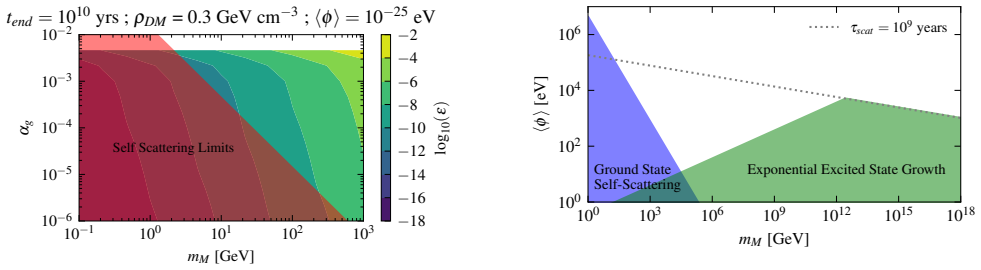
A dark matter sector composed of magnetic monopoles of a dark U(1) symmetry having a small kinetic mixing with the Standard Model photon has three phenomenologically distinct cases based on the temperature of the dark sector and scale of spontaneous symmetry breaking. In all cases, constraints on dark matter self-interactions are translated into constraints on the model parameters. As the magnetic monopoles acquire a small visible magnetic charge, the survival of galactic magnetic fields, known as the Parker effect, places further constraints on the mixing between the dark and visible sectors.
What carries the argument
The kinetic mixing between the dark U(1) and the visible photon, which induces a small visible magnetic charge on the dark monopoles and enables direct application of the Parker bound.
Load-bearing premise
The analysis assumes that the three phenomenologically distinct cases defined by dark-sector temperature and spontaneous symmetry-breaking scale exhaust the relevant regimes and that the Parker effect applies directly to these millicharged monopoles without additional suppression or enhancement mechanisms not modeled in the paper.
What would settle it
An observation that galactic magnetic fields persist at strengths inconsistent with the Parker bound applied to the mixing values allowed by self-interaction constraints in any of the three regimes would contradict the model.
Figures




read the original abstract
A dark matter sector composed of magnetic monopoles of a dark U(1) symmetry having a small kinetic mixing with the Standard Model photon has a rich and interesting phenomenology. The model in itself is also of theoretical interest. Based on the temperature of the dark sector and scale of spontaneous symmetry breaking for this U(1), three phenomenologically distinct cases for this model of dark matter are discussed. In all cases, constraints on dark matter self-interactions are translated into constraints on the model parameters. As the magnetic monopoles acquire a small visible magnetic charge, the survival of galactic magnetic fields, known as the Parker effect, places further constraints on the mixing between the dark and visible sectors.
Editorial analysis
A structured set of objections, weighed in public.
Referee Report
Summary. The manuscript proposes a dark matter model consisting of magnetic monopoles charged under a hidden U(1) that kinetically mixes with the SM photon, inducing a small visible magnetic charge. It identifies three regimes set by the dark-sector temperature and the U(1) spontaneous symmetry-breaking scale, translates existing dark-matter self-interaction bounds into limits on the model parameters in each regime, and invokes the Parker effect to place additional upper bounds on the kinetic mixing parameter from the survival of galactic magnetic fields.
Significance. If the central claims are correct, the work supplies a combined set of self-interaction and astrophysical magnetic-field constraints on millicharged monopole dark matter, mapping existing limits onto the kinetic mixing, dark temperature, and symmetry-breaking scale. The translation of bounds is a straightforward but useful exercise provided the Parker-effect application remains valid; the result would be of moderate interest to the dark-matter phenomenology community if the ε-dependent modifications to monopole dynamics are properly addressed.
major comments (2)
- [Parker-effect section (likely §3–4)] The Parker-effect bounds (invoked to constrain the kinetic mixing via the induced visible magnetic charge q_m = ε g_dark) assume unmodified monopole trapping and flux-draining in galactic fields. With Lorentz force suppressed by ε, the critical velocity, deflection, and trapping efficiency change for small ε; the manuscript does not appear to derive or cite the ε threshold below which the standard Parker argument ceases to apply. This is load-bearing for the “further constraints” claimed in the abstract and must be quantified, for example by computing the ε-dependent acceleration time-scale relative to the galactic crossing time.
- [Regime classification (likely §2)] The three phenomenologically distinct cases are defined by dark-sector temperature and SSB scale, yet the transition between regimes may itself depend on ε through the visible charge. The manuscript should demonstrate that the case boundaries remain stable under the small visible charge or explicitly include ε in the regime classification.
minor comments (2)
- [Abstract and §2] The abstract states that constraints are “translated” but does not list the numerical self-interaction bounds adopted or the reference from which they are taken; adding a short table or explicit citations in the main text would improve traceability.
- [Notation throughout] Notation for the dark magnetic charge g_dark and the visible charge ε g_dark should be introduced once and used consistently; occasional use of q_m without definition risks confusion.
Simulated Author's Rebuttal
We thank the referee for their careful reading of the manuscript and for the constructive comments, which have helped us strengthen the presentation of the Parker-effect constraints and the regime classification. We address each major comment below and have revised the manuscript accordingly.
read point-by-point responses
-
Referee: [Parker-effect section (likely §3–4)] The Parker-effect bounds (invoked to constrain the kinetic mixing via the induced visible magnetic charge q_m = ε g_dark) assume unmodified monopole trapping and flux-draining in galactic fields. With Lorentz force suppressed by ε, the critical velocity, deflection, and trapping efficiency change for small ε; the manuscript does not appear to derive or cite the ε threshold below which the standard Parker argument ceases to apply. This is load-bearing for the “further constraints” claimed in the abstract and must be quantified, for example by computing the ε-dependent acceleration time-scale relative to the galactic crossing time.
Authors: We agree that the ε dependence of the monopole dynamics must be quantified to validate the Parker bounds. In the revised manuscript we have added a dedicated paragraph in §3 that computes the acceleration timescale τ_acc = v_esc m / (ε g_dark B_gal) and compares it directly to the galactic crossing time τ_cross ≈ 3 × 10^8 yr. For the monopole masses and galactic field strengths relevant to our parameter space, the standard trapping and flux-draining assumptions remain valid for ε ≳ 10^{-13}. Below this threshold the bound weakens, but that region is already excluded by the self-interaction limits we derive. We have updated the abstract, §3, and the conclusions to state this range of applicability explicitly, so the claimed constraints are now properly qualified. revision: yes
-
Referee: [Regime classification (likely §2)] The three phenomenologically distinct cases are defined by dark-sector temperature and SSB scale, yet the transition between regimes may itself depend on ε through the visible charge. The manuscript should demonstrate that the case boundaries remain stable under the small visible charge or explicitly include ε in the regime classification.
Authors: The three regimes are delineated solely by dark-sector quantities: the dark temperature at decoupling and the dark U(1) breaking scale, which fix the monopole mass, relic density, and dark self-interaction cross section. The kinetic mixing parameter ε enters only through the induced visible magnetic charge and therefore affects only visible-sector scattering and the Parker effect; it does not back-react on the dark-sector temperature evolution or the timing of symmetry breaking for the small values of ε we consider. To make this explicit we have inserted a short paragraph at the end of §2 showing that the visible charge contributes negligibly to the dark-sector energy density and pressure for ε < 10^{-3}, leaving the regime boundaries unchanged. No modification to the classification itself was required. revision: yes
Circularity Check
No significant circularity in derivation chain
full rationale
The paper maps external astrophysical constraints (self-interaction bounds and the Parker effect) onto its three regimes defined by dark-sector temperature and U(1) breaking scale. These inputs are independent observations and standard literature results, not fitted parameters or self-referential definitions within the paper. The translation of bounds to model parameters (kinetic mixing, charges) follows from the model's explicit charge acquisition via mixing and standard Lorentz-force dynamics, without any step reducing by construction to its own outputs or prior self-citations that carry the central claim. The derivation remains self-contained against external benchmarks.
Axiom & Free-Parameter Ledger
free parameters (3)
- kinetic mixing parameter
- dark sector temperature
- SSB scale
axioms (3)
- domain assumption Existence of a dark U(1) gauge symmetry with magnetic monopoles as dark matter
- domain assumption Kinetic mixing between dark U(1) and SM photon produces visible magnetic charge on the monopoles
- ad hoc to paper Parker effect applies to these millicharged monopoles without additional model-dependent suppression
invented entities (1)
-
millicharged magnetic monopoles
no independent evidence
Forward citations
Cited by 1 Pith paper
-
Magnetic Monopoles -- From Dirac to the Large Hadron Collider
Magnetic monopoles are theoretically well-motivated but remain unobserved after extensive searches in cosmic rays and at particle colliders such as the LHC.
Reference graph
Works this paper leans on
-
[1]
ionized” states described here are not truly free ions, but rather are still connected with a string, sim- ilar to the idea of “quirks
can be closely approximated by a linear function of kinetic energy (see their figure 3), giving a cross section as a function of relative velocityvbetween the two bound states, NM σI(v) = 0 forv/α g < p 1/2 σgeo,C v2 α2g − 1 2 for p 1/2< v/α g < p 5/2 2σgeo forv/α g > p 5/2, 4 As noted earlier, because of the flux tube, the state is not truly io...
-
[2]
’t Hooft, Nucl
G. ’t Hooft, Nucl. Phys. B79, 276 (1974)
1974
-
[3]
A. M. Polyakov, JETP Lett.20, 194 (1974)
1974
-
[4]
H. B. Nielsen and P. Olesen, Nucl. Phys. B61, 45 (1973)
1973
-
[5]
H. B. Nielsen and P. Olesen, Nucl. Phys. B57, 367 (1973)
1973
-
[6]
Nambu, Phys
Y. Nambu, Phys. Rev. D10, 4262 (1974)
1974
-
[7]
J. Terning and C. B. Verhaaren, JHEP12, 123 (2018), arXiv:1808.09459 [hep-th]
-
[8]
J. Terning and C. B. Verhaaren, JHEP03, 177 (2019), arXiv:1809.05102 [hep-th]
-
[9]
J. Terning and C. B. Verhaaren, JHEP12, 152 (2019), arXiv:1906.00014 [hep-ph]
-
[10]
J. Terning and C. B. Verhaaren, JHEP12, 153 (2020), arXiv:2010.02232 [hep-th]
-
[11]
L. B. Okun, Sov. Phys. JETP56, 502 (1982)
1982
-
[12]
Holdom, Phys
B. Holdom, Phys. Lett. B166, 196 (1986)
1986
-
[13]
Weinberg, Phys
S. Weinberg, Phys. Rev.140, B516 (1965)
1965
-
[14]
Zwanziger, Phys
D. Zwanziger, Phys. Rev. D3, 880 (1971)
1971
-
[15]
P. A. M. Dirac, Phys. Rev.74, 817 (1948)
1948
-
[16]
Kobayashi, Prog
M. Kobayashi, Prog. Theor. Phys.51, 1636 (1974)
1974
- [17]
-
[18]
A. Hook and J. Huang, Phys. Rev. D96, 055010 (2017), arXiv:1705.01107 [hep-ph]
- [19]
-
[20]
M. Rocha, A. H. G. Peter, J. S. Bullock, M. Kapling- hat, S. Garrison-Kimmel, J. Onorbe, and L. A. Mous- takas, Mon. Not. Roy. Astron. Soc.430, 81 (2013), arXiv:1208.3025 [astro-ph.CO]
- [21]
-
[22]
Lasenby, JCAP11, 034 (2020), arXiv:2007.00667 [hep-ph]
R. Lasenby, JCAP11, 034 (2020), arXiv:2007.00667 [hep-ph]
-
[23]
A. Cruz and M. McQuinn, JCAP04, 028 (2023), arXiv:2202.12464 [astro-ph.CO]
-
[24]
W. DeRocco and P. Giffin, Phys. Rev. D111, 095031 (2025), arXiv:2411.11958 [hep-ph]
-
[25]
E. N. Parker, Astrophys. J.160, 383 (1970)
1970
-
[26]
M. S. Turner, E. N. Parker, and T. J. Bogdan, Phys. Rev. D26, 1296 (1982)
1982
-
[27]
Arons and R
J. Arons and R. D. Blandford, Phys. Rev. Lett.50, 544 (1983)
1983
-
[28]
E. N. Parker, Astrophys. J.321, 349 (1987)
1987
- [29]
-
[30]
Cosmological Perturbation Theory in the Synchronous and Conformal Newtonian Gauges
C.-P. Ma and E. Bertschinger, Astrophys. J.455, 7 (1995), arXiv:astro-ph/9506072
work page Pith review arXiv 1995
- [31]
- [32]
-
[33]
J. W. Sheldon,Cross section for impact ionization of H/is/atoms by H/is/atoms near threshold, Tech. Rep. (Lewis Research Center, 1965)
1965
-
[34]
J. Kang and M. A. Luty, JHEP11, 065 (2009), arXiv:0805.4642 [hep-ph]
- [35]
-
[36]
Shellard, Nuclear Physics B283, 624 (1987)
E. Shellard, Nuclear Physics B283, 624 (1987)
1987
-
[37]
Banks,Modern quantum field theory: a concise intro- duction(Cambridge University Press, 2008)
T. Banks,Modern quantum field theory: a concise intro- duction(Cambridge University Press, 2008)
2008
-
[38]
A. Caputo, A. J. Millar, C. A. J. O’Hare, and E. Vitagliano, Phys. Rev. D104, 095029 (2021), arXiv:2105.04565 [hep-ph]
-
[39]
Axion limits - dark photon limits,
C. A. J. O’Hare, “Axion limits - dark photon limits,” (2025),https://github.com/cajohare/AxionLimits/ blob/master/docs/dp.md[Accessed 2026-01-07]
2025
- [40]
-
[41]
F.-Y. Cyr-Racine and K. Sigurdson, Phys. Rev. D87, 103515 (2013), arXiv:1209.5752 [astro-ph.CO]
- [42]
-
[43]
H. Murayama and J. Shu, Phys. Lett. B686, 162 (2010), arXiv:0905.1720 [hep-ph]
- [44]
- [45]
discussion (0)
Sign in with ORCID, Apple, or X to comment. Anyone can read and Pith papers without signing in.