Recognition: unknown
Ultra-High-Energy Tau Neutrinos as Probes of Lorentz Invariance
Pith reviewed 2026-05-10 01:47 UTC · model grok-4.3
The pith
Ultra-high-energy tau neutrinos can place the most stringent constraints on Lorentz invariance violation.
A machine-rendered reading of the paper's core claim, the machinery that carries it, and where it could break.
Core claim
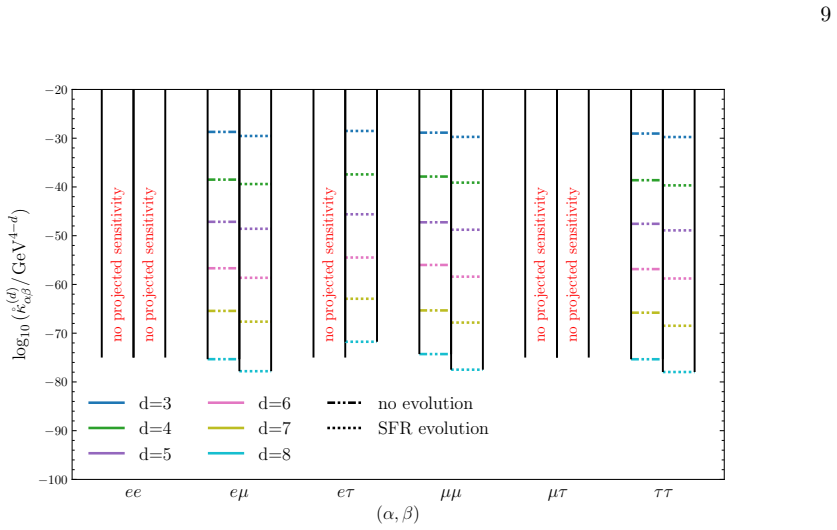
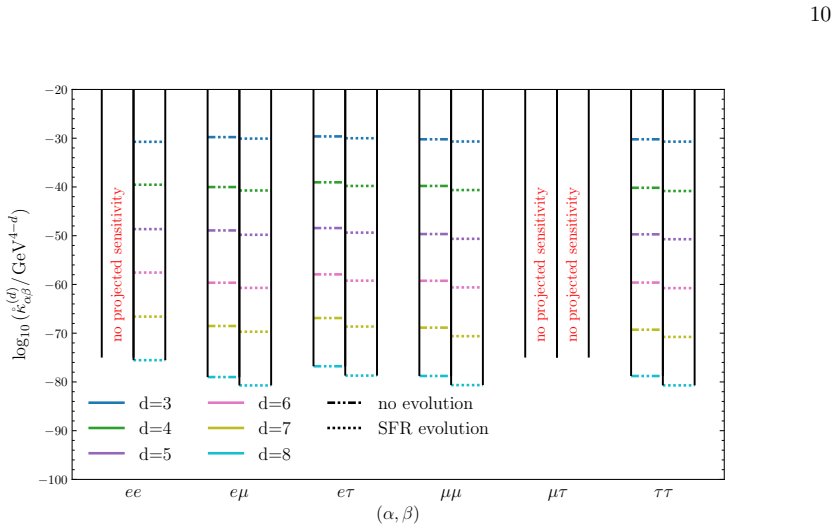
The central claim is that upcoming observations of ultra-high-energy tau neutrinos will place some of the most stringent constraints on LIV, with projected sensitivities for single nonzero LIV operators of various dimensions exceeding existing limits by orders of magnitude, and multi-parameter cases showing significantly modified sensitivities due to parameter interplay.
What carries the argument
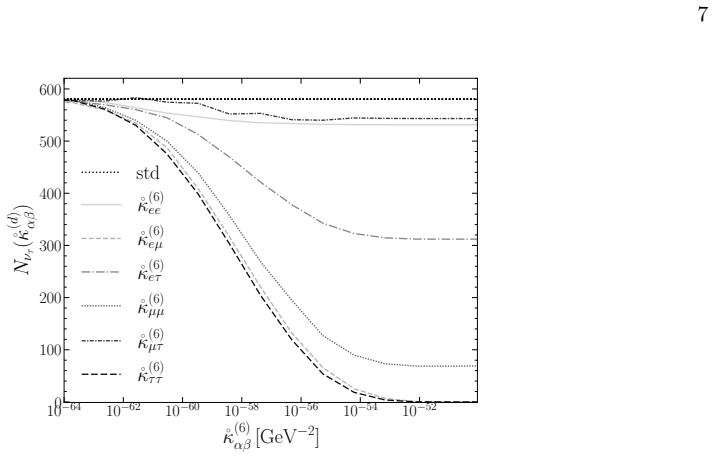
Calculation of LIV-modified neutrino flavor transition probabilities combined with the cosmogenic neutrino flux from SimProp to predict tau neutrino event rates at GRAND and POEMMA.
If this is right
- Single nonzero LIV operators of various dimensions yield projected sensitivities orders of magnitude better than lower-energy probes.
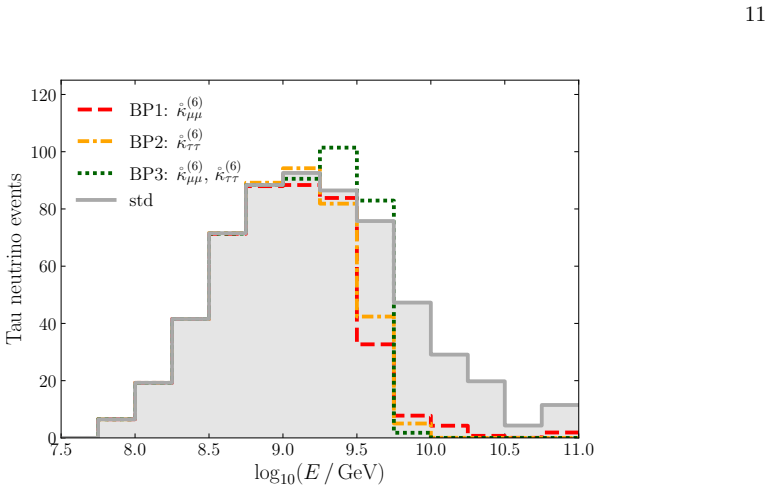
- Multiple nonzero LIV parameters can significantly modify the sensitivities compared to the single-parameter case.
- Deviations from standard flavor transition probabilities manifest as changes in the expected tau neutrino event rates.
- Upcoming observations of ultra-high-energy tau neutrinos will place some of the most stringent constraints on LIV.
Where Pith is reading between the lines
- This approach could elevate ultra-high-energy neutrino observations as a leading method for testing fundamental symmetries beyond the standard model.
- Detection of LIV effects here might link to quantum gravity signatures at energies reachable by current technology.
- If confirmed, analyses of high-energy astrophysical neutrinos would need to routinely include LIV modifications.
- Combinations with other cosmic messengers could cross-check the LIV parameter space in independent ways.
Load-bearing premise
The cosmogenic neutrino flux and its flavor composition at Earth are accurately predicted by SimProp under standard assumptions, and LIV-induced changes translate directly into measurable shifts in tau event rates without significant astrophysical uncertainties.
What would settle it
If high-statistics data from GRAND or POEMMA show tau neutrino event rates consistent with standard predictions and no LIV deviations, this would indicate either no LIV within the sensitivity range or inaccuracies in the flux modeling assumptions.
Figures





read the original abstract
Neutrino telescopes have detected astrophysical neutrinos with energies up to ${O}(100)$ PeV. Several current and proposed experiments aim to observe neutrinos at even higher energies, with the goal of detecting cosmogenic neutrinos. This increase in neutrino energy makes tests of Lorentz invariance violation (LIV) particularly appealing, since the effects of higher-dimension LIV operators on neutrino propagation grow rapidly with energy. In this work, we investigate the potential of the upcoming experiments GRAND and POEMMA to probe LIV in the neutrino sector through the detection of ultra-high-energy tau neutrinos. We generate the cosmogenic neutrino flux using SimProp and interface it with a calculation of neutrino flavor transition probabilities in the presence of LIV effects. Deviations from standard flavor transition probabilities manifest as changes in the expected tau neutrino event rates at GRAND and POEMMA. We first consider the case with a single nonzero LIV operator of various dimensions, and find that the projected sensitivities exceed existing limits from lower-energy probes by orders of magnitude. We then explore scenarios with multiple nonzero LIV parameters and show that their interplay can significantly modify the sensitivities compared to the single-parameter case. Overall, we find that upcoming observations of ultra-high-energy tau neutrinos will place some of the most stringent constraints on LIV.
Editorial analysis
A structured set of objections, weighed in public.
Referee Report
Summary. The manuscript claims that ultra-high-energy tau neutrinos detectable by GRAND and POEMMA can probe Lorentz invariance violation (LIV) via modified flavor transition probabilities. Cosmogenic fluxes are generated with SimProp under standard assumptions, LIV operators (single and multiple) are added to the propagation Hamiltonian, and the resulting deviations in tau event rates are used to project sensitivities that exceed existing limits by orders of magnitude for single operators, with modified reach in multi-parameter scenarios.
Significance. If the projections remain robust after addressing flux uncertainties, the work would establish UHE tau-neutrino observations as a leading probe of LIV in the neutrino sector, exploiting the rapid growth of higher-dimensional operator effects with energy. The explicit treatment of multi-operator interplay is a constructive addition. Use of the public SimProp code supports reproducibility of the baseline flux.
major comments (2)
- [§2] §2 (Flux generation): The cosmogenic neutrino flux and 1:1:1 flavor composition at Earth are computed with SimProp using fixed parameters for source evolution, injection spectrum, and nuclear composition. No scan or marginalization over these astrophysical inputs is performed, even though literature shows O(1) variations in all-flavor normalization and flavor ratios. This directly affects whether LIV-induced shifts in tau rates exceed astrophysical modeling errors, which is load-bearing for the headline sensitivity claim.
- [§4] §4 (Projected sensitivities, single-operator results): The quoted order-of-magnitude improvement over existing limits is derived from rate deviations relative to the fixed SimProp baseline. Without propagating flux uncertainties into the event-rate predictions or sensitivity curves, it is unclear whether the claimed improvement survives when source parameters are varied within current UHECR constraints.
minor comments (2)
- [Abstract] The abstract states that sensitivities 'exceed existing limits by orders of magnitude' but does not quote the numerical factors or reference the specific existing bounds being compared; adding these in the results section would improve clarity.
- [§3] Notation for the LIV effective operators (e.g., the dimension-5 and dimension-6 coefficients) is introduced in §3 but could be summarized in a table for quick reference when multiple operators are considered simultaneously.
Simulated Author's Rebuttal
We thank the referee for the constructive comments and positive overall assessment. We address the major concerns regarding astrophysical uncertainties below and have revised the manuscript to strengthen the robustness of our projections.
read point-by-point responses
-
Referee: [§2] §2 (Flux generation): The cosmogenic neutrino flux and 1:1:1 flavor composition at Earth are computed with SimProp using fixed parameters for source evolution, injection spectrum, and nuclear composition. No scan or marginalization over these astrophysical inputs is performed, even though literature shows O(1) variations in all-flavor normalization and flavor ratios. This directly affects whether LIV-induced shifts in tau rates exceed astrophysical modeling errors, which is load-bearing for the headline sensitivity claim.
Authors: We acknowledge the use of fixed SimProp parameters in the original analysis. The LIV effects we consider exhibit strong energy dependence that amplifies deviations at ultra-high energies, making them distinguishable from O(1) astrophysical variations in normalization and flavor ratios. In the revised manuscript we have added a dedicated discussion (new subsection in §2) that varies source evolution, injection spectrum, and nuclear composition within current UHECR-allowed ranges drawn from the literature. We show that the resulting spread in tau event rates is smaller than the LIV-induced shifts for the parameter space where our sensitivity claims are made, thereby supporting the headline results while qualifying them appropriately. revision: partial
-
Referee: [§4] §4 (Projected sensitivities, single-operator results): The quoted order-of-magnitude improvement over existing limits is derived from rate deviations relative to the fixed SimProp baseline. Without propagating flux uncertainties into the event-rate predictions or sensitivity curves, it is unclear whether the claimed improvement survives when source parameters are varied within current UHECR constraints.
Authors: We have updated §4 and the associated figures to propagate representative flux uncertainties. Error bands on the sensitivity curves now reflect O(1) variations in all-flavor normalization and flavor composition consistent with UHECR constraints. These bands demonstrate that the order-of-magnitude improvement over existing limits remains intact for the central values and across most of the uncertainty range, especially for higher-dimensional operators. The revised text explicitly states this robustness check. revision: yes
Circularity Check
Forward projection using external SimProp flux and standard LIV operators; no reduction to fitted inputs or self-citations.
full rationale
The paper generates cosmogenic fluxes via the public SimProp code under standard assumptions, computes flavor transition probabilities with conventional higher-dimensional LIV operators, and maps deviations to projected event rates at GRAND/POEMMA. No parameter is fitted to the target dataset and then relabeled as a prediction, no self-citation supplies a load-bearing uniqueness theorem or ansatz, and the central result is a sensitivity forecast rather than a closed derivation. The fixed-flux assumption affects robustness but does not create circularity by construction.
Axiom & Free-Parameter Ledger
axioms (2)
- standard math Standard three-flavor neutrino mixing and propagation in vacuum or matter
- domain assumption Effective field theory description of Lorentz invariance violation via higher-dimensional operators
Reference graph
Works this paper leans on
-
[1]
Davis, Jr., D
R. Davis, Jr., D. S. Harmer, and K. C. Hoffman,Search for neutrinos from the sun,Phys. Rev. Lett. 20(1968) 1205–1209
1968
-
[2]
B. T. Cleveland, T. Daily, R. Davis, Jr., J. R. Distel, K. Lande, C. K. Lee, P. S. Wildenhain, and J. Ullman,Measurement of the solar electron neutrino flux with the Homestake chlorine detector, Astrophys. J.496(1998) 505–526. [5]SAGECollaboration, J. N. Abdurashitov et al.,Measurement of the solar neutrino capture rate with gallium metal,Phys. Rev. C60(1...
-
[3]
R. M. Bionta et al.,Observation of a Neutrino Burst in Coincidence with Supernova SN 1987a in the Large Magellanic Cloud,Phys. Rev. Lett.58(1987) 1494
1987
-
[4]
Neutrino emission from the direction of the blazar TXS 0506+056 prior to the IceCube-170922A alert
E. Alexeyev, L. Alexeyeva, I. Krivosheina, and V. Volchenko,Detection of the neutrino signal from SN 1987A in the LMC using the INR Baksan underground scintillation telescope,Physics Letters B 205(1988), no. 2 209–214. [12]IceCubeCollaboration, M. G. Aartsen et al.,Neutrino emission from the direction of the blazar TXS 0506+056 prior to the IceCube-170922...
work page Pith review arXiv 1988
- [5]
-
[6]
Does the 220 PeV Event at KM3NeT Point to New Physics?,
V. Brdar and D. S. Chattopadhyay,Does the 220 PeV Event at KM3NeT Point to New Physics?, Phys. Rev. Lett.136(2026), no. 8 081001, [arXiv:2502.21299]
- [7]
-
[8]
Y. Farzan and M. Hostert,Astrophysical flux of dark particles as a solution to the KM3NeT and IceCube tension over KM3-230213A,JHEP10(2025) 208, [arXiv:2505.22711]
-
[9]
D. Southall et al.,Design and initial performance of the prototype for the BEACON instrument for detection of ultrahigh energy particles,Nucl. Instrum. Meth. A1048(2023) 167889, [arXiv:2206.09660]. [24]GRANDCollaboration, J. ´Alvarez-Mu˜ niz et al.,The Giant Radio Array for Neutrino Detection (GRAND): Science and Design,Sci. China Phys. Mech. Astron.63(20...
-
[10]
M. Ackermann et al.,High-energy and ultra-high-energy neutrinos: A Snowmass white paper,JHEAp 36(2022) 55–110, [arXiv:2203.08096]
-
[11]
Greisen,End to the cosmic ray spectrum?,Phys
K. Greisen,End to the cosmic ray spectrum?,Phys. Rev. Lett.16(1966) 748–750
1966
-
[12]
G. T. Zatsepin and V. A. Kuzmin,Upper limit of the spectrum of cosmic rays,JETP Lett.4(1966) 78–80
1966
-
[13]
F. Halzen and D. Hooper,High-energy neutrino astronomy: The Cosmic ray connection,Rept. Prog. Phys.65(2002) 1025–1078, [astro-ph/0204527]
- [14]
- [15]
- [16]
- [17]
-
[18]
Lorentz-violating extensio n of the standard model
D. Colladay and V. A. Kostelecky,Lorentz violating extension of the standard model,Phys. Rev. D58 (1998) 116002, [hep-ph/9809521]
- [19]
- [20]
-
[21]
C. A. Arg¨ uelles, T. Katori, and J. Salvado,New Physics in Astrophysical Neutrino Flavor,Phys. Rev. Lett.115(2015) 161303, [arXiv:1506.02043]. [41]IceCubeCollaboration, R. Abbasi et al.,Search for quantum gravity using astrophysical neutrino flavour with IceCube,Nature Phys.18(2022), no. 11 1287–1292, [arXiv:2111.04654]
-
[22]
B. Telalovic and M. Bustamante,Flavor anisotropy in the high-energy astrophysical neutrino sky, JCAP05(2025) 013, [arXiv:2310.15224]
-
[23]
M. Bustamante, J. Ellis, R. Konoplich, and A. S. Sakharov,Probing Lorentz invariance with a high-energy neutrino flare,Phys. Rev. D111(2025), no. 12 123031, [arXiv:2408.15949]
-
[24]
B. Telalovic and M. Bustamante,No flavor anisotropy in the high-energy neutrino sky upholds Lorentz invariance,JHEP02(2026) 024, [arXiv:2503.15468]. [45]KM3NeTCollaboration, O. Adriani et al.,KM3NeT constraint on Lorentz-violating superluminal neutrino velocity,Commun. Phys.8(2025), no. 1 457, [arXiv:2502.12070]
-
[25]
P. Satunin,Ultra-high-energy event KM3-230213A constraints on Lorentz Invariance Violation in neutrino sector,Eur. Phys. J. C85(2025), no. 5 545, [arXiv:2502.09548]
-
[26]
Y.-M. Yang, X.-J. Lv, X.-J. Bi, and P.-F. Yin,Constraints on Lorentz-invariance violation in the neutrino sector from the ultrahigh-energy event KM3-230213A,Phys. Rev. D111(2025), no. 12 123037, [arXiv:2502.18256]
-
[27]
C. Li and B.-Q. Ma,Probes for String-Inspired Foam, Lorentz, and CPT Violations in Astrophysics, Symmetry17(2025), no. 6 974, [arXiv:2508.11172]
-
[28]
F. Testagrossa, D. F. G. Fiorillo, and M. Bustamante,Two-detector flavor sensitivity to ultrahigh-energy cosmic neutrinos,Phys. Rev. D110(2024), no. 8 083026, [arXiv:2310.12215]
-
[29]
R. Aloisio, D. Boncioli, A. F. Grillo, S. Petrera, and F. Salamida,SimProp: a Simulation Code for Ultra High Energy Cosmic Ray Propagation,JCAP10(2012) 007, [arXiv:1204.2970]
-
[30]
R. Aloisio, D. Boncioli, A. di Matteo, A. F. Grillo, S. Petrera, and F. Salamida,SimProp v2r2: a Monte Carlo simulation to compute cosmogenic neutrino fluxes,arXiv:1505.01347. 16
-
[31]
R. Aloisio, D. Boncioli, A. di Matteo, A. Grillo, S. Petrera, and F. Salamida,SimProp v2r3: Monte Carlo simulation code of UHECR propagation,arXiv:1602.01239
-
[32]
R. Aloisio, D. Boncioli, A. Di Matteo, A. F. Grillo, S. Petrera, and F. Salamida,SimProp v2r4: Monte Carlo simulation code for UHECR propagation,JCAP11(2017) 009, [arXiv:1705.03729]
- [33]
- [34]
-
[35]
S. Yoshida and A. Ishihara,Constraints on the origin of the ultrahigh energy cosmic rays using cosmic diffuse neutrino flux limits: An analytical approach,Phys. Rev. D85(Mar., 2012) 063002, [arXiv:1202.3522]
-
[36]
A. van Vliet, R. Alves Batista, and J. R. H¨ orandel,Determining the fraction of cosmic-ray protons at ultrahigh energies with cosmogenic neutrinos,Phys. Rev. D100(2019), no. 2 021302, [arXiv:1901.01899]
-
[37]
A. Kostelecky and M. Mewes,Neutrinos with Lorentz-violating operators of arbitrary dimension, Phys. Rev. D85(2012) 096005, [arXiv:1112.6395]. [59]IceCubeCollaboration, M. G. Aartsen et al.,Neutrino Interferometry for High-Precision Tests of Lorentz Symmetry with IceCube,Nature Phys.14(2018), no. 9 961–966, [arXiv:1709.03434]
-
[38]
V. S. Berezinsky and G. T. Zatsepin,Cosmic rays at ultrahigh-energies (neutrino?),Phys. Lett. B28 (1969) 423–424
1969
- [39]
- [40]
- [41]
- [42]
-
[43]
T. Kashti and E. Waxman,Flavoring astrophysical neutrinos: Flavor ratios depend on energy,Phys. Rev. Lett.95(2005) 181101, [astro-ph/0507599]
-
[44]
M. Kachelriess and R. Tomas,High energy neutrino yields from astrophysical sources I: Weakly magnetized sources,Phys. Rev. D74(2006) 063009, [astro-ph/0606406]
- [45]
-
[46]
NuFit-6.0: Updated global analysis of three-flavor neutrino oscillations
I. Esteban, M. C. Gonzalez-Garcia, M. Maltoni, I. Martinez-Soler, J. P. Pinheiro, and T. Schwetz, NuFit-6.0: updated global analysis of three-flavor neutrino oscillations,JHEP12(2024) 216, [arXiv:2410.05380]. [69]HiResCollaboration, R. U. Abbasi et al.,Indications of Proton-Dominated Cosmic Ray Composition above 1.6 EeV,Phys. Rev. Lett.104(2010) 161101, [...
work page internal anchor Pith review arXiv 2024
-
[47]
P. Plotko, A. van Vliet, X. Rodrigues, and W. Winter,Differences between the Pierre Auger Observatory and Telescope Array Spectra: Systematic Effects or Indication of a Local Source of Ultra-high-energy Cosmic Rays?,Astrophys. J.953(2023), no. 2 129, [arXiv:2208.12274]. [74]Pierre AugerCollaboration, A. A. Halim et al.,Constraining models for the origin o...
- [48]
-
[49]
M. Ave, N. Busca, A. V. Olinto, A. A. Watson, and T. Yamamoto,Cosmogenic neutrinos from ultra-high energy nuclei,Astropart. Phys.23(2005) 19–29, [astro-ph/0409316]. [77](IceCube Collaboration)§, IceCubeCollaboration, R. Abbasi et al.,Search for Extremely-High-Energy Neutrinos and First Constraints on the Ultrahigh-Energy Cosmic-Ray Proton Fraction with Ic...
-
[50]
Revealing the High-Redshift Star Formation Rate with Gamma-Ray Bursts
H. Yuksel, M. D. Kistler, J. F. Beacom, and A. M. Hopkins,Revealing the High-Redshift Star Formation Rate with Gamma-Ray Bursts,Astrophys. J. Lett.683(2008) L5–L8, [arXiv:0804.4008]
work page Pith review arXiv 2008
-
[51]
X.-Y. Wang, R.-Y. Liu, and F. Aharnonian,Constraining the Emissivity of Ultrahigh Energy Cosmic Rays in the Distant Universe with the Diffuse Gamma-ray Emission,Astrophys. J.736(2011) 112, [arXiv:1103.3574]
- [52]
- [53]
-
[54]
V. Berezinsky, A. Z. Gazizov, and S. I. Grigorieva,On astrophysical solution to ultrahigh-energy cosmic rays,Phys. Rev. D74(2006) 043005, [hep-ph/0204357]
-
[55]
R. Aloisio, V. Berezinsky, P. Blasi, A. Gazizov, S. Grigorieva, and B. Hnatyk,A dip in the UHECR spectrum and the transition from galactic to extragalactic cosmic rays,Astropart. Phys.27(2007) 76–91, [astro-ph/0608219]
- [56]
-
[57]
F. D. Kahn and I. Lerche,Radiation from Cosmic Ray Air Showers,Proceedings of the Royal Society of London Series A289(Jan., 1966) 206–213
1966
-
[58]
O. Scholten, K. Werner, and F. Rusydi,A Macroscopic Description of Coherent Geo-Magnetic Radiation from Cosmic Ray Air Showers,Astropart. Phys.29(2008) 94–103, [arXiv:0709.2872]
-
[59]
G. A. Askaryan,Excess negative charge of an electron-photon shower and its coherent radio emission, Sov. Phys. JETP14(1962) 441
1962
-
[60]
G. A. Askaryan,Coherent radio emission from cosmic showers in air and in dense media,Sov. Phys. JETP21(1965) 658–659
1965
-
[61]
POEMMA-Balloon with Radio: A multi-messenger, multi-detector balloon payload
J. Adams et al.,POEMMA-Balloon with Radio: A multi-messenger, multi-detector balloon payload, arXiv:2601.19997. [91]GRANDCollaboration, O. Martineau-Huynh,Status of the GRAND project, in39th International Cosmic Ray Conference, 7, 2025.arXiv:2507.07260
work page internal anchor Pith review Pith/arXiv arXiv 2025
- [62]
-
[63]
T. M. Venters, M. H. Reno, J. F. Krizmanic, L. A. Anchordoqui, C. Gu´ epin, and A. V. Olinto, POEMMA’s Target of Opportunity Sensitivity to Cosmic Neutrino Transient Sources,Phys. Rev. D 102(2020) 123013, [arXiv:1906.07209]. [94]IceCube-Gen2Collaboration, M. G. Aartsen et al.,IceCube-Gen2: the window to the extreme Universe,J. Phys. G48(2021), no. 6 06050...
discussion (0)
Sign in with ORCID, Apple, or X to comment. Anyone can read and Pith papers without signing in.