Recognition: unknown
HI 21-cm absorption in low- and high-excitation radio-loud AGNs at z<0.5 from MALS
Pith reviewed 2026-05-10 01:39 UTC · model grok-4.3
The pith
HI 21-cm absorption occurs at similar rates in radio-loud AGNs from low redshifts up to z ~ 0.5.
A machine-rendered reading of the paper's core claim, the machinery that carries it, and where it could break.
Core claim
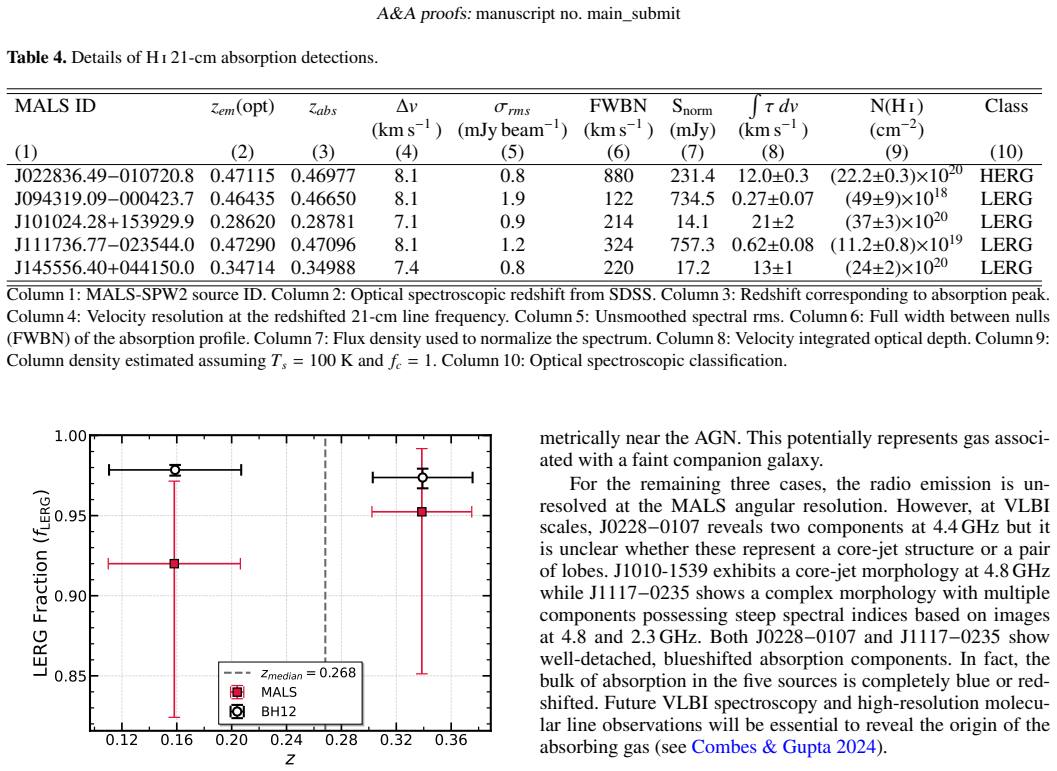
The authors report five new HI 21-cm absorption detections in a sample of 99 radio-loud AGNs at 0.29 < z < 0.47. The detection rate of 3+3-2 percent at 3-sigma is consistent with sensitivity-matched samples at z<0.2, with no evidence for redshift evolution or radio luminosity dependence. Absorption profiles indicate disturbed gas kinematics in LERGs with velocity offsets over 350 km/s.
What carries the argument
Classification of AGNs into LERGs and HERGs using BPT diagnostics and radio luminosity, followed by targeted HI 21-cm absorption search in the radio-bright subsample from MALS.
If this is right
- The cold gas in these systems shows disturbed kinematics likely due to jet or lobe activity.
- Detection rates do not depend on radio luminosity over six orders of magnitude.
- Redshifted and blueshifted absorption profiles suggest both inflow and outflow motions.
Where Pith is reading between the lines
- If confirmed, this would mean that models of AGN feedback can use similar gas fractions across this redshift range.
- The color difference between LERGs and HERGs may reflect different stages of galaxy quenching.
- Future higher-sensitivity observations could reveal weaker absorption missed in the current threshold.
Load-bearing premise
The selected radio-bright subsample accurately represents the broader population of radio-loud AGNs without selection biases, and prior surveys are correctly matched in sensitivity and resolution.
What would settle it
Observing a detection rate much higher or lower than 3% in an expanded sample at similar redshifts or luminosities would falsify the claim of no evolution.
Figures




read the original abstract
We present results from a search of cold neutral gas associated with radio-loud active galactic nuclei (AGNs) at $z < 0.5$ using HI 21-cm absorption measurements from the MeerKAT Absorption Line Survey (MALS). Cross-matching the MALS 1006 MHz and SDSS DR18 catalogs yields 1908 radio sources at $z < 0.5$. Of these, 613 are classified as AGNs using BPT diagnostics and radio luminosity criteria. We further classify 426 AGNs into 327 low-excitation radio galaxies (LERGs) and 99 high-excitation radio galaxies (HERGs). We observe a significant ($>3\sigma$) difference in $k$-corrected $g-r$ color, consistent with LERGs residing in older galaxies with quenched star formation. We searched a radio-bright subsample of 79 LERGs and 20 HERGs ($S_{\mathrm{1.4\,GHz}} > 4$ mJy) for associated HI 21-cm absorption. This spans six decades in radio luminosity ($\log L_{\mathrm{1.4\,GHz}}$ (WHz$^{-1}$) $\sim 21.1-27.0$), probing an order of magnitude fainter than previous targeted HI surveys. We report five new detections (4 LERGs, 1 HERG) at $0.29 < z < 0.47$. The overall detection rate of $3^{+3}_{-2}$% (at a $3\sigma$ threshold of 10.0 kms$^{-1}$) is consistent with sensitivity-matched low-$z$ ($<0.2$) samples, suggesting no significant redshift evolution out to $z \sim 0.5$ or dependence on radio luminosity. Evaluating velocity offset, asymmetry, and width reveals three systems with entirely redshifted absorption and two with predominantly blueshifted absorption. HI profiles in LERGs show diverse asymmetries and velocity offsets exceeding 350 kms$^{-1}$, indicating disturbed cold-gas kinematics likely driven by lobe expansion or jet activity.
Editorial analysis
A structured set of objections, weighed in public.
Referee Report
Summary. The manuscript reports results from a search for associated HI 21-cm absorption toward radio-loud AGNs at z<0.5 drawn from the MeerKAT Absorption Line Survey (MALS). Cross-matching MALS 1006 MHz sources with SDSS DR18 yields 1908 radio sources at z<0.5, of which 613 are classified as AGNs via BPT diagnostics and radio luminosity; these are further divided into 327 LERGs and 99 HERGs. A radio-bright subsample (S_{1.4 GHz}>4 mJy) of 79 LERGs + 20 HERGs is searched, producing five new detections (4 LERGs, 1 HERG) at 0.29<z<0.47. The overall detection rate is reported as 3^{+3}_{-2}% (3σ optical-depth threshold of 10 km s^{-1}), stated to be consistent with sensitivity-matched low-z (<0.2) samples and therefore indicating no significant redshift evolution or radio-luminosity dependence out to z~0.5. Kinematic analysis of the profiles is also presented.
Significance. If the central consistency result holds after verification of the matching procedure, the work supplies a valuable extension of HI absorption statistics to an order of magnitude fainter radio luminosities (log L_{1.4 GHz} ~21.1-27.0) and to z~0.5, reinforcing the picture of little evolution in cold-gas incidence around radio-loud AGNs over the last ~5 Gyr. The LERG/HERG classification, the noted g-r color difference, and the direct count of five detections with Poisson errors constitute concrete observational anchors that future models of AGN feedback and gas accretion can be tested against.
major comments (2)
- [Sample selection and results] Subsample selection (radio-bright cut S_{1.4 GHz}>4 mJy): the claim that the 99-source subsample yields a detection rate representative for comparison to prior low-z surveys rests on the assumption that this flux cut does not introduce differential bias relative to the full 426-AGN parent sample; the manuscript does not quantify how gas properties or completeness might differ for the excluded fainter sources.
- [Detection statistics and comparison] Sensitivity matching to low-z samples: the consistency statement (detection rate 3^{+3}_{-2}%) requires that noise, resolution, and selection differences between MALS and the reference low-z surveys have been matched at the level of the 10 km s^{-1} 3σ threshold; without an explicit table or equation showing the matched sensitivity distributions, it is not possible to assess whether residual systematics could shift the rate outside the quoted Poisson errors.
minor comments (3)
- [Abstract] The abstract states 'six decades in radio luminosity' while the quoted range is log L_{1.4 GHz} ~21.1-27.0 (exactly six dex); this is minor but the precise span should be stated consistently in the text and any summary table.
- [Kinematic analysis] The velocity-offset and asymmetry analysis for the five detections is described qualitatively; a supplementary table listing the measured centroid offsets, FWHM, and asymmetry parameters for each profile would improve reproducibility.
- [AGN classification] The BPT/radio-luminosity classification criteria that separate the 327 LERGs from the 99 HERGs are referenced but not reproduced; a brief restatement or citation to the exact demarcation lines used would aid readers.
Simulated Author's Rebuttal
We are grateful to the referee for their careful review and the recommendation for minor revision. We address each of the major comments below and will make the necessary revisions to the manuscript.
read point-by-point responses
-
Referee: [Sample selection and results] Subsample selection (radio-bright cut S_{1.4 GHz}>4 mJy): the claim that the 99-source subsample yields a detection rate representative for comparison to prior low-z surveys rests on the assumption that this flux cut does not introduce differential bias relative to the full 426-AGN parent sample; the manuscript does not quantify how gas properties or completeness might differ for the excluded fainter sources.
Authors: The subsample was selected based on the radio flux density to ensure that the MALS observations have adequate sensitivity to detect HI 21-cm absorption at the 3σ level corresponding to an integrated optical depth of 10 km s^{-1}. Sources below this threshold in the parent sample of 426 AGNs would not yield reliable non-detections or detections at this sensitivity, making the detection rate applicable to the sensitivity-matched subsample. We will revise the manuscript to include a more detailed justification of the cut, including a comparison of the radio luminosity and color distributions between the full sample and the subsample, and a discussion of the implications for completeness. This will clarify that the rate is not claimed to be representative of the entire population but of sources with comparable observational sensitivity to previous studies. revision: partial
-
Referee: [Detection statistics and comparison] Sensitivity matching to low-z samples: the consistency statement (detection rate 3^{+3}_{-2}%) requires that noise, resolution, and selection differences between MALS and the reference low-z surveys have been matched at the level of the 10 km s^{-1} 3σ threshold; without an explicit table or equation showing the matched sensitivity distributions, it is not possible to assess whether residual systematics could shift the rate outside the quoted Poisson errors.
Authors: We agree that providing explicit details on the sensitivity matching will improve the robustness of our comparison. In the revised version, we will include a new table that lists the key sensitivity parameters (rms noise, channel width, and the resulting 3σ integrated optical depth limit) for our sample and for the low-redshift reference samples from the literature. Additionally, we will describe the matching procedure in the text, including the equation for calculating the sensitivity limit: τ_{3σ} Δv = 3 * (σ_rms / S_cont) * sqrt(Δv * N), where we normalize to a 10 km s^{-1} velocity width. This will demonstrate that the detection rates are compared at equivalent sensitivities, supporting our conclusion of consistency within the quoted uncertainties. revision: yes
Circularity Check
No significant circularity in purely observational analysis
full rationale
The paper reports direct catalog cross-matching (MALS 1006 MHz with SDSS DR18), BPT/radio-luminosity classification of 613 AGNs into LERGs/HERGs, a radio-bright subsample selection, and five new HI absorption detections with a measured rate of 3^{+3}_{-2}%. No equations, fitted parameters, predictions, or derivations are present that could reduce to inputs by construction. The consistency statement with low-z samples relies on explicit sensitivity matching and Poisson uncertainties, with no self-citation chains or ansatzes invoked for the central result. This is a standard observational report self-contained against external benchmarks.
Axiom & Free-Parameter Ledger
free parameters (1)
- 3-sigma detection threshold of 10.0 km/s
axioms (1)
- domain assumption BPT diagnostics and radio luminosity criteria reliably separate AGNs from other sources and distinguish LERGs from HERGs
Reference graph
Works this paper leans on
-
[1]
Science goals and survey design
The First Large Absorption Survey in H I (FLASH): I. Science goals and survey design. , keywords =. doi:10.1017/pasa.2022.3 , archivePrefix =. 2110.00469 , primaryClass =
-
[2]
The Messenger , year = 2023, month = mar, volume =
The 4MOST Gaia Purely Astrometric Quasar Survey (4G-PAQS). The Messenger , year = 2023, month = mar, volume =. doi:10.18727/0722-6691/5310 , adsurl =
-
[3]
Cold molecules in H I 21 cm absorbers across redshifts 0.1-4. , keywords =. doi:10.1051/0004-6361/202348386 , archivePrefix =. 2310.17204 , primaryClass =
-
[4]
The MeerKAT Absorption Line Survey (MALS) data release 3: Cold atomic gas associated with the Milky Way. arXiv e-prints , keywords =. doi:10.48550/arXiv.2504.00097 , archivePrefix =. 2504.00097 , primaryClass =
-
[5]
A Giant Metrewave Radio Telescope search for associated H I 21 cm absorption in GHz-peaked-spectrum sources. , keywords =. doi:10.1093/mnras/stx2325 , archivePrefix =. 1710.00711 , primaryClass =
-
[6]
Giant Metrewave Radio Telescope detection of associated H I 21-cm absorption at z = 1.2230 towards TXS 1954+513. , keywords =. doi:10.1093/mnras/stw3105 , archivePrefix =. 1612.01139 , primaryClass =
-
[7]
A survey for H I in the distant Universe: the detection of associated 21-cm absorption at z = 1.28. , keywords =. doi:10.1093/mnras/sts604 , archivePrefix =. 1212.2754 , primaryClass =
-
[8]
Journal of Astrophysics and Astronomy , keywords =
GMRT Detection of HI 21 cm Associated Absorption towards the z = 1.2 Red Quasar 3C 190. Journal of Astrophysics and Astronomy , keywords =. doi:10.1007/BF03012190 , archivePrefix =. astro-ph/0306525 , primaryClass =
-
[9]
C., et al., 2011, @doi [ApJ] 10.1088/0004-637X/744/1/60 , 744, 60
The Cosmic Origins Spectrograph. , keywords =. doi:10.1088/0004-637X/744/1/60 , archivePrefix =. 1110.0462 , primaryClass =
-
[10]
2020 , abstract =
, month = sep, number =. 2020 , abstract =
2020
-
[11]
MIKE: A Double Echelle Spectrograph for the Magellan Telescopes at Las Campanas Observatory. Instrument Design and Performance for Optical/Infrared Ground-based Telescopes , year = 2003, series =. doi:10.1117/12.461502 , adsurl =
-
[12]
The radio spectral turnover of radio-loud quasars at z > 5. , keywords =. doi:10.1051/0004-6361/202142489 , archivePrefix =. 2112.03133 , primaryClass =
-
[13]
Broadband Spectral Modeling of the Extreme Gigahertz-peaked Spectrum Radio Source PKS B0008-421. , keywords =. doi:10.1088/0004-637X/809/2/168 , archivePrefix =. 1507.04819 , primaryClass =
-
[14]
2012, MNRAS, 427, 127, doi: 10.1111/j.1365-2966.2012.21948.x
Parsec-scale morphology and spectral-index distribution in faint high-frequency peakers. , keywords =. doi:10.1111/j.1365-2966.2012.21226.x , archivePrefix =. 1205.0395 , primaryClass =
-
[15]
Unification of the Radio and Optical Properties of Gigahertz Peak Spectrum and Compact Steep-Spectrum Radio Sources. , keywords =. doi:10.1086/304400 , adsurl =
-
[16]
The Star Formation in Radio Survey: GBT 33 GHz Observations of Nearby Galaxy Nuclei and Extranuclear Star-forming Regions. , keywords =. doi:10.1088/0004-637X/761/2/97 , archivePrefix =. 1210.3360 , primaryClass =
-
[17]
Astronomical Data Analysis Software and Systems XVI , year = 2007, editor =
CASA Architecture and Applications. Astronomical Data Analysis Software and Systems XVI , year = 2007, editor =
2007
-
[18]
Galactic H II Regions. I. Observations of Their Continuum Radiation at the Frequency 5 GHz. , year = 1967, month = feb, volume =. doi:10.1086/149030 , adsurl =
-
[19]
2010, MNRAS, 401, 791, doi: 10.1111/j.1365-2966.2009.15715.x
The Australia Telescope 20 GHz Survey: the source catalogue. , keywords =. doi:10.1111/j.1365-2966.2009.15961.x , archivePrefix =. 0911.0002 , primaryClass =
-
[20]
, keywords =
The absolute spectrum of Cas A: an accurate flux density scale and a set of secondary calibrators. , keywords =
-
[21]
X-Ray--irradiated Molecular Gas. I. Physical Processes and General Results. , keywords =. doi:10.1086/177532 , adsurl =
-
[22]
Proceedings of the IRE , year = 1958, month = jan, volume =
Excitation of the Hydrogen 21-CM Line. Proceedings of the IRE , year = 1958, month = jan, volume =. doi:10.1109/JRPROC.1958.286741 , adsurl =
-
[23]
A Giant Metrewave Radio Telescope survey for associated H I 21 cm absorption in the Caltech-Jodrell flat-spectrum sample. , keywords =. doi:10.1093/mnras/sty2184 , archivePrefix =. 1808.03280 , primaryClass =
-
[24]
The location and impact of jet-driven outflows of cold gas: the case of 3C 293. , keywords =. doi:10.1093/mnrasl/slt094 , archivePrefix =. 1307.4535 , primaryClass =
-
[25]
Cool outflows in galaxies and their implications. , keywords =. doi:10.1007/s00159-019-0121-9 , archivePrefix =. 2002.07765 , primaryClass =
-
[26]
H I Gas Playing Hide-and-seek around a Powerful FRI-type Quasar at z 2.1. , keywords =. doi:10.3847/2041-8213/ac589f , archivePrefix =. 2202.11755 , primaryClass =
-
[27]
GaLactic and Extragalactic All-sky Murchison Widefield Array (GLEAM) survey - I. A low-frequency extragalactic catalogue. , keywords =. doi:10.1093/mnras/stw2337 , archivePrefix =. 1610.08318 , primaryClass =
-
[28]
Quasar Clustering and the Lifetime of Quasars. , keywords =. doi:10.1086/318331 , archivePrefix =. astro-ph/0002384 , primaryClass =
-
[29]
Towards modelling ghostly damped Ly s. , keywords =. doi:10.1093/mnras/stab173 , archivePrefix =. 2101.08218 , primaryClass =
-
[30]
2017, MNRAS, 466, L58, doi: 10.1093/mnrasl/slw233
A ghostly damped Ly system revealed by metal absorption lines. , keywords =. doi:10.1093/mnrasl/slw233 , archivePrefix =. 1611.05421 , primaryClass =
-
[31]
285, Information Handling in Astronomy - Historical Vistas, ed
AIPS, the VLA, and the VLBA. Information Handling in Astronomy - Historical Vistas , year = 2003, editor =. doi:10.1007/0-306-48080-8\_7 , adsurl =
-
[32]
Reverberation Mapping of High-Luminosity Quasars: First Results. , keywords =. doi:10.1086/512094 , archivePrefix =. astro-ph/0612722 , primaryClass =
-
[33]
The MURALES survey. IV. Searching for nuclear outflows in 3C radio galaxies at z < 0.3 with MUSE observations. arXiv e-prints , keywords =
-
[34]
Multi-frequency VLA observations of a new sample of CSS/GPS radio sources. , keywords =. doi:10.1051/0004-6361:20010051 , adsurl =
-
[35]
Polarization asymmetry in CSS sources: Evidence of AGN fuel?. , keywords =. doi:10.1051/0004-6361:20030635 , archivePrefix =. astro-ph/0304532 , primaryClass =
-
[36]
Compact steep-spectrum and peaked-spectrum radio sources. , keywords =. doi:10.1007/s00159-021-00131-w , archivePrefix =. 2009.02750 , primaryClass =
-
[37]
arXiv e-prints , keywords =
MALS SALT-NOT survey of MIR-selected powerful radio-bright AGN at 0<z<5. arXiv e-prints , keywords =
-
[38]
arXiv e-prints , keywords =
A Catalog of Host Galaxies for WISE-Selected AGN: Connecting Host Properties with Nuclear Activity and Identifying Contaminants. arXiv e-prints , keywords =
-
[39]
Type 2 Active Galactic Nuclei with Double-Peaked [O III] Lines: Narrow-Line Region Kinematics or Merging Supermassive Black Hole Pairs?. , keywords =. doi:10.1088/0004-637X/708/1/427 , archivePrefix =. 0908.2426 , primaryClass =
-
[40]
arXiv e-prints , keywords =
CASA, the Common Astronomy Software Applications for Radio Astronomy. arXiv e-prints , keywords =
-
[41]
MALS SALT-NOT Survey of MIR-selected Powerful Radio-bright AGN at 0 < z < 3.5. , keywords =. doi:10.3847/1538-4357/ac4220 , archivePrefix =. 2107.09705 , primaryClass =
-
[42]
Buried AGNs in Advanced Mergers: Mid-infrared Color Selection as a Dual AGN Candidate Finder. , keywords =. doi:10.3847/1538-4357/aa88ca , archivePrefix =. 1707.03921 , primaryClass =
-
[43]
Pan-STARRS Pixel Processing: Detrending, Warping, Stacking. , keywords =. doi:10.3847/1538-4365/abb82b , archivePrefix =. 1612.05245 , primaryClass =
-
[44]
On Black Hole Masses and Radio Loudness in Active Galactic Nuclei. , keywords =. doi:10.1086/317280 , archivePrefix =. astro-ph/0009192 , primaryClass =
-
[45]
Magnetic Flux Paradigm for Radio Loudness of Active Galactic Nuclei. , keywords =. doi:10.1088/2041-8205/764/2/L24 , archivePrefix =. 1301.5638 , primaryClass =
-
[46]
Radio-loud active galactic nuclei at high redshifts and the cosmic microwave background. , keywords =. doi:10.1093/mnras/stt2394 , archivePrefix =. 1311.7147 , primaryClass =
-
[47]
Radio Loudness of Active Galactic Nuclei: Observational Facts and Theoretical Implications. , keywords =. doi:10.1086/511972 , archivePrefix =. astro-ph/0604095 , primaryClass =
-
[48]
Spectral Energy Distributions and Multiwavelength Selection of Type 1 Quasars. , keywords =. doi:10.1086/506525 , archivePrefix =. astro-ph/0601558 , primaryClass =
-
[49]
Reverberation Mapping Measurements of Black Hole Masses in Six Local Seyfert Galaxies. , keywords =. doi:10.1088/0004-637X/721/1/715 , archivePrefix =. 1006.4160 , primaryClass =
-
[50]
Reverberation Measurements for 17 Quasars and the Size-Mass-Luminosity Relations in Active Galactic Nuclei. , keywords =. doi:10.1086/308704 , archivePrefix =. astro-ph/9911476 , primaryClass =
-
[51]
2WHSP: A multi-frequency selected catalogue of high energy and very high energy -ray blazars and blazar candidates. , keywords =. doi:10.1051/0004-6361/201629487 , archivePrefix =. 1609.05808 , primaryClass =
-
[52]
Resolving the Powerful Radio-loud Quasar at z 6. , keywords =. doi:10.3847/1538-4357/aac76f , archivePrefix =. 1807.02560 , primaryClass =
-
[53]
Discovery of a radio galaxy at z = 5.72. , keywords =. doi:10.1093/mnras/sty1996 , archivePrefix =. 1806.01191 , primaryClass =
-
[54]
The Properties of the Radio-Selected 1 Jy Sample of BL Lacertae Objects. , keywords =. doi:10.1086/321179 , archivePrefix =. astro-ph/0105100 , primaryClass =
-
[55]
arXiv e-prints , keywords =
Fermi Large Area Telescope Fourth Source Catalog Data Release 2. arXiv e-prints , keywords =
-
[56]
C IV emission-line properties and systematic trends in quasar black hole mass estimates. , keywords =. doi:10.1093/mnras/stw1360 , archivePrefix =. 1606.02726 , primaryClass =
-
[57]
Narrow-line region gas kinematics of 24 264 optically selected AGN: the radio connection. , keywords =. doi:10.1093/mnras/stt751 , archivePrefix =. 1305.0263 , primaryClass =
-
[58]
, archivePrefix = "arXiv", eprint =
Active galactic nuclei: what's in a name?. , keywords =. doi:10.1007/s00159-017-0102-9 , archivePrefix =. 1707.07134 , primaryClass =
-
[59]
Planck 2018 results. VI. Cosmological parameters. , keywords =. doi:10.1051/0004-6361/201833910 , archivePrefix =. 1807.06209 , primaryClass =
-
[60]
Obscured Active Galactic Nuclei. , keywords =. doi:10.1146/annurev-astro-081817-051803 , archivePrefix =. 1806.04680 , primaryClass =
-
[61]
Low-Resolution Spectral Templates for Active Galactic Nuclei and Galaxies from 0.03 to 30 m. , keywords =. doi:10.1088/0004-637X/713/2/970 , archivePrefix =. 0909.3849 , primaryClass =
-
[62]
The WISE AGN Catalog. , keywords =. doi:10.3847/1538-4365/aaa00a , archivePrefix =. 1706.09901 , primaryClass =
-
[63]
Searching for dust reddening in SDSS spectra with damped Lyman systems. , keywords =. doi:10.1111/j.1365-2966.2010.16848.x , archivePrefix =. 1004.3298 , primaryClass =
-
[64]
X-Ray Absorption toward the Einstein Ring Source PKS 1830-211. , keywords =. doi:10.1086/304327 , archivePrefix =. astro-ph/9703015 , primaryClass =
-
[65]
Evidence for Late-time Feedback from the Discovery of Multiphase Gas in a Massive Elliptical at z = 0.4. , keywords =. doi:10.3847/2041-8213/abc48d , archivePrefix =. 2009.14232 , primaryClass =
-
[66]
The Cosmic Ultraviolet Baryon Survey (CUBS). II. Discovery of an H _ 2 -bearing DLA in the Vicinity of an Early-type Galaxy at z = 0.576. , keywords =. doi:10.3847/1538-4357/abf0a0 , archivePrefix =. 2010.11958 , primaryClass =
-
[67]
Molecular hydrogen and excited carbon, oxygen, and silicon at log N(H i) = 22.4
VLT/UVES observations of extremely strong intervening damped Lyman- systems. Molecular hydrogen and excited carbon, oxygen, and silicon at log N(H i) = 22.4. , keywords =. doi:10.1051/0004-6361/201425376 , archivePrefix =. 1502.03921 , primaryClass =
-
[68]
The Coevolution of Galaxies and Supermassive Black Holes: Insights from Surveys of the Contemporary Universe. , keywords =. doi:10.1146/annurev-astro-081913-035722 , archivePrefix =. 1403.4620 , primaryClass =
work page internal anchor Pith review doi:10.1146/annurev-astro-081913-035722
-
[69]
Supermassive Black Holes in Active Galactic Nuclei. II. Calibration of the Black Hole Mass-Velocity Dispersion Relationship for Active Galactic Nuclei. , keywords =. doi:10.1086/424655 , archivePrefix =. astro-ph/0407297 , primaryClass =
-
[70]
Determining Central Black Hole Masses in Distant Active Galaxies and Quasars. II. Improved Optical and UV Scaling Relationships. , keywords =. doi:10.1086/500572 , archivePrefix =. astro-ph/0601303 , primaryClass =
-
[71]
A Catalog of Quasar Properties from Sloan Digital Sky Survey Data Release 7. , keywords =. doi:10.1088/0067-0049/194/2/45 , archivePrefix =. 1006.5178 , primaryClass =
-
[72]
The Complete Sample of 1 Jansky BL Lacertae Objects. I. Summary Properties. , keywords =. doi:10.1086/170133 , adsurl =
-
[73]
Acero, et al., Fermi Large Area Telescope Third Source Catalog, Astrophys
Fermi Large Area Telescope Third Source Catalog. , keywords =. doi:10.1088/0067-0049/218/2/23 , archivePrefix =. 1501.02003 , primaryClass =
-
[74]
Two New Catalogs of Blazar Candidates in the WISE Infrared Sky. , keywords =. doi:10.3847/1538-4365/ab16f4 , archivePrefix =. 1903.11124 , primaryClass =
-
[75]
On characterizing the variability properties of X-ray light curves from active galaxies. , keywords =. doi:10.1046/j.1365-2966.2003.07042.x , archivePrefix =. astro-ph/0307420 , primaryClass =
-
[76]
ASCA Observations of Seyfert 1 Galaxies. I. Data Analysis, Imaging, and Timing. , keywords =. doi:10.1086/303600 , adsurl =
-
[77]
The Zwicky Transient Facility: Data Processing, Products, and Archive
The Zwicky Transient Facility: Data Processing, Products, and Archive. , keywords =. doi:10.1088/1538-3873/aae8ac , archivePrefix =. 1902.01872 , primaryClass =
work page internal anchor Pith review Pith/arXiv arXiv doi:10.1088/1538-3873/aae8ac 1902
-
[78]
Roma-BZCAT: a multifrequency catalogue of blazars. , keywords =. doi:10.1051/0004-6361:200810161 , archivePrefix =. 0810.2206 , primaryClass =
-
[79]
The WISE Blazar-like Radio-loud Sources: An All-sky Catalog of Candidate -ray Blazars. , keywords =. doi:10.1088/0067-0049/215/1/14 , archivePrefix =. 1410.0029 , primaryClass =
-
[80]
Evolution of Cold Gas at 2 < z < 5: A Blind Search for H I and OH Absorption Lines toward Mid-infrared Color-selected Radio-loud AGN. , keywords =. doi:10.3847/1538-4365/ac03b5 , archivePrefix =. 2103.09437 , primaryClass =
discussion (0)
Sign in with ORCID, Apple, or X to comment. Anyone can read and Pith papers without signing in.