Recognition: unknown
Geometric Correction of Side-Scan Sonar Images with Image-Consistent Attitude Refinement
Pith reviewed 2026-05-10 00:47 UTC · model grok-4.3
The pith
Refining sonar attitudes with port-starboard symmetry corrects image geometric distortions
A machine-rendered reading of the paper's core claim, the machinery that carries it, and where it could break.
Core claim
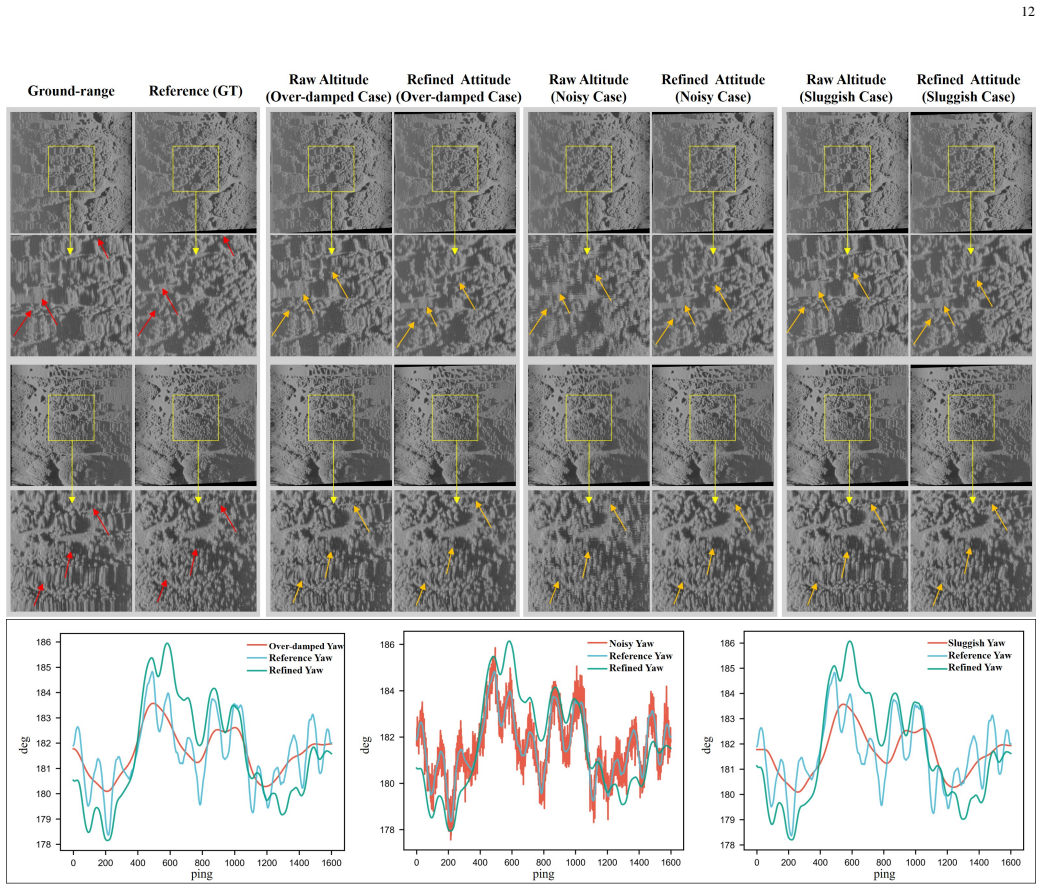
By explicitly connecting stripe-wise distortion patterns in dual-sided side-scan sonar waterfall images to geometric deformation modes and using port-starboard symmetry to separate pitch common-mode from yaw differential-mode responses, the refined attitude sequence is incorporated into a physically-based geocoding framework with track-aligned gridding and normalized-convolution hole completion, resulting in corrected images that exhibit reduced inter-ping misalignment, local stretching, and structural discontinuity along with improved local geometric consistency.
What carries the argument
The attitude refinement process that fuses navigation baseline with image-inferred perturbations separated by port-starboard symmetry into common-mode pitch and differential-mode yaw components.
If this is right
- Decreases inter-ping misalignment in the final images
- Reduces local stretching and structural discontinuity
- Enhances local geometric consistency even under degraded attitude conditions
- Generalizes across different sonar platforms and environments in cross-dataset tests
Where Pith is reading between the lines
- This could support sonar surveys with lower-cost navigation systems by compensating for attitude errors using image data.
- The symmetry separation idea might apply to other dual-view imaging modalities for motion compensation.
- Improved consistency could benefit automated feature extraction and 3D reconstruction from side-scan sonar mosaics.
Load-bearing premise
The assumption that port-starboard symmetry in the images allows clean separation of pitch and yaw motion effects without significant confounding from seabed texture or noise.
What would settle it
Perform an experiment with a sonar system undergoing precisely controlled pitch and yaw motions while recording both navigation data and images; if the corrected images do not show measurably better alignment metrics than those using raw navigation attitudes, the refinement method would be falsified.
Figures



read the original abstract
Side-scan sonar (SSS) images are susceptible to motion-induced geometric distortion, which degrades their reliability for seabed interpretation and downstream tasks. Existing correction methods either exploit image-domain consistency without adequately preserving global geometric referencing, or rely on navigation-based geocoding whose effectiveness is limited when recorded attitude and motion fail to capture ping-scale perturbations. To address this issue, we propose a geometric correction method for SSS images with image-consistent attitude refinement. The core idea is to refine the yaw-pitch sequence used in geocoding by explicitly linking stripe-wise distortion patterns in dual-sided waterfall images to geometric deformation modes. Specifically, a navigation-derived macro-scale attitude baseline is fused with image-inferred microscopic perturbations, where port-starboard symmetry is used to separate pitch-related common-mode responses from yaw-related differential-mode responses. The refined attitude is then incorporated into a physically geocoding framework with track-aligned gridding and normalized-convolution-based hole completion to generate the corrected image. Experiments on real SSS datasets from different sonar platforms and environments show that the proposed method reduces inter-ping misalignment, local stretching, and structural discontinuity, and improves local geometric consistency under both degraded-attitude and cross-dataset evaluation settings, demonstrating its effectiveness for geometrically consistent SSS correction.
Editorial analysis
A structured set of objections, weighed in public.
Referee Report
Summary. The manuscript proposes a geometric correction method for side-scan sonar (SSS) images that refines the yaw-pitch attitude sequence by fusing a navigation-derived macro-scale baseline with image-inferred microscopic perturbations. Port-starboard symmetry in dual-sided waterfall images separates pitch-related common-mode responses from yaw-related differential-mode responses. The refined attitude drives a physically-based geocoding framework with track-aligned gridding and normalized-convolution hole-filling. Real-data experiments on multiple sonar platforms and environments claim reductions in inter-ping misalignment, local stretching, and structural discontinuity, plus improved local geometric consistency under degraded-attitude and cross-dataset settings.
Significance. If the central claims hold, the work offers a practical hybrid correction pipeline that preserves global geometric referencing while addressing ping-scale perturbations missed by navigation alone. The explicit use of physical geocoding and hole-filling is a strength over purely image-domain methods. However, the reported evidence consists solely of qualitative observations on real datasets; without quantitative metrics or controlled tests of the symmetry cue, the practical significance for seabed interpretation tasks remains difficult to gauge.
major comments (2)
- [Abstract] Abstract: the core attitude-refinement step attributes common-mode patterns to pitch and differential-mode to yaw via port-starboard symmetry. This separation is load-bearing for the refined attitude sequence and subsequent geocoding, yet the experiments provide no controlled tests with deliberately asymmetric seabed textures or low-SNR conditions to confirm that inferred perturbations are not biased by texture variations or noise unrelated to attitude.
- [Abstract] Abstract: the experiments claim improved consistency under degraded-attitude and cross-dataset settings but report only qualitative reductions in misalignment, stretching, and discontinuity. No quantitative metrics (e.g., alignment error, RMSE against ground-truth features, or statistical comparisons to baselines) or error analysis are described, leaving the magnitude and reliability of the claimed improvements unassessable.
minor comments (1)
- [Abstract] The abstract would benefit from explicit mention of the number of datasets, sonar platforms, and environmental conditions tested to allow readers to gauge the breadth of the evaluation.
Simulated Author's Rebuttal
We thank the referee for the constructive feedback, which identifies key areas where additional validation would strengthen the claims regarding the symmetry-based attitude refinement and the overall performance improvements. We respond to each major comment below and specify the revisions planned for the next manuscript version.
read point-by-point responses
-
Referee: [Abstract] Abstract: the core attitude-refinement step attributes common-mode patterns to pitch and differential-mode to yaw via port-starboard symmetry. This separation is load-bearing for the refined attitude sequence and subsequent geocoding, yet the experiments provide no controlled tests with deliberately asymmetric seabed textures or low-SNR conditions to confirm that inferred perturbations are not biased by texture variations or noise unrelated to attitude.
Authors: We agree that the lack of controlled tests with asymmetric textures or low-SNR conditions leaves the robustness of the common-mode/differential-mode separation open to question. The current validation uses real multi-platform datasets in which the symmetry cue appears effective, but these do not isolate texture-induced bias. In the revision we will add a new subsection under Experiments that explicitly discusses the symmetry assumption, enumerates potential failure modes (including texture asymmetry and noise), and provides qualitative examples of cases where the separation may degrade. We cannot, however, introduce fully synthetic controlled experiments without substantial new simulation infrastructure; therefore the revision will be limited to expanded discussion and failure-case analysis rather than new quantitative isolation tests. revision: partial
-
Referee: [Abstract] Abstract: the experiments claim improved consistency under degraded-attitude and cross-dataset settings but report only qualitative reductions in misalignment, stretching, and discontinuity. No quantitative metrics (e.g., alignment error, RMSE against ground-truth features, or statistical comparisons to baselines) or error analysis are described, leaving the magnitude and reliability of the claimed improvements unassessable.
Authors: The referee is correct that the reported gains are described only qualitatively. We will revise the Experiments and Results sections to include quantitative metrics: inter-ping alignment error computed via feature matching, local stretching quantified by normalized cross-correlation on selected patches, and RMSE against manually delineated linear features where available. Statistical comparisons (mean and standard deviation) against the navigation-only baseline and a purely image-domain method will also be added for both the degraded-attitude and cross-dataset scenarios. These additions will make the magnitude of the improvements directly assessable. revision: yes
Circularity Check
No significant circularity; derivation fuses external navigation baseline with image observations via physical geocoding
full rationale
The paper's central pipeline starts from a navigation-derived macro-scale attitude baseline, fuses it with image-inferred perturbations separated by port-starboard symmetry, and feeds the result into a physically-based geocoding and hole-filling stage. No equation reduces a claimed prediction to a fitted parameter by construction, no self-citation supplies a load-bearing uniqueness theorem, and no ansatz is smuggled in via prior work. The symmetry cue is an explicit modeling assumption rather than a self-definitional loop, and the reported improvements are evaluated against external baselines and cross-dataset tests rather than internal consistency alone. The derivation therefore remains self-contained against independent navigation and image data.
Axiom & Free-Parameter Ledger
free parameters (1)
- fusion weights between navigation baseline and image-inferred perturbations
axioms (1)
- domain assumption Port-starboard symmetry separates pitch-related common-mode responses from yaw-related differential-mode responses
Reference graph
Works this paper leans on
-
[2]
Backpropagation through time and the brain.Current Opinion in Neurobiology, 55:82–89, 2019
S. Li, T. Li, and Y . Wu, “Side-scan sonar mine-like target detection considering acoustic illumination and shadow characteristics,”Ocean Engineering, vol. 336, p. 121711, 2025, doi: https://doi.org/10.1016/j. oceaneng.2025.121711
work page doi:10.1016/j 2025
-
[3]
C. Lei and H. Wang, “Eff-gat: an expanded feature fusion graph attention network for side-scan sonar image classification,”Instrumentation view- point, no. 24, pp. 68–69, 2025, doi: https://doi.org/10.5821/iwp.2025.24. 13966
-
[4]
I. Klaucke, “Sidescan sonar,” inSubmarine Geomorphology. Springer, 2017, pp. 13–24, doi: https://doi.org/10.1007/978-3-319-57852-1 2
-
[5]
Acoustic seabed surveying-meeting the new demands for accuracy, coverage and spatial resolution,
J. E. H. Clarke, “Acoustic seabed surveying-meeting the new demands for accuracy, coverage and spatial resolution,”Geomatica, vol. 54, no. 4, pp. 473–485, 2000. [Online]. Available: https: //cdnsciencepub.com/doi/abs/10.5623/geomat-2000-0063
-
[6]
G. Huo, S. X. Yang, Q. Li, and Y . Zhou, “A robust and fast method for sidescan sonar image segmentation using nonlocal despeckling and active contour model,”IEEE Transactions on Cybernetics, vol. 47, no. 4, pp. 855–872, 2016, doi: https://doi.org/10.1109/TCYB.2016.2530786
-
[7]
Side scan sonar image geocoding based on carrier velocity coarseness correction,
L. Kai, “Side scan sonar image geocoding based on carrier velocity coarseness correction,” inJournal of Physics: Conference Series, vol. 1576, no. 1. IOP Publishing, 2020, p. 012012, doi: https://doi.org/10. 1088/1742-6596/1576/1/012012
2020
-
[8]
A. Grzadziel, “The impact of side-scan sonar resolution and acoustic shadow phenomenon on the quality of sonar imagery and data interpre- tation capabilities,”Remote Sensing, vol. 15, no. 23, p. 5599, 2023, doi: https://doi.org/10.3390/rs15235599
-
[9]
Geometric distortions in side-scan sonar images: a procedure for their estimation and correction,
D. T. Cobra, A. V . Oppenheim, and J. S. Jaffe, “Geometric distortions in side-scan sonar images: a procedure for their estimation and correction,” IEEE Journal of Oceanic Engineering, vol. 17, no. 3, pp. 252–268, 2002, doi: https://doi.org/10.1109/48.153442. 15
-
[10]
The geological interpretation of side- scan sonar,
H. P. Johnson and M. Helferty, “The geological interpretation of side- scan sonar,”Reviews of Geophysics, vol. 28, no. 4, pp. 357–380, 1990, doi: https://doi.org/10.1029/RG028i004p00357
-
[11]
Sonar-based real-world mapping and navigation,
A. Elfes, “Sonar-based real-world mapping and navigation,”IEEE Journal on Robotics and Automation, vol. 3, no. 3, pp. 249–265, 2003, doi: https://doi.org/10.1109/JRA.1987.1087096
-
[12]
Geometrical correction of side-scan sonar images,
T. Sheffer and H. Guterman, “Geometrical correction of side-scan sonar images,” in2018 IEEE International Conference on the Science of Electrical Engineering in Israel (ICSEE). IEEE, 2018, pp. 1–5, doi: https://doi.org/10.1109/ICSEE.2018.8646188
-
[13]
Geometric correction method of side-scan sonar image,
X. Ye, H. Yang, Y . Jia, and J. Liu, “Geometric correction method of side-scan sonar image,” inOCEANS 2019-Marseille. IEEE, 2019, pp. 1–7, doi: https://doi.org/10.1109/OCEANSE.2019.8867463
-
[14]
Distortion correction of auv-acquired side-scan sonar data,
V . Franchi, H. Rajani, R. Garcia, B. Martinez-Clavel, and N. Gracias, “Distortion correction of auv-acquired side-scan sonar data,” inOCEANS 2023-Limerick. IEEE, 2023, pp. 1–10, doi: https://doi.org/10.1109/ OCEANSLimerick52467.2023.10244553
-
[15]
Distortion localization and restoration method in water column area of side-scan sonar image,
Y . Cui, X. Ye, H. Huang, W. Liu, H. Xing, and J. Hou, “Distortion localization and restoration method in water column area of side-scan sonar image,” inOCEANS 2022, Hampton Roads. IEEE, 2022, pp. 1–5, doi: https://doi.org/10.1109/OCEANS47191.2022.9977065
-
[16]
X. Huang, R. Yang, Q. Wang, F. Yu, and B. He, “A novel method for real-time atr system of auv based on attention-mobilenetv3 network and pixel correction algorithm,”Ocean Engineering, vol. 270, p. 113403, 2023, doi: https://doi.org/10.1016/j.oceaneng.2022.113403
-
[17]
Side scan sonar using phased arrays for high resolution imaging and wide swath bathymetry,
F. Ollivier, P. Cervenka, and P. Alais, “Side scan sonar using phased arrays for high resolution imaging and wide swath bathymetry,”IEE Proceedings-Radar, Sonar and Navigation, vol. 143, no. 3, pp. 163– 168, 1996, doi: https://doi.org/10.1049/ip-rsn:19960582
-
[18]
A robust sidescan sonar bottom-tracking method based on an adaptive threshold,
F. Yang, H. Xu, X. Bu, C. Feng, and M. Gan, “A robust sidescan sonar bottom-tracking method based on an adaptive threshold,”IEEE Journal of Oceanic Engineering, vol. 50, no. 1, pp. 370–379, 2024, doi: https: //doi.org/10.1109/JOE.2024.3455432
-
[19]
B. Marty, B. Chemisky, and D. Charlot, “Inertial sidescan sonar: Expanding side scan sonar processing by leveraging inertial navigation systems,” inOCEANS 2024-Halifax. IEEE, 2024, pp. 1–4, doi: https://doi.org/10.1109/OCEANS55160.2024.10754250
-
[20]
Pre-processing data and window function testing on wave spectrum analysis,
S. Panalaran, Suntoyo, and A. Sulisetyono, “Pre-processing data and window function testing on wave spectrum analysis,” inIOP Conference Series: Earth and Environmental Science, vol. 1298, no. 1. IOP Publishing, 2024, p. 012037, doi: https://doi.org/10.1088/1755-1315/ 1298/1/012037
-
[21]
J. Long, C. Yang, B. Geng, and X. Liu, “Path following control for underactuated marine robots based on direct dynamic programming of desired yaw angle,” in2024 18th International Conference on Control, Automation, Robotics and Vision (ICARCV). IEEE, 2024, pp. 574–579, doi: https://doi.org/10.1109/ICARCV63323.2024.10821588
-
[22]
On the trend, detrending, and variability of nonlinear and nonstationary time series,
Z. Wu, N. E. Huang, S. R. Long, and C.-K. Peng, “On the trend, detrending, and variability of nonlinear and nonstationary time series,” Proceedings of the National Academy of Sciences, vol. 104, no. 38, pp. 14 889–14 894, 2007, doi: https://doi.org/10.1073/pnas.0701020104
-
[23]
High-precision surfacing position prediction for underwater gliders via coordinate transformation,
Y . Zhou, M. Kang, J. Yu, J. Bai, T. Xue, and X. Cheng, “High-precision surfacing position prediction for underwater gliders via coordinate transformation,”Journal of Marine Science and Engineering, vol. 13, no. 4, p. 760, 2025, doi: https://doi.org/10.3390/jmse13040760
-
[24]
Robust fusion of irregularly sampled data using adaptive normalized convolution,
T. Q. Pham, L. J. Van Vliet, and K. Schutte, “Robust fusion of irregularly sampled data using adaptive normalized convolution,”EURASIP Journal on Advances in Signal Processing, vol. 2006, no. 1, p. 083268, 2006, doi: https://doi.org/10.1155/ASP/2006/83268
-
[25]
Benthicat: An opti-acoustic dataset for advancing benthic classification and habitat mapping,
H. Rajani, V . Franchi, B. M.-C. Valles, R. Ramos, R. Garcia, and N. Gracias, “Benthicat: An opti-acoustic dataset for advancing benthic classification and habitat mapping,”arXiv preprint:2510.04876, 2025, doi: https://doi.org/10.48550/arXiv.2510.04876
-
[26]
Structural similarity index (ssim) revisited: A data-driven approach,
I. Bakurov, M. Buzzelli, R. Schettini, M. Castelli, and L. Vanneschi, “Structural similarity index (ssim) revisited: A data-driven approach,” Expert Systems with Applications, vol. 189, p. 116087, 2022, doi: https: //doi.org/10.1016/j.eswa.2021.116087
-
[27]
R. Zhang, P. Isola, A. A. Efros, E. Shechtman, and O. Wang, “The unreasonable effectiveness of deep features as a perceptual metric,” in Proceedings of the IEEE Conference on Computer Vision and Pattern Recognition, 2018, pp. 586–595, doi: https://doi.org/10.1109/CVPR. 2018.00068
-
[28]
Combined effects of time delay and noise on the ability of neuronal network to detect the subthreshold signal,
X. Sun and Z. Liu, “Combined effects of time delay and noise on the ability of neuronal network to detect the subthreshold signal,”Nonlinear Dynamics, vol. 92, no. 4, pp. 1707–1717, 2018, doi: https://doi.org/10. 1007/s11071-018-4156-7
2018
-
[29]
Metasurface absorber for ultra-broadband sound via over-damped modes coupling,
C. Shao, Y . Zhu, H. Long, C. Liu, Y . Cheng, and X. Liu, “Metasurface absorber for ultra-broadband sound via over-damped modes coupling,” Applied Physics Letters, vol. 120, no. 8, 2022, doi: https://doi.org/10. 1063/5.0080930
2022
-
[30]
A method for estimation and filtering of gaussian noise in images,
F. Russo, “A method for estimation and filtering of gaussian noise in images,”IEEE Transactions on Instrumentation and Measurement, vol. 52, no. 4, pp. 1148–1154, 2003, doi: https://doi.org/10.1109/TIM. 2003.815989
work page doi:10.1109/tim 2003
-
[31]
C. F. Hauth and T. Brand, “Modeling sluggishness in binaural unmasking of speech for maskers with time-varying interaural phase differences,” Trends in Hearing, vol. 22, p. 2331216517753547, 2018, doi: https: //doi.org/10.1177/2331216517753547
discussion (0)
Sign in with ORCID, Apple, or X to comment. Anyone can read and Pith papers without signing in.