Recognition: unknown
CreativeGame:Toward Mechanic-Aware Creative Game Generation
Pith reviewed 2026-05-10 01:57 UTC · model grok-4.3
The pith
A system makes game mechanics explicit planning targets to enable and observe progressive creative evolution across game versions.
A machine-rendered reading of the paper's core claim, the machinery that carries it, and where it could break.
Core claim
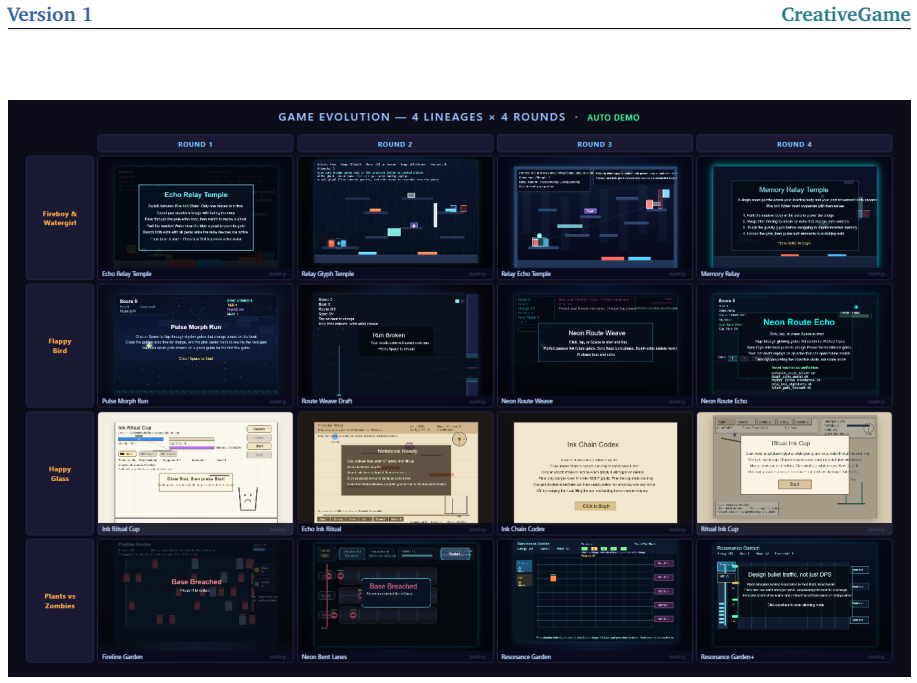
The central claim is that a combination of mechanic-guided planning, lineage-scoped memory, runtime validation, and proxy rewards allows mechanic-level innovation to emerge in later versions of a generated game lineage, with those changes directly inspectable through version-to-version records, thereby providing a concrete pipeline for observing progressive evolution through explicit mechanic change.
What carries the argument
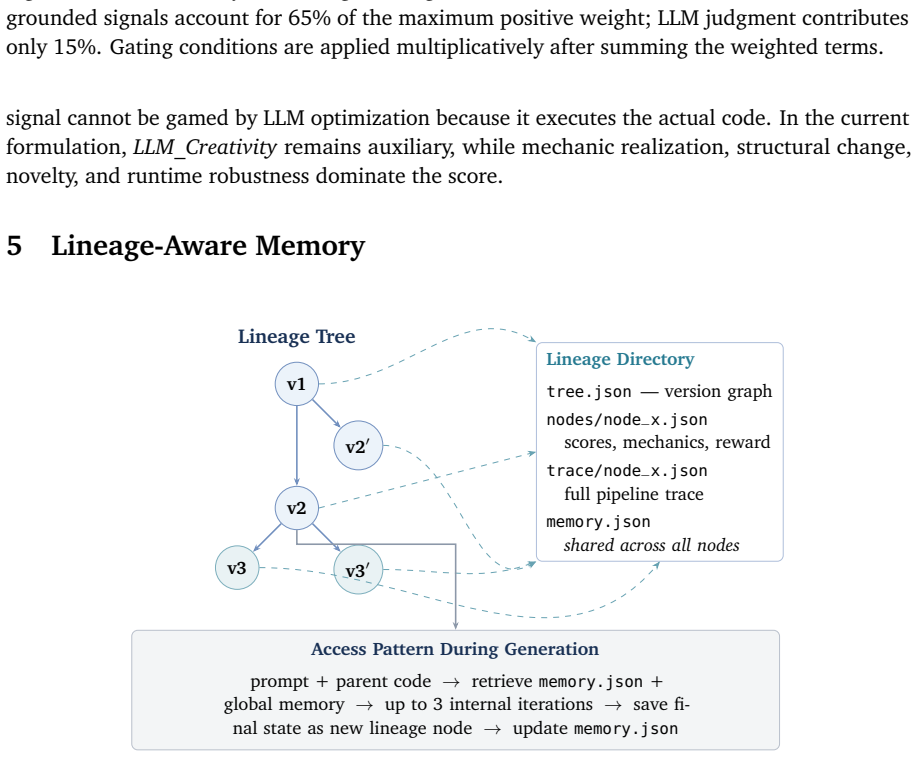
The mechanic-guided planning loop, which converts retrieved mechanic knowledge into an explicit mechanic plan before code generation begins, together with lineage memory for cross-version accumulation.
Load-bearing premise
That planning and tracking explicit mechanics, along with lineage memory and programmatic rewards, will produce games that improve creatively or in quality across iterations rather than remaining merely playable variants.
What would settle it
Generate matched pairs of lineages, one with the mechanic-guided planning loop and one without it, then check whether mechanic innovations appear in later generations only in the versions that use explicit planning.
Figures


read the original abstract
Large language models can generate plausible game code, but turning this capability into \emph{iterative creative improvement} remains difficult. In practice, single-shot generation often produces brittle runtime behavior, weak accumulation of experience across versions, and creativity scores that are too subjective to serve as reliable optimization signals. A further limitation is that mechanics are frequently treated only as post-hoc descriptions, rather than as explicit objects that can be planned, tracked, preserved, and evaluated during generation. This report presents \textbf{CreativeGame}, a multi-agent system for iterative HTML5 game generation that addresses these issues through four coupled ideas: a proxy reward centered on programmatic signals rather than pure LLM judgment; lineage-scoped memory for cross-version experience accumulation; runtime validation integrated into both repair and reward; and a mechanic-guided planning loop in which retrieved mechanic knowledge is converted into an explicit mechanic plan before code generation begins. The goal is not merely to produce a playable artifact in one step, but to support interpretable version-to-version evolution. The current system contains 71 stored lineages, 88 saved nodes, and a 774-entry global mechanic archive, implemented in 6{,}181 lines of Python together with inspection and visualization tooling. The system is therefore substantial enough to support architectural analysis, reward inspection, and real lineage-level case studies rather than only prompt-level demos. A real 4-generation lineage shows that mechanic-level innovation can emerge in later versions and can be inspected directly through version-to-version records. The central contribution is therefore not only game generation, but a concrete pipeline for observing progressive evolution through explicit mechanic change.
Editorial analysis
A structured set of objections, weighed in public.
Referee Report
Summary. The manuscript introduces CreativeGame, a multi-agent system for iterative HTML5 game generation. It couples a programmatic proxy reward, lineage-scoped memory, runtime validation, and a mechanic-guided planning loop that retrieves from a global mechanic archive to produce explicit mechanic plans before code generation. The system is implemented at scale (71 lineages, 88 saved nodes, 774-entry archive, 6,181 lines of Python) and is illustrated by a single 4-generation lineage in which mechanic-level changes appear in later versions, with the central claim being a concrete pipeline for observing progressive, interpretable evolution rather than single-shot generation.
Significance. If the core pipeline can be shown to produce systematic improvement rather than stochastic variation, the work would be significant for AI-assisted creative design: it supplies an explicit, inspectable mechanism for mechanic tracking and cross-version accumulation that is currently missing from most LLM game-generation efforts. The implementation scale and tooling for inspection are concrete strengths that could support follow-on research.
major comments (3)
- [the 4-generation lineage case study] The central claim that mechanic-aware planning plus lineage memory produces meaningfully creative or improving games rests on a single 4-generation lineage example. No aggregate statistics across the 71 lineages (success rates, reward trajectories, novelty scores, or fraction of nodes that exhibit mechanic innovation) are reported, leaving open whether the observed changes are attributable to the architecture or to LLM stochasticity.
- [the reward and validation components] The programmatic proxy rewards are presented as the key solution to subjective creativity scoring, yet the manuscript supplies no validation of these proxies (correlation with human playability ratings, ablation results with vs. without the proxy, or failure-mode analysis of when the proxy misleads).
- [mechanic-guided planning loop] While the mechanic archive (774 entries) and mechanic-guided planning loop are described as core contributions, no quantitative analysis is given on retrieval accuracy, how often the mechanic plan is followed in generated code, or whether its use measurably increases mechanic novelty or playability relative to a non-mechanic baseline.
minor comments (2)
- [abstract] The abstract contains the unusual notation '6{,}181' for lines of code; standard formatting (6,181) would improve readability.
- [system architecture] The description of how runtime validation feeds back into both repair and reward could be expanded with a concrete example or pseudocode to clarify the integration.
Simulated Author's Rebuttal
We thank the referee for the constructive comments and the opportunity to clarify the scope of our contributions. The manuscript presents CreativeGame as a pipeline for explicit, inspectable mechanic evolution in iterative game generation, illustrated by a detailed lineage case study, rather than as an empirical demonstration of systematic improvement. We address each major comment below.
read point-by-point responses
-
Referee: [the 4-generation lineage case study] The central claim that mechanic-aware planning plus lineage memory produces meaningfully creative or improving games rests on a single 4-generation lineage example. No aggregate statistics across the 71 lineages (success rates, reward trajectories, novelty scores, or fraction of nodes that exhibit mechanic innovation) are reported, leaving open whether the observed changes are attributable to the architecture or to LLM stochasticity.
Authors: The manuscript does not advance a claim of systematic improvement or attribute changes definitively to the architecture over stochasticity. Its central contribution is instead a pipeline enabling explicit mechanic planning, tracking, and version-to-version inspection. The 4-generation lineage is offered as a concrete, inspectable demonstration of this capability. Aggregate statistics across the 71 lineages were not reported because the emphasis was on architectural mechanisms and interpretability rather than statistical aggregation. We can add basic summary statistics (e.g., fraction of lineages showing mechanic changes and reward trends) in a revision to provide additional context. revision: partial
-
Referee: [the reward and validation components] The programmatic proxy rewards are presented as the key solution to subjective creativity scoring, yet the manuscript supplies no validation of these proxies (correlation with human playability ratings, ablation results with vs. without the proxy, or failure-mode analysis of when the proxy misleads).
Authors: The proxy rewards consist of programmatic signals (runtime validation outcomes and mechanic presence checks) intended to supply an objective signal for iteration without sole reliance on LLM judgment. We acknowledge that the manuscript contains no human correlation studies, ablations, or systematic failure-mode analysis. Such validations would require separate user studies outside the scope of this system-description paper. We can expand the text to discuss the proxy design rationale and known limitations, but a full empirical validation is not feasible within the current work. revision: no
-
Referee: [mechanic-guided planning loop] While the mechanic archive (774 entries) and mechanic-guided planning loop are described as core contributions, no quantitative analysis is given on retrieval accuracy, how often the mechanic plan is followed in generated code, or whether its use measurably increases mechanic novelty or playability relative to a non-mechanic baseline.
Authors: The mechanic archive and planning loop are presented to support explicit planning and retrieval, thereby making mechanic evolution traceable. The paper demonstrates this through the lineage example rather than through quantitative metrics such as retrieval precision or baseline comparisons. We did not include such analyses to maintain focus on qualitative interpretability. We can add a limited examination of plan adherence within the reported lineage, but a full comparative baseline study would require additional experiments not performed in the current implementation. revision: partial
- Empirical validation of the proxy rewards against human playability ratings or through controlled ablations
- Quantitative evaluation of retrieval accuracy and comparative performance of the mechanic-guided planning loop versus non-mechanic baselines
Circularity Check
No significant circularity; system description with empirical case study
full rationale
The paper describes an implemented multi-agent pipeline for iterative HTML5 game generation, emphasizing mechanic-guided planning, lineage memory, and programmatic proxy rewards. No mathematical derivations, equations, fitted parameters, or self-citations appear in the text. The central claim—that the system enables observation of progressive evolution via explicit mechanic change—is supported by a reported 4-generation lineage and aggregate system statistics (71 lineages, 88 nodes, 774-entry archive), which function as independent empirical evidence rather than any reduction to inputs by construction. The contribution is therefore self-contained as an architectural report and case study, with no load-bearing steps that equate outputs to their own definitions or prior self-references.
Axiom & Free-Parameter Ledger
axioms (2)
- domain assumption Large language models can generate plausible game code
- ad hoc to paper Programmatic signals are adequate proxies for creativity and playability
invented entities (2)
-
Mechanic archive
no independent evidence
-
Lineage-scoped memory
no independent evidence
Reference graph
Works this paper leans on
-
[1]
Beyond new and appropriate: Who decides what is creative?
J. C. Kaufman and J. Baer, “Beyond new and appropriate: Who decides what is creative?” Creativity Research Journal, vol. 24, no. 1, pp. 83–91, 2012
2012
-
[2]
Creative experience: A non-standard definition of creativity ,
V. P. Gl˘aveanu and R. A. Beghetto, “Creative experience: A non-standard definition of creativity ,”Creativity Research Journal, vol. 33, no. 2, pp. 75–80, 2021
2021
-
[3]
S. Zhang, J. Wang, R. Zhou, J. Liao, Y. Feng, W. Zhang, Y. Wen, Z. Li, F. Xiong, Y. Qi, B. Tang, and M. Wen, “Memrl: Self-evolving agents via runtime reinforcement learning on episodic memory ,” 2026. [Online]. Available: https://arxiv.org/abs/2601.03192 17 Version 1 CreativeGame
-
[4]
Salen and E
K. Salen and E. Zimmerman,Rules of Play: Game Design Fundamentals. MIT Press, 2003
2003
-
[5]
Schell,The Art of Game Design: A Book of Lenses
J. Schell,The Art of Game Design: A Book of Lenses. Elsevier/Morgan Kaufmann, 2008
2008
-
[6]
Defining game mechanics,
M. Sicart, “Defining game mechanics,”Game Studies, vol. 8, no. 2, 2008. [Online]. Available: https://www.gamestudies.org/0802/articles/sicart
2008
-
[7]
ChatDev: Communicative Agents for Software Development
C. Qian, W. Liu, H. Liu, N. Chen, Y. Dang, J. Li, C. Yang, W. Chen, Y. Su, X. Cong, J. Xu, D. Li, Z. Liu, and M. Sun, “Chatdev: Communicative agents for software development,”arXiv preprint arXiv:2307.07924, 2023. [Online]. Available: https://arxiv.org/abs/2307.07924
work page internal anchor Pith review arXiv 2023
-
[8]
MetaGPT: Meta programming for a multi-agent collaborative framework,
S. Hong, M. Zhuge, J. Chen, X. Zheng, Y. Cheng, J. Wang, C. Zhang, Z. Wang, S. K. S. Yau, Z. Lin, L. Zhou, C. Ran, L. Xiao, C. Wu, and J. Schmidhuber, “MetaGPT: Meta programming for a multi-agent collaborative framework,” inThe Twelfth International Conference on Learning Representations, 2024. [Online]. Available: https://openreview.net/forum?id=VtmBAGCN7o
2024
-
[9]
Agentverse: Facilitat- ing multi-agent collaboration and exploring emergent behaviors in agents
W. Chen, Y. Su, J. Zuo, C. Yang, C. Yuan, C. Qian, C.-M. Chan, Y. Qin, Y. Lu, R. Xieet al., “Agentverse: Facilitating multi-agent collaboration and exploring emergent behaviors in agents,”arXiv preprint arXiv:2308.10848, 2023
-
[10]
Judging LLM-as-a-Judge with MT-Bench and Chatbot Arena
L. Zheng, W.-L. Chiang, Y. Sheng, S. Zhuang, Z. Wu, Y. Zhuang, Z. Lin, Z. Li, D. Li, E. P. Xing, H. Zhang, J. E. Gonzalez, and I. Stoica, “ Judging LLM-as-a-judge with MT-Bench and Chatbot Arena,”arXiv preprint arXiv:2306.05685, 2023. [Online]. Available: https://arxiv.org/abs/2306.05685
work page internal anchor Pith review arXiv 2023
-
[11]
Koster,A Theory of Fun for Game Design
R. Koster,A Theory of Fun for Game Design. Paraglyph Press, 2005
2005
-
[12]
Evaluating Large Language Models Trained on Code
M. Chen, J. Tworek, H. Jun, Q. Yuan, H. P. de Oliveira Pinto, J. Kaplan, H. Edwards, Y. Burda, N. Joseph, G. Brockmanet al., “Evaluating large language models trained on code,”arXiv preprint arXiv:2107.03374, 2021. [Online]. Available: https://arxiv.org/abs/2107.03374 18
work page internal anchor Pith review Pith/arXiv arXiv 2021
discussion (0)
Sign in with ORCID, Apple, or X to comment. Anyone can read and Pith papers without signing in.