Recognition: unknown
The Evans function as a lower bound on the spectral distance function
Pith reviewed 2026-05-10 00:35 UTC · model grok-4.3
The pith
A normalized Evans function bounds the distance from any point to the spectrum of a boundary-value problem
A machine-rendered reading of the paper's core claim, the machinery that carries it, and where it could break.
Core claim
With a natural normalization on compact domains, the magnitude of the Evans function E(λ) at a point λ in the resolvent set is a lower bound on the distance from λ to the spectrum of the associated boundary-value problem; hence the disk of radius |E(λ)| centered at λ lies entirely in the resolvent set.
What carries the argument
The Evans function built from the matching condition of left- and right-traveling fundamental solutions that satisfy the boundary conditions of the ODE on a compact interval; its analytic properties under this normalization translate directly into a distance-to-spectrum bound.
If this is right
- Non-vanishing of the normalized E at λ* certifies that the entire disk |λ − λ*| < |E(λ*)| contains no spectrum.
- The same function now supplies both the location of eigenvalues (its zeros) and quantitative spectral-gap certificates (its magnitude).
- The bound applies to standard boundary conditions on compact intervals and is demonstrated for second- and fourth-order self-adjoint operators and linearized mKdV.
Where Pith is reading between the lines
- The magnitude could be used as a cheap distance estimator to steer adaptive numerical searches away from already-cleared regions of the complex plane.
- Similar distance bounds might be obtainable on unbounded domains once decay estimates at infinity are incorporated into the normalization.
- The construction may extend to other analytic functions that encode spectral data, such as characteristic polynomials or Fredholm determinants.
Load-bearing premise
The normalization is chosen so that the analytic properties coming from the fundamental-solution construction on a finite interval directly yield the distance bound.
What would settle it
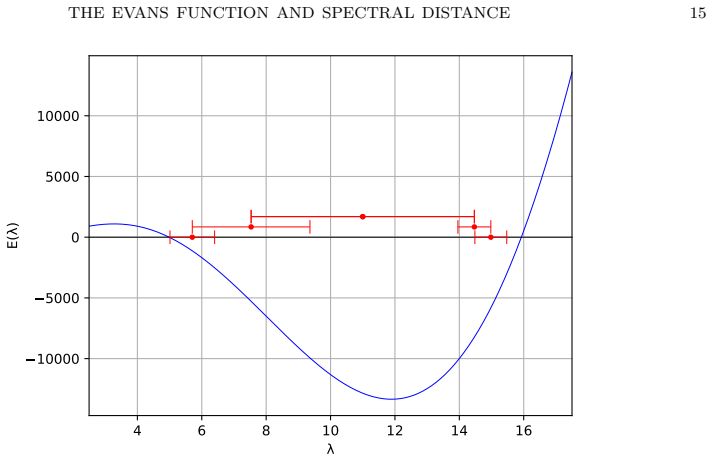
For the Dirichlet Laplacian on [0, π], evaluate the normalized Evans function at a point such as λ = 0.1 and check whether the distance to the nearest eigenvalue π² is at least |E(0.1)|.
Figures




read the original abstract
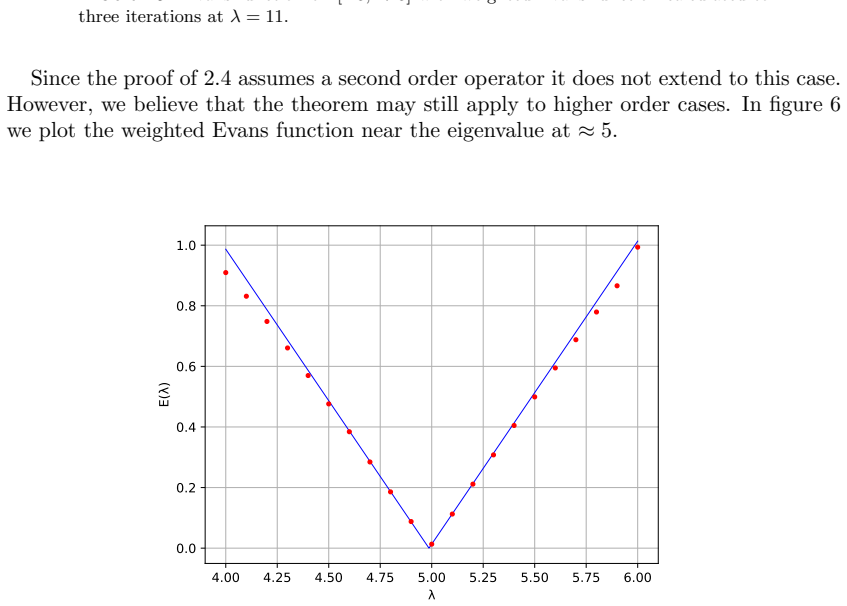
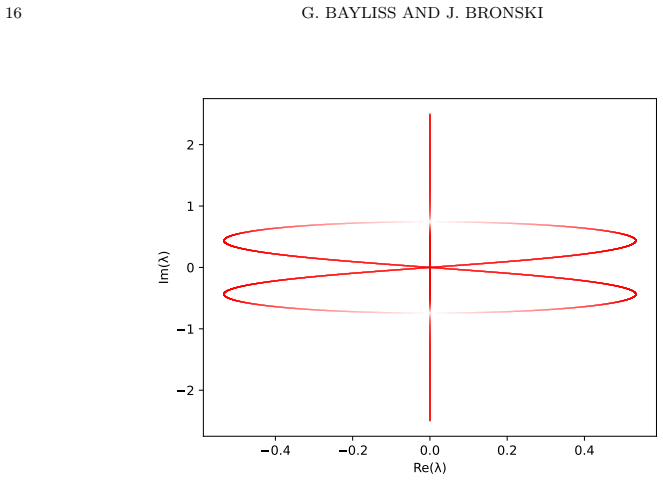
The Evans function is an analytic function that encodes information about the intersection of certain subspaces in ODE boundary value problems. As such it is a useful tool for computing the spectrum of boundary value problems arising in the stability of coherent structures. In typical applications one is interested in the roots of the Evans function, but the overall normalization is somewhat arbitrary. We present a natural normalization of the Evans function on compact domains such that the magnitude of the Evans function provides a lower bound on the distance to the nearest point in the spectrum. In other words the magnitude of the Evans function at a point in the resolvent set implies that a ball about the point in question lies in the resolvent set. Thus, when appropriately normalized, not only does the Evans function $E(\lambda)$ vanish if and only if $\lambda$ lies in the spectrum of the operator in question, but a non-zero value for the Evans function guarantees that a disk of radius $|E(\lambda^*)|$ about the point $\lambda^*$ lies in the resolvent set. We present some calculations for some common sets of boundary conditions on a compact interval, and present some numerical experiments for 2nd and 4th order self-adjoint operators and for a linearized modified Korteweg-De Vries equation.
Editorial analysis
A structured set of objections, weighed in public.
Referee Report
Summary. The manuscript proposes a natural normalization of the Evans function E(λ) for boundary-value problems arising from linear ODEs on compact intervals. With this normalization, |E(λ)| at any point λ in the resolvent set is asserted to lower-bound the distance from λ to the spectrum of the operator. Consequently, the open disk of radius |E(λ*)| centered at any resolvent point λ* is guaranteed to contain no spectrum. The authors illustrate the normalization with explicit calculations for standard boundary conditions and report numerical experiments on second- and fourth-order self-adjoint operators together with a linearized mKdV equation.
Significance. If the central claim were valid, the normalized Evans function would simultaneously locate eigenvalues via its zeros and certify spectral-free regions via its magnitude, providing a computable, rigorous a-posteriori bound useful for numerical stability analysis of coherent structures.
major comments (2)
- [Abstract] Abstract: The asserted normalization cannot satisfy the claimed bound. The Evans function constructed from fundamental solutions on a compact interval is entire and has infinitely many zeros (the discrete spectrum). No entire function with infinitely many zeros can obey |E(λ)| ≤ dist(λ, spec) for all λ in the resolvent set. This follows from the growth of entire functions: for any non-linear entire function the modulus grows faster than the distance to its zero set in the complex plane (e.g., sin(πz) violates the inequality at half-integers with large imaginary part). Multiplication by a nowhere-vanishing entire function (the only operation that preserves both analyticity and the zero set) leaves the contradiction intact. The claim is therefore false for all examples treated in the paper.
- [Abstract] Abstract (numerical experiments paragraph): The reported numerical experiments for the 2nd- and 4th-order self-adjoint operators and the mKdV linearization supply no tabulated values, error bars, comparison against independently computed spectra, or explicit checks that observed |E(λ)| respects the distance bound. Without these data the experiments cannot corroborate the central claim.
minor comments (2)
- The precise definition of the proposed normalization (including any λ-dependent scaling factors) is not stated explicitly enough to allow independent verification or reproduction.
- The manuscript would benefit from additional references to existing literature on Evans-function normalizations and on a-posteriori spectral bounds.
Simulated Author's Rebuttal
We thank the referee for their careful reading and for identifying a fundamental inconsistency in the central claim of the manuscript. We agree that the asserted bound cannot hold, and we will revise the paper to remove this claim while retaining the construction of the normalized Evans function. Our point-by-point responses to the major comments follow.
read point-by-point responses
-
Referee: [Abstract] Abstract: The asserted normalization cannot satisfy the claimed bound. The Evans function constructed from fundamental solutions on a compact interval is entire and has infinitely many zeros (the discrete spectrum). No entire function with infinitely many zeros can obey |E(λ)| ≤ dist(λ, spec) for all λ in the resolvent set. This follows from the growth of entire functions: for any non-linear entire function the modulus grows faster than the distance to its zero set in the complex plane (e.g., sin(πz) violates the inequality at half-integers with large imaginary part). Multiplication by a nowhere-vanishing entire function (the only operation that preserves both analyticity and the zero set) leaves the contradiction intact. The claim is therefore false for all examples treated in the paper.
Authors: We agree with the referee's analysis. The Evans function, being entire with infinitely many zeros, cannot satisfy |E(λ)| ≤ dist(λ, spec) everywhere in the resolvent set, as demonstrated by standard growth estimates for entire functions. This invalidates the central claim of the paper. We will revise the manuscript to eliminate the assertion that the magnitude provides a lower bound on the spectral distance for all resolvent points. The revised version will instead present the natural normalization and its role in identifying eigenvalues through zeros, without the distance-bound claim. revision: yes
-
Referee: [Abstract] Abstract (numerical experiments paragraph): The reported numerical experiments for the 2nd- and 4th-order self-adjoint operators and the mKdV linearization supply no tabulated values, error bars, comparison against independently computed spectra, or explicit checks that observed |E(λ)| respects the distance bound. Without these data the experiments cannot corroborate the central claim.
Authors: We acknowledge that the numerical experiments lack the necessary detail, such as tabulated values, error estimates, and direct comparisons to independently computed spectra, to support verification. Since the theoretical bound does not hold, these experiments cannot corroborate the original claim. In the revision we will remove or substantially rewrite the numerical section, focusing instead on explicit calculations for standard boundary conditions as described in the manuscript body. revision: yes
Circularity Check
No significant circularity; derivation self-contained
full rationale
The paper constructs a specific normalization of the Evans function from the fundamental solutions and boundary conditions on the compact interval. The lower-bound claim is asserted to follow directly from the resulting analytic properties of this normalized E(λ), without any reduction of the central statement to a fitted parameter, self-definition, or load-bearing self-citation. No equation or step is shown to be equivalent to its inputs by construction, and the numerical experiments on specific operators are presented as verification rather than as the source of the general bound.
Axiom & Free-Parameter Ledger
axioms (2)
- domain assumption The Evans function is analytic in the resolvent set and its zeros coincide exactly with the spectrum of the boundary-value problem.
- ad hoc to paper A natural normalization exists on compact domains that makes |E(λ)| a lower bound on the distance to the spectrum.
Reference graph
Works this paper leans on
-
[1]
Numerical implementation of complex orthogonaliza- tion, parallel transport on Stiefel bundles, and analyticity.Physica D: Nonlinear Phenomena, 239(12):1038–1047, 2010
Daniele Avitabile and Thomas J Bridges. Numerical implementation of complex orthogonaliza- tion, parallel transport on Stiefel bundles, and analyticity.Physica D: Nonlinear Phenomena, 239(12):1038–1047, 2010
2010
-
[2]
Asymptotic stability of sharp fronts: Analysis and rigorous computation.Journal of Differential Equations, 444:113550, 2025
Blake Barker, Jared C Bronski, Vera Mikyoung Hur, and Zhao Yang. Asymptotic stability of sharp fronts: Analysis and rigorous computation.Journal of Differential Equations, 444:113550, 2025
2025
-
[3]
Blake Barker, Jeffrey Humpherys, Gregory Lyng, and Joshua Lytle. Evans function computation for the stability of travelling waves.Philosophical Transactions of the Royal Society A: Mathematical, Physical and Engineering Sciences, 376(2117):20170184, 2018
2018
-
[4]
Computing Evans functions numerically via boundary-value problems.Physica D: Nonlinear Phenomena, 367:1–10, 2018
Blake Barker, Rose Nguyen, Bj¨ orn Sandstede, Nathaniel Ventura, and Colin Wahl. Computing Evans functions numerically via boundary-value problems.Physica D: Nonlinear Phenomena, 367:1–10, 2018
2018
-
[5]
Brigham Young University, 2009
Blake H Barker.Evans function computation. Brigham Young University, 2009
2009
-
[6]
Validated spectral stability via conjugate points.SIAM Journal on Applied Dynamical Systems, 21(1):366–404, 2022
Margaret Beck and Jonathan Jaquette. Validated spectral stability via conjugate points.SIAM Journal on Applied Dynamical Systems, 21(1):366–404, 2022
2022
-
[7]
Electrical waves in a one-dimensional model of cardiac tissue.SIAM Journal on Applied Dynamical Systems, 7(4):1558–1581, 2008
Margaret Beck, Christopher KRT Jones, David Schaeffer, and Martin Wechselberger. Electrical waves in a one-dimensional model of cardiac tissue.SIAM Journal on Applied Dynamical Systems, 7(4):1558–1581, 2008
2008
-
[8]
Planar traveling waves in capillary fluids.Differential and integral equations, 26(3-4):433–478, 2013
Sylvie Benzoni-Gavage. Planar traveling waves in capillary fluids.Differential and integral equations, 26(3-4):433–478, 2013
2013
-
[9]
Transversality of homoclinic orbits, the Maslov index and the symplectic Evans function.Nonlinearity, 28(1):77, 2014
Fr´ ed´ eric Chardard and Thomas J Bridges. Transversality of homoclinic orbits, the Maslov index and the symplectic Evans function.Nonlinearity, 28(1):77, 2014
2014
-
[10]
Stability of shock wave structures in nonlinear elastic media.Mathematics and Mechanics of Solids, 24(11):3456–3471, 2019
AP Chugainova, AT Il’ichev, and VA Shargatov. Stability of shock wave structures in nonlinear elastic media.Mathematics and Mechanics of Solids, 24(11):3456–3471, 2019
2019
-
[11]
Evans functions for integral neural field equations with Heaviside firing rate function.SIAM Journal on Applied Dynamical Systems, 3(4):574–600, 2004
Stephen Coombes and Markus R Owen. Evans functions for integral neural field equations with Heaviside firing rate function.SIAM Journal on Applied Dynamical Systems, 3(4):574–600, 2004
2004
-
[12]
Fredholm determinants, Evans functions and Maslov indices for partial differential equations.Mathematische Annalen, 389(2):1963–2036, 2024
Graham Cox, Yuri Latushkin, and Alim Sukhtayev. Fredholm determinants, Evans functions and Maslov indices for partial differential equations.Mathematische Annalen, 389(2):1963–2036, 2024
1963
-
[13]
Computing spectra of linear operators using the floquet– fourier–hill method.Journal of Computational Physics, 219(1):296–321, 2006
Bernard Deconinck and J Nathan Kutz. Computing spectra of linear operators using the floquet– fourier–hill method.Journal of Computational Physics, 219(1):296–321, 2006
2006
-
[14]
Transverse instabilities of deep-water solitary waves.Proceedings of the Royal Society A: Mathematical, Physical and Engineering Sciences, 462(2071):2039–2061, 2006
Bernard Deconinck, Dmitry E Pelinovsky, and John D Carter. Transverse instabilities of deep-water solitary waves.Proceedings of the Royal Society A: Mathematical, Physical and Engineering Sciences, 462(2071):2039–2061, 2006
2071
-
[15]
Nerve axon equations: 1 linear approximations.Indiana University Mathematics Journal, 21(9):877–885, 1972
John W Evans. Nerve axon equations: 1 linear approximations.Indiana University Mathematics Journal, 21(9):877–885, 1972. THE EV ANS FUNCTION AND SPECTRAL DISTANCE 21
1972
-
[16]
Nerve axon equations: Ii stability at rest.Indiana University Mathematics Journal, 22(1):75–90, 1972
John W Evans. Nerve axon equations: Ii stability at rest.Indiana University Mathematics Journal, 22(1):75–90, 1972
1972
-
[17]
Nerve axon equations: Iii stability of the nerve impulse.Indiana University Mathe- matics Journal, 22(6):577–593, 1972
John W Evans. Nerve axon equations: Iii stability of the nerve impulse.Indiana University Mathe- matics Journal, 22(6):577–593, 1972
1972
-
[18]
Nerve axon equations: Iv the stable and the unstable impulse.Indiana University Mathematics Journal, 24(12):1169–1190, 1975
John W Evans. Nerve axon equations: Iv the stable and the unstable impulse.Indiana University Mathematics Journal, 24(12):1169–1190, 1975
1975
-
[19]
PhD thesis, Boston University, 2010
Matthew Denson Holzer.Renormalization group methods for singularly perturbed systems, normal forms and stability of traveling waves in a reaction-diffusion-mechanics system. PhD thesis, Boston University, 2010
2010
-
[20]
An efficient shooting algorithm for Evans function calcu- lations in large systems.Physica D: Nonlinear Phenomena, 220(2):116–126, 2006
Jeffrey Humpherys and Kevin Zumbrun. An efficient shooting algorithm for Evans function calcu- lations in large systems.Physica D: Nonlinear Phenomena, 220(2):116–126, 2006
2006
-
[21]
Modulational instability in the Whitham equation for water waves.Studies in Applied Mathematics, 134(1):120–143, 2015
Vera Mikyoung Hur and Mathew A Johnson. Modulational instability in the Whitham equation for water waves.Studies in Applied Mathematics, 134(1):120–143, 2015
2015
-
[22]
Unstable Stokes waves.Archive for Rational Mechanics and Analysis, 247(4):62, 2023
Vera Mikyoung Hur and Zhao Yang. Unstable Stokes waves.Archive for Rational Mechanics and Analysis, 247(4):62, 2023
2023
-
[23]
Instability of solitary waves on Euler’s elastica.Zeitschrift f¨ ur angewandte Math- ematik und Physik ZAMP, 57(4):547–566, 2006
Andrej T Il’ichev. Instability of solitary waves on Euler’s elastica.Zeitschrift f¨ ur angewandte Math- ematik und Physik ZAMP, 57(4):547–566, 2006
2006
-
[24]
The Evans function for nonlocal equations
Todd Kapitula, Nathan Kutz, and Bj¨ orn Sandstede. The Evans function for nonlocal equations. Indiana University mathematics journal, pages 1095–1126, 2004
2004
-
[25]
Instability of local deformations of an elastic rod: numerical evaluation of the Evans function.SIAM Journal on Applied Mathematics, 71(5):1653– 1672, 2011
St´ ephane Lafortune, Joceline Lega, and S Madrid. Instability of local deformations of an elastic rod: numerical evaluation of the Evans function.SIAM Journal on Applied Mathematics, 71(5):1653– 1672, 2011
2011
-
[26]
Computing stability of mul- tidimensional traveling waves.SIAM Journal on Applied Dynamical Systems, 8(1):480–507, 2009
Veerle Ledoux, Simon JA Malham, Jitse Niesen, and Vera Th¨ ummler. Computing stability of mul- tidimensional traveling waves.SIAM Journal on Applied Dynamical Systems, 8(1):480–507, 2009
2009
-
[27]
Traveling waves in a three-variable reaction-diffusion-mechanics model of cardiac tissue.Communications on Pure and Applied Analysis, 24(5):892–925, 2025
Ji Li and Qing Yu. Traveling waves in a three-variable reaction-diffusion-mechanics model of cardiac tissue.Communications on Pure and Applied Analysis, 24(5):892–925, 2025
2025
-
[28]
YA Li. The eigenvalue problem for solitary waves of the Green–Naghdi equations.Mathematical and Numerical Aspects of Wave Propagation (Santiago de Compostela, 2000), SIAM, Philadelphia, PA, pages 339–343, 2000
2000
-
[29]
Evaluating the Evans function: order reduction in numerical methods.Mathematics of computation, 77(261):159–179, 2008
Simon Malham and Jitse Niesen. Evaluating the Evans function: order reduction in numerical methods.Mathematics of computation, 77(261):159–179, 2008
2008
-
[30]
Stability of periodic solutions of conservation laws with vis- cosity: Analysis of the Evans function.Archive for Rational Mechanics and Analysis, 166:99–166, 2003
Myunghyun Oh and Kevin Zumbrun. Stability of periodic solutions of conservation laws with vis- cosity: Analysis of the Evans function.Archive for Rational Mechanics and Analysis, 166:99–166, 2003
2003
-
[31]
Stability of travelling waves
Bj¨ orn Sandstede. Stability of travelling waves. InHandbook of dynamical systems, volume 2, pages 983–1055. Elsevier, 2002
2002
-
[32]
The stability of homoclinic pulses: a generalisation of Evans’s method.Physics Letters A, 163(1):57–62, 1992
Jonathan Swinton. The stability of homoclinic pulses: a generalisation of Evans’s method.Physics Letters A, 163(1):57–62, 1992. University of Illinois, Urbana, IL 61801, USA Email address:bayliss2@illinois.edu Department of Mathematics, University of Illinois, Urbana, IL 61801, USA Email address:bronski@illinois.edu
1992
discussion (0)
Sign in with ORCID, Apple, or X to comment. Anyone can read and Pith papers without signing in.