Recognition: unknown
LatentGandr: Visual Exploration of Generative AI Latent Space via Local Embeddings
Pith reviewed 2026-05-10 01:08 UTC · model grok-4.3
The pith
LatentGandr identifies local neighborhoods in generative AI embeddings via topology and curvature analysis, then uses localized PCA to produce interactive image grids for controlling outputs.
A machine-rendered reading of the paper's core claim, the machinery that carries it, and where it could break.
Core claim
LatentGandr facilitates latent space exploration by extracting locally linear dimensions from embeddings in high-dimensional latent spaces. By analyzing the topology and local curvature of the embeddings, LatentGandr automatically identifies local neighborhoods and computes their principal components using localized PCA. These local principal components are visualized as interactive image grids, allowing users to efficiently explore and control the generative process, providing an intuitive means to refine the generation of novel content and concepts.
What carries the argument
Local neighborhoods identified by topology and local curvature analysis of embeddings, with principal components computed via localized PCA and rendered as interactive image grids.
If this is right
- Control of generative outputs becomes feasible at higher latent dimensions because only locally relevant directions are shown at once.
- Users can refine generated images or concepts through direct manipulation of image grids rather than abstract sliders.
- The technique scales exploration beyond what global dimensionality reduction supports in current slider interfaces.
- Localized linear approximations align better with human perception of visual changes than global ones do.
Where Pith is reading between the lines
- The same neighborhood-finding logic could be tested on non-image generative models such as those for 3D shapes or audio to see whether local grids remain intuitive.
- Hybrid interfaces that switch between global overview and local detail might combine the strengths of both approaches.
- Applying curvature-aware neighborhood detection to other high-dimensional embedding spaces, such as those in scientific simulation data, could reveal analogous exploration tools.
Load-bearing premise
Automatically detected local neighborhoods based on topology and curvature will reliably produce more intuitive control directions than global PCA, and a user study against GANSlider will show this benefit without confounding factors from task design or participant selection.
What would settle it
A follow-up study in which participants complete the same refinement tasks with LatentGandr and GANSlider shows no measurable difference in completion time, accuracy, or reported ease of use.
Figures



read the original abstract
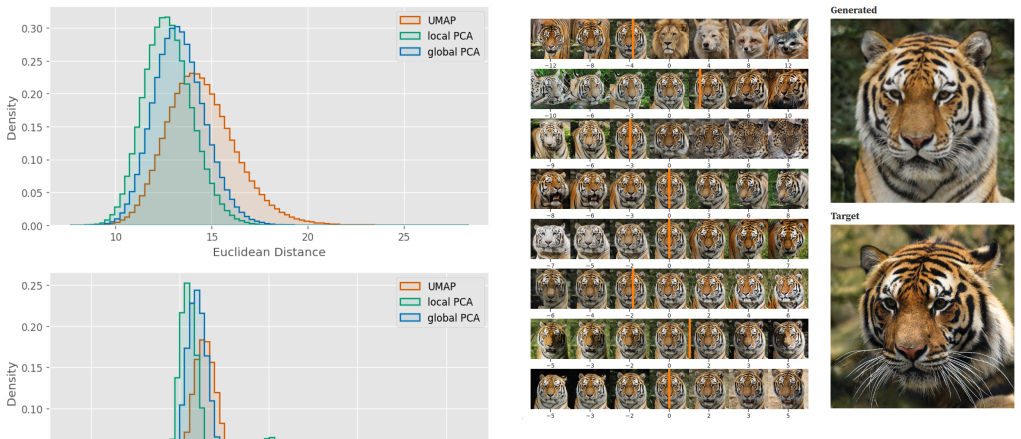
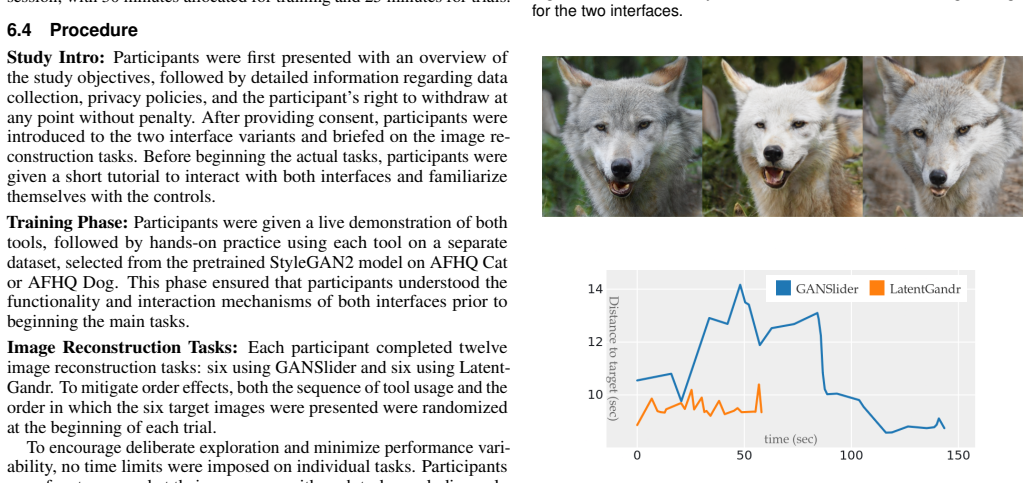
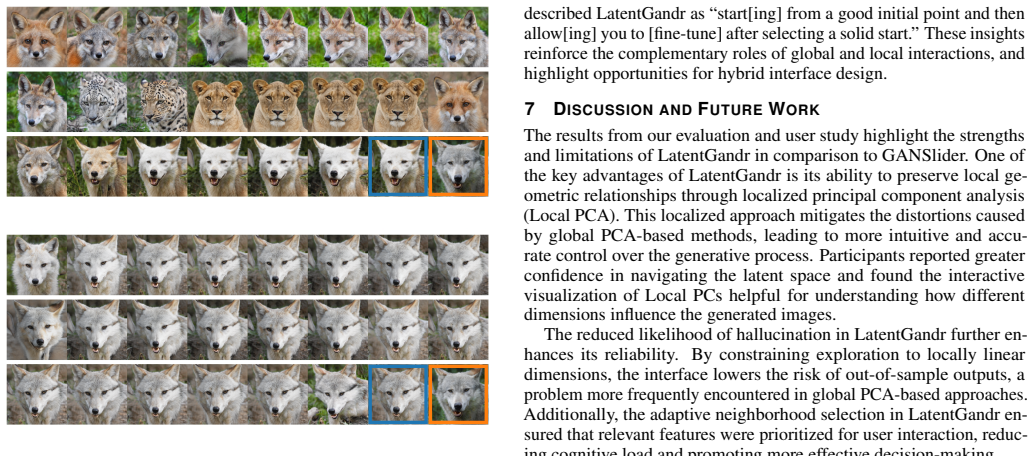
Generative AI has demonstrated significant potential in creative design, enabling the rapid generation of visual content and imaginative concepts. Although deep AI models achieve effective featurization in the latent space, navigating the space remains a challenge. Current techniques, such as GANSlider and SliderSpace, use multiple sliders to generate high-dimensional vectors in generative AI's latent space. Despite applying (global) PCA to reduce the number of sliders, these approaches struggle with scalability and usability as the number of control dimensions increases. In this paper, we introduce LatentGandr, a visual analytics technique that facilitates latent space exploration by extracting locally linear dimensions from embeddings in high-dimensional latent spaces. By analyzing the topology and local curvature of the embeddings, LatentGandr automatically identifies local neighborhoods and computes their principal components using localized PCA. These local principal components are visualized as interactive image grids, allowing users to efficiently explore and control the generative process, providing an intuitive means to refine the generation of novel content and concepts. To evaluate the effectiveness of LatentGandr, we conducted a study comparing it to GANSlider, the current state-of-the-art visualization interface for generative AI models. The results offer insights into how localized exploration techniques can enhance user interaction with these models.
Editorial analysis
A structured set of objections, weighed in public.
Referee Report
Summary. The manuscript introduces LatentGandr, a visual analytics technique for exploring high-dimensional latent spaces of generative AI models. It automatically identifies local neighborhoods by analyzing topology and local curvature of embeddings, computes principal components via localized PCA, and visualizes these as interactive image grids to enable intuitive control over the generative process. The approach is positioned as an improvement over global-PCA-based interfaces such as GANSlider and SliderSpace, and is evaluated via a comparative user study.
Significance. If the local-neighborhood identification and user-study results hold, LatentGandr would provide a concrete, scalable alternative to global dimensionality reduction for latent-space navigation, directly addressing usability complaints in creative-AI interfaces. The core technical move—topology/curvature-driven local PCA—is internally consistent with the stated goal and could influence future HCI tools for generative models.
major comments (1)
- [User study / Evaluation] The effectiveness claim rests on the user study comparing LatentGandr to GANSlider, yet the abstract and method description provide no quantitative metrics (e.g., task completion time, error rates, or subjective ratings), no details on neighborhood identification parameters or validation, and no error analysis. Without these, it is impossible to verify whether the local approach yields more intuitive dimensions than global PCA or whether the study design avoids confounds in task or participant selection.
minor comments (1)
- [Abstract] The abstract would be strengthened by including one or two key quantitative outcomes from the user study to summarize the comparative results.
Simulated Author's Rebuttal
We thank the referee for the constructive feedback on the evaluation of LatentGandr. We address the major comment point-by-point below and will revise the manuscript to improve verifiability of the user study results.
read point-by-point responses
-
Referee: [User study / Evaluation] The effectiveness claim rests on the user study comparing LatentGandr to GANSlider, yet the abstract and method description provide no quantitative metrics (e.g., task completion time, error rates, or subjective ratings), no details on neighborhood identification parameters or validation, and no error analysis. Without these, it is impossible to verify whether the local approach yields more intuitive dimensions than global PCA or whether the study design avoids confounds in task or participant selection.
Authors: We agree that the current abstract and method description lack the requested quantitative details, parameter specifications, validation steps, and error analysis, which limits the ability to fully assess the claims. We will revise the manuscript by expanding the abstract to report key quantitative outcomes from the comparative user study (including task completion times, error rates, and subjective ratings), adding explicit descriptions of neighborhood identification parameters (such as neighborhood size, topology analysis thresholds, and local curvature criteria) along with their validation, incorporating an error analysis, and elaborating on the study design to clarify participant selection, task formulation, and controls for confounds. These additions will strengthen the evidence that localized PCA yields more intuitive dimensions than global approaches. revision: yes
Circularity Check
No significant circularity
full rationale
The paper describes an algorithmic visual analytics pipeline for latent space exploration: topology/curvature analysis to identify local neighborhoods, followed by localized PCA whose components are rendered as image grids. No equations, first-principles derivations, or statistical predictions are presented that reduce to fitted parameters, self-definitions, or prior self-citations. The method applies standard PCA locally after neighborhood detection; the user study supplies independent empirical comparison to GANSlider. The derivation chain is therefore self-contained and does not collapse to its own inputs by construction.
Axiom & Free-Parameter Ledger
axioms (1)
- domain assumption Local neighborhoods defined by topology and curvature in latent embeddings contain meaningful linear variation directions.
Reference graph
Works this paper leans on
-
[1]
Amorim, E
E. Amorim, E. V . Brazil], J. Mena-Chalco, L. Velho, L. G. Nonato, F. Samavati, and M. C. Sousa]. Facing the high-dimensions: Inverse projection with radial basis functions.Computers & Graphics, 48:35 – 47,
-
[2]
Appleby, M
G. Appleby, M. Espadoto, R. Chen, S. Goree, A. C. Telea, E. W. Anderson, and R. Chang. HyperNP: Interactive visual exploration of multidimen- sional projection hyperparameters. InComputer Graphics Forum, vol. 41, pp. 169–181. Wiley Online Library, 2022. 3
2022
-
[3]
Balasubramanian and E
M. Balasubramanian and E. L. Schwartz. The isomap algorithm and topological stability.Science, 295(5552):7–7, 2002. 3
2002
-
[4]
Cavallo and c
M. Cavallo and c. Demiralp. A visual interaction framework for dimen- sionality reduction based data exploration. InConference on Human Factors in Computing Systems, CHI ’18, 13 pages, p. 1–13. Association for Computing Machinery, New York, NY , USA, 2018. 3
2018
-
[5]
T. F. Cox and M. A. Cox.Multidimensional scaling. CRC press, 2000. 3
2000
-
[6]
H. Dang, L. Mecke, and D. Buschek. GANSlider: How users control generative models for images using multiple sliders with and without feedforward information. InProceedings of the 2022 CHI Conference on Human Factors in Computing Systems, pp. 1–15, 2022. 1, 2, 3
2022
-
[7]
E. P. dos Santos Amorim, E. V . Brazil, J. Daniels, P. Joia, L. G. Nonato, and M. C. Sousa. iLAMP: Exploring high-dimensional spacing through backward multidimensional projection. In2012 IEEE Conference on Visual Analytics Science and Technology (VAST), pp. 53–62, 2012. 3
2012
-
[8]
Espadoto, G
M. Espadoto, G. Appleby, A. Suh, D. Cashman, M. Li, C. Scheidegger, E. W. Anderson, R. Chang, and A. C. Telea. UnProjection: Leveraging inverse-projections for visual analytics of high-dimensional data.IEEE Transactions on Visualization and Computer Graphics, 29(2):1559–1572,
-
[9]
Faust, D
R. Faust, D. Glickenstein, and C. Scheidegger. DimReader: Axis lines that explain non-linear projections.IEEE transactions on visualization and computer graphics, 25(1):481–490, 2018. 3
2018
-
[10]
R. Gandikota, Z. Wu, R. Zhang, D. Bau, E. Shechtman, and N. Kolkin. SliderSpace: Decomposing the visual capabilities of diffusion models. arXiv preprint arXiv:2502.01639, 2025. 2, 3
-
[11]
Härkönen, A
E. Härkönen, A. Hertzmann, J. Lehtinen, and S. Paris. Ganspace: Discover- ing interpretable gan controls.Advances in neural information processing systems, 33:9841–9850, 2020. 2
2020
-
[12]
G. E. Hinton and R. R. Salakhutdinov. Reducing the dimensionality of data with neural networks.Science, 313(5786):504–507, 2006. 3
2006
-
[13]
J. Ho, A. Jain, and P. Abbeel. Denoising diffusion probabilistic models. Advances in neural information processing systems, 33:6840–6851, 2020. 2
2020
-
[14]
P. Joia, D. Coimbra, J. A. Cuminato, F. V . Paulovich, and L. G. Nonato. Local affine multidimensional projection.IEEE Transactions on Visual- ization and Computer Graphics, 17(12):2563–2571, 2011. 3
2011
-
[15]
Karras, S
T. Karras, S. Laine, M. Aittala, J. Hellsten, J. Lehtinen, and T. Aila. Analyzing and improving the image quality of stylegan. InProceedings of the IEEE/CVF conference on computer vision and pattern recognition, pp. 8110–8119, 2020. 1, 2
2020
-
[16]
Kriegeskorte and M
N. Kriegeskorte and M. Mur. Inverse MDS: Inferring dissimilarity struc- ture from multiple item arrangements.Frontiers in Psychology, 3:245,
-
[17]
M. J. Kusner, B. Paige, and J. M. Hernández-Lobato. Grammar variational autoencoder. InInternational Conference on Machine Learning, pp. 1945–
1945
-
[18]
Kwon and K.-L
O.-H. Kwon and K.-L. Ma. A deep generative model for graph layout. IEEE Transactions on visualization and Computer Graphics, 26(1):665– 675, 2019. 3
2019
-
[19]
A. V . Little, J. Lee, Y .-M. Jung, and M. Maggioni. Estimation of intrinsic dimensionality of samples from noisy low-dimensional manifolds in high dimensions with multiscale svd. In2009 IEEE/SP 15th Workshop on Statistical Signal Processing, pp. 85–88. IEEE, 2009. 4, 5
2009
-
[20]
G. M. H. Mamani, F. M. Fatore, L. G. Nonato, and F. V . Paulovich. User-driven feature space transformation.Computer Graphics Forum, 32(3pt3):291–299, 2013. 3
2013
-
[21]
UMAP: Uniform Manifold Approximation and Projection for Dimension Reduction
L. McInnes, J. Healy, and J. Melville. Umap: Uniform manifold ap- proximation and projection for dimension reduction.arXiv preprint arXiv:1802.03426, 2018. 3
work page internal anchor Pith review arXiv 2018
-
[22]
Montambault, G
B. Montambault, G. Appleby, J. Rogers, C. D. Brumar, M. Li, and R. Chang. DimBridge: Interactive explanation of visual patterns in dimen- sionality reductions with predicate logic.IEEE Transactions on Visualiza- tion and Computer Graphics, 2024. 3
2024
-
[23]
Rombach, A
R. Rombach, A. Blattmann, D. Lorenz, P. Esser, and B. Ommer. High- resolution image synthesis with latent diffusion models. InProceedings of the IEEE/CVF conference on computer vision and pattern recognition, pp. 10684–10695, 2022. 1, 2
2022
-
[24]
A. Ross, N. Chen, E. Z. Hang, E. L. Glassman, and F. Doshi-Velez. Evalu- ating the interpretability of generative models by interactive reconstruction. InProceedings of the 2021 CHI Conference on Human Factors in Com- puting Systems, pp. 1–15, 2021. 3
2021
-
[25]
J. Song, C. Meng, and S. Ermon. Denoising diffusion implicit models. arXiv preprint arXiv:2010.02502, 2020. 2
work page internal anchor Pith review Pith/arXiv arXiv 2010
-
[26]
Stahnke, M
J. Stahnke, M. Dörk, B. Müller, and A. Thom. Probing projections: Interac- tion techniques for interpreting arrangements and errors of dimensionality reductions.IEEE transactions on visualization and computer graphics, 22(1):629–638, 2015. 3
2015
-
[27]
Van Den Oord, O
A. Van Den Oord, O. Vinyals, et al. Neural discrete representation learning. Advances in neural information processing systems, 30, 2017. 1
2017
-
[28]
Van der Maaten and G
L. Van der Maaten and G. Hinton. Visualizing data using t-SNE.Journal of machine learning research, 9(11), 2008. 3
2008
-
[29]
Van Der Maaten, E
L. Van Der Maaten, E. Postma, and J. Van den Herik. Dimensionality reduction: a comparative review.J Mach Learn Res, 10(66-71):13, 2009. 3
2009
-
[30]
Vernier, R
E. Vernier, R. Garcia, I. da Silva, J. Comba, and A. Telea. Quantita- tive evaluation of time-dependent multidimensional projection techniques. Computer Graphics Forum, 39(3), 2020. 3
2020
-
[31]
J. Zhao, M. Fan, and M. Feng. ChartSeer:: Interactive steering exploratory visual analysis with machine intelligence.IEEE Transactions on Visual- ization and Computer Graphics, pp. 1–1, 2020. doi: 10.1109/TVCG.2020 .301872 3
discussion (0)
Sign in with ORCID, Apple, or X to comment. Anyone can read and Pith papers without signing in.