Recognition: unknown
Automated Quantum Software and AI Engineering
Pith reviewed 2026-05-10 01:33 UTC · model grok-4.3
The pith
A systematic review maps (semi-)automated methods that can widen access to quantum software engineering and AI in hybrid systems.
A machine-rendered reading of the paper's core claim, the machinery that carries it, and where it could break.
Core claim
By surveying the literature on (semi-)automated approaches in quantum software engineering and quantum AI, the work shows that these techniques address the shortage of quantum experts and support decisions on hardware placement within hybrid quantum-classical applications, thereby enabling wider development and deployment of such systems while highlighting current trends and open directions.
What carries the argument
The systematic literature review of (semi-)automated approaches to quantum software engineering and quantum AI, with emphasis on their application to hybrid quantum-classical systems.
If this is right
- Automation helps determine which parts of an application should run on quantum hardware versus classical hardware in hybrid setups.
- The methods support efficiency gains and productivity increases even when used by subject-matter experts.
- Trends extracted from the reviewed approaches can guide the creation of additional tools for quantum and hybrid development.
- Future work should build on the identified directions to broaden access to quantum software and AI engineering.
Where Pith is reading between the lines
- The catalog of methods could be tested in practice by applying one or more reviewed techniques to a concrete hybrid application and measuring development time or error rates.
- Parallels with automation successes in classical software engineering might reveal which quantum approaches are extensions of known practices.
- Periodic updates to the review could track whether new automation tools close the expertise gap more effectively over time.
Load-bearing premise
The review's search and selection steps captured the full set of relevant (semi-)automated methods from the quantum software engineering and quantum AI literature without major omissions.
What would settle it
Locating multiple important papers on automated quantum software or AI tools that the review overlooked would show the identified trends and future directions are incomplete.
Figures




read the original abstract
In this paper, we conduct a systematic literature review of (semi-) automated approaches to Quantum Software Engineering (QSE) and Quantum Artificial Intelligence (QAI). Prior work in the literature indicated that both Software Engineering (SE) and Artificial Intelligence (AI) practices may become more efficient by using (semi-) automated approaches. This also holds in the Quantum Computing (QC), Quantum Information Science (QIS), and Quantum Engineering (QE) world, as well as in hybrid quantum-classical applications. In fact, automation is even more crucial in such cases since there is a limited number of developers and AI experts (e.g., data scientists) who possess the required knowledge and skills in QC. Moreover, in hybrid setups, automation may help decide what part of the application should be deployed on quantum hardware and on which of the available quantum platforms, if applicable. This can be a significant help to achieve productivity leap and efficiency even for subject matter experts. Unlike prior literature reviews and surveys, this work focuses on automation in SE and AI for quantum and hybrid quantum-classical applications and identifies the recent trends and future directions through a systematic literature review. We are interested in methods and techniques that can enable a broader development and deployment of quantum and hybrid AI-enabled software systems.
Editorial analysis
A structured set of objections, weighed in public.
Referee Report
Summary. The manuscript conducts a systematic literature review of (semi-)automated approaches to Quantum Software Engineering (QSE) and Quantum Artificial Intelligence (QAI). It motivates the work by noting limited expert availability in quantum computing and the potential for automation to assist hybrid quantum-classical deployment decisions, then identifies recent trends and future directions to enable broader development of quantum and hybrid AI-enabled systems.
Significance. If the SLR search and selection are shown to be comprehensive and reproducible, the review could usefully aggregate and trend-map automation techniques across QSE and QAI, providing a reference point for researchers working on productivity tools in a domain with scarce specialized expertise. The emphasis on hybrid partitioning and platform selection is a timely angle not always foregrounded in prior quantum surveys.
major comments (2)
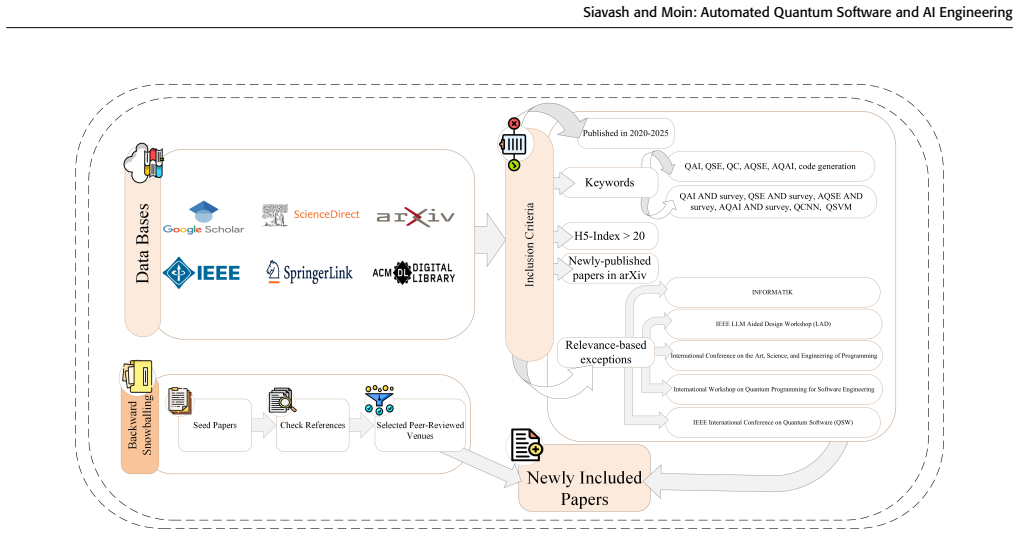
- [Methodology] Methodology section: the abstract states that a systematic literature review was performed but supplies no search strings, databases, inclusion/exclusion criteria, time bounds, or screening protocol. Without these details it is impossible to assess whether the reported trends rest on a representative corpus or suffer from systematic omissions (e.g., missing papers on automated quantum circuit synthesis or hybrid partitioning tools).
- [Results and Discussion] Results/Discussion: the central claim that automation trends and future directions have been identified for hybrid quantum-classical applications depends on the completeness of the literature base. Absent a PRISMA-style flow diagram, paper counts, or explicit justification that key sub-areas were covered, the trend synthesis and recommendations cannot be evaluated for robustness.
minor comments (1)
- [Abstract] Abstract: the phrase 'prior work in the literature indicated' is not accompanied by citations; adding 2-3 key references would clarify the baseline being extended.
Simulated Author's Rebuttal
We thank the referee for their thoughtful and constructive review. We agree that greater methodological transparency is essential for a systematic literature review and have revised the manuscript to address both major comments in full.
read point-by-point responses
-
Referee: [Methodology] Methodology section: the abstract states that a systematic literature review was performed but supplies no search strings, databases, inclusion/exclusion criteria, time bounds, or screening protocol. Without these details it is impossible to assess whether the reported trends rest on a representative corpus or suffer from systematic omissions (e.g., missing papers on automated quantum circuit synthesis or hybrid partitioning tools).
Authors: We agree that the original manuscript did not present these elements with sufficient explicitness. Although a methodology section existed, it omitted the precise search strings, list of databases, formal inclusion/exclusion criteria, time bounds, and screening protocol. In the revised version we have expanded the Methodology section to include: (1) the complete Boolean search strings, (2) the databases queried (IEEE Xplore, ACM DL, SpringerLink, arXiv, and Google Scholar), (3) explicit inclusion/exclusion criteria, (4) the time window 2015–2024, and (5) the two-stage screening protocol with inter-rater agreement statistics. We also added a short paragraph justifying coverage of sub-areas such as automated quantum circuit synthesis and hybrid partitioning tools. revision: yes
-
Referee: [Results and Discussion] Results/Discussion: the central claim that automation trends and future directions have been identified for hybrid quantum-classical applications depends on the completeness of the literature base. Absent a PRISMA-style flow diagram, paper counts, or explicit justification that key sub-areas were covered, the trend synthesis and recommendations cannot be evaluated for robustness.
Authors: We accept this criticism. The revised manuscript now contains a PRISMA flow diagram that reports the number of records at each stage (identification, screening, eligibility, inclusion). We also state the final corpus size and provide a table that maps the included papers to the key sub-areas (including automated circuit synthesis and hybrid partitioning). These additions allow readers to assess the completeness of the evidence base underlying our trend analysis and recommendations. revision: yes
Circularity Check
No circularity: SLR aggregates external sources without internal derivations or self-referential reductions
full rationale
This is a systematic literature review with no equations, fitted parameters, predictions, or derivations. The central contribution rests on standard SLR search/selection from external literature rather than any self-definitional loop, fitted-input renaming, or load-bearing self-citation chain. The paper's claims about automation needs and trends are presented as summaries of cited prior work, with no reduction of outputs to the review's own inputs by construction. Methodological assumptions about search completeness are limitations, not circularity.
Axiom & Free-Parameter Ledger
Reference graph
Works this paper leans on
-
[1]
Dwivedi, M
K. Dwivedi, M. Haghparast, and T. Mikkonen, ‘‘Quantum software engi- neering and quantum software development lifecycle: a survey,’’Cluster Computing, vol. 27, no. 6, pp. 7127–7145, 2024
2024
-
[2]
Y u and J
W. Y u and J. Zhao, ‘‘Quantum multi-agent reinforcement learning as an emerging ai technology: A survey and future directions,’’ in2023 International Conference on Computer and Applications (ICCA), pp. 1–7, IEEE, 2023
2023
-
[3]
Melnikov, M
A. Melnikov, M. Kordzanganeh, A. Alodjants, and R.-K. Lee, ‘‘Quantum machine learning: from physics to software engineering,’’Advances in Physics: X, vol. 8, no. 1, p. 2165452, 2023
2023
-
[4]
Klusch, J
M. Klusch, J. Lässig, D. Müssig, A. Macaluso, and F. K. Wilhelm, ‘‘Quan- tum artificial intelligence: A brief survey,’’KI-Künstliche Intelligenz, pp. 1–20, 2024
2024
-
[5]
Kusyk, S
J. Kusyk, S. M. Saeed, and M. U. Uyar, ‘‘Survey on quantum circuit compilation for noisy intermediate-scale quantum computers: Artificial intelligence to heuristics,’’IEEE Transactions on Quantum Engineering, vol. 2, pp. 1–16, 2021
2021
-
[6]
Sarkar, ‘‘Automated quantum software engineering,’’Automated Soft- ware Engineering, vol
A. Sarkar, ‘‘Automated quantum software engineering,’’Automated Soft- ware Engineering, vol. 31, no. 1, p. 36, 2024
2024
-
[7]
A. Moin, A. Mituca, M. Challenger, A. Badii, and S. Günnemann, ‘‘Ml- quadrat & driotdata: a model-driven engineering tool and a low-code platform for smart iot services,’’ inProceedings of the ACM/IEEE 44th International Conference on Software Engineering: Companion Proceed- ings, ICSE ’22, (New Y ork, NY , USA), p. 144–148, Association for Computing Mach...
2022
-
[8]
Rädler, L
S. Rädler, L. Berardinelli, K. Winter, A. Rahimi, and S. Rinderle-Ma, ‘‘Bridging mde and ai: a systematic review of domain-specific languages and model-driven practices in ai software systems engineering,’’Software and Systems Modeling, 2024
2024
-
[9]
A. Moin, U. Wattanavaekin, A. Lungu, S. Rössler, and S. Günnemann, ‘‘Automated machine learning: A case study on non-intrusive appliance load monitoring,’’ inThe 22nd International Conference on Information Technology-New Generations (ITNG), Springer Nature Switzerland AG, 2025
2025
-
[10]
Deutsch, ‘‘Quantum theory, the church–turing principle and the uni- versal quantum computer,’’Proceedings of the Royal Society of London
D. Deutsch, ‘‘Quantum theory, the church–turing principle and the uni- versal quantum computer,’’Proceedings of the Royal Society of London. A. Mathematical and Physical Sciences, vol. 400, no. 1818, pp. 97–117, 1985
1985
-
[11]
P . A. M. Dirac,The principles of quantum mechanics. No. 27, Oxford university press, 1981
1981
-
[12]
Gyongyosi and S
L. Gyongyosi and S. Imre, ‘‘A survey on quantum computing technol- ogy,’’Computer Science Review, vol. 31, pp. 51–71, 2019
2019
-
[13]
Quantum software engineering: Landscapes and horizons,
J. Zhao, ‘‘Quantum software engineering: Landscapes and horizons,’’ arXiv preprint arXiv:2007.07047, 2020
-
[14]
Fernández Pérez, F
I. Fernández Pérez, F. d. l. Prieta, S. Rodríguez-González, J. M. Corchado, and J. Prieto, ‘‘Quantum ai: achievements and challenges in the interplay of quantum computing and artificial intelligence,’’ inInternational Sym- posium on Ambient Intelligence, pp. 155–166, Springer, 2022
2022
-
[15]
Peral-García, J
D. Peral-García, J. Cruz-Benito, and F. J. García-Peñalvo, ‘‘Systematic literature review: Quantum machine learning and its applications,’’Com- puter Science Review, vol. 51, p. 100619, 2024
2024
-
[16]
R. P . Feynman, ‘‘Simulating physics with computers,’’ inFeynman and Computation, p. 21, CRC Press, 1st ed., 2002
2002
-
[17]
BAW A, ‘‘Exploring quantum computing: Principles and applications,’’ Journal of Quantum Science and Technology, vol
S. BAW A, ‘‘Exploring quantum computing: Principles and applications,’’ Journal of Quantum Science and Technology, vol. 1, no. 3, 2024
2024
-
[18]
M. A. Shafique, A. Munir, and I. Latif, ‘‘Quantum Computing: Circuits, Algorithms, and Applications,’’IEEE Access, 2024
2024
-
[19]
C. H. Bennett and P . W. Shor, ‘‘Quantum information theory,’’IEEE transactions on information theory, vol. 44, no. 6, pp. 2724–2742, 1998
1998
-
[20]
R. S. Sutor,Dancing with Qubits: How quantum computing works and how it can change the world. Packt Publishing Ltd, 2019
2019
-
[21]
L. K. Grover, ‘‘A fast quantum mechanical algorithm for database search,’’ inProceedings of the twenty-eighth annual ACM symposium on Theory of computing, pp. 212–219, 1996
1996
-
[22]
P . W. Shor, ‘‘Algorithms for quantum computation: discrete logarithms and factoring,’’ inProceedings 35th annual symposium on foundations of computer science, pp. 124–134, Ieee, 1994
1994
-
[23]
D. R. Simon, ‘‘On the power of quantum computation,’’SIAM journal on computing, vol. 26, no. 5, pp. 1474–1483, 1997
1997
-
[24]
F. V . Massoli, L. V adicamo, G. Amato, and F. Falchi, ‘‘A leap among quantum computing and quantum neural networks: A survey,’’ACM Comput. Surv., vol. 55, Dec. 2022
2022
-
[25]
Albash and D
T. Albash and D. A. Lidar, ‘‘Adiabatic quantum computation,’’Reviews of Modern Physics, vol. 90, no. 1, p. 015002, 2018
2018
-
[26]
Kato, ‘‘On the adiabatic theorem of quantum mechanics,’’Journal of the Physical Society of Japan, vol
T. Kato, ‘‘On the adiabatic theorem of quantum mechanics,’’Journal of the Physical Society of Japan, vol. 5, no. 6, pp. 435–439, 1950
1950
-
[27]
Ackerman, ‘‘MIT News - Explained: Quantum Engineering,’’ 2020
D. Ackerman, ‘‘MIT News - Explained: Quantum Engineering,’’ 2020. Accessed: 2025-03-31
2020
-
[28]
M. A. Serrano, R. Pérez-Castillo, and M. Piattini,Quantum software engineering. Springer, 2022
2022
-
[29]
Booch, ‘‘The history of software engineering,’’IEEE software, vol
G. Booch, ‘‘The history of software engineering,’’IEEE software, vol. 35, no. 5, pp. 108–114, 2018
2018
-
[30]
M. P . Papazoglou and D. Georgakopoulos, ‘‘Introduction: Service- oriented computing,’’Communications of the ACM, vol. 46, no. 10, pp. 24–28, 2003
2003
-
[31]
M. A. Akbar, A. A. Khan, S. Mahmood, and S. Rafi, ‘‘Quantum software engineering: a new genre of computing,’’ inProceedings of the 1st ACM International Workshop on Quantum Software Engineering: The Next Evolution, pp. 1–6, 2024
2024
-
[32]
‘‘IBM Qiskit.’’ Accessed: 2025-04-09
2025
-
[33]
A. Moin, M. Challenger, A. Badii, and S. Günnemann, ‘‘Towards model- driven engineering for quantum ai,’’ inINFORMATIK 2022(D. Demmler, D. Krupka, and H. Federrath, eds.), pp. 1121–1131, Gesellschaft für Informatik, Bonn, 2022
2022
-
[34]
I. F. Pérez, F. de la Prieta, S. Rodríguez, J. M. Corchado, and J. Prieto, ‘‘Quantum ai: Achievements and challenges in the interplay of quantum computing and artificial intelligence,’’ inInternational Symposium on Ambient Intelligence, 2022
2022
-
[35]
Manan, F
I. Manan, F. Rehman, H. Sharif, N. Riaz, M. Atif, and M. Aqeel, ‘‘Quan- tum computing and machine learning algorithms - a review,’’ in2022 3rd International Conference on Innovations in Computer Science & Software Engineering (ICONICS), pp. 1–6, 2022
2022
-
[36]
Fernández Pérez, F
I. Fernández Pérez, F. d. l. Prieta, S. Rodríguez-González, J. M. Cor- chado, and J. Prieto, ‘‘Quantum ai: Achievements and challenges in the interplay of quantum computing and artificial intelligence,’’ inAmbient Intelligence—Software and Applications—13th International Symposium on Ambient Intelligence(V . Julián, J. Carneiro, R. S. Alonso, P . Chamoso,...
2023
- [37]
-
[38]
‘‘ACM Empirical Standards.’’ Accessed: 2025-04-11
2025
-
[39]
C. Wohlin, ‘‘Guidelines for snowballing in systematic literature studies and a replication in software engineering,’’ inProceedings of the 18th international conference on evaluation and assessment in software engi- neering, pp. 1–10, 2014
2014
-
[40]
Jalali and C
S. Jalali and C. Wohlin, ‘‘Systematic literature studies: database searches vs. backward snowballing,’’ inProceedings of the ACM-IEEE interna- tional symposium on Empirical software engineering and measurement, pp. 29–38, 2012
2012
-
[41]
A. K. Mandal, M. Nadim, C. K. Roy, B. Roy, and K. A. Schneider, ‘‘Quantum software engineering and potential of quantum computing in software engineering research: a review,’’Automated Software Engineer- ing, vol. 32, p. 27, Mar 2025
2025
-
[42]
Pérez-Castillo and M
R. Pérez-Castillo and M. Piattini, ‘‘Design of classical-quantum systems with uml,’’Computing, vol. 104, no. 11, pp. 2375–2403, 2022. 13 Siavash and Moin: Automated Quantum Software and AI Engineering
2022
-
[43]
Naur and B
P . Naur and B. Randell,Software Engineering: Report of a conference sponsored by the NATO Science Committee, Garmisch, Germany, 7-11 Oct. 1968, Brussels, Scientific Affairs Division, NATO. 1969
1968
-
[44]
Piattini, G
M. Piattini, G. Peterssen, R. Pérez-Castillo, J. L. Hevia, M. A. Serrano, G. Hernández, I. G. R. De Guzmán, C. A. Paradela, M. Polo, E. Murina, et al., ‘‘The talavera manifesto for quantum software engineering and programming.,’’ inQANSWER, pp. 1–5, 2020
2020
-
[45]
A. A. Khan, A. Ahmad, M. Waseem, P . Liang, M. Fahmideh, T. Mikko- nen, and P . Abrahamsson, ‘‘Software architecture for quantum comput- ing systems—a systematic review,’’Journal of Systems and Software, vol. 201, p. 111682, 2023
2023
-
[46]
S. Ali, T. Y ue, and R. Abreu, ‘‘When software engineering meets quantum computing,’’Communications of the ACM, vol. 65, no. 4, pp. 84–88, 2022
2022
-
[47]
G. Q. AI, ‘‘Cirq: An open source framework for programming quantum computers,’’ 2023. Accessed: 2025-03-04
2023
-
[48]
M. Broughton, G. V erdon, T. McCourt, A. J. Martinez, J. H. Y oo, S. V . Isakov, P . Massey, R. Halavati, M. Y . Niu, A. Zlokapa,et al., ‘‘Tensorflow quantum: A software framework for quantum machine learning,’’arXiv preprint arXiv:2003.02989, 2020
-
[49]
A. Javadi-Abhari, M. Treinish, K. Krsulich, C. J. Wood, J. Lishman, J. Gacon, S. Martiel, P . D. Nation, L. S. Bishop, A. W. Cross,et al., ‘‘Quantum computing with qiskit,’’arXiv preprint arXiv:2405.08810, 2024
work page internal anchor Pith review arXiv 2024
-
[50]
PennyLane: Automatic differentiation of hybrid quantum-classical computations
V . Bergholm, J. Izaac, M. Schuld, C. Gogolin, S. Ahmed, V . Ajith, M. S. Alam, G. Alonso-Linaje, B. AkashNarayanan, A. Asadi,et al., ‘‘Pennylane: Automatic differentiation of hybrid quantum-classical com- putations,’’arXiv preprint arXiv:1811.04968, 2018
work page internal anchor Pith review arXiv 2018
- [51]
-
[52]
S. Wang, Z. Wang, W. Li, L. Fan, G. Cui, Z. Wei, and Y . Gu, ‘‘Quan- tum circuits design for evaluating transcendental functions based on a function-value binary expansion method,’’Quantum Information Pro- cessing, vol. 19, pp. 1–31, 2020
2020
-
[53]
X. Zhou, S. Li, and Y . Feng, ‘‘Quantum circuit transformation based on simulated annealing and heuristic search,’’IEEE Transactions on Computer-Aided Design of Integrated Circuits and Systems, vol. 39, no. 12, pp. 4683–4694, 2020
2020
-
[54]
Zhao, ‘‘On refactoring quantum programs in q,’’ in2023 IEEE Inter- national Conference on Quantum Computing and Engineering (QCE), vol
J. Zhao, ‘‘On refactoring quantum programs in q,’’ in2023 IEEE Inter- national Conference on Quantum Computing and Engineering (QCE), vol. 2, pp. 169–172, IEEE, 2023
2023
-
[55]
P . Zhao, J. Zhao, Z. Miao, and S. Lan, ‘‘Bugs4q: A benchmark of real bugs for quantum programs,’’ in2021 36th IEEE/ACM International Conference on Automated Software Engineering (ASE), pp. 1373–1376, IEEE, 2021
2021
-
[56]
T. Y ue, S. Ali, and P . Arcaini, ‘‘Towards quantum software requirements engineering,’’ in2023 IEEE International Conference on Quantum Com- puting and Engineering (QCE), vol. 2, pp. 161–164, IEEE, 2023
2023
-
[57]
Kottahachchi Kankanamge Don and I
A. Kottahachchi Kankanamge Don and I. Khalil, ‘‘Qrlaxai: quantum rep- resentation learning and explainable ai,’’Quantum Machine Intelligence, vol. 7, no. 1, pp. 1–22, 2025
2025
-
[58]
Aïmeur, G
E. Aïmeur, G. Brassard, and S. Gambs, ‘‘Machine learning in a quantum world,’’ inConference of the Canadian Society for Computational Studies of Intelligence, pp. 431–442, Springer, 2006
2006
-
[59]
Macaluso, S
A. Macaluso, S. Lodi, C. Sartori,et al., ‘‘Quantum algorithm for ensemble learning.,’’ inICTCS, pp. 149–154, 2020
2020
-
[60]
Bhowmik and H
S. Bhowmik and H. Thaplival, ‘‘Quantum machine learning for anomaly detection in consumer electronics,’’ in2024 IEEE Computer Society Annual Symposium on VLSI (ISVLSI), pp. 544–550, IEEE, 2024
2024
-
[61]
J. Amin, M. Sharif, N. Gul, S. Kadry, and C. Chakraborty, ‘‘Quantum ma- chine learning architecture for covid-19 classification based on synthetic data generation using conditional adversarial neural network,’’Cognitive computation, vol. 14, no. 5, pp. 1677–1688, 2022
2022
-
[62]
Matic, M
A. Matic, M. Monnet, J. M. Lorenz, B. Schachtner, and T. Messerer, ‘‘Quantum-classical convolutional neural networks in radiological im- age classification,’’ in2022 IEEE International Conference on Quantum Computing and Engineering (QCE), pp. 56–66, IEEE, 2022
2022
-
[63]
Gohel, A
P . Gohel, A. Chakraborty, and K. R. JV , ‘‘Organ classification using quantum convolution network,’’ in2022 IEEE International Conference on Quantum Computing and Engineering (QCE), pp. 831–832, 2022
2022
-
[64]
Ullah and B
U. Ullah and B. Garcia-Zapirain, ‘‘Quantum machine learning revolution in healthcare: A systematic review of emerging perspectives and applica- tions,’’IEEE Access, vol. 12, pp. 11423–11450, 2024
2024
-
[65]
Neukart, D
F. Neukart, D. V . Dollen, and C. Seidel, ‘‘Quantum-assisted cluster anal- ysis on a quantum annealing device,’’Frontiers in Physics, vol. 6, p. 55, 2018
2018
-
[66]
R. Wang, J. Du, and T. Gao, ‘‘Quantum transfer learning using the large- scale unsupervised pre-trained model wavlm-large for synthetic speech detection,’’ inICASSP 2023 - 2023 IEEE International Conference on Acoustics, Speech and Signal Processing (ICASSP), pp. 1–5, 2023
2023
-
[67]
J. M. Murillo, J. Garcia-Alonso, E. Moguel, J. Barzen, F. Leymann, S. Ali, T. Y ue, P . Arcaini, R. Pérez, I. García Rodríguez de Guzmán,et al., ‘‘Challenges of quantum software engineering for the next decade: The road ahead,’’arXiv e-prints, pp. arXiv–2404, 2024
2024
-
[68]
H. Asif, A. Basit, N. Innan, M. Kashif, A. Marchisio, and M. Shafique, ‘‘Pennylang: Pioneering llm-based quantum code generation with a novel pennylane-centric dataset,’’arXiv preprint arXiv:2503.02497, 2025
work page internal anchor Pith review Pith/arXiv arXiv 2025
-
[69]
M. C. Saxena, A. Tamrakar, and U. Arranz, ‘‘Automated testing and deployment strategies for quantum algorithms,’’ in2024 7th International Conference on Contemporary Computing and Informatics (IC3I), vol. 7, pp. 771–779, IEEE, 2024
2024
-
[70]
Dupuis, L
N. Dupuis, L. Buratti, S. Vishwakarma, A. V . Forrat, D. Kremer, I. Faro, R. Puri, and J. Cruz-Benito, ‘‘Qiskit code assistant: Training llms for generating quantum computing code,’’ in2024 IEEE LLM Aided Design Workshop (LAD), pp. 1–4, IEEE, 2024
2024
-
[71]
Siavash and A
N. Siavash and A. Moin, ‘‘Llm-powered quantum code transpilation,’’ in2025 IEEE International Conference on Quantum Computing and Engineering (QCE), vol. 02, pp. 410–411, 2025
2025
-
[72]
Siavash and A
N. Siavash and A. Moin, ‘‘Model-driven quantum code generation using large language models and retrieval-augmented generation,’’ in2025 ACM/IEEE 28th International Conference on Model Driven Engineering Languages and Systems (MODELS), pp. 260–266, 2025
2025
-
[73]
A. Moin, A. Mituca, M. Challenger, A. Badii, and S. Günnemann, ‘‘Ml- quadrat & driotdata: a model-driven engineering tool and a low-code platform for smart iot services,’’ inProceedings of the ACM/IEEE 44th International Conference on Software Engineering: Companion Proceed- ings, pp. 144–148, 2022
2022
-
[74]
A. Moin, A. Badii, and M. Challenger, ‘‘Model-driven quantum federated learning (qfl),’’ inCompanion Proceedings of the 7th International Con- ference on the Art, Science, and Engineering of Programming, Program- ming ’23, (New Y ork, NY , USA), p. 111–113, Association for Computing Machinery, 2023
2023
-
[75]
Polat, H
F. Polat, H. Tuncer, A. Moin, and M. Challenger, ‘‘Model-driven engi- neering for quantum programming: A case study on ground state energy calculation,’’ in2024 IEEE 48th Annual Computers, Software, and Appli- cations Conference (COMPSAC), pp. 2353–2360, 2024
2024
-
[76]
Di Rocco, D
J. Di Rocco, D. Di Ruscio, C. Di Sipio, P . T. Nguyen, and R. Rubei, ‘‘On the use of large language models in model-driven engineering,’’Software and Systems Modeling, 2025
2025
-
[77]
Lavrijsen, A
W. Lavrijsen, A. Tudor, J. Müller, C. Iancu, and W. De Jong, ‘‘Classical optimizers for noisy intermediate-scale quantum devices,’’ in2020 IEEE international conference on quantum computing and engineering (QCE), pp. 267–277, IEEE, 2020
2020
-
[78]
Jiménez-Navajas, R
L. Jiménez-Navajas, R. Pérez-Castillo, and M. Piattini, ‘‘Code generation for classical-quantum software systems modeled in uml,’’Software and Systems Modeling, pp. 1–27, 2025
2025
-
[79]
R. B. Gómez, C. O’Meara, G. Cortiana, C. B. Mendl, and J. Bernabé- Moreno, ‘‘Towards autoqml: A cloud-based automated circuit architec- ture search framework,’’ in2022 IEEE 19th International Conference on Software Architecture Companion (ICSA-C), pp. 129–136, IEEE, 2022
2022
-
[80]
Altares-López, J
S. Altares-López, J. J. García-Ripoll, and A. Ribeiro, ‘‘Autoqml: Auto- matic generation and training of robust quantum-inspired classifiers by using evolutionary algorithms on grayscale images,’’Expert Systems with Applications, vol. 244, p. 122984, 2024
2024
discussion (0)
Sign in with ORCID, Apple, or X to comment. Anyone can read and Pith papers without signing in.