Recognition: unknown
Algebraic Diversity: Principles of a Group-Theoretic Approach to Signal Processing
Pith reviewed 2026-05-10 01:11 UTC · model grok-4.3
The pith
A signal's invariance group enables averaging estimators over its actions to reduce variance using only one observation.
A machine-rendered reading of the paper's core claim, the machinery that carries it, and where it could break.
Core claim
The core discovery is that averaging an estimator over the action of the matched group reduces variance without additional snapshots. Four theorems formalize a structural capacity κ, the Rényi-2 analog of Shannon and von Neumann's Rényi-1 entropies, which quantifies the organization of a signal's information rather than its quantity. The matched group is identified blindly from data via a polynomial-time generalized eigenvalue problem on the unitary Lie algebra, positioning standard transforms like the DFT on a manifold, and a cost-symmetry principle extends the method to adaptive and blind processing.
What carries the argument
The matched group of invariant transformations, which carries the argument by enabling group-action averaging and defining the natural transform and structural capacity κ.
If this is right
- Averaging over the group action reduces variance without requiring additional snapshots.
- Rank promotion admits AD on scalar data streams and identifies the law of large numbers as the trivial-group case of a (G, L) continuum combining sample-count with group-orbit averaging.
- An eigentensor hierarchy handles signals with nested symmetry.
- A blind group-matching methodology identifies the matched group from data via a polynomial-time generalized eigenvalue problem on the unitary Lie algebra, placing the DFT, DCT, and Karhunen-Loève transforms as distinguished points on a transform manifold.
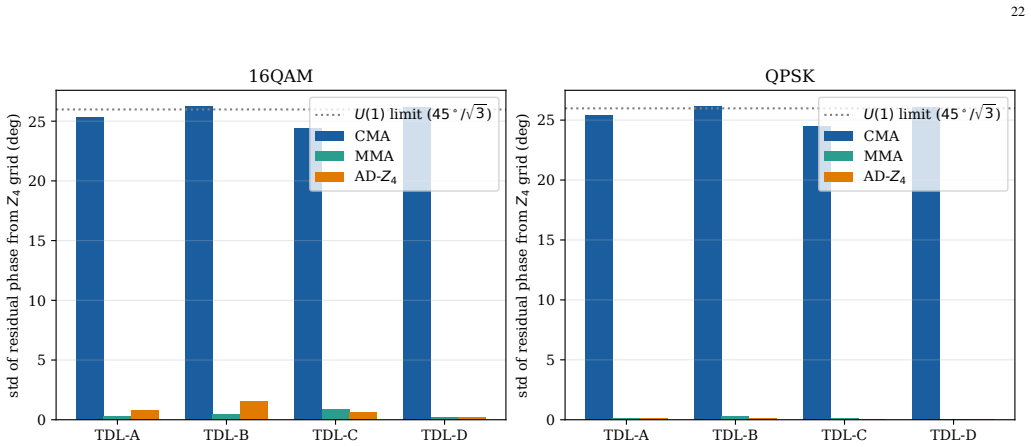
- A cost-symmetry matching principle extends AD to blind and adaptive signal processing, with the Constant Modulus Algorithm's residual phase ambiguity predicted analytically and matched within two degrees on 3GPP TDL multipath channels.
Where Pith is reading between the lines
- The (G, L) continuum suggests a unified statistical framework that interpolates between classical sample averaging and symmetry-based averaging.
- If the blind identification is reliable, it could enable automatic, data-driven selection of analysis transforms for new signal classes.
- The structural capacity κ offers a potential metric for comparing information organization across different signal representations or domains.
- Mapping additional blind problems to the cost-symmetry principle may reveal analytic predictions for other phase or sign ambiguities.
Load-bearing premise
The transformations under which a signal's statistics are invariant form a matched group that can be identified from data and determines a natural transform for analysis.
What would settle it
A controlled test with a known matched group where applying the group averaging does not reduce estimator variance as predicted, or where the blind generalized eigenvalue identification fails to recover the correct group from data.
Figures




read the original abstract
We present principles of algebraic diversity (AD), a group-theoretic approach to signal processing exploiting signal symmetry to extract more information per observation, complementing classical methods that use temporal and spatial diversity. The transformations under which a signal's statistics are invariant form a matched group; this group determines the natural transform for analysis, and averaging an estimator over the group action reduces variance without requiring additional snapshots. The viewpoint is broadened in five directions beyond the single-observation measurement of a companion paper. Rank promotion admits AD on scalar data streams and identifies the law of large numbers as the trivial-group case of a $(G, L)$ continuum combining sample-count with group-orbit averaging. An eigentensor hierarchy handles signals with nested symmetry. A blind group-matching methodology identifies the matched group from data via a polynomial-time generalized eigenvalue problem on the unitary Lie algebra, placing the DFT, DCT, and Karhunen--Lo\`{e}ve transforms as distinguished points on a transform manifold. A cost-symmetry matching principle then extends AD from measurement to blind and adaptive signal processing generally; blind equalization is given as a detailed example, with the Constant Modulus Algorithm's residual phase ambiguity predicted analytically and matched within two degrees on 3GPP TDL multipath channels, and other blind problems in signal processing are mapped into the framework. Four theorems formalize a structural capacity $\kappa$, the R\'{e}nyi-2 analog of Shannon and von Neumann's R\'{e}nyi-1 entropies, quantifying how a signal's information is organized rather than how much information it contains. AD complements prior algebraic approaches including invariant estimation, minimax robust estimation, algebraic signal processing, and compressed sensing.
Editorial analysis
A structured set of objections, weighed in public.
Referee Report
Summary. The paper introduces algebraic diversity (AD), a group-theoretic approach to signal processing that identifies 'matched groups' of transformations preserving signal statistics. These groups define natural transforms and enable variance reduction by averaging estimators over the group action without additional snapshots. Extensions include rank promotion for scalar streams (identifying the law of large numbers as the trivial-group case), eigentensor hierarchies for nested symmetries, a blind group-matching method via polynomial-time generalized eigenvalue problems on the unitary Lie algebra (placing DFT, DCT, and Karhunen-Loève transforms on a manifold), and a cost-symmetry principle applied to blind equalization. Four theorems define a structural capacity κ as the Rényi-2 analog of Shannon/von Neumann entropies, and the CMA phase ambiguity is analytically predicted and matched within two degrees on 3GPP TDL channels.
Significance. If the central claims hold, particularly reliable data-driven group identification and consequent variance reduction, AD could complement classical diversity techniques by systematically exploiting symmetry, potentially improving estimation efficiency in data-limited regimes. The four theorems formalizing structural capacity κ provide a novel measure focused on information organization rather than quantity, and the analytical CMA prediction matched to standard-channel simulations is a concrete strength demonstrating applicability. The mapping of multiple blind problems into the framework offers a unifying perspective that builds on prior algebraic signal processing and invariant estimation methods.
major comments (2)
- [Blind group-matching methodology] Blind group-matching methodology: The polynomial-time generalized eigenvalue problem on the unitary Lie algebra for identifying the matched group from data provides no analysis of numerical conditioning, convergence rates under finite noisy observations, or error propagation when exact invariance is violated (e.g., by additive noise or model mismatch). This is load-bearing for the variance-reduction claim, as inaccurate group recovery can increase rather than decrease estimator variance; Monte Carlo robustness tests at varying SNR would be required to support the polynomial-time identification and averaging results.
- [Four theorems on structural capacity κ] Structural capacity κ: The four theorems introduce κ as the Rényi-2 analog quantifying information organization, yet the presentation does not demonstrate whether the definition is parameter-free or reduces by construction to a known quantity (e.g., under the trivial-group case or specific symmetry assumptions). This affects the independence of the new measure from prior entropies and should be clarified with an explicit reduction or counter-example.
minor comments (2)
- The abstract states the viewpoint is broadened in five directions but enumerates rank promotion, eigentensor hierarchy, blind group-matching, cost-symmetry matching, and the structural capacity theorems (four items plus theorems); an explicit numbered list of the five directions would improve readability.
- [CMA example] In the CMA blind equalization example, the statement that the analytically predicted phase ambiguity is 'matched within two degrees' on 3GPP TDL channels lacks details on the number of Monte Carlo trials, channel realizations, or any error statistics; adding these would strengthen the empirical support.
Simulated Author's Rebuttal
We thank the referee for the constructive comments on our work introducing algebraic diversity. We address the two major comments point by point below. We agree that further analysis is needed for the blind group identification method and clarification for the structural capacity κ, and will revise the manuscript accordingly to strengthen these aspects.
read point-by-point responses
-
Referee: Blind group-matching methodology: The polynomial-time generalized eigenvalue problem on the unitary Lie algebra for identifying the matched group from data provides no analysis of numerical conditioning, convergence rates under finite noisy observations, or error propagation when exact invariance is violated (e.g., by additive noise or model mismatch). This is load-bearing for the variance-reduction claim, as inaccurate group recovery can increase rather than decrease estimator variance; Monte Carlo robustness tests at varying SNR would be required to support the polynomial-time identification and averaging results.
Authors: We agree with the referee that additional analysis on the numerical properties and robustness of the blind group-matching methodology is necessary to fully support the variance-reduction claims. The manuscript currently emphasizes the algebraic formulation and the polynomial-time nature of the generalized eigenvalue problem on the unitary Lie algebra. In the revised version, we will incorporate a new subsection providing analysis of the numerical conditioning, theoretical considerations on convergence rates for finite noisy observations, discussion of error propagation under model mismatch, and Monte Carlo simulation results demonstrating performance across varying SNR levels. revision: yes
-
Referee: Structural capacity κ: The four theorems introduce κ as the Rényi-2 analog quantifying information organization, yet the presentation does not demonstrate whether the definition is parameter-free or reduces by construction to a known quantity (e.g., under the trivial-group case or specific symmetry assumptions). This affects the independence of the new measure from prior entropies and should be clarified with an explicit reduction or counter-example.
Authors: We appreciate the referee pointing out the need for clarification on the structural capacity κ. The four theorems present κ as a parameter-free measure derived from the group action within the Rényi-2 framework. In the revised manuscript, we will add an explicit corollary demonstrating the reduction to the trivial-group case (where it coincides with the standard Rényi-2 entropy) and include a counter-example for a non-trivial symmetry group to illustrate its independence from conventional entropy measures. revision: yes
Circularity Check
Derivation chain is self-contained with no circular reductions
full rationale
The paper introduces algebraic diversity via the matched group concept, a blind identification method based on a generalized eigenvalue problem on the unitary Lie algebra, variance reduction by group-orbit averaging, and structural capacity κ formalized through four new theorems as a Rényi-2 entropy analog. These elements are presented as extensions beyond a companion paper rather than reductions to it. No quoted equations or definitions show a result being equivalent to its inputs by construction, a fitted parameter renamed as a prediction, or a load-bearing premise justified solely by overlapping-author self-citation. The transform manifold placement of DFT/DCT/KL and the cost-symmetry matching principle are derived from the group action framework without tautological redefinition. The overall structure relies on external group theory and signal processing concepts, making the central claims independently derivable from the stated assumptions.
Axiom & Free-Parameter Ledger
axioms (2)
- domain assumption A signal's statistics are invariant under the action of a matched group of transformations.
- domain assumption Averaging estimators over the group action reduces variance without additional snapshots.
invented entities (3)
-
Algebraic diversity (AD)
no independent evidence
-
Matched group
no independent evidence
-
Structural capacity κ
no independent evidence
Forward citations
Cited by 3 Pith papers
-
Polynomial-Time Optimal Group Selection via the Double-Commutator Eigenvalue Problem
Optimal group selection for covariance matching reduces exactly to the minimum eigenvector of the double-commutator matrix, solvable in O(d²M² + d³) time.
-
Algebraic Diversity: Group-Theoretic Spectral Estimation from Single Observations
Group-averaged estimators from one observation achieve equivalent subspace decomposition to multi-observation covariance methods, with variance scaling by group order and unifying DFT, DCT, and KLT as special cases.
-
Unification of Signal Transform Theory
Signal transforms are unified as group representation eigenbases, with an algorithm to find the matched group from empirical covariances.
Reference graph
Works this paper leans on
-
[1]
Algebraic Diversity: Group-Theoretic Spectral Estimation from Single Observations
M. A. Thornton, “Algebraic diversity: Group-theoretic spectral estima- tion from single observations,” arXiv:2604.03634, 2026
work page internal anchor Pith review Pith/arXiv arXiv 2026
-
[2]
Quantum Algebraic Diversity: Single-Copy Density Matrix Estimation via Group-Structured Measurements
M. A. Thornton, “Quantum algebraic diversity: Single-copy density ma- trix estimation via group-structured measurements,” arXiv:2604.03725, 2026
work page internal anchor Pith review Pith/arXiv arXiv 2026
-
[3]
Self-recovering equalization and carrier tracking in two-dimensional data communication systems,
D. N. Godard, “Self-recovering equalization and carrier tracking in two-dimensional data communication systems,”IEEE Trans. Commun., vol. COM-28, no. 11, pp. 1867–1875, Nov. 1980
1980
-
[4]
A method of self-recovering equalization for multilevel amplitude-modulation systems,
Y . Sato, “A method of self-recovering equalization for multilevel amplitude-modulation systems,”IEEE Trans. Commun., vol. COM-23, no. 6, pp. 679–682, Jun. 1975
1975
-
[5]
Bussgang techniques for blind equalization,
S. Bellini, “Bussgang techniques for blind equalization,” inProc. IEEE Global Commun. Conf. (GLOBECOM), Dec. 1986, pp. 1634–1640
1986
-
[6]
New criteria for blind deconvolution of nonminimum phase systems (channels),
O. Shalvi and E. Weinstein, “New criteria for blind deconvolution of nonminimum phase systems (channels),”IEEE Trans. Inf. Theory, vol. 36, no. 2, pp. 312–321, Mar. 1990
1990
-
[7]
A new approach to multipath correction of constant modulus signals,
J. R. Treichler and B. G. Agee, “A new approach to multipath correction of constant modulus signals,”IEEE Trans. Acoust., Speech, Signal Process., vol. ASSP-31, no. 2, pp. 459–472, Apr. 1983. 30
1983
-
[8]
The multimodulus blind equalization and its generalized algorithms,
J. Yang, J.-J. Werner, and G. A. Dumont, “The multimodulus blind equalization and its generalized algorithms,”IEEE J. Sel. Areas Com- mun., vol. 20, no. 5, pp. 997–1015, Jun. 2002
2002
-
[9]
Exploitation of spectral redundancy in cyclostationary signals,
W. A. Gardner, “Exploitation of spectral redundancy in cyclostationary signals,”IEEE Signal Process. Mag., vol. 8, no. 2, pp. 14–36, Apr. 1991
1991
-
[10]
On spatial smoothing for direction- of-arrival estimation of coherent signals,
T. J. Shan, M. Wax, and T. Kailath, “On spatial smoothing for direction- of-arrival estimation of coherent signals,”IEEE Trans. Acoust., Speech, Signal Process., vol. ASSP-33, no. 4, pp. 806–811, Aug. 1985
1985
-
[11]
Forward/backward spatial smoothing techniques for coherent signal identification,
S. U. Pillai and B. H. Kwon, “Forward/backward spatial smoothing techniques for coherent signal identification,”IEEE Trans. Acoust., Speech, Signal Process., vol. 37, no. 1, pp. 8–15, Jan. 1989
1989
-
[12]
On the application of uniform linear array bearing estimation techniques to uniform circular arrays,
A. H. Tewfik and W. Hong, “On the application of uniform linear array bearing estimation techniques to uniform circular arrays,”IEEE Trans. Signal Process., vol. 40, no. 4, pp. 1008–1011, Apr. 1992
1992
-
[13]
Direction finding using spatial smooth- ing with interpolated arrays,
B. Friedlander and A. J. Weiss, “Direction finding using spatial smooth- ing with interpolated arrays,”IEEE Trans. Aerospace and Electronic Systems, vol. 28, no. 2, pp. 574–587, Apr. 1992
1992
-
[14]
Study on channel model for frequencies from 0.5 to 100 GHz,
3GPP TR 38.901, “Study on channel model for frequencies from 0.5 to 100 GHz,” V16.1.0, 2019
2019
-
[15]
Algebraic signal processing theory: Foundation and 1-D time,
M. Püschel and J. M. F. Moura, “Algebraic signal processing theory: Foundation and 1-D time,”IEEE Trans. Signal Process., vol. 56, no. 8, pp. 3572–3585, Aug. 2008
2008
-
[16]
Algebraic signal processing theory: 1-D space,
M. Püschel and J. M. F. Moura, “Algebraic signal processing theory: 1-D space,”IEEE Trans. Signal Process., vol. 56, no. 8, pp. 3586–3599, Aug. 2008
2008
-
[17]
Algebraic signal process- ing theory: 1-D nearest neighbor models,
A. Sandryhaila, J. Kova ˇcevi´c, and M. Püschel, “Algebraic signal process- ing theory: 1-D nearest neighbor models,”IEEE Trans. Signal Process., vol. 60, no. 5, pp. 2247–2259, May 2012
2012
-
[18]
Discrete signal processing on graphs,
A. Sandryhaila and J. M. F. Moura, “Discrete signal processing on graphs,”IEEE Trans. Signal Process., vol. 61, no. 7, pp. 1644–1656, Apr. 2013
2013
-
[19]
Discrete signal processing on graphs: Frequency analysis,
A. Sandryhaila and J. M. F. Moura, “Discrete signal processing on graphs: Frequency analysis,”IEEE Trans. Signal Process., vol. 62, no. 12, pp. 3042–3054, Jun. 2014
2014
-
[20]
H. V . Poor,An Introduction to Signal Detection and Estimation, 2nd ed., Springer-Verlag, New York, 1994
1994
-
[21]
E. L. Lehmann and J. P. Romano,Testing Statistical Hypotheses, 3rd ed., Springer, New York, 2005
2005
-
[22]
A competitive minimax approach to robust estimation of random parameters,
Y . C. Eldar and N. Merhav, “A competitive minimax approach to robust estimation of random parameters,”IEEE Trans. Signal Process., vol. 52, no. 7, pp. 1931–1946, Jul. 2004
1931
-
[23]
Robust mean-squared error estimation in the presence of model uncertainties,
Y . C. Eldar, A. Ben-Tal, and A. Nemirovski, “Robust mean-squared error estimation in the presence of model uncertainties,”IEEE Trans. Signal Process., vol. 53, no. 1, pp. 168–181, Jan. 2005
2005
-
[24]
D. P. Palomar and Y . C. Eldar, Eds.,Convex Optimization in Signal Pro- cessing and Communications, Cambridge University Press, Cambridge, 2010
2010
-
[25]
Stable signal recovery from incomplete and inaccurate measurements,
E. J. Candès, J. K. Romberg, and T. Tao, “Stable signal recovery from incomplete and inaccurate measurements,”Commun. Pure Appl. Math., vol. 59, no. 8, pp. 1207–1223, Aug. 2006
2006
-
[26]
Compressed sensing,
D. L. Donoho, “Compressed sensing,”IEEE Trans. Inf. Theory, vol. 52, no. 4, pp. 1289–1306, Apr. 2006
2006
-
[27]
A mathematical theory of communication,
C. E. Shannon, “A mathematical theory of communication,”Bell Syst. Tech. J., vol. 27, pp. 379–423 and 623–656, 1948
1948
-
[28]
Vergleichende Betrachtungen über neuere geometrische Forschungen,
F. Klein, “Vergleichende Betrachtungen über neuere geometrische Forschungen,”Math. Ann., vol. 43, pp. 63–100, 1872
-
[29]
Diversity and evenness: A unifying notation and its consequences,
M. O. Hill, “Diversity and evenness: A unifying notation and its consequences,”Ecology, vol. 54, no. 2, pp. 427–432, 1973
1973
-
[30]
von Neumann,Mathematische Grundlagen der Quantenmechanik, Springer, Berlin, 1932
J. von Neumann,Mathematische Grundlagen der Quantenmechanik, Springer, Berlin, 1932
1932
-
[31]
The uncertainty principle,
H. P. Robertson, “The uncertainty principle,”Phys. Rev., vol. 34, no. 1, pp. 163–164, Jul. 1929
1929
-
[32]
NDT: Ultrasonic testing for pitting and corrosion,
Quality Magazine, “NDT: Ultrasonic testing for pitting and corrosion,” industry technical note, 2016
2016
-
[33]
Phased array ultrasonic testing for corrosion inspection,
Team Industrial Services, “Phased array ultrasonic testing for corrosion inspection,” industry technical bulletin, 2025
2025
-
[34]
Magnetic flux leakage vs. ultrasonic pit depth measurement on ferrous pipe,
NDT.net comparative study, “Magnetic flux leakage vs. ultrasonic pit depth measurement on ferrous pipe,”NDT.net, 2000
2000
discussion (0)
Sign in with ORCID, Apple, or X to comment. Anyone can read and Pith papers without signing in.