Recognition: unknown
Algorithm and Hardware Co-Design for Efficient Complex-Valued Uncertainty Estimation
Pith reviewed 2026-05-10 00:55 UTC · model grok-4.3
The pith
Bayesian dropout enables uncertainty quantification directly in complex-valued neural networks with hardware-efficient implementations.
A machine-rendered reading of the paper's core claim, the machinery that carries it, and where it could break.
Core claim
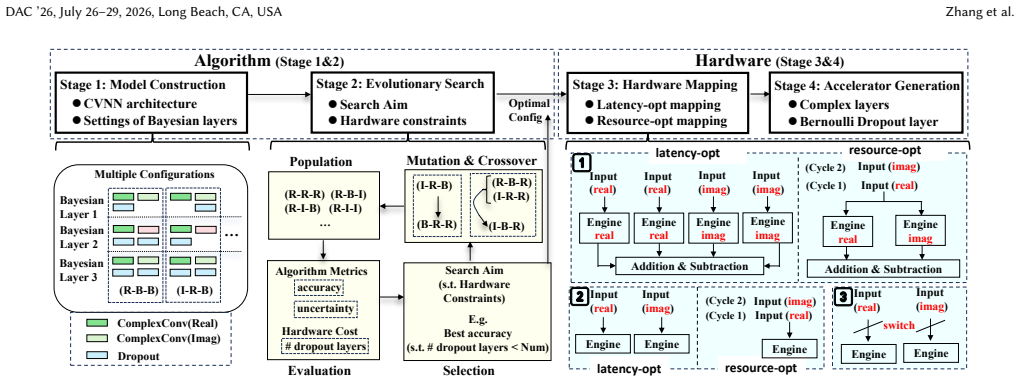
We propose, for the first time, dropout-based Bayesian Complex-Valued Neural Networks (BayesCVNNs) to enable uncertainty quantification for complex-valued applications, exhibiting broad applicability and efficiency for hardware implementation due to modularity. As the dual-part nature of complex values broadens the design space with novel layer-mixing and part-mixing configurations, an automated search identifies optimal setups for real and imaginary parts. A framework generates customized FPGA-based accelerators using optimized building blocks, with experiments showing the best configurations attain higher performance with lower hardware costs.
What carries the argument
dropout-based variational inference extended to complex-valued layers combined with automated search over layer-mixing and part-mixing configurations
Load-bearing premise
That dropout remains a valid variational approximation to Bayesian inference when the network weights and operations are complex-valued rather than real-valued.
What would settle it
Observing whether the uncertainty estimates from BayesCVNNs are well-calibrated on a complex-valued test set, or whether the automatically searched configurations use fewer hardware resources than the best manually designed ones while maintaining or improving accuracy.
Figures



read the original abstract
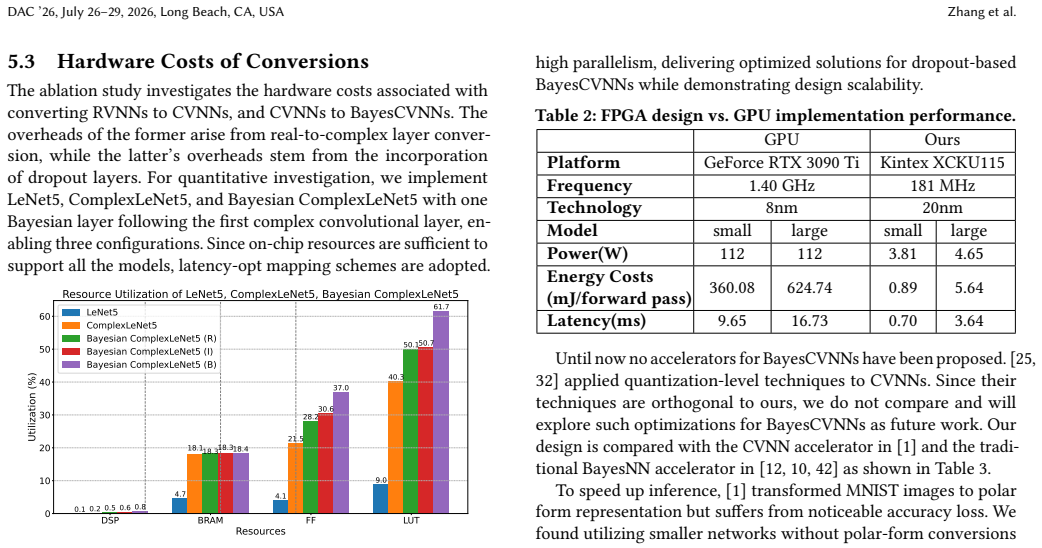
Complex-Valued Neural Networks (CVNNs) have significant advantages in handling tasks that involve complex numbers. However, existing CVNNs are unable to quantify predictive uncertainty. We propose, for the first time, dropout-based Bayesian Complex-Valued Neural Networks (BayesCVNNs) to enable uncertainty quantification for complex-valued applications, exhibiting broad applicability and efficiency for hardware implementation due to modularity. Furthermore, as the dual-part nature of complex values significantly broadens the design space and enables novel configurations based on layer-mixing and part-mixing, we introduce an automated search approach to effectively identify optimal configurations for both real and imaginary components. To facilitate deployment, we present a framework that generates customized FPGA-based accelerators for BayesCVNNs, leveraging a set of optimized building blocks. Experiments demonstrate the best configuration can be effectively found via the automated search, attaining higher performance with lower hardware costs compared with manually crafted models. The optimized accelerators achieve approximately 4.5x and 13x speedups on different models with less than 10% power consumption compared to GPU implementations, and outperform existing work in both algorithm and hardware aspects. Our code is publicly available at: https://github.com/zehuanzhang/BayesCVNN.git.
Editorial analysis
A structured set of objections, weighed in public.
Referee Report
Summary. The paper proposes the first dropout-based Bayesian Complex-Valued Neural Networks (BayesCVNNs) for predictive uncertainty quantification in CVNNs. It introduces an automated search over layer-mixing and part-mixing configurations to optimize accuracy and hardware cost, together with a modular FPGA accelerator generation framework that produces custom accelerators from optimized building blocks. Experiments are said to show that the search finds superior configurations and that the resulting accelerators deliver ~4.5× and 13× speedups versus GPU baselines at <10% power.
Significance. If the central claims are substantiated, the work would provide a practical route to uncertainty-aware complex-valued models together with hardware co-design, which is relevant for signal-processing and communications applications. Public release of the code is a clear positive.
major comments (2)
- [Abstract and §4] Abstract and §4 (Experiments): the claim that the automated search attains “higher performance with lower hardware costs” and that accelerators achieve 4.5×/13× speedups rests on unspecified datasets, baselines, uncertainty calibration metrics (e.g., ECE, NLL), and synthesis results. Without these details the experimental support for the co-design claim cannot be evaluated.
- [§3] §3 (BayesCVNN construction): the paper applies real-valued dropout (layer-wise or part-wise) inside complex multiplication and addition to obtain a variational posterior, yet provides no calibration study, comparison against exact inference, or analysis of whether the induced variational family respects the circular geometry of complex posteriors. This assumption is load-bearing for the entire uncertainty-quantification claim.
minor comments (2)
- [§3] Notation for real/imaginary part mixing and the precise definition of the search space (layer-mixing vs. part-mixing) should be formalized with a small table or diagram early in §3 to improve readability.
- [Abstract] The abstract states “outperform existing work in both algorithm and hardware aspects” without naming the prior CVNN or Bayesian hardware papers being compared; a short related-work paragraph or table would clarify the novelty.
Simulated Author's Rebuttal
We thank the referee for the thorough and constructive review. The comments highlight important areas for clarification and strengthening, particularly around experimental details and theoretical justification of the variational approximation. We address each point below and commit to revisions that improve the manuscript without misrepresenting our contributions.
read point-by-point responses
-
Referee: [Abstract and §4] Abstract and §4 (Experiments): the claim that the automated search attains “higher performance with lower hardware costs” and that accelerators achieve 4.5×/13× speedups rests on unspecified datasets, baselines, uncertainty calibration metrics (e.g., ECE, NLL), and synthesis results. Without these details the experimental support for the co-design claim cannot be evaluated.
Authors: We agree that the abstract and experimental section would benefit from greater specificity to allow full evaluation of the claims. In the revised version, we will explicitly name the datasets (complex-valued signal processing and communications benchmarks used in §4), detail the GPU baselines (including hardware platforms and software implementations), report uncertainty calibration metrics such as ECE and NLL alongside accuracy, and expand the synthesis results with concrete FPGA metrics (resource utilization, latency, power). These additions will directly support the co-design performance claims. revision: yes
-
Referee: [§3] §3 (BayesCVNN construction): the paper applies real-valued dropout (layer-wise or part-wise) inside complex multiplication and addition to obtain a variational posterior, yet provides no calibration study, comparison against exact inference, or analysis of whether the induced variational family respects the circular geometry of complex posteriors. This assumption is load-bearing for the entire uncertainty-quantification claim.
Authors: We acknowledge the importance of validating the variational approximation. Our method extends the established real-valued dropout variational inference to CVNNs via layer-wise and part-mixing strategies applied to complex operations. Exact inference is intractable for networks of this size (as is standard in the BNN literature), precluding direct comparison. In the revision we will add: (i) a discussion of how the part-mixing and layer-mixing configurations preserve key complex properties, (ii) empirical calibration results using ECE and NLL, and (iii) analysis of the induced posterior relative to circular symmetry. This strengthens the uncertainty-quantification foundation while preserving the paper's focus on the novel co-design. revision: partial
Circularity Check
No circularity: novel BayesCVNN construction and search evaluated empirically
full rationale
The paper introduces dropout-based variational inference for complex-valued networks as a new construction, along with an automated search over layer-mixing and part-mixing configurations whose outputs are measured against external GPU baselines and manual designs. No derivation step reduces to a self-definition, fitted parameter renamed as prediction, or load-bearing self-citation chain; the central claims rest on empirical validation rather than tautological equivalence to inputs.
Axiom & Free-Parameter Ledger
Reference graph
Works this paper leans on
-
[1]
Maruf Ahmad, Lei Zhang, and Muhammad EH Chowdhury. 2024. FPGA im- plementation of complex-valued neural network for polar-represented image classification.Sensors, 24, 3, 897
2024
- [2]
-
[3]
Hiromitsu Awano and Masanori Hashimoto. 2020. BYNQnet: Bayesian neural network with quadratic activations for sampling-free uncertainty estimation on FPGA. In2020 Design, Automation & Test in Europe Conference & Exhibition (DATE). IEEE, 1402–1407
2020
-
[4]
Jose Agustin Barrachina, Chenfang Ren, Christele Morisseau, Gilles Vieillard, and J-P Ovarlez. 2021. Complex-valued vs. real-valued neural networks for clas- sification perspectives: an example on non-circular data. InIEEE International Conference on Acoustics, Speech and Signal Processing. IEEE, 2990–2994
2021
-
[5]
David M Blei, Alp Kucukelbir, and Jon D McAuliffe. 2017. Variational inference: a review for statisticians.Journal of the American Statistical Association, 112, 518, 859–877
2017
-
[6]
Charles Blundell, Julien Cornebise, Koray Kavukcuoglu, and Daan Wierstra
-
[7]
InInternational Conference on Machine Learning
Weight uncertainty in neural network. InInternational Conference on Machine Learning. PMLR, 1613–1622
-
[8]
Ruizhe Cai, Ao Ren, Ning Liu, Caiwen Ding, Luhao Wang, Xuehai Qian, Massoud Pedram, and Yanzhi Wang. 2018. VIBNN: hardware acceleration of Bayesian neural networks.ACM SIGPLAN Notices, 53, 2, 476–488
2018
-
[9]
Yice Cao, Yan Wu, Peng Zhang, Wenkai Liang, and Ming Li. 2019. Pixel-wise polsar image classification via a novel complex-valued deep fully convolutional network.Remote Sensing, 11, 22, 2653
2019
-
[10]
Elizabeth Cole, Joseph Cheng, John Pauly, and Shreyas Vasanawala. 2021. Analysis of deep complex-valued convolutional neural networks for MRI re- construction and phase-focused applications.Magnetic Resonance in Medicine, 86, 2, 1093–1109
2021
-
[11]
Hongxiang Fan, Mark Chen, Liam Castelli, Zhiqiang Que, He Li, Kenneth Long, and Wayne Luk. 2023. When Monte-Carlo dropout meets multi-exit: op- timizing Bayesian neural networks on FPGA. InACM/IEEE Design Automation Conference. IEEE, 1–6
2023
-
[12]
Hongxiang Fan, Martin Ferianc, Zhiqiang Que, Shuanglong Liu, Xinyu Niu, Miguel RD Rodrigues, and Wayne Luk. 2022. FPGA-based acceleration for Bayesian convolutional neural networks.IEEE Transactions on Computer-Aided Design of Integrated Circuits and Systems, 41, 12, 5343–5356
2022
-
[13]
Hongxiang Fan, Martin Ferianc, Zhiqiang Que, Xinyu Niu, Miguel Rodrigues, and Wayne Luk. 2022. Accelerating bayesian neural networks via algorithmic and hardware optimizations.IEEE Transactions on Parallel and Distributed Systems, 33, 12, 3387–3399
2022
-
[14]
Hongxiang Fan, Martin Ferianc, Miguel Rodrigues, Hongyu Zhou, Xinyu Niu, and Wayne Luk. 2021. High-performance FPGA-based accelerator for Bayesian neural networks. In2021 58th ACM/IEEE Design Automation Conference (DAC). IEEE, 1063–1068
2021
-
[15]
Martin Ferianc, Divyansh Manocha, Hongxiang Fan, and Miguel Rodrigues
-
[16]
InInternational Conference on Artificial Neural Networks
Combinet: compact convolutional bayesian neural network for image seg- mentation. InInternational Conference on Artificial Neural Networks. Springer, 483–494
-
[17]
Martin Ferianc, Zhiqiang Que, Hongxiang Fan, Wayne Luk, and Miguel Ro- drigues. 2021. Optimizing Bayesian recurrent neural networks on an FPGA- based accelerator. In2021 International Conference on Field-Programmable Tech- nology (ICFPT). IEEE, 1–10
2021
-
[18]
Yoshiki Fujiwara and Shinya Takamaeda-Yamazaki. 2021. ASBNN: acceleration of Bayesian convolutional neural networks by algorithm-hardware co-design. In2021 IEEE 32nd International Conference on Application-specific Systems, Architectures and Processors (ASAP). IEEE, 226–233
2021
-
[19]
Yarin Gal and Zoubin Ghahramani. 2016. Dropout as a Bayesian approximation: representing model uncertainty in deep learning. InInternational Conference on Machine Learning. PMLR, 1050–1059
2016
-
[20]
Jingkun Gao, Bin Deng, Yuliang Qin, Hongqiang Wang, and Xiang Li. 2018. Enhanced radar imaging using a complex-valued convolutional neural network. IEEE Geoscience and Remote Sensing Letters, 16, 1, 35–39
2018
-
[21]
Ethan Goan and Clinton Fookes. 2020. Bayesian neural networks: an introduc- tion and survey.Case Studies in Applied Bayesian Data Science: CIRM Jean-Morlet Chair, Fall 2018, 45–87
2020
-
[22]
Su Lee Goh, Mo Chen, DH Popović, K Aihara, D Obradovic, and DP Mandic
-
[23]
Complex-valued forecasting of wind profile.Renewable Energy, 31, 11, 1733–1750
-
[24]
Chuan Guo, Geoff Pleiss, Yu Sun, and Kilian Q Weinberger. 2017. On calibration of modern neural networks. InInternational conference on machine learning. PMLR, 1321–1330
2017
-
[25]
Laurent Valentin Jospin, Hamid Laga, Farid Boussaid, Wray Buntine, and Mohammed Bennamoun. 2022. Hands-on Bayesian neural networks—a tutorial for deep learning users.IEEE Computational Intelligence Magazine, 17, 2, 29–48
2022
- [26]
-
[27]
Yann LeCun, Léon Bottou, Yoshua Bengio, and Patrick Haffner. 2002. Gradient- based learning applied to document recognition.Proceedings of the IEEE, 86, 11, 2278–2324
2002
-
[28]
Hyunwuk Lee, Hyungjun Jang, Sungbin Kim, Sungwoo Kim, Wonho Cho, and Won Woo Ro. 2023. Exploiting inherent properties of complex numbers for accelerating complex valued neural networks. InProceedings of the 56th Annual IEEE/ACM International Symposium on Microarchitecture, 1121–1134
2023
-
[29]
Ruochen Li, Jiazhen Pan, Youxiang Zhu, Juncheng Ni, and Daniel Rueckert
-
[30]
InInternational Workshop on Machine Learning in Medical Imaging
Classification, regression and segmentation directly from k-space in cardiac mri. InInternational Workshop on Machine Learning in Medical Imaging. Springer, 31–41
-
[31]
Mingqi Lv, Wei Xu, and Tieming Chen. 2019. A hybrid deep convolutional and recurrent neural network for complex activity recognition using multimodal sensors.Neurocomputing, 362, 33–40
2019
-
[32]
Huilin Mu, Yun Zhang, Yicheng Jiang, and Chang Ding. 2021. CV-GMTINet: GMTI using a deep complex-valued convolutional neural network for multi- channel SAR-GMTI system.IEEE Transactions on Geoscience and Remote Sensing, 60, 1–15
2021
-
[33]
Radford Neal. 1992. Bayesian learning via stochastic dynamics.Advances in Neural Information Processing Systems, 5
1992
-
[34]
Radford M Neal et al. 2011. Mcmc using hamiltonian dynamics.Handbook of Markov Chain Monte Carlo, 2, 11, 2
2011
-
[35]
Othmane-Latif Ouabi, Radmila Pribić, and Sorin Olaru. 2021. Stochastic complex- valued neural networks for radar. In28th European Signal Processing Conference, 1442–1446. doi:10.23919/Eusipco47968.2020.9287425
-
[36]
Hongwu Peng et al. 2021. Binary complex neural network acceleration on FPGA. In2021 IEEE 32nd International Conference on Application-specific Systems, Architectures and Processors (ASAP). IEEE, 85–92
2021
-
[37]
Călin-Adrian Popa. 2017. Complex-valued convolutional neural networks for real-valued image classification. InInternational Joint Conference on Neural Networks. IEEE, 816–822
2017
-
[38]
Zhiqiang Que, Hongxiang Fan, Gabriel Figueiredo, Ce Guo, Wayne Luk, Ryota Yasudo, and Masato Motomura. 2025. Trustworthy deep learning accelera- tion with customizable design flow automation. InProceedings of the 15th International Symposium on Highly Efficient Accelerators and Reconfigurable Technologies, 1–13
2025
-
[39]
Koosha Sharifani and Mahyar Amini. 2023. Machine learning and deep learn- ing: a review of methods and applications.World Information Technology and Engineering Journal, 10, 07, 3897–3904
2023
-
[40]
Yuki Sunaga, Ryo Natsuaki, and Akira Hirose. 2019. Land form classification and similar land-shape discovery by using complex-valued convolutional neural networks.IEEE Transactions on Geoscience and Remote Sensing, 57, 10, 7907– 7917
2019
-
[41]
Chiheb Trabelsi et al. 2017. Deep complex networks.arXiv preprint arXiv: 1705.09792
work page Pith review arXiv 2017
-
[42]
Shanshan Wang, Huitao Cheng, Leslie Ying, Taohui Xiao, Ziwen Ke, Hairong Zheng, and Dong Liang. 2020. Deepcomplexmri: exploiting deep residual net- work for fast parallel mr imaging with complex convolution.Magnetic resonance imaging, 68, 136–147
2020
-
[43]
Max Welling and Yee W Teh. 2011. Bayesian learning via stochastic gradi- ent langevin dynamics. InProceedings of the 28th international conference on machine learning (ICML-11). Citeseer, 681–688
2011
-
[44]
Linfang Xiao, Yilong Liu, Zheyuan Yi, Yujiao Zhao, Linshan Xie, Peibei Cao, Alex TL Leong, and Ed X Wu. 2022. Partial fourier reconstruction of complex mr images using complex-valued convolutional neural networks.Magnetic Resonance in Medicine, 87, 2, 999–1014
2022
-
[45]
Ximei Yang, Ronny G Guendel, Alexander Yarovoy, and Francesco Fioranelli
-
[46]
In2022 IEEE radar conference (radarConf22)
Radar-based human activities classification with complex-valued neural networks. In2022 IEEE radar conference (radarConf22). IEEE, 1–6
-
[47]
Zehuan Zhang, Hongxiang Fan, Hao Chen, Lukasz Dudziak, and Wayne Luk
-
[48]
InProceedings of the 61st ACM/IEEE Design Automation Conference (DAC), 1–6
Hardware-aware neural dropout search for reliable uncertainty prediction on FPGA. InProceedings of the 61st ACM/IEEE Design Automation Conference (DAC), 1–6
-
[49]
Zehuan Zhang, Matej Genci, Hongxiang Fan, Andreas Wetscherek, and Wayne Luk. 2024. Accelerating MRI uncertainty estimation with mask-based Bayesian neural network. InIEEE 35th International Conference on Application-specific Systems, Architectures and Processors. IEEE, 107–115
2024
- [50]
-
[51]
Ke Zou, Zhihao Chen, Xuedong Yuan, Xiaojing Shen, Meng Wang, and Huazhu Fu. 2023. A review of uncertainty estimation and its application in medical imaging.Meta-Radiology, 100003
2023
discussion (0)
Sign in with ORCID, Apple, or X to comment. Anyone can read and Pith papers without signing in.