Recognition: unknown
Weighted Holm Procedures: Theory, Properties, and Recommendations
Pith reviewed 2026-05-10 01:30 UTC · model grok-4.3
The pith
Ordering weighted p-values first yields a uniformly more powerful Holm procedure than ordering raw p-values while controlling familywise error.
A machine-rendered reading of the paper's core claim, the machinery that carries it, and where it could break.
Core claim
The paper establishes that the weighted Holm procedure (WHP), which orders hypotheses by their weighted p-values, is uniformly more powerful than the weighted alternative Holm procedure (WAP) that orders by raw p-values. This follows from direct comparison of their closed testing procedures. Additional results include that WAP is consonant but not monotone, graphical representations that share an initial graph yet use distinct updating strategies, derivation of both adjusted p-values and adjusted weighted p-values, and an optimality theorem stating that WHP cannot have any critical value enlarged without violating FWER control whereas WAP achieves optimality only under specific conditions.
What carries the argument
Closed testing procedures attached to each weighted Holm variant, which determine rejections by checking adjusted thresholds on all supersets of a given hypothesis.
If this is right
- Practitioners should prefer ordering by weighted p-values when weights are available to increase the chance of rejecting important false nulls.
- The shared-graph graphical representations allow non-statisticians to follow and verify the rejection steps for either procedure.
- Adjusted p-values and adjusted weighted p-values make both methods directly usable in reporting without needing to recompute thresholds.
- The optimality result for WHP means its critical values are tight for the class of procedures that use the same weighted p-value ordering.
Where Pith is reading between the lines
- Incorporating weights at the ordering step rather than only at the threshold step appears to be the source of the power advantage.
- Similar ordering comparisons could be applied to other weighted step-down or step-up procedures to check for parallel gains.
- In clinical trial design the result suggests assigning higher weights to primary endpoints can be paired with the WHP rule to improve overall study power without extra sample size.
Load-bearing premise
The p-values are valid and uniformly distributed under each null, and the weights are fixed in advance without depending on the observed data.
What would settle it
A concrete counter-example or simulation in which the weighted alternative procedure rejects strictly more hypotheses than the weighted Holm procedure while keeping the familywise error rate at or below the target alpha level.
Figures



read the original abstract
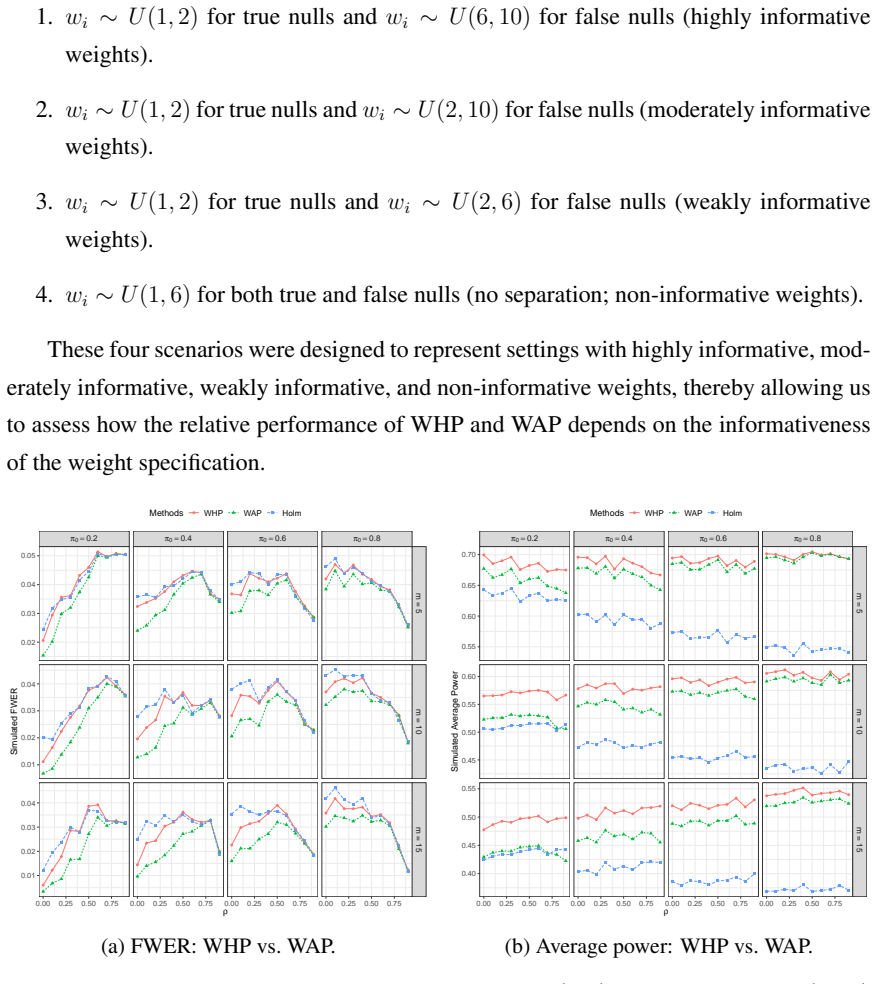
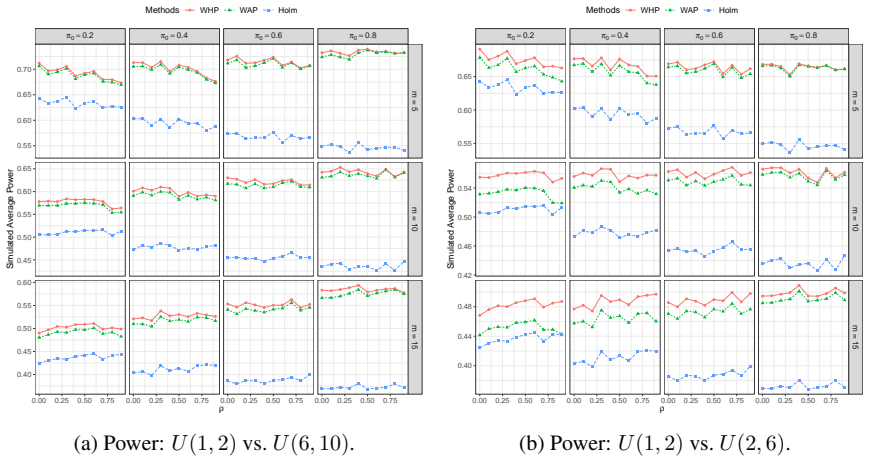
In many statistical applications, particularly in clinical studies, hypotheses may carry different levels of importance, motivating the use of weighted multiple testing procedures (wMTPs) to control the familywise error rate (FWER). Among these approaches, two weighted Holm procedures are commonly used: the weighted Holm procedure (WHP), which is based on ordered weighted $p$-values, and the weighted alternative Holm procedure (WAP), which relies on ordered raw $p$-values. This paper provides a systematic comparison of these two procedures, along with practical recommendations for their use. We first examine their corresponding closed testing procedures (CTPs) and show that WHP is uniformly more powerful than WAP. We further investigate their structural properties, demonstrating that WAP, while consonant, lacks monotonicity. To facilitate communication with non-statisticians, we introduce graphical representations of both procedures using a common initial graph and distinct updating strategies. In addition, we derive adjusted $p$-values and adjusted weighted $p$-values for both methods. Finally, we establish an optimality result: WHP cannot be improved by enlarging any of its critical values without violating FWER control, whereas WAP is optimal only under specific conditions. Simulation studies support these theoretical findings and highlight the superior FWER control and average power of WHP.
Editorial analysis
A structured set of objections, weighed in public.
Referee Report
Summary. The manuscript compares two weighted multiple testing procedures for FWER control: the weighted Holm procedure (WHP), based on ordered weighted p-values, and the weighted alternative Holm procedure (WAP), based on ordered raw p-values. It establishes via their closed testing procedures that WHP is uniformly more powerful than WAP, shows that WAP is consonant but not monotone, introduces graphical representations with a shared initial graph but different updating rules, derives adjusted p-values and adjusted weighted p-values, and proves an optimality result that WHP's critical values cannot be enlarged without violating FWER control while WAP is optimal only under specific conditions. Simulation studies are cited in support of the theoretical findings and practical recommendations.
Significance. If the derivations hold, the work supplies clear, actionable guidance for clinical-trial settings where hypotheses carry unequal importance. The uniform power superiority, optimality characterization, and graphical tools are concrete contributions that can improve procedure selection and communication with non-statisticians.
major comments (2)
- [Closed testing procedures] The section deriving the closed testing procedures: the uniform power superiority of WHP over WAP is asserted to follow from the local tests on intersection hypotheses; the manuscript should explicitly display the critical-value expressions for both procedures on a generic intersection hypothesis to make the nesting of rejection regions transparent.
- [Optimality result] The optimality theorem: the statement that WHP cannot be improved by enlarging any critical value is load-bearing for the final recommendation; the proof should clarify whether this optimality is with respect to the class of all consonant procedures or only within weighted Holm-type procedures, and should contrast the specific conditions under which WAP is optimal.
minor comments (3)
- [Simulation studies] The simulation section should report the exact number of hypotheses, the dependence structures examined, and the range of weight configurations; without these details it is difficult to assess how broadly the reported power and FWER advantages generalize.
- [Adjusted p-values] Notation for adjusted weighted p-values is introduced but not contrasted with ordinary adjusted p-values in a single table; adding such a comparison would improve readability.
- [Graphical representations] The graphical representations are described as using a common initial graph; a small numerical example showing the updating steps for both WHP and WAP on the same set of weighted p-values would make the distinction concrete.
Simulated Author's Rebuttal
We thank the referee for the careful reading of the manuscript and the constructive comments. We address each major comment below and will incorporate revisions to improve clarity as suggested.
read point-by-point responses
-
Referee: [Closed testing procedures] The section deriving the closed testing procedures: the uniform power superiority of WHP over WAP is asserted to follow from the local tests on intersection hypotheses; the manuscript should explicitly display the critical-value expressions for both procedures on a generic intersection hypothesis to make the nesting of rejection regions transparent.
Authors: We agree that explicitly displaying the critical-value expressions for a generic intersection hypothesis will make the argument more transparent. In the revised manuscript we will add the explicit formulas for the local-test critical values under both WHP and WAP for an arbitrary intersection hypothesis H_I. These expressions will directly illustrate the nesting of the rejection regions and thereby confirm the uniform power superiority of WHP over WAP. revision: yes
-
Referee: [Optimality result] The optimality theorem: the statement that WHP cannot be improved by enlarging any critical value is load-bearing for the final recommendation; the proof should clarify whether this optimality is with respect to the class of all consonant procedures or only within weighted Holm-type procedures, and should contrast the specific conditions under which WAP is optimal.
Authors: The optimality result shows that no critical value of WHP can be enlarged without violating FWER control. We will revise the theorem statement and its proof to make explicit that the result holds within the class of weighted Holm-type procedures that employ the same weighting scheme. We will also expand the contrast with the more restrictive conditions under which WAP is optimal, as already derived in the manuscript. revision: yes
Circularity Check
No significant circularity identified
full rationale
The paper's central derivations rest on standard closed testing theory (Marcus et al.) and FWER definitions applied to fixed-weight local tests. The uniform power superiority of WHP over WAP follows from the nested rejection regions induced by comparing local critical values on every intersection hypothesis, which is a direct consequence of the CTP construction and does not reduce to any fitted parameter, self-definition, or self-citation chain. Graphical representations, adjusted p-values, and optimality results are likewise obtained by algebraic manipulation of the same standard framework without circular reduction. The paper is self-contained against external benchmarks.
Axiom & Free-Parameter Ledger
axioms (2)
- domain assumption P-values are valid and stochastically larger than uniform under the null hypothesis
- domain assumption Weights are fixed and known in advance
Reference graph
Works this paper leans on
-
[1]
Statistics in medicine , volume=
Testing strategies in multi-dose experiments including active control , author=. Statistics in medicine , volume=. 1998 , publisher=
1998
-
[2]
Statistics in medicine , volume=
A graphical approach to sequentially rejective multiple test procedures , author=. Statistics in medicine , volume=. 2009 , publisher=
2009
-
[3]
Statistics in medicine , volume=
A recycling framework for the construction of Bonferroni-based multiple tests , author=. Statistics in medicine , volume=. 2009 , publisher=
2009
-
[4]
Statistics in medicine , volume=
Gatekeeping strategies for clinical trials that do not require all primary effects to be significant , author=. Statistics in medicine , volume=. 2003 , publisher=
2003
-
[5]
Statistics in medicine , volume=
Mixtures of multiple testing procedures for gatekeeping applications in clinical trials , author=. Statistics in medicine , volume=. 2011 , publisher=
2011
-
[6]
Biometrical Journal , volume=
General theory of mixture procedures for gatekeeping , author=. Biometrical Journal , volume=. 2013 , publisher=
2013
-
[7]
Statistics in medicine , volume=
A note on tree gatekeeping procedures in clinical trials , author=. Statistics in medicine , volume=. 2008 , publisher=
2008
-
[8]
Biometrical Journal: Journal of Mathematical Methods in Biosciences , volume=
Stepwise gatekeeping procedures in clinical trial applications , author=. Biometrical Journal: Journal of Mathematical Methods in Biosciences , volume=. 2006 , publisher=
2006
-
[9]
Biometrical Journal: Journal of Mathematical Methods in Biosciences , volume=
General multistage gatekeeping procedures , author=. Biometrical Journal: Journal of Mathematical Methods in Biosciences , volume=. 2008 , publisher=
2008
-
[10]
Statistics in medicine , volume=
Tree-structured gatekeeping tests in clinical trials with hierarchically ordered multiple objectives , author=. Statistics in medicine , volume=. 2007 , publisher=
2007
-
[11]
Biometrical Journal: Journal of Mathematical Methods in Biosciences , volume=
Bonferroni parallel gatekeeping--transparent generalizations, adjusted p-values, and short direct proofs , author=. Biometrical Journal: Journal of Mathematical Methods in Biosciences , volume=. 2007 , publisher=
2007
-
[12]
Statistics in Medicine , volume=
Superchain procedures in clinical trials with multiple objectives , author=. Statistics in Medicine , volume=. 2013 , publisher=
2013
-
[13]
Biometrika , volume=
On closed testing procedures with special reference to ordered analysis of variance , author=. Biometrika , volume=. 1976 , publisher=
1976
-
[14]
Statistics in Medicine , volume=
A note on testing families of hypotheses using graphical procedures , author=. Statistics in Medicine , volume=. 2014 , publisher=
2014
-
[15]
Multiple comparisons in drug clinical trials and preclinical assays: a-priori ordered hypothesis , author=. Biomed. Chem.-Pharm. Ind. , volume=
-
[16]
Journal of Statistical Planning and Inference , volume=
Optimally weighted, fixed sequence and gatekeeper multiple testing procedures , author=. Journal of Statistical Planning and Inference , volume=. 2001 , publisher=
2001
-
[17]
Statistics in medicine , volume=
Test and power considerations for multiple endpoint analyses using sequentially rejective graphical procedures , author=. Statistics in medicine , volume=. 2011 , publisher=
2011
-
[18]
Biometrical Journal , volume=
Graphical approaches for multiple comparison procedures using weighted Bonferroni, Simes, or parametric tests , author=. Biometrical Journal , volume=. 2011 , publisher=
2011
-
[19]
The Annals of Statistics , pages=
The sequential rejection principle of familywise error control , author=. The Annals of Statistics , pages=. 2010 , publisher=
2010
-
[20]
Biometrical journal , volume=
Note on simultaneous inferences about non-inferiority and superiority for a primary and a secondary endpoint , author=. Biometrical journal , volume=. 2011 , publisher=
2011
-
[21]
Biometrika , volume=
A sharper Bonferroni procedure for multiple tests of significance , author=. Biometrika , volume=. 1988 , publisher=
1988
-
[22]
Scandinavian journal of statistics , pages=
A simple sequentially rejective multiple test procedure , author=. Scandinavian journal of statistics , pages=. 1979 , publisher=
1979
-
[23]
Statistics in Medicine , volume=
Powerful short-cuts for multiple testing procedures with special reference to gatekeeping strategies , author=. Statistics in Medicine , volume=. 2007 , publisher=
2007
-
[24]
Journal of Biopharmaceutical Statistics , volume=
Some controversial multiple testing problems in regulatory applications , author=. Journal of Biopharmaceutical Statistics , volume=. 2009 , publisher=
2009
-
[25]
Journal of biopharmaceutical statistics , volume=
Addressing multiplicity issues of a composite endpoint and its components in clinical trials , author=. Journal of biopharmaceutical statistics , volume=. 2011 , publisher=
2011
-
[26]
Biometrika , volume=
The union closure method for testing a fixed sequence of families of hypotheses , author=. Biometrika , volume=. 2011 , publisher=
2011
-
[27]
Pharmaceutical Statistics , volume=
Adaptive graph-based multiple testing procedures , author=. Pharmaceutical Statistics , volume=. 2014 , publisher=
2014
-
[28]
Statistics in Medicine , volume=
Graphical approaches using a Bonferroni mixture of weighted Simes tests , author=. Statistics in Medicine , volume=. 2016 , publisher=
2016
-
[29]
Statistics in medicine , volume=
Memory and other properties of multiple test procedures generated by entangled graphs , author=. Statistics in medicine , volume=. 2013 , publisher=
2013
-
[30]
Statistics in Biopharmaceutical Research , volume=
Multiple testing in group sequential trials using graphical approaches , author=. Statistics in Biopharmaceutical Research , volume=. 2013 , publisher=
2013
-
[31]
Statistics in Biopharmaceutical Research , volume=
Multiple and repeated testing of primary, coprimary, and secondary hypotheses , author=. Statistics in Biopharmaceutical Research , volume=. 2011 , publisher=
2011
-
[32]
Biometrika , volume=
Hierarchical testing of variable importance , author=. Biometrika , volume=. 2008 , publisher=
2008
-
[33]
Statistics in Biopharmaceutical Research , volume=
Chain procedures: a class of flexible closed testing procedures with clinical trial applications , author=. Statistics in Biopharmaceutical Research , volume=. 2011 , publisher=
2011
-
[34]
Pharmaceutical Statistics: The Journal of Applied Statistics in the Pharmaceutical Industry , volume=
A fixed sequence Bonferroni procedure for testing multiple endpoints , author=. Pharmaceutical Statistics: The Journal of Applied Statistics in the Pharmaceutical Industry , volume=. 2003 , publisher=
2003
-
[35]
Journal of biopharmaceutical statistics , volume=
The fallback procedure for evaluating a single family of hypotheses , author=. Journal of biopharmaceutical statistics , volume=. 2005 , publisher=
2005
-
[36]
Journal of biopharmaceutical statistics , volume=
Methods for the analysis of multiple endpoints in small populations: a review , author=. Journal of biopharmaceutical statistics , volume=. 2019 , publisher=
2019
-
[37]
Journal of the American Statistical Association , volume=
Testing for efficacy in primary and secondary endpoints by partitioning decision paths , author=. Journal of the American Statistical Association , volume=. 2009 , publisher=
2009
-
[38]
Annals of statistics , pages=
The partitioning principle: a powerful tool in multiple decision theory , author=. Annals of statistics , pages=. 2002 , publisher=
2002
-
[39]
2009 , publisher=
Multiple testing problems in pharmaceutical statistics , author=. 2009 , publisher=
2009
-
[40]
Pharmaceutical Statistics: The Journal of Applied Statistics in the Pharmaceutical Industry , volume=
Gatekeeping procedures with clinical trial applications , author=. Pharmaceutical Statistics: The Journal of Applied Statistics in the Pharmaceutical Industry , volume=. 2007 , publisher=
2007
-
[41]
Statistics in medicine , volume=
Key multiplicity issues in clinical drug development , author=. Statistics in medicine , volume=. 2013 , publisher=
2013
-
[42]
Statistics in medicine , volume=
Advanced multiplicity adjustment methods in clinical trials , author=. Statistics in medicine , volume=. 2014 , publisher=
2014
-
[43]
Journal of biopharmaceutical statistics , volume=
Advances in p-value based multiple test procedures , author=. Journal of biopharmaceutical statistics , volume=. 2018 , publisher=
2018
-
[44]
Journal of Biopharmaceutical Statistics , volume=
Multistage and mixture parallel gatekeeping procedures in clinical trials , author=. Journal of Biopharmaceutical Statistics , volume=. 2011 , publisher=
2011
-
[45]
Journal of the American Statistical Association , volume=
Modified sequentially rejective multiple test procedures , author=. Journal of the American Statistical Association , volume=. 1986 , publisher=
1986
-
[46]
Journal of the American Statistical Association , volume=
Multiple testing of general contrasts using logical constraints and correlations , author=. Journal of the American Statistical Association , volume=. 1997 , publisher=
1997
-
[47]
Journal of the American Statistical Association , volume=
Multiple testing of general contrasts: Truncated closure and the extended Shaffer--Royen method , author=. Journal of the American Statistical Association , volume=. 2007 , publisher=
2007
-
[48]
Journal of Statistical Planning and Inference , volume=
Bonferroni procedures for logically related hypotheses , author=. Journal of Statistical Planning and Inference , volume=. 1999 , publisher=
1999
-
[49]
Critical care medicine , volume=
Neutrophil elastase inhibition in acute lung injury: results of the STRIVE study , author=. Critical care medicine , volume=. 2004 , publisher=
2004
-
[50]
2016 , publisher=
Multiple comparisons using R , author=. 2016 , publisher=
2016
-
[51]
With applications in the life sciences
Simultaneous statistical inference , author=. With applications in the life sciences. Springer , year=
-
[52]
2022 , publisher=
Testing Statistical Hypotheses , author=. 2022 , publisher=
2022
-
[53]
1987 , publisher=
Multiple Comparison Procedures , author=. 1987 , publisher=
1987
-
[54]
Multiple comparisons and multiple testing using SAS , author=
-
[55]
2012 , publisher=
Large-scale inference: empirical Bayes methods for estimation, testing, and prediction , author=. 2012 , publisher=
2012
-
[56]
Biometrical Journal , volume=
Simultaneous and selective inference: Current successes and future challenges , author=. Biometrical Journal , volume=. 2010 , publisher=
2010
-
[57]
The Annals of Statistics , volume=
On a generalized false discovery rate , author=. The Annals of Statistics , volume=. 2009 , publisher=
2009
-
[58]
Journal of the Royal statistical society: series B (Methodological) , volume=
Controlling the false discovery rate: a practical and powerful approach to multiple testing , author=. Journal of the Royal statistical society: series B (Methodological) , volume=. 1995 , publisher=
1995
-
[59]
The Annals of Statistics , volume=
STEPUP PROCEDURES CONTROLLING GENERALIZED FWER AND GENERALIZED FDR1 , author=. The Annals of Statistics , volume=. 2007 , publisher=
2007
-
[60]
The Annals of Statistics , volume=
GENERALIZATIONS OF THE FAMILYWISE ERROR RATE , author=. The Annals of Statistics , volume=
-
[61]
Journal of the Royal Statistical Society Series B: Statistical Methodology , volume=
A direct approach to false discovery rates , author=. Journal of the Royal Statistical Society Series B: Statistical Methodology , volume=. 2002 , publisher=
2002
-
[62]
The annals of statistics , volume=
The positive false discovery rate: a Bayesian interpretation and the q-value , author=. The annals of statistics , volume=. 2003 , publisher=
2003
-
[63]
Recent Advances in Biostatistics: False Discovery Rates, Survival Analysis, and Related Topics , pages=
Adaptive multiple testing procedures under positive dependence , author=. Recent Advances in Biostatistics: False Discovery Rates, Survival Analysis, and Related Topics , pages=. 2011 , publisher=
2011
-
[64]
Biometrika , volume=
An improved Bonferroni procedure for multiple tests of significance , author=. Biometrika , volume=. 1986 , publisher=
1986
-
[65]
Annals of statistics , pages=
The control of the false discovery rate in multiple testing under dependency , author=. Annals of statistics , pages=. 2001 , publisher=
2001
-
[66]
Electronic Journal of Statistics , volume=
On stepwise control of the generalized familywise error rate , author=. Electronic Journal of Statistics , volume=
-
[67]
and Kim, W
Stefansson, G. and Kim, W. and Hsu, J. , title =. Statistical Decision Theory and Related Topics IV , editor =
-
[68]
Working paper , year =
Yu, Li and Guo, Wenge , title =. Working paper , year =
-
[69]
1993 , publisher=
Resampling-based multiple testing: Examples and methods for p-value adjustment , author=. 1993 , publisher=
1993
-
[70]
arXiv preprint arXiv:1612.04467 , year=
On procedures controlling the FDR for testing hierarchically ordered hypotheses , author=. arXiv preprint arXiv:1612.04467 , year=
-
[71]
Statistics in Biopharmaceutical Research , volume=
Family-wise error rate controlling procedures for discrete data , author=. Statistics in Biopharmaceutical Research , volume=. 2020 , publisher=
2020
-
[72]
Statistical applications in genetics and molecular biology , volume=
A generalized Sidak-Holm procedure and control of generalized error rates under independence , author=. Statistical applications in genetics and molecular biology , volume=. 2007 , publisher=
2007
-
[73]
Biometrika , volume=
Improving Holm's procedure using pairwise dependencies , author=. Biometrika , volume=. 2016 , publisher=
2016
-
[74]
2018 , school=
FWER Controlling Procedures in Simultaneous and Selective Inference , author=. 2018 , school=
2018
-
[75]
Statistics in Medicine , volume=
On generalized fixed sequence procedures for controlling the FWER , author=. Statistics in Medicine , volume=. 2015 , publisher=
2015
-
[76]
Electronic Journal of Statistics , volume=
The control of the false discovery rate in fixed sequence multiple testing , author=. Electronic Journal of Statistics , volume=
-
[77]
Statistica Sinica , volume=
Control of directional errors in fixed sequence multiple testing , author=. Statistica Sinica , volume=. 2019 , publisher=
2019
-
[78]
2015 , publisher=
Multiple testing procedures for complex structured hypotheses and directional decisions , author=. 2015 , publisher=
2015
-
[79]
arXiv preprint arXiv:1611.03439 , year=
Bonferroni-based gatekeeping procedure with retesting option , author=. arXiv preprint arXiv:1611.03439 , year=
-
[80]
A Graphical Framework for Testing Hierarchically Structured Hypothesis Families
A family-based graphical approach for testing hierarchically ordered families of hypotheses , author=. arXiv preprint arXiv:1812.00250 , year=
work page internal anchor Pith review Pith/arXiv arXiv
discussion (0)
Sign in with ORCID, Apple, or X to comment. Anyone can read and Pith papers without signing in.