Recognition: unknown
Gaussians on a Diet: High-Quality Memory-Bounded 3D Gaussian Splatting Training
Pith reviewed 2026-05-10 02:00 UTC · model grok-4.3
The pith
A training framework for 3D Gaussian Splatting alternates pruning and growing to bound memory use while preserving rendering quality.
A machine-rendered reading of the paper's core claim, the machinery that carries it, and where it could break.
Core claim
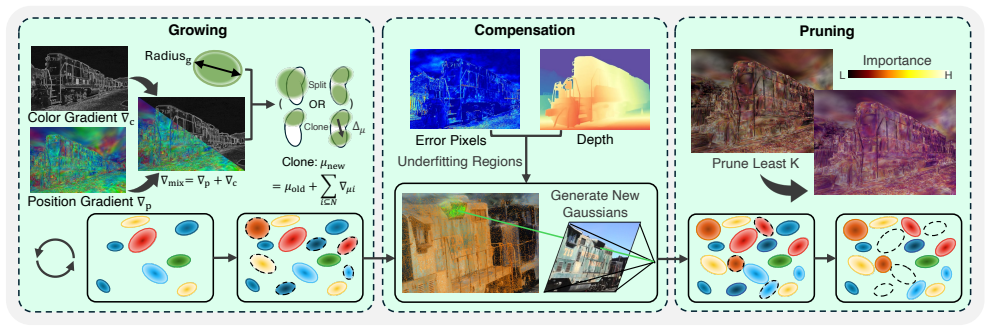
The central claim is that a systematic framework alternating incremental pruning of low-impact Gaussians with strategic growing of new primitives plus adaptive compensation maintains near-constant low memory usage while progressively refining rendering fidelity on real-world datasets.
What carries the argument
Iterative pruning of low-impact Gaussians combined with strategic growing of new primitives and an adaptive Gaussian compensation mechanism.
If this is right
- 3DGS training becomes practical on memory-limited edge hardware such as the NVIDIA Jetson AGX Xavier.
- Peak training memory can drop by as much as 80 percent relative to the original method while visual quality stays similar.
- The same bounded schedule applies to multiple real-world datasets under fixed memory caps.
- Rendering quality continues to rise over training steps even though the Gaussian count stays controlled.
Where Pith is reading between the lines
- The same alternating prune-and-grow pattern may help other primitive-based methods that suffer early memory explosions.
- Combining this schedule with final post-training pruning could shrink both training and inference footprints.
- Testing the method on very large outdoor scenes would show whether memory bounds still hold when scene scale increases.
Load-bearing premise
The process of pruning low-impact Gaussians and growing new ones with compensation will keep improving fidelity without creating artifacts or quality loss across diverse scenes.
What would settle it
A clear drop in PSNR or visible artifacts on standard benchmarks such as Mip-NeRF 360 when the bounded-memory schedule is used instead of unrestricted 3DGS training.
Figures






read the original abstract
3D Gaussian Splatting (3DGS) has revolutionized novel view synthesis with high-quality rendering through continuous aggregations of millions of 3D Gaussian primitives. However, it suffers from a substantial memory footprint, particularly during training due to uncontrolled densification, posing a critical bottleneck for deployment on memory-constrained edge devices. While existing methods prune redundant Gaussians post-training, they fail to address the peak memory spikes caused by the abrupt growth of Gaussians early in the training process. To solve the training memory consumption problem, we propose a systematic memory-bounded training framework that dynamically optimizes Gaussians through iterative growth and pruning. In other words, the proposed framework alternates between incremental pruning of low-impact Gaussians and strategic growing of new primitives with an adaptive Gaussian compensation, maintaining a near-constant low memory usage while progressively refining rendering fidelity. We comprehensively evaluate the proposed training framework on various real-world datasets under strict memory constraints, showing significant improvements over existing state-of-the-art methods. Particularly, our proposed method practically enables memory-efficient 3DGS training on NVIDIA Jetson AGX Xavier, achieving similar visual quality with up to 80% lower peak training memory consumption than the original 3DGS.
Editorial analysis
A structured set of objections, weighed in public.
Referee Report
Summary. The paper proposes a memory-bounded training framework for 3D Gaussian Splatting that alternates iterative pruning of low-impact Gaussians with strategic growing and adaptive compensation. This maintains near-constant low peak memory during training while progressively refining fidelity, evaluated on real-world datasets to achieve up to 80% lower peak training memory than standard 3DGS and enable deployment on NVIDIA Jetson AGX Xavier with comparable visual quality.
Significance. If validated, the work addresses a critical training-time memory bottleneck in 3DGS, enabling high-quality novel view synthesis on edge devices where post-training pruning alone is insufficient. The focus on real-world datasets and practical hardware demonstration strengthens its relevance for efficient neural rendering applications.
major comments (2)
- [Method] Method section (iterative pruning/growing description): The adaptive compensation mechanism is presented heuristically without a precise formulation (e.g., no equation detailing how new Gaussians are initialized, attributes adjusted, or gradient flow restored post-pruning). This directly bears on the central claim that the process avoids quality loss or artifacts, as the impact metric for pruning and compensation form are both heuristic and risk removing necessary high-frequency detail on diverse scenes.
- [Experiments] Experiments section (results and ablations): The reported 80% memory reduction and 'similar visual quality' lack detailed per-dataset PSNR/SSIM tables, memory curves with baselines, and sensitivity analysis on the pruning threshold and compensation factor. Without these, the robustness of the iterative process across real-world scenes cannot be fully assessed, undermining the Jetson deployment assertion.
minor comments (2)
- [Abstract] Abstract: The phrase 'In other words' is redundant and disrupts flow; rephrase the sentence on the framework for conciseness.
- [Figures] Figures: Memory consumption plots should explicitly overlay the original 3DGS baseline and include multiple runs or variance indicators for clarity.
Simulated Author's Rebuttal
We thank the referee for the constructive comments, which help clarify key aspects of our memory-bounded 3D Gaussian Splatting training framework. We address each major point below and commit to revisions that strengthen the presentation of the method and experiments.
read point-by-point responses
-
Referee: [Method] Method section (iterative pruning/growing description): The adaptive compensation mechanism is presented heuristically without a precise formulation (e.g., no equation detailing how new Gaussians are initialized, attributes adjusted, or gradient flow restored post-pruning). This directly bears on the central claim that the process avoids quality loss or artifacts, as the impact metric for pruning and compensation form are both heuristic and risk removing necessary high-frequency detail on diverse scenes.
Authors: We acknowledge that the adaptive compensation is described at a high level in the current manuscript. In the revision we will add explicit equations in the method section: one defining the impact metric (contribution to per-pixel photometric loss), one for initializing replacement Gaussians (position and covariance derived from the pruned primitive's spatial support and gradient statistics), and one for attribute adjustment plus gradient restoration (opacity and SH coefficients scaled to preserve local density while re-enabling densification gradients). The growing phase is triggered by the same loss-based criterion, ensuring high-frequency regions receive new primitives. We will also include a short discussion of failure modes and empirical checks that high-frequency detail is retained on the evaluated scenes. revision: yes
-
Referee: [Experiments] Experiments section (results and ablations): The reported 80% memory reduction and 'similar visual quality' lack detailed per-dataset PSNR/SSIM tables, memory curves with baselines, and sensitivity analysis on the pruning threshold and compensation factor. Without these, the robustness of the iterative process across real-world scenes cannot be fully assessed, undermining the Jetson deployment assertion.
Authors: We agree that the current experimental section would benefit from greater granularity. The revised manuscript will contain: (i) full per-dataset tables of PSNR, SSIM and LPIPS for all scenes, (ii) training-time memory curves plotted against iteration count for our method, vanilla 3DGS and relevant baselines, and (iii) sensitivity plots and tables varying the pruning threshold and compensation factor. These additions will directly support the robustness claim and the Jetson AGX Xavier results. revision: yes
Circularity Check
No significant circularity in the memory-bounded 3DGS training framework.
full rationale
The paper presents an iterative pruning-growing framework with adaptive compensation as a practical heuristic for controlling memory during 3D Gaussian Splatting training. This is grounded in empirical evaluation on external real-world datasets rather than any self-referential derivation. No load-bearing steps reduce by construction to fitted parameters, self-citations, or renamed inputs; the central claims about near-constant memory and comparable visual quality are supported by direct comparisons to unconstrained 3DGS and other methods, making the derivation self-contained.
Axiom & Free-Parameter Ledger
free parameters (2)
- pruning threshold
- growth compensation factor
axioms (1)
- domain assumption 3D Gaussian primitives can be added or removed without fundamentally altering the underlying scene representation when done iteratively.
Reference graph
Works this paper leans on
- [1]
-
[2]
3d gaussian splatting: Survey, technologies, challenges, and opportunities.IEEE Transactions on Circuits and Systems for Video Technology,
Yanqi Bao, Tianyu Ding, Jing Huo, Yaoli Liu, Yuxin Li, Wenbin Li, Yang Gao, and Jiebo Luo. 3d gaussian splatting: Survey, technologies, challenges, and opportunities.IEEE Transactions on Circuits and Systems for Video Technology,
-
[3]
Mip-nerf: A multiscale representation for anti-aliasing neu- ral radiance fields
Jonathan T Barron, Ben Mildenhall, Matthew Tancik, Peter Hedman, Ricardo Martin-Brualla, and Pratul P Srinivasan. Mip-nerf: A multiscale representation for anti-aliasing neu- ral radiance fields. InProceedings of the IEEE/CVF inter- national conference on computer vision, pages 5855–5864,
-
[4]
Mip-nerf 360: Unbounded anti-aliased neural radiance fields
Jonathan T Barron, Ben Mildenhall, Dor Verbin, Pratul P Srinivasan, and Peter Hedman. Mip-nerf 360: Unbounded anti-aliased neural radiance fields. InProceedings of the IEEE/CVF conference on computer vision and pattern recognition, pages 5470–5479, 2022. 2, 7
2022
-
[5]
Zip-nerf: Anti-aliased grid-based neural radiance fields
Jonathan T Barron, Ben Mildenhall, Dor Verbin, Pratul P Srinivasan, and Peter Hedman. Zip-nerf: Anti-aliased grid-based neural radiance fields. InProceedings of the IEEE/CVF International Conference on Computer Vision, pages 19697–19705, 2023. 2
2023
-
[6]
A Survey on 3D Gaussian Splatting
Guikun Chen and Wenguan Wang. A survey on 3d gaussian splatting.arXiv preprint arXiv:2401.03890, 2024. 2
work page internal anchor Pith review Pith/arXiv arXiv 2024
-
[7]
Efficient density control for 3d gaussian splat- ting.arXiv preprint arXiv:2411.10133, 2024
Xiaobin Deng, Changyu Diao, Min Li, Ruohan Yu, and Du- anqing Xu. Efficient density control for 3d gaussian splat- ting.arXiv preprint arXiv:2411.10133, 2024. 2, 4
-
[8]
Lightgaussian: Unbounded 3d gaussian compression with 15x reduction and 200+ fps
Zhiwen Fan, Kevin Wang, Kairun Wen, Zehao Zhu, De- jia Xu, and Zhangyang Wang. Lightgaussian: Unbounded 3d gaussian compression with 15x reduction and 200+ fps. arXiv preprint arXiv:2311.17245, 2023. 2, 3, 6
-
[9]
Guangchi Fang and Bing Wang. Mini-splatting: Represent- ing scenes with a constrained number of gaussians.arXiv preprint arXiv:2403.14166, 2024. 2, 6, 7, 8
-
[10]
3d gaussian splatting as new era: A survey.IEEE Transactions on Visualization and Computer Graphics, 2024
Ben Fei, Jingyi Xu, Rui Zhang, Qingyuan Zhou, Weidong Yang, and Ying He. 3d gaussian splatting as new era: A survey.IEEE Transactions on Visualization and Computer Graphics, 2024. 3
2024
-
[11]
Guofeng Feng, Siyan Chen, Rong Fu, Zimu Liao, Yi Wang, Tao Liu, Zhilin Pei, Hengjie Li, Xingcheng Zhang, and Bo Dai. Flashgs: Efficient 3d gaussian splatting for large-scale and high-resolution rendering.arXiv preprint arXiv:2408.07967, 2024. 3, 4
-
[12]
The Lottery Ticket Hypothesis: Finding Sparse, Trainable Neural Networks
Jonathan Frankle and Michael Carbin. The lottery ticket hy- pothesis: Finding sparse, trainable neural networks.arXiv preprint arXiv:1803.03635, 2018. 2, 4
work page Pith review arXiv 2018
-
[13]
Ea- gles: Efficient accelerated 3d gaussians with lightweight en- codings
Sharath Girish, Kamal Gupta, and Abhinav Shrivastava. Ea- gles: Efficient accelerated 3d gaussians with lightweight en- codings. InEuropean Conference on Computer Vision, pages 54–71. Springer, 2024. 2, 8, 1
2024
-
[14]
Dsd: Dense-sparse-dense training for deep neural networks.arXiv preprint arXiv:1607.04381,
Song Han, Jeff Pool, Sharan Narang, Huizi Mao, Enhao Gong, Shijian Tang, Erich Elsen, Peter Vajda, Manohar Paluri, John Tran, et al. Dsd: Dense-sparse-dense training for deep neural networks.arXiv preprint arXiv:1607.04381,
-
[15]
Alex Hanson, Allen Tu, Geng Lin, Vasu Singla, Matthias Zwicker, and Tom Goldstein. Speedy-splat: Fast 3d gaus- sian splatting with sparse pixels and sparse primitives.arXiv preprint arXiv:2412.00578, 2024. 3
-
[16]
Deep blending for free-viewpoint image-based rendering.ACM Transactions on Graphics (ToG), 37(6):1–15, 2018
Peter Hedman, Julien Philip, True Price, Jan-Michael Frahm, George Drettakis, and Gabriel Brostow. Deep blending for free-viewpoint image-based rendering.ACM Transactions on Graphics (ToG), 37(6):1–15, 2018. 7, 8
2018
-
[17]
3d gaussian splatting for real-time radiance field rendering.ACM Trans
Bernhard Kerbl, Georgios Kopanas, Thomas Leimk ¨uhler, and George Drettakis. 3d gaussian splatting for real-time radiance field rendering.ACM Trans. Graph., 42(4):139–1,
-
[18]
3d gaussian splat- ting as markov chain monte carlo.Advances in Neural Infor- mation Processing Systems, 37:80965–80986, 2024
Shakiba Kheradmand, Daniel Rebain, Gopal Sharma, Wei- wei Sun, Yang-Che Tseng, Hossam Isack, Abhishek Kar, Andrea Tagliasacchi, and Kwang Moo Yi. 3d gaussian splat- ting as markov chain monte carlo.Advances in Neural Infor- mation Processing Systems, 37:80965–80986, 2024. 2
2024
-
[19]
Tanks and temples: Benchmarking large-scale scene reconstruction.ACM Transactions on Graphics, 36(4), 2017
Arno Knapitsch, Jaesik Park, Qian-Yi Zhou, and Vladlen Koltun. Tanks and temples: Benchmarking large-scale scene reconstruction.ACM Transactions on Graphics, 36(4), 2017. 7
2017
-
[20]
Deblurring 3d gaussian splatting
Byeonghyeon Lee, Howoong Lee, Xiangyu Sun, Usman Ali, and Eunbyung Park. Deblurring 3d gaussian splatting. In European Conference on Computer Vision, pages 127–143. Springer, 2024. 2
2024
-
[21]
Compact 3d gaussian representation for radiance field
Joo Chan Lee, Daniel Rho, Xiangyu Sun, Jong Hwan Ko, and Eunbyung Park. Compact 3d gaussian representation for radiance field. InProceedings of the IEEE/CVF Conference on Computer Vision and Pattern Recognition, pages 21719– 21728, 2024. 4, 8
2024
-
[22]
Optimized minimal 3d gaussian splatting,
Joo Chan Lee, Jong Hwan Ko, and Eunbyung Park. Op- timized minimal 3d gaussian splatting.arXiv preprint arXiv:2503.16924, 2025. 3
-
[23]
Yifei Liu, Zhihang Zhong, Yifan Zhan, Sheng Xu, and Xiao Sun. Maskgaussian: Adaptive 3d gaussian representation from probabilistic masks.arXiv preprint arXiv:2412.20522,
-
[24]
Scaffold-gs: Structured 3d gaussians for view-adaptive rendering
Tao Lu, Mulin Yu, Linning Xu, Yuanbo Xiangli, Limin Wang, Dahua Lin, and Bo Dai. Scaffold-gs: Structured 3d gaussians for view-adaptive rendering. InProceedings of the IEEE/CVF Conference on Computer Vision and Pattern Recognition, pages 20654–20664, 2024. 3, 4
2024
-
[25]
Taming 3dgs: High-quality radiance fields with limited resources
Saswat Subhajyoti Mallick, Rahul Goel, Bernhard Kerbl, Markus Steinberger, Francisco Vicente Carrasco, and Fer- nando De La Torre. Taming 3dgs: High-quality radiance fields with limited resources. InSIGGRAPH Asia 2024 Con- ference Papers, pages 1–11, 2024. 2, 3, 4, 7, 8, 1
2024
-
[26]
Gaussian splatting slam
Hidenobu Matsuki, Riku Murai, Paul HJ Kelly, and An- drew J Davison. Gaussian splatting slam. InProceedings of the IEEE/CVF Conference on Computer Vision and Pat- tern Recognition, pages 18039–18048, 2024. 2
2024
-
[27]
Nerf: Representing scenes as neural radiance fields for view syn- thesis.Communications of the ACM, 65(1):99–106, 2021
Ben Mildenhall, Pratul P Srinivasan, Matthew Tancik, Jonathan T Barron, Ravi Ramamoorthi, and Ren Ng. Nerf: Representing scenes as neural radiance fields for view syn- thesis.Communications of the ACM, 65(1):99–106, 2021. 2
2021
-
[28]
Compact 3d scene representation via self- organizing gaussian grids
Wieland Morgenstern, Florian Barthel, Anna Hilsmann, and Peter Eisert. Compact 3d scene representation via self- organizing gaussian grids. InEuropean Conference on Com- puter Vision, pages 18–34. Springer, 2024. 2
2024
-
[29]
Compgs: Smaller and faster gaussian splatting with vector quantization
KL Navaneet, Kossar Pourahmadi Meibodi, Soroush Abbasi Koohpayegani, and Hamed Pirsiavash. Compgs: Smaller and faster gaussian splatting with vector quantization. InEuro- pean Conference on Computer Vision, 2024. 2, 3, 4
2024
-
[30]
Michael Niemeyer, Fabian Manhardt, Marie-Julie Rakoto- saona, Michael Oechsle, Daniel Duckworth, Rama Gosula, Keisuke Tateno, John Bates, Dominik Kaeser, and Federico Tombari. Radsplat: Radiance field-informed gaussian splat- ting for robust real-time rendering with 900+ fps.arXiv preprint arXiv:2403.13806, 2024. 2, 3, 6
-
[31]
Reducing the memory footprint of 3d gaussian splatting.Proceedings of the ACM on Computer Graphics and Interactive Tech- niques, 7(1):1–17, 2024
Panagiotis Papantonakis, Georgios Kopanas, Bernhard Kerbl, Alexandre Lanvin, and George Drettakis. Reducing the memory footprint of 3d gaussian splatting.Proceedings of the ACM on Computer Graphics and Interactive Tech- niques, 7(1):1–17, 2024. 2, 8
2024
-
[32]
Dense depth pri- ors for neural radiance fields from sparse input views
Barbara Roessle, Jonathan T Barron, Ben Mildenhall, Pratul P Srinivasan, and Matthias Nießner. Dense depth pri- ors for neural radiance fields from sparse input views. In Proceedings of the IEEE/CVF Conference on Computer Vi- sion and Pattern Recognition, pages 12892–12901, 2022. 2
2022
-
[33]
Revising densification in gaussian splatting
Samuel Rota Bul `o, Lorenzo Porzi, and Peter Kontschieder. Revising densification in gaussian splatting. InEuropean Conference on Computer Vision, pages 347–362. Springer,
-
[34]
Structure- from-motion revisited
Johannes L Schonberger and Jan-Michael Frahm. Structure- from-motion revisited. InProceedings of the IEEE con- ference on computer vision and pattern recognition, pages 4104–4113, 2016. 3, 5
2016
-
[35]
The interpretation of structure from mo- tion.Proceedings of the Royal Society of London
Shimon Ullman. The interpretation of structure from mo- tion.Proceedings of the Royal Society of London. Series B. Biological Sciences, 203(1153):405–426, 1979. 5
1979
-
[36]
3d gaus- sian rendering can be sparser: Efficient rendering via learned fragment pruning.Advances in Neural Information Process- ing Systems, 37:5850–5869, 2024
Zhifan Ye, Chenxi Wan, Chaojian Li, Jihoon Hong, Sixu Li, Leshu Li, Yongan Zhang, and Yingyan Celine Lin. 3d gaus- sian rendering can be sparser: Efficient rendering via learned fragment pruning.Advances in Neural Information Process- ing Systems, 37:5850–5869, 2024. 3
2024
-
[37]
Cogs: Controllable gaussian splatting
Heng Yu, Joel Julin, Zolt ´an ´A Milacski, Koichiro Niinuma, and L ´aszl´o A Jeni. Cogs: Controllable gaussian splatting. InProceedings of the IEEE/CVF Conference on Computer Vision and Pattern Recognition, pages 21624–21633, 2024. 2
2024
-
[38]
Mip-splatting: Alias-free 3d gaussian splat- ting
Zehao Yu, Anpei Chen, Binbin Huang, Torsten Sattler, and Andreas Geiger. Mip-splatting: Alias-free 3d gaussian splat- ting. InProceedings of the IEEE/CVF conference on com- puter vision and pattern recognition, pages 19447–19456,
-
[39]
Gaussian in the wild: 3d gaussian splatting for unconstrained image collections
Dongbin Zhang, Chuming Wang, Weitao Wang, Peihao Li, Minghan Qin, and Haoqian Wang. Gaussian in the wild: 3d gaussian splatting for unconstrained image collections. In European Conference on Computer Vision, pages 341–359. Springer, 2024. 3, 4
2024
-
[40]
Fregs: 3d gaussian splatting with progressive frequency regularization
Jiahui Zhang, Fangneng Zhan, Muyu Xu, Shijian Lu, and Eric Xing. Fregs: 3d gaussian splatting with progressive frequency regularization. InProceedings of the IEEE/CVF Conference on Computer Vision and Pattern Recognition, pages 21424–21433, 2024. 2
2024
-
[41]
The unreasonable effectiveness of deep features as a perceptual metric
Richard Zhang, Phillip Isola, Alexei A Efros, Eli Shecht- man, and Oliver Wang. The unreasonable effectiveness of deep features as a perceptual metric. InProceedings of the IEEE conference on computer vision and pattern recogni- tion, pages 586–595, 2018. 7
2018
-
[42]
Lp-3dgs: Learning to prune 3d gaussian splatting.arXiv preprint arXiv:2405.18784, 2024
Zhaoliang Zhang, Tianchen Song, Yongjae Lee, Li Yang, Cheng Peng, Rama Chellappa, and Deliang Fan. Lp-3dgs: Learning to prune 3d gaussian splatting.arXiv preprint arXiv:2405.18784, 2024. 2
-
[43]
Feature 3dgs: Supercharging 3d gaussian splatting to enable distilled feature fields
Shijie Zhou, Haoran Chang, Sicheng Jiang, Zhiwen Fan, Ze- hao Zhu, Dejia Xu, Pradyumna Chari, Suya You, Zhangyang Wang, and Achuta Kadambi. Feature 3dgs: Supercharging 3d gaussian splatting to enable distilled feature fields. InPro- ceedings of the IEEE/CVF Conference on Computer Vision and Pattern Recognition, pages 21676–21685, 2024. 4 Appendix
2024
-
[44]
Additional Quantitative Results We summarize additional quantitative results on the Mip- NeRF 360, Tanks&Temples, and Deep Blending datasets in Table 5, Table 4, and Table 3
Additional Results 7.1. Additional Quantitative Results We summarize additional quantitative results on the Mip- NeRF 360, Tanks&Temples, and Deep Blending datasets in Table 5, Table 4, and Table 3. Table 3. Deep Blending per scene results. 3DGS results are re- ported from [13]. Taming 3DGS [25] results are replicated using official code. Scene Method PSN...
discussion (0)
Sign in with ORCID, Apple, or X to comment. Anyone can read and Pith papers without signing in.