Recognition: unknown
Entropy bound and the non-universality of entanglement islands
Pith reviewed 2026-05-10 00:27 UTC · model grok-4.3
The pith
Universal compact islands for all Hawking radiation regions accumulate entropy beyond the Bekenstein-Hawking bound at late times.
A machine-rendered reading of the paper's core claim, the machinery that carries it, and where it could break.
Core claim
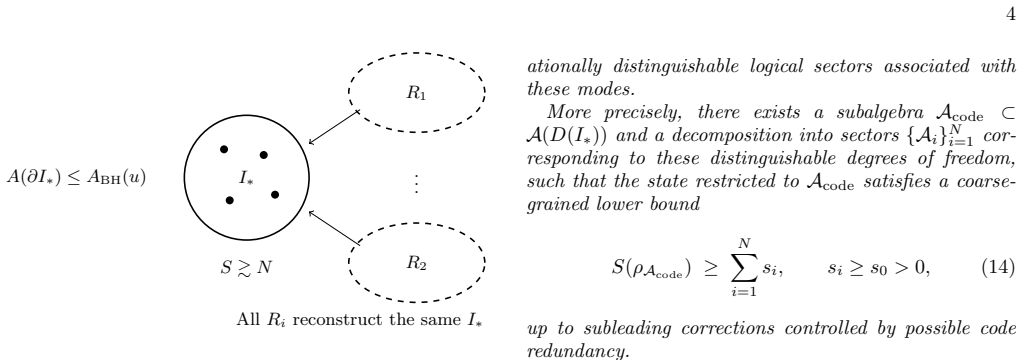
Under the assumption that any bona fide semiclassical island realization for at least one radiation region respects semiclassical entropy bounds, a single compact island cannot serve as common interior support for all AMPS-relevant radiation regions. Universality requires the interior partner entropy of every such region to be localized within the same fixed compact volume, and at sufficiently late times this accumulated entropy exceeds the Bekenstein-Hawking bound fixed by the boundary area of that volume, producing an inconsistency.
What carries the argument
The universal compact entanglement island proposed as a common interior for the entanglement wedges of all relevant radiation regions, together with the mechanism of late-time accumulation of interior partner entropy inside its fixed boundary.
If this is right
- Interior reconstruction of Hawking radiation must be performed separately for each radiation region rather than with a shared island.
- Entanglement islands can resolve the AMPS paradox only in a region-dependent manner.
- No single compact region can simultaneously host the partner degrees of freedom for every AMPS-relevant radiation region without violating an entropy bound.
Where Pith is reading between the lines
- Different radiation regions may need genuinely distinct island geometries whose locations or shapes vary with the chosen region.
- Attempts to find global, time-independent interior descriptions of evaporating black holes may be obstructed by the same entropy accumulation.
- The result motivates checking whether time-dependent or non-compact islands can evade the bound while still reproducing semiclassical expectations for individual regions.
Load-bearing premise
A semiclassical island realization for at least one radiation region must remain compatible with semiclassical entropy bounds.
What would settle it
An explicit construction of a single compact island whose total accumulated interior partner entropy stays below the Bekenstein-Hawking bound set by its boundary area at arbitrarily late times would falsify the no-go result.
Figures
read the original abstract
Entanglement islands resolve the AMPS firewall paradox in a region-dependent manner by modifying the entanglement wedge of Hawking radiation. We investigate whether this resolution can be made universal, in the sense that a single compact island serves as a common interior support for all AMPS-relevant radiation regions. We show that such a construction is obstructed under reasonable assumptions. Universality forces an accumulation of interior partner entropy within a fixed compact region, which at late times exceeds the Bekenstein--Hawking bound set by its boundary area. However, a bona fide semiclassical island realization for at least one radiation region is expected to be compatible with semiclassical entropy bounds. This leads to a contradiction, yielding a conditional no-go result for universal compact islands. Our result implies that interior reconstruction in the island framework must remain intrinsically region-dependent.
Editorial analysis
A structured set of objections, weighed in public.
Referee Report
Summary. The paper claims that a universal compact entanglement island (a single fixed compact region serving as interior support for all AMPS-relevant radiation regions) is obstructed. Universality would force accumulation of interior partner entropy inside this fixed region, eventually exceeding the Bekenstein-Hawking bound set by its boundary area at late times. This contradicts the expectation that any semiclassical island realization respects standard entropy bounds, yielding a conditional no-go result and implying that interior reconstruction must remain region-dependent.
Significance. If the central argument holds, the result provides a clean, logically coherent no-go theorem constraining the island paradigm for the black hole information paradox. It demonstrates that entanglement islands cannot be made universal without violating semiclassical entropy bounds, reinforcing the intrinsic region-dependence of entanglement wedges. The argument relies on standard Bekenstein-Hawking bounds and the definition of partner entropy without introducing free parameters or model-specific dynamics, offering a falsifiable conceptual constraint that advances understanding of semiclassical gravity in evaporating black holes.
minor comments (3)
- The abstract and introduction would benefit from a brief explicit statement of the precise definition of 'partner entropy' and how its accumulation is quantified for multiple radiation regions sharing the same island (e.g., via a formula or inequality in the main text).
- Clarify the time scale on which the Bekenstein-Hawking bound is violated (e.g., Page time or later) and whether this depends on the specific choice of radiation regions considered.
- The manuscript should include a short discussion of potential loopholes, such as whether non-compact islands or time-dependent island boundaries could evade the accumulation argument.
Simulated Author's Rebuttal
We thank the referee for their careful reading of the manuscript and for the positive assessment, including the recommendation for minor revision. The referee's summary accurately reflects the central claim: that a universal compact entanglement island is obstructed by an entropy bound violation, implying that interior reconstruction must remain region-dependent. No specific major comments were raised in the report.
Circularity Check
No significant circularity identified
full rationale
The paper advances a conditional no-go theorem: assuming a single compact island is universal for all radiation regions forces late-time partner entropy to accumulate inside a fixed region whose area sets a Bekenstein-Hawking bound that is eventually violated, contradicting the expectation that any semiclassical island respects such bounds. This logical structure relies on the standard, externally established Bekenstein-Hawking bound applied to a compact region and does not reduce any central claim to a self-definition, a fitted parameter renamed as a prediction, or a load-bearing self-citation chain. The derivation is self-contained against external benchmarks and contains no steps that are equivalent to their inputs by construction.
Axiom & Free-Parameter Ledger
axioms (2)
- domain assumption Semiclassical gravity remains valid for entanglement island constructions.
- standard math The Bekenstein-Hawking bound applies to the boundary area of the compact island region.
Reference graph
Works this paper leans on
-
[1]
Black Holes: Complementarity or Firewalls?
A. Almheiri, D. Marolf, J. Polchinski, and J. Sully, “Black Holes: Complementarity or Firewalls?,”JHEP 02(2013) 062,arXiv:1207.3123 [hep-th]
work page Pith review arXiv 2013
-
[2]
G. Penington, “Entanglement Wedge Reconstruction and the Information Paradox,”JHEP09(2020) 002, arXiv:1905.08255 [hep-th]
-
[3]
A. Almheiri, R. Mahajan, J. Maldacena, and Y. Zhao, “The Page curve of Hawking radiation from semiclassical geometry,”JHEP03(2020) 149, arXiv:1908.10996 [hep-th]
-
[4]
A. Almheiri, N. Engelhardt, D. Marolf, and H. Maxfield, “The entropy of bulk quantum fields and the entanglement wedge of an evaporating black hole,” JHEP12(2019) 063,arXiv:1905.08762 [hep-th]
-
[5]
A. Almheiri, R. Mahajan, and J. Maldacena, “Islands outside the horizon,”arXiv:1910.11077 [hep-th]
-
[6]
The entropy of Hawking radiation,
A. Almheiri, T. Hartman, J. Maldacena, E. Shaghoulian, and A. Tajdini, “The entropy of Hawking radiation,”Rev. Mod. Phys.93no. 3, (2021) 035002,arXiv:2006.06872 [hep-th]
-
[7]
M.-H. Yu and X.-H. Ge, “Entanglement islands in generalized two-dimensional dilaton black holes,”Phys. Rev. D107no. 6, (2023) 066020,arXiv:2208.01943 [hep-th]
-
[8]
Information in Black Hole Radiation
D. N. Page, “Information in black hole radiation,” Phys. Rev. Lett.71(1993) 3743–3746, arXiv:hep-th/9306083
work page Pith review arXiv 1993
-
[9]
Black holes and entropy,
J. D. Bekenstein, “Black holes and entropy,”Phys. Rev. D7(1973) 2333–2346
1973
-
[10]
Particle Creation by Black Holes,
S. W. Hawking, “Particle Creation by Black Holes,” Commun. Math. Phys.43(1975) 199–220. [Erratum: Commun.Math.Phys. 46, 206 (1976)]
1975
-
[11]
A Universal Upper Bound on the Entropy to Energy Ratio for Bounded Systems,
J. D. Bekenstein, “A Universal Upper Bound on the Entropy to Energy Ratio for Bounded Systems,”Phys. Rev. D23(1981) 287
1981
-
[12]
A Covariant entropy conjecture,
R. Bousso, “A Covariant entropy conjecture,”JHEP07 (1999) 004,arXiv:hep-th/9905177
-
[13]
R. Bousso and A. Shahbazi-Moghaddam, “Singularities from Entropy,”Phys. Rev. Lett.128no. 23, (2022) 231301,arXiv:2201.11132 [hep-th]
-
[14]
Firewalls from General Covariance,
R. Bousso, “Firewalls from General Covariance,”Phys. Rev. Lett.135no. 2, (2025) 021501,arXiv:2502.08724 [hep-th]
-
[15]
A Quantum Focussing Conjecture
R. Bousso, Z. Fisher, S. Leichenauer, and A. C. Wall, “Quantum focusing conjecture,”Phys. Rev. D93no. 6, (2016) 064044,arXiv:1506.02669 [hep-th]
work page Pith review arXiv 2016
-
[16]
Tests of restricted Quantum Focusing and a new CFT bound,
V. Franken, S. Kaya, F. Rondeau, A. Shahbazi-Moghaddam, and P. Tran, “Tests of restricted Quantum Focusing and a new CFT bound,” arXiv:2510.13961 [hep-th]
-
[17]
A. Shahbazi-Moghaddam, “Restricted quantum focusing,”Phys. Rev. D109no. 6, (2024) 066023, arXiv:2212.03881 [hep-th]
-
[18]
A Quantum Weak Cosmic Censorship and Its Proof
N. Kumar, “A quantum weak cosmic censorship and its proof,”Physics Letters B(2026) 140449, arXiv:2603.13957 [hep-th]. https://www.sciencedirect.com/science/article/ pii/S0370269326003023
work page internal anchor Pith review Pith/arXiv arXiv 2026
-
[19]
A. Strominger and D. M. Thompson, “A Quantum Bousso bound,”Phys. Rev. D70(2004) 044007, arXiv:hep-th/0303067
-
[20]
Proof of a Quantum Bousso Bound,
R. Bousso, H. Casini, Z. Fisher, and J. Maldacena, “Proof of a Quantum Bousso Bound,”Phys. Rev. D90 no. 4, (2014) 044002,arXiv:1404.5635 [hep-th]
-
[21]
On the quantum Bousso bound in JT gravity,
V. Franken and F. Rondeau, “On the quantum Bousso bound in JT gravity,”JHEP03(2024) 178, arXiv:2311.17152 [hep-th]
-
[22]
Franken,Information-theoretic constraints in quantum gravity and cosmology
V. Franken,Information-theoretic constraints in quantum gravity and cosmology. PhD thesis, CPHT - Centre de Physique Th´ eorique - X -´Ecole polytechnique - IP Paris - Institut Polytechnique de Paris - CNRS - Centre National de la Recherche Scientifique, Institut polytechnique de Paris, 2025. arXiv:2510.15787 [hep-th]
-
[23]
Bulk Locality and Quantum Error Correction in AdS/CFT
A. Almheiri, X. Dong, and D. Harlow, “Bulk Locality and Quantum Error Correction in AdS/CFT,”JHEP 04(2015) 163,arXiv:1411.7041 [hep-th]
work page Pith review arXiv 2015
-
[24]
Reconstruction of Bulk Operators within the Entanglement Wedge in Gauge-Gravity Duality
X. Dong, D. Harlow, and A. C. Wall, “Reconstruction of Bulk Operators within the Entanglement Wedge in Gauge-Gravity Duality,”Phys. Rev. Lett.117no. 2, (2016) 021601,arXiv:1601.05416 [hep-th]
work page Pith review arXiv 2016
-
[25]
Information Transfer with a Gravitating Bath,
H. Geng, A. Karch, C. Perez-Pardavila, S. Raju, L. Randall, M. Riojas, and S. Shashi, “Information Transfer with a Gravitating Bath,”SciPost Phys.10 no. 5, (2021) 103,arXiv:2012.04671 [hep-th]
-
[26]
H. Geng and A. Karch, “Massive islands,”JHEP09 (2020) 121,arXiv:2006.02438 [hep-th]
-
[27]
Entanglement phase structure of a holographic BCFT in a black hole background,
H. Geng, A. Karch, C. Perez-Pardavila, S. Raju, L. Randall, M. Riojas, and S. Shashi, “Entanglement phase structure of a holographic BCFT in a black hole background,”JHEP05(2022) 153,arXiv:2112.09132 [hep-th]
-
[28]
Geng, (2025), arXiv:2502.08703 [hep-th]
H. Geng, “The mechanism behind the information encoding for islands,”JHEP03(2026) 037, arXiv:2502.08703 [hep-th]
-
[29]
H. Geng, L.-Y. Hung, and Y. Jiang, “It from ETH: Multi-interval Entanglement and Replica Wormholes from Large-cBCFT Ensemble,”arXiv:2505.20385 [hep-th]
-
[30]
Ryu-Takayanagi formula for multi-boundary black holes from 2D large-c CFT ensemble,
N. Bao, H. Geng, and Y. Jiang, “Ryu-Takayanagi formula for multi-boundary black holes from 2D large-c CFT ensemble,”JHEP10(2025) 042, arXiv:2504.12388 [hep-th]
discussion (0)
Sign in with ORCID, Apple, or X to comment. Anyone can read and Pith papers without signing in.