Recognition: unknown
WildFireVQA: A Large-Scale Radiometric Thermal VQA Benchmark for Aerial Wildfire Monitoring
Pith reviewed 2026-05-10 01:04 UTC · model grok-4.3
The pith
WildFireVQA introduces a benchmark of 6,097 aerial RGB-thermal samples with 207,298 questions to test multimodal models on wildfire monitoring tasks.
A machine-rendered reading of the paper's core claim, the machinery that carries it, and where it could break.
Core claim
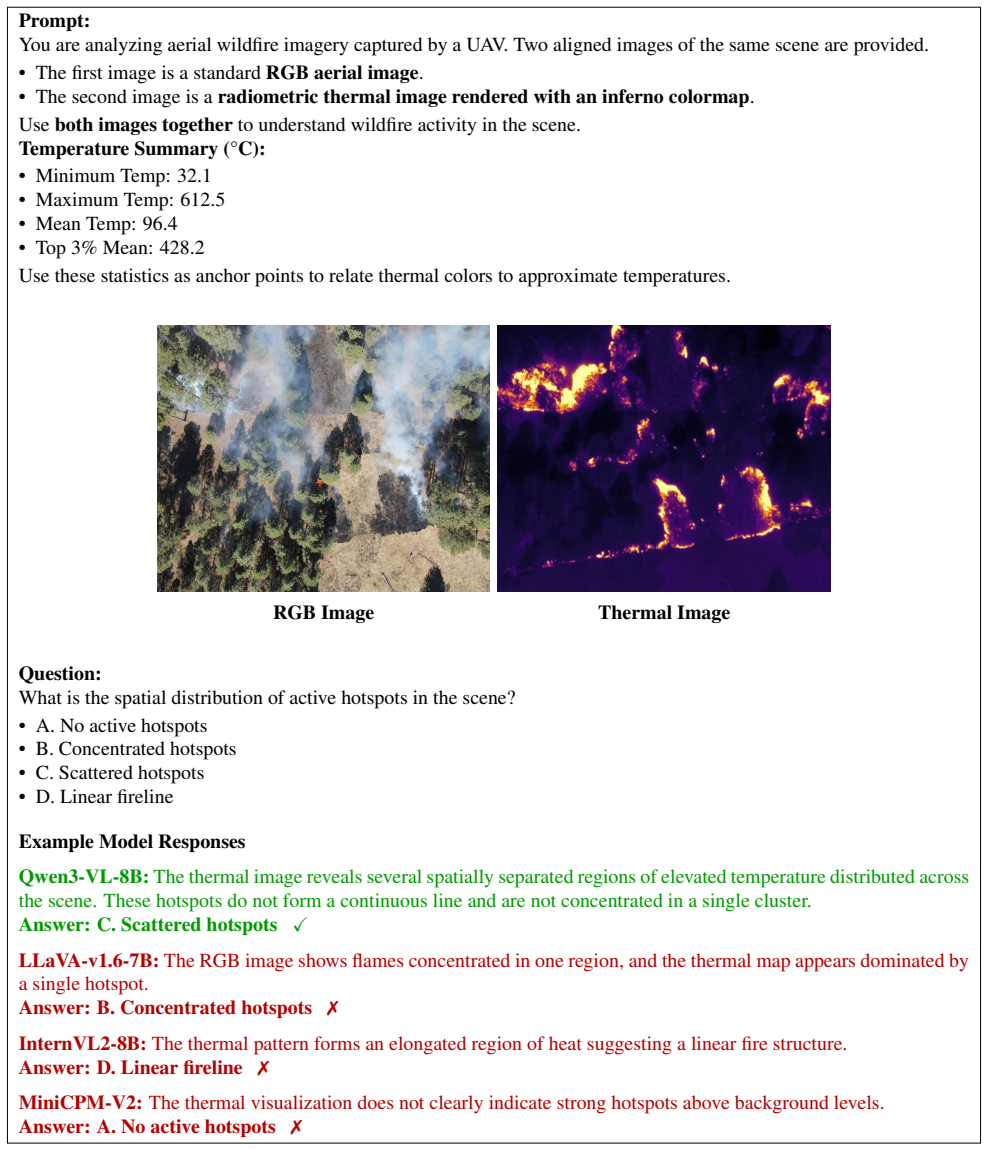
WildFireVQA supplies 6,097 RGB-thermal samples, each containing an RGB image, a color-mapped thermal visualization, and a radiometric TIFF, paired with 34 questions for a total of 207,298 multiple-choice items. The benchmark spans six operational categories and uses a hybrid annotation method that merges MLLM-generated answers with deterministic sensor labeling, manual verification, and intra- and inter-frame consistency checks. Evaluation of representative MLLMs under RGB-only, thermal-only, and retrieval-augmented settings demonstrates that RGB currently yields the highest accuracy across tasks, yet thermal retrieval produces measurable gains for stronger models and exposes limitations in
What carries the argument
The WildFireVQA benchmark itself, which supplies aligned RGB images, color-mapped thermal visualizations, radiometric TIFF files, and verified question-answer pairs across six wildfire intelligence categories.
If this is right
- Developers can now measure and improve temperature-grounded reasoning in MLLMs using a public wildfire-specific testbed.
- Retrieval of radiometric statistics becomes a concrete, testable technique for boosting multimodal performance on operational tasks.
- The six task categories supply a structured way to diagnose where current models fail in detection, localization, and planning for fires.
- Open release of the dataset and evaluation code allows direct comparison of future models against the reported RGB and thermal baselines.
Where Pith is reading between the lines
- The benchmark could be extended to video sequences to test temporal reasoning in evolving fire scenarios.
- Limitations in thermal handling may motivate creation of specialized thermal feature encoders rather than reliance on general vision-language pretraining.
- Operational drone systems might adopt the retrieval-augmented protocol as a lightweight way to incorporate temperature data without full multimodal retraining.
Load-bearing premise
The hybrid annotation process of MLLM generation, sensor-driven deterministic labels, and consistency checks produces ground-truth answers reliable enough for safety-critical wildfire tasks.
What would settle it
Independent expert review of a random subset of the dataset answers that finds error rates above 5 percent, or a follow-on study in which models scoring above 80 percent on the benchmark still produce unsafe recommendations in controlled live-fire drone flights.
Figures


read the original abstract
Wildfire monitoring requires timely, actionable situational awareness from airborne platforms, yet existing aerial visual question answering (VQA) benchmarks do not evaluate wildfire-specific multimodal reasoning grounded in thermal measurements. We introduce WildFireVQA, a large-scale VQA benchmark for aerial wildfire monitoring that integrates RGB imagery with radiometric thermal data. WildFireVQA contains 6,097 RGB-thermal samples, where each sample includes an RGB image, a color-mapped thermal visualization, and a radiometric thermal TIFF, and is paired with 34 questions, yielding a total of 207,298 multiple-choice questions spanning presence and detection, classification, distribution and segmentation, localization and direction, cross-modal reasoning, and flight planning for operational wildfire intelligence. To improve annotation reliability, we combine multimodal large language model (MLLM)-based answer generation with sensor-driven deterministic labeling, manual verification, and intra-frame and inter-frame consistency checks. We further establish a comprehensive evaluation protocol for representative MLLMs under RGB, Thermal, and retrieval-augmented settings using radiometric thermal statistics. Experiments show that across task categories, RGB remains the strongest modality for current models, while retrieved thermal context yields gains for stronger MLLMs, highlighting both the value of temperature-grounded reasoning and the limitations of existing MLLMs in safety-critical wildfire scenarios. The dataset and benchmark code are open-source at https://github.com/mobiiin/WildFire_VQA.
Editorial analysis
A structured set of objections, weighed in public.
Referee Report
Summary. The paper introduces WildFireVQA, a large-scale VQA benchmark for aerial wildfire monitoring comprising 6,097 RGB-thermal samples (each with RGB image, color-mapped thermal visualization, and radiometric TIFF) paired with 207,298 multiple-choice questions across six task categories: presence/detection, classification, distribution/segmentation, localization/direction, cross-modal reasoning, and flight planning. It describes a multi-stage annotation pipeline that combines MLLM-based answer generation, sensor-driven deterministic labeling, manual verification, and intra-/inter-frame consistency checks. The authors evaluate representative MLLMs under RGB-only, thermal-only, and retrieval-augmented settings using radiometric statistics, reporting that RGB remains the strongest modality overall while retrieved thermal context improves performance for stronger models.
Significance. If the ground-truth annotations prove reliable, this benchmark would fill an important gap by providing the first large-scale VQA resource that grounds wildfire reasoning in radiometric thermal measurements, supporting development of multimodal models for safety-critical aerial monitoring. The open release of the dataset and benchmark code is a clear strength that enables reproducibility and community follow-up. The empirical finding that current MLLMs still struggle with temperature-grounded reasoning even when thermal context is supplied is a useful signal for the field.
major comments (2)
- [Section 3] Annotation pipeline (Section 3): The central claim that the multi-stage process (MLLM generation + sensor-driven labels + manual verification + consistency checks) produces sufficiently reliable ground truth for safety-critical wildfire intelligence tasks is load-bearing, yet the manuscript reports no quantitative metrics such as inter-annotator agreement, fraction of the 207,298 questions that received manual inspection, or measured error rate on a held-out expert sample. Without these numbers it is impossible to assess residual hallucination or inconsistency rates.
- [Section 5] Experimental results (Section 5): The modality-comparison claims rest on reported performance differences across task categories, but the manuscript provides neither complete per-model/per-task accuracy tables nor statistical significance tests for the stated gains from retrieved thermal context. This weakens the ability to evaluate the strength of the conclusion that RGB remains strongest while thermal retrieval helps stronger MLLMs.
minor comments (2)
- [Abstract / Section 3] The abstract states the total question count but does not break down the number of questions per task category; a small table or sentence in Section 3 would improve clarity.
- [Figures 1-3] Figure captions for the sample visualizations could explicitly note the radiometric temperature range and color-mapping function used, to aid readers in interpreting the thermal channel.
Simulated Author's Rebuttal
We thank the referee for the constructive and detailed feedback on our manuscript. The comments highlight key areas where additional transparency will strengthen the presentation of the benchmark's reliability and experimental findings. We address each major comment point-by-point below, outlining the specific revisions we will incorporate.
read point-by-point responses
-
Referee: [Section 3] Annotation pipeline (Section 3): The central claim that the multi-stage process (MLLM generation + sensor-driven labels + manual verification + consistency checks) produces sufficiently reliable ground truth for safety-critical wildfire intelligence tasks is load-bearing, yet the manuscript reports no quantitative metrics such as inter-annotator agreement, fraction of the 207,298 questions that received manual inspection, or measured error rate on a held-out expert sample. Without these numbers it is impossible to assess residual hallucination or inconsistency rates.
Authors: We agree that explicit quantitative metrics are essential to substantiate the reliability of the ground-truth annotations, especially given the safety-critical nature of wildfire monitoring. While the manuscript describes the multi-stage pipeline, it does not report the requested numerical details. In the revised version, we will expand Section 3 to include: the fraction of questions that received manual inspection, inter-annotator agreement computed on a sampled subset of the data, and an estimated error rate based on consistency checks together with validation on a held-out expert-annotated sample. These additions will enable readers to better evaluate residual error rates. revision: yes
-
Referee: [Section 5] Experimental results (Section 5): The modality-comparison claims rest on reported performance differences across task categories, but the manuscript provides neither complete per-model/per-task accuracy tables nor statistical significance tests for the stated gains from retrieved thermal context. This weakens the ability to evaluate the strength of the conclusion that RGB remains strongest while thermal retrieval helps stronger MLLMs.
Authors: We acknowledge that complete per-model/per-task tables and statistical significance tests are necessary for a rigorous evaluation of the modality comparisons. The current manuscript summarizes key trends but omits the full tables and formal tests. In the revised manuscript, we will include exhaustive accuracy tables for all models and task categories (in the main text or as an appendix) and report the results of appropriate statistical significance tests (e.g., McNemar's test for paired comparisons) on the observed performance differences, including gains from retrieved thermal context. This will strengthen the evidential basis for our conclusions. revision: yes
Circularity Check
No circularity: empirical dataset and benchmark paper with no derivations
full rationale
This is a dataset introduction and benchmarking paper. It defines WildFireVQA by describing data collection (6,097 RGB-thermal samples), question generation (34 questions per sample yielding 207k MCQs), and an annotation pipeline (MLLM generation + deterministic labeling + manual verification + consistency checks). Experiments report direct empirical accuracies of existing MLLMs under RGB, thermal, and retrieval settings. No equations, fitted parameters, predictions derived from inputs, uniqueness theorems, or self-citation chains appear in the provided text. All claims reduce to measurements on the newly constructed data rather than any self-referential derivation, satisfying the self-contained criterion.
Axiom & Free-Parameter Ledger
Reference graph
Works this paper leans on
-
[1]
Wildfire monitoring in remote areas us- ing autonomous unmanned aerial vehicles
Fatemeh Afghah, Abolfazl Razi, Jacob Chakareski, and Jonathan Ashdown. Wildfire monitoring in remote areas us- ing autonomous unmanned aerial vehicles. InIEEE INFO- COM 2019-IEEE Conference on Computer Communications Workshops (INFOCOM WKSHPS), pages 835–840. IEEE,
2019
-
[2]
Open-ended remote sensing visual ques- tion answering with transformers.International Journal of Remote Sensing, 43(18):6809–6823, 2022
Mohamad M Al Rahhal, Yakoub Bazi, Sara O Alsaleh, Muna Al-Razgan, Mohamed Lamine Mekhalfi, Mansour Al Zuair, and Naif Alajlan. Open-ended remote sensing visual ques- tion answering with transformers.International Journal of Remote Sensing, 43(18):6809–6823, 2022. 2
2022
-
[3]
Disa: Directional saliency- aware prompt learning for generalizable vision-language models
Niloufar Alipour Talemi, Hossein Kashiani, Hossein R Nowdeh, and Fatemeh Afghah. Disa: Directional saliency- aware prompt learning for generalizable vision-language models. InProceedings of the 31st ACM SIGKDD Confer- ence on Knowledge Discovery and Data Mining V . 2, pages 37–46, 2025. 1
2025
-
[4]
Vqa: Visual question answering
Stanislaw Antol, Aishwarya Agrawal, Jiasen Lu, Margaret Mitchell, Dhruv Batra, C Lawrence Zitnick, and Devi Parikh. Vqa: Visual question answering. InProceedings of the IEEE international conference on computer vision, pages 2425– 2433, 2015. 1
2015
-
[5]
Shuai Bai, Yuxuan Cai, Ruizhe Chen, Keqin Chen, Xionghui Chen, Zesen Cheng, Lianghao Deng, Wei Ding, Chang Gao, Chunjiang Ge, et al. Qwen3-vl technical report.arXiv preprint arXiv:2511.21631, 2025. 7, 11, 12
work page internal anchor Pith review Pith/arXiv arXiv 2025
-
[6]
A review of multi-modal large language and vision models,
Kilian Carolan, Laura Fennelly, and Alan F Smeaton. A re- view of multi-modal large language and vision models.arXiv preprint arXiv:2404.01322, 2024. 1
-
[7]
Internvl: Scaling up vision foundation mod- els and aligning for generic visual-linguistic tasks
Zhe Chen, Jiannan Wu, Wenhai Wang, Weijie Su, Guo Chen, Sen Xing, Muyan Zhong, Qinglong Zhang, Xizhou Zhu, Lewei Lu, et al. Internvl: Scaling up vision foundation mod- els and aligning for generic visual-linguistic tasks. InPro- ceedings of the IEEE/CVF Conference on Computer Vision and Pattern Recognition, pages 24185–24198, 2024. 7
2024
-
[8]
Yolo-world: Real-time open-vocabulary object detection
Tianheng Cheng, Lin Song, Yixiao Ge, Wenyu Liu, Xing- gang Wang, and Ying Shan. Yolo-world: Real-time open-vocabulary object detection. InProceedings of the IEEE/CVF conference on computer vision and pattern recognition, pages 16901–16911, 2024. 7
2024
-
[9]
Gheorghe Comanici, Eric Bieber, Mike Schaekermann, Ice Pasupat, Noveen Sachdeva, Inderjit Dhillon, Marcel Blis- tein, Ori Ram, Dan Zhang, Evan Rosen, et al. Gemini 2.5: Pushing the frontier with advanced reasoning, multimodality, long context, and next generation agentic capabilities.arXiv preprint arXiv:2507.06261, 2025. 4
work page internal anchor Pith review Pith/arXiv arXiv 2025
-
[10]
A survey on in-context learning
Qingxiu Dong, Lei Li, Damai Dai, Ce Zheng, Jingyuan Ma, Rui Li, Heming Xia, Jingjing Xu, Zhiyong Wu, Baobao Chang, et al. A survey on in-context learning. InProceed- ings of the 2024 conference on empirical methods in natural language processing, pages 1107–1128, 2024. 2
2024
-
[11]
The shuttle radar topography mission.Reviews of geophysics, 45(2), 2007
Tom G Farr, Paul A Rosen, Edward Caro, Robert Crippen, Riley Duren, Scott Hensley, Michael Kobrick, Mimi Paller, Ernesto Rodriguez, Ladislav Roth, et al. The shuttle radar topography mission.Reviews of geophysics, 45(2), 2007. 5
2007
-
[12]
Flame 2: Fire detection and modeling: Aerial multi-spectral image dataset.IEEE DataPort, 2023
Bryce Hopkins, Leo O’Neill, Fatemeh Afghah, Abolfazl Razi, Eric Rowell, Adam Watts, Peter Fule, and Janice Coen. Flame 2: Fire detection and modeling: Aerial multi-spectral image dataset.IEEE DataPort, 2023. 2
2023
-
[13]
Bryce Hopkins, Leo ONeill, Michael Marinaccio, Eric Row- ell, Russell Parsons, Sarah Flanary, Irtija Nazim, Carl Seiel- stad, and Fatemeh Afghah. Flame 3 dataset: Unleashing the power of radiometric thermal uav imagery for wildfire man- agement.arXiv preprint arXiv:2412.02831, 2024. 2, 3, 5
-
[14]
Wit- uas: A wildland-fire infrared thermal dataset to detect crew assets from aerial views
Andrew Jong, Mukai Yu, Devansh Dhrafani, Siva Kailas, Brady Moon, Katia Sycara, and Sebastian Scherer. Wit- uas: A wildland-fire infrared thermal dataset to detect crew assets from aerial views. In2023 IEEE/RSJ International Conference on Intelligent Robots and Systems (IROS), pages 11464–11471. IEEE, 2023. 2
2023
-
[15]
Seed-bench: Bench- marking multimodal large language models
Bohao Li, Yuying Ge, Yixiao Ge, Guangzhi Wang, Rui Wang, Ruimao Zhang, and Ying Shan. Seed-bench: Bench- marking multimodal large language models. InProceedings of the IEEE/CVF Conference on Computer Vision and Pat- tern Recognition, pages 13299–13308, 2024. 3
2024
-
[16]
Hrvqa: A visual question answering benchmark for high-resolution aerial images.ISPRS Journal of Photogrammetry and Re- mote Sensing, 214:65–81, 2024
Kun Li, George V osselman, and Michael Ying Yang. Hrvqa: A visual question answering benchmark for high-resolution aerial images.ISPRS Journal of Photogrammetry and Re- mote Sensing, 214:65–81, 2024. 1, 2
2024
-
[17]
Vrsbench: A versatile vision-language benchmark dataset for remote sens- ing image understanding.Advances in Neural Information Processing Systems, 37:3229–3242, 2024
Xiang Li, Jian Ding, and Mohamed Elhoseiny. Vrsbench: A versatile vision-language benchmark dataset for remote sens- ing image understanding.Advances in Neural Information Processing Systems, 37:3229–3242, 2024. 2
2024
-
[18]
Improved baselines with visual instruction tuning, 2023
Haotian Liu, Chunyuan Li, Yuheng Li, and Yong Jae Lee. Improved baselines with visual instruction tuning, 2023. 7
2023
-
[19]
Mmbench: Is your multi-modal model an all-around player? InEuropean conference on computer vi- sion, pages 216–233
Yuan Liu, Haodong Duan, Yuanhan Zhang, Bo Li, Songyang Zhang, Wangbo Zhao, Yike Yuan, Jiaqi Wang, Conghui He, Ziwei Liu, et al. Mmbench: Is your multi-modal model an all-around player? InEuropean conference on computer vi- sion, pages 216–233. Springer, 2024. 3
2024
-
[20]
Rsvqa: Visual question answering for remote sensing data
Sylvain Lobry, Diego Marcos, Jesse Murray, and Devis Tuia. Rsvqa: Visual question answering for remote sensing data. IEEE Transactions on Geoscience and Remote Sensing, 58 (12):8555–8566, 2020. 2
2020
-
[21]
Ok-vqa: A visual question answering benchmark requiring external knowledge
Kenneth Marino, Mohammad Rastegari, Ali Farhadi, and Roozbeh Mottaghi. Ok-vqa: A visual question answering benchmark requiring external knowledge. InProceedings of the IEEE/cvf conference on computer vision and pattern recognition, pages 3195–3204, 2019. 1
2019
-
[22]
Boreal forest fire: Uav- collected wildfire detection and smoke segmentation dataset
Julius Pesonen, Anna-Maria Raita-Hakola, Jukka Jout- salainen, Teemu Hakala, Waleed Akhtar, Niko Koivum ¨aki, Lauri Markelin, Juha Suomalainen, Raquel Alves de Oliveira, Ilkka P ¨ol¨onen, et al. Boreal forest fire: Uav- collected wildfire detection and smoke segmentation dataset. Scientific Data, 12(1):1419, 2025. 2
2025
-
[23]
Firetwin: Digital twin advancing multi-modal sens- ing, interactive analytics for tactical wildfire response
Mayamin Hamid Raha, Ali Reza Tavakkoli, Chris Webb, Mobin Habibpour, Janice Coen, Eric Rowell, and Fatemeh Afghah. Firetwin: Digital twin advancing multi-modal sens- ing, interactive analytics for tactical wildfire response. In 2025 IEEE 30th International Workshop on Computer Aided Modeling and Design of Communication Links and Networks (CAMAD), pages 1–...
2025
-
[24]
Floodnet: A high resolution aerial imagery dataset for post flood scene understanding.IEEE Access, 9:89644–89654, 2021
Maryam Rahnemoonfar, Tashnim Chowdhury, Argho Sarkar, Debvrat Varshney, Masoud Yari, and Robin Rober- son Murphy. Floodnet: A high resolution aerial imagery dataset for post flood scene understanding.IEEE Access, 9:89644–89654, 2021. 2
2021
-
[25]
Orb: An efficient alternative to sift or surf
Ethan Rublee, Vincent Rabaud, Kurt Konolige, and Gary Bradski. Orb: An efficient alternative to sift or surf. In2011 International conference on computer vision, pages 2564–
-
[26]
Rescuenet-vqa: A large-scale visual question answering benchmark for dam- age assessment
Argho Sarkar and Maryam Rahnemoonfar. Rescuenet-vqa: A large-scale visual question answering benchmark for dam- age assessment. InIGARSS 2023-2023 IEEE International Geoscience and Remote Sensing Symposium, pages 1150–
2023
-
[27]
Aerial im- agery pile burn detection using deep learning: The flame dataset.Computer Networks, 193:108001, 2021
Alireza Shamsoshoara, Fatemeh Afghah, Abolfazl Razi, Liming Zheng, Peter Z Ful ´e, and Erik Blasch. Aerial im- agery pile burn detection using deep learning: The flame dataset.Computer Networks, 193:108001, 2021. 2
2021
-
[28]
Style-pro: Style-guided prompt learning for gen- eralizable vision-language models
Niloufar Alipour Talemi, Hossein Kashiani, and Fatemeh Afghah. Style-pro: Style-guided prompt learning for gen- eralizable vision-language models. In2025 IEEE/CVF Win- ter Conference on Applications of Computer Vision (WACV), pages 6207–6216. IEEE, 2025. 1
2025
-
[29]
Fire-vlm: A vision-language-driven reinforcement learning framework for uav wildfire tracking in a physics-grounded fire digital twin
Chris Webb, Mobin Habibpour, Mayamin Hamid Raha, Ali Reza Tavakkoli, Janice Coen, and Fatemeh Afghah. Fire-vlm: A vision-language-driven reinforcement learning framework for uav wildfire tracking in a physics-grounded fire digital twin. InProceedings of the IEEE/CVF Win- ter Conference on Applications of Computer Vision (WACV) Workshops, pages 1493–1502, 2026. 1
2026
-
[30]
MiniCPM-V: A GPT-4V Level MLLM on Your Phone
Yuan Yao, Tianyu Yu, Ao Zhang, Chongyi Wang, Junbo Cui, Hongji Zhu, Tianchi Cai, Haoyu Li, Weilin Zhao, Zhihui He, Qianyu Chen, Huarong Zhou, Zhensheng Zou, Haoye Zhang, Shengding Hu, Zhi Zheng, Jie Zhou, Jie Cai, Xu Han, Guoyang Zeng, Dahai Li, Zhiyuan Liu, and Maosong Sun. Minicpm-v: A gpt-4v level mllm on your phone.arXiv preprint arXiv:2408.01800, 2024. 7
work page internal anchor Pith review arXiv 2024
-
[31]
A survey on multimodal large language models.National Science Review, 11(12): nwae403, 2024
Shukang Yin, Chaoyou Fu, Sirui Zhao, Ke Li, Xing Sun, Tong Xu, and Enhong Chen. A survey on multimodal large language models.National Science Review, 11(12): nwae403, 2024. 1
2024
-
[32]
Mm-llms: Recent advances in multimodal large language models.Findings of the As- sociation for Computational Linguistics: ACL 2024, pages 12401–12430, 2024
Duzhen Zhang, Yahan Yu, Jiahua Dong, Chenxing Li, Dan Su, Chenhui Chu, and Dong Yu. Mm-llms: Recent advances in multimodal large language models.Findings of the As- sociation for Computational Linguistics: ACL 2024, pages 12401–12430, 2024. 1
2024
-
[33]
Mutual attention inception network for remote sensing visual question answering.IEEE Transactions on Geoscience and Remote Sensing, 60:1–14, 2021
Xiangtao Zheng, Binqiang Wang, Xingqian Du, and Xiao- qiang Lu. Mutual attention inception network for remote sensing visual question answering.IEEE Transactions on Geoscience and Remote Sensing, 60:1–14, 2021. 1, 2
2021
-
[34]
Rsvlm-qa: A benchmark dataset for remote sensing vision language model-based question answering
Xing Zi, Jinghao Xiao, Yunxiao Shi, Xian Tao, Jun Li, Ali Braytee, and Mukesh Prasad. Rsvlm-qa: A benchmark dataset for remote sensing vision language model-based question answering. InProceedings of the 33rd ACM In- ternational Conference on Multimedia, pages 12905–12911,
-
[35]
2 WildFireVQA: A Large-Scale Radiometric Thermal VQA Benchmark for Aerial Wildfire Monitoring Supplementary Material Supplementary Overview This supplementary material complements the main paper by providing a detailed analysis of temperature-grounded retrieval, the complete WildFireVQA question inventory, and additional information on the multimodal inpu...
-
[36]
The first image is a standard RGB aerial image
-
[37]
Use both images together to understand wildfire activity in the scene
The second image is a color-mapped thermal image derived from radiometric thermal data. Use both images together to understand wildfire activity in the scene. You are also given a compact temperature sum- mary computed from the paired radiometric ther- mal TIFF: - Minimum temperature:{min} - Maximum temperature:{max} - Temperature standard deviation:{std}...
discussion (0)
Sign in with ORCID, Apple, or X to comment. Anyone can read and Pith papers without signing in.