Recognition: unknown
Symmetry breaking phases and transitions in an Ising fusion category lattice model
Pith reviewed 2026-05-09 23:30 UTC · model grok-4.3
The pith
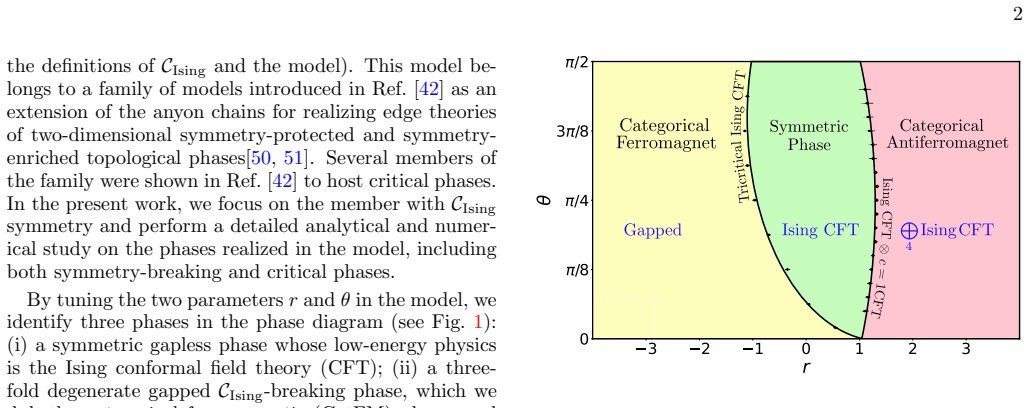
A lattice model with Ising fusion category symmetry hosts a symmetric Ising critical phase, a categorical ferromagnetic phase with threefold degeneracy, and a critical categorical antiferromagnetic phase.
A machine-rendered reading of the paper's core claim, the machinery that carries it, and where it could break.
Core claim
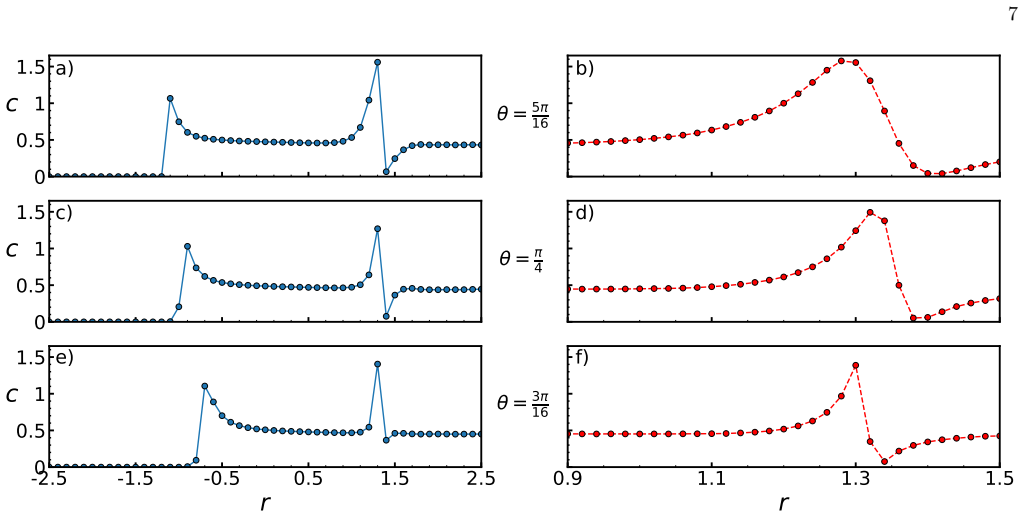
In an anyon-chain-like lattice model with symmetry described by the Ising fusion category, numerical and analytical studies reveal a phase diagram with a symmetric critical phase in the usual Ising universality class, a categorical ferromagnetic phase in which the Ising fusion category is fully broken and the ground state is threefold degenerate, and a categorical antiferromagnetic phase that breaks lattice translation symmetry and part of the category while being described by a fourfold degenerate Ising conformal field theory. The transition between the symmetric and categorical ferromagnetic phases is governed by the c=7/10 tricritical Ising CFT, and numerical data indicate that the latter
What carries the argument
The Ising fusion category, which supplies the non-invertible symmetry and whose domain walls carry quantum dimension greater than one, thereby enlarging the low-energy manifold in the antiferromagnetic phase.
If this is right
- Antiferromagnetic states associated with broken non-invertible symmetries remain critical because domain walls have quantum dimension larger than one.
- The generalized Landau paradigm correctly predicts the threefold degeneracy of the categorical ferromagnetic phase.
- The symmetric phase belongs to the Ising universality class even though the microscopic symmetry is non-invertible.
- Transitions out of the symmetric phase can be captured by known conformal field theories such as the tricritical Ising model.
Where Pith is reading between the lines
- Similar lattice constructions for other fusion categories may also produce critical antiferromagnetic phases with exponentially large low-energy manifolds.
- The numerical identification of c=3/2 at one transition invites analytic constructions that match this central charge to known theories.
- The exponential growth of the low-energy manifold in the categorical antiferromagnetic phase suggests that entanglement entropy will scale differently from conventional gapped antiferromagnets.
Load-bearing premise
The finite-size numerical data correctly identify the central charges, ground-state degeneracies, and phase boundaries in the infinite-volume limit without substantial finite-size effects.
What would settle it
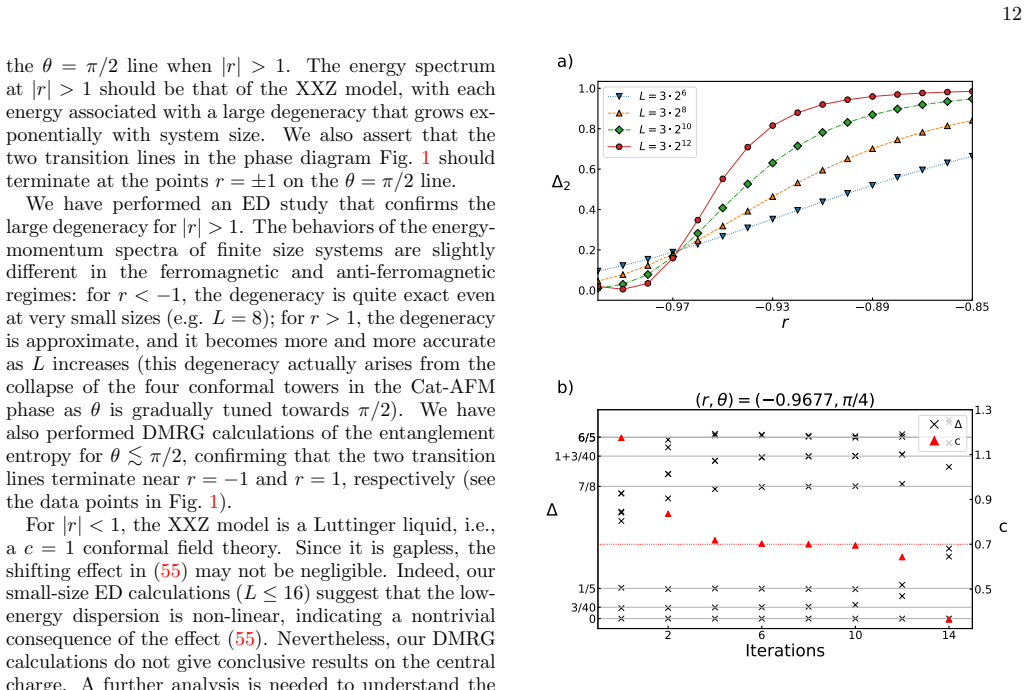
Exact diagonalization or tensor-network calculations on chains of length 30 or larger that yield a central charge clearly different from 3/2 at the symmetric-to-categorical-antiferromagnetic transition or that show a first-order rather than continuous transition.
Figures




read the original abstract
An anyon-chain-like lattice model with symmetry described by the Ising fusion category is studied. Combining numerical and analytical studies, we uncover a rich phase diagram that contains three phases: a symmetric critical phase and two categorical symmetry breaking phases. The symmetric phase lies in the same universality class as the usual critical Ising model. The first symmetry-breaking phase, dubbed the \emph{categorical ferromagnetic} phase, has the Ising fusion category fully broken and exhibits a threefold ground-state degeneracy, as expected from the generalized Landau paradigm. The other symmetry-breaking phase is analogous to a conventional antiferromagnet: it breaks lattice translation and part of the Ising fusion category, and therefore is termed the \emph{categorical antiferromagnetic} phase. Unlike ordinary antiferromagnetic states associated with finite invertible symmetry breaking, this phase itself is critical, being described by a fourfold degenerate Ising conformal field theory. We argue more generally that antiferromagnetic states associated with broken non-invertible symmetries have a large low-energy manifold that grows exponentially in system size, due to the greater-than-one quantum dimension of domain walls. We also numerically study the transitions between the three phases. The transition between the symmetric and categorical ferromagnetic phase is described by the $c=7/10$ tricritical Ising CFT, while the transition between the symmetric and categorical antiferromagnetic phases is less understood. Our numerical data suggest that the latter transition is continuous and described by a conformal field theory with central charge $c=3/2$.
Editorial analysis
A structured set of objections, weighed in public.
Referee Report
Summary. The manuscript studies an anyon-chain-like lattice model whose symmetry is described by the Ising fusion category. Combining numerical and analytical methods, the authors map a phase diagram containing a symmetric critical phase in the Ising universality class, a categorical ferromagnetic phase with threefold ground-state degeneracy arising from complete symmetry breaking, and a categorical antiferromagnetic phase that breaks lattice translation together with part of the fusion category. The latter phase is itself critical and described by a fourfold-degenerate Ising CFT. The authors further argue that antiferromagnetic states associated with non-invertible symmetry breaking generically possess an exponentially large low-energy manifold because domain walls carry quantum dimension greater than one. The symmetric-to-categorical-ferromagnetic transition is identified with the tricritical Ising CFT (c=7/10), while the symmetric-to-categorical-antiferromagnetic transition is reported as continuous with central charge c=3/2 on the basis of numerical data.
Significance. If the central claims are substantiated, the work supplies a concrete lattice realization of generalized symmetry breaking for a non-invertible fusion category and illustrates how the greater-than-one quantum dimension of domain walls forces antiferromagnetic phases to remain critical. The general argument concerning the exponential growth of the low-energy manifold is a useful conceptual contribution. The identification of the tricritical Ising point provides a controlled benchmark, while the c=3/2 transition, if confirmed, would furnish an example of a novel universality class arising from non-invertible symmetry breaking.
major comments (1)
- [Abstract and numerical results on the symmetric-to-categorical-antiferromagnetic transition] The claim that the symmetric-to-categorical-antiferromagnetic transition is continuous and belongs to a c=3/2 CFT rests on the statement that 'our numerical data suggest' this identification. No system sizes, entanglement-entropy scaling fits, level-spectroscopy data, or controlled extrapolation procedure are supplied in the abstract or the summary of numerical results. Because the categorical antiferromagnetic phase is itself asserted to be critical with fourfold degeneracy, finite-size effects or crossover could produce an apparent central charge near 3/2 without the transition actually being described by a single c=3/2 CFT. This identification is load-bearing for the reported phase diagram and the assertion that the transition is continuous.
Simulated Author's Rebuttal
We thank the referee for their careful reading of our manuscript and for identifying the need for clearer documentation of the numerical evidence supporting the symmetric-to-categorical-antiferromagnetic transition. We address this point directly below and will revise the manuscript accordingly.
read point-by-point responses
-
Referee: [Abstract and numerical results on the symmetric-to-categorical-antiferromagnetic transition] The claim that the symmetric-to-categorical-antiferromagnetic transition is continuous and belongs to a c=3/2 CFT rests on the statement that 'our numerical data suggest' this identification. No system sizes, entanglement-entropy scaling fits, level-spectroscopy data, or controlled extrapolation procedure are supplied in the abstract or the summary of numerical results. Because the categorical antiferromagnetic phase is itself asserted to be critical with fourfold degeneracy, finite-size effects or crossover could produce an apparent central charge near 3/2 without the transition actually being described by a single c=3/2 CFT. This identification is load-bearing for the reported phase diagram and the assertion that the transition is continuous.
Authors: We agree that the abstract and the high-level summary of numerical results are too terse and do not adequately document the supporting data or address possible finite-size artifacts arising from the critical nature of the categorical antiferromagnetic phase. The detailed numerical analysis (system sizes, entanglement-entropy scaling, level spectroscopy, and extrapolation) appears in the main text, but we acknowledge that this is insufficient for a load-bearing claim. We will revise the abstract to include a concise statement of the largest system sizes employed and the extrapolated central charge. We will also expand the summary of numerical results into a dedicated paragraph that (i) reports the entanglement-entropy scaling fits and their stability under extrapolation, (ii) summarizes the level-spectroscopy results confirming the expected fourfold degeneracy without level crossings indicative of a first-order transition, and (iii) explicitly discusses why crossover effects from the adjacent critical phase do not dominate the scaling window. These additions will make the evidence for continuity and the c=3/2 identification transparent while preserving the original interpretation. revision: yes
Circularity Check
No significant circularity detected
full rationale
The paper identifies phases and transitions via a combination of direct numerical measurements (central charges, degeneracies, entanglement scaling) and analytical arguments grounded in standard fusion-category properties and known CFT universality classes (Ising, tricritical Ising). No derivation step reduces by construction to its own inputs: the threefold degeneracy follows from the generalized Landau paradigm applied to the Ising category, the fourfold degeneracy of the categorical antiferromagnet is tied to the quantum dimension of domain walls (a pre-existing anyon property), and the c=3/2 suggestion is explicitly labeled as a numerical observation rather than a fitted or self-defined prediction. No load-bearing self-citations or ansatz smuggling appear in the provided text.
Axiom & Free-Parameter Ledger
free parameters (1)
- Hamiltonian coupling constants
axioms (1)
- domain assumption The lattice model realizes the Ising fusion category symmetry
Reference graph
Works this paper leans on
-
[1]
non-invertible
is understood as the identity representation. For the other two representations, either U(ψ) orU(σ) is associated with a minus sign. We remark that the algebra (22) being commutative is due to the fact thatC Ising is actually braided. The fusion rules of any braided fusion category are commu- tative. In this case, the symmetry algebra (identical to the fu...
-
[2]
All other states— descendants of the primaries—have scaling dimensions that differ by some integers
and (1 2 , 1 2), respectively. All other states— descendants of the primaries—have scaling dimensions that differ by some integers. We find that the ED spec- trum of our model agrees well with Eq. 25, up to a rea- sonable finite size effect (see the caption of Fig. 3). Notably, exact diagonalization allows us to investigate the symmetry properties of the ...
-
[3]
For the primary states ( 1 16 , 1 16) and ( 1 2 , 1
symmetry sector, i.e., the trivial representation ofC Ising. For the primary states ( 1 16 , 1 16) and ( 1 2 , 1
-
[4]
(and their descendants), we find that they lie in the ⃗λ= (1,−1,0) and ⃗λ= (1,1,− √
-
[5]
↑” represents the absence of a domain wall and “↓
sectors, re- spectively, i.e., nontrivial representations ofC Ising. These symmetry properties agree with the CFT expectation. A particularly useful result in CFT is the state-operator correspondence: there is a one-to-one correspondence be- tween eigenstates and local operators. With this corre- spondence, we conclude that there are no relevant oper- ato...
-
[6]
σ” site, while the second sum comes from anH flip i that acts on a “µ
CatFM phase:r≪ −1 Forr≪ −1, as discussed in the main text, the ground- state manifold of the unperturbed HamiltonianH 0 de- pends on the parity ofL. Here, we considerLto be even. In this case,H 0 has a ground state degeneracy of G.S.D. = 3 + 2·2 L/2. There are two types of ground states: three ferromagnetic states |· · ·111· · ·⟩,|· · ·ψψψ· · ·⟩,|· · ·σσσ...
-
[7]
The ground state manifold ofH 0 depends onLmodulo 4
CatAFM phase:r≫1 In this case, the model favors anti-ferromagnetic ground states. The ground state manifold ofH 0 depends onLmodulo 4. For simplicity, we takeLto be a multi- ple of four (the other cases can be thought of as trans- lational defects inserted into the ground states). The ground state degeneracy is 4·2 L/4. The unperturbed ground states are o...
-
[9]
J. McGreevy, Generalized Symmetries in Condensed Matter, Annual Review of Condensed Matter Physics14, 57 (2023), arXiv:2204.03045
-
[10]
What’s Done CannotBe Undone: TASILectures on Non-InvertibleSymmetries,
S.-H. Shao, What’s Done Cannot Be Undone: TASI Lectures on Non-Invertible Symmetries, arXiv e-prints (2023), arXiv:2308.00747
-
[11]
Sch¨ afer-Nameki, ICTP lectures on (non-)invertible generalized symmetries, Physics Reports1063, 1 (2024)
S. Sch¨ afer-Nameki, ICTP lectures on (non-)invertible generalized symmetries, Physics Reports1063, 1 (2024)
2024
-
[12]
Bhardwaj, L
L. Bhardwaj, L. E. Bottini, L. Fraser-Taliente, L. Glad- den, D. S. Gould, A. Platschorre, and H. Tillim, Lec- tures on generalized symmetries, Physics Reports1051, 1 (2024)
2024
-
[13]
Luo, Q.-R
R. Luo, Q.-R. Wang, and Y.-N. Wang, Lecture notes on generalized symmetries and applications, Physics Re- ports1065, 1 (2024)
2024
-
[14]
A. Feiguin, S. Trebst, A. W. W. Ludwig, M. Troyer, A. Kitaev, Z. Wang, and M. H. Freedman, Interacting Anyons in Topological Quantum Liquids: The Golden Chain, Phys. Rev. Lett.98, 160409 (2007), arXiv:cond- mat/0612341
-
[15]
On finite symmetries and their gauging in two dimensions,
L. Bhardwaj and Y. Tachikawa, On finite symmetries and their gauging in two dimensions, Journal of High Energy Physics2018, 189 (2018), arXiv:1704.02330
-
[16]
Topological Defect Lines and Renormalization Group Flows in Two Dimensions
C.-M. Chang, Y.-H. Lin, S.-H. Shao, Y. Wang, and X. Yin, Topological defect lines and renormalization group flows in two dimensions, Journal of High Energy Physics2019, 26 (2019), arXiv:1802.04445
work page Pith review arXiv 2019
-
[17]
Ji and X.-G
W. Ji and X.-G. Wen, Categorical symmetry and nonin- vertible anomaly in symmetry-breaking and topological phase transitions, Phys. Rev. Res.2, 033417 (2020)
2020
- [18]
-
[19]
Etingof, S
P. Etingof, S. Gelaki, D. Nikshych, and V. Ostrik,Tensor Categories(American Mathematical Society, 2015)
2015
-
[20]
D. Gaiotto, A. Kapustin, N. Seiberg, and B. Willett, Generalized global symmetries, Journal of High Energy Physics2015, 172 (2015), arXiv:1412.5148
work page internal anchor Pith review arXiv 2015
-
[21]
’t Hooft, Naturalness, chiral symmetry, and sponta- neous chiral symmetry breaking, NATO Sci
G. ’t Hooft, Naturalness, chiral symmetry, and sponta- neous chiral symmetry breaking, NATO Sci. Ser. B59, 135 (1980)
1980
- [22]
-
[23]
L. Kong and X.-G. Wen, Braided fusion categories, grav- itational anomalies, and the mathematical framework for topological orders in any dimensions, arXiv e-prints (2014), arXiv:1405.5858
- [24]
- [25]
-
[26]
Blume, V
M. Blume, V. J. Emery, and R. B. Griffiths, Ising model for theλtransition and phase separation in He 3-He4 mix- tures, Phys. Rev. A4, 1071 (1971)
1971
-
[27]
O’Brien and P
E. O’Brien and P. Fendley, Lattice Supersymmetry and Order-Disorder Coexistence in the Tricritical Ising Model, Phys. Rev. Lett.120, 206403 (2018)
2018
-
[28]
Non-invertible symmetries and LSM-type constraints on a tensor product Hilbert space,
N. Seiberg, S. Seifnashri, and S.-H. Shao, Non-invertible symmetries and LSM-type constraints on a tensor prod- uct Hilbert space, SciPost Physics16, 154 (2024), arXiv:2401.12281
-
[29]
Wen, Colloquium: Zoo of quantum-topological phases of matter, Rev
X.-G. Wen, Colloquium: Zoo of quantum-topological phases of matter, Rev. Mod. Phys.89, 041004 (2017)
2017
-
[30]
Wen, Emergent anomalous higher symmetries from topological order and from dynamical electromagnetic field in condensed matter systems, Phys
X.-G. Wen, Emergent anomalous higher symmetries from topological order and from dynamical electromagnetic field in condensed matter systems, Phys. Rev. B99, 205139 (2019)
2019
-
[31]
Higher-form symmetries and spontaneous symmetry breaking
E. Lake, Higher-form symmetries and spontaneous sym- metry breaking, arXiv e-prints (2018), arXiv:1802.07747
work page Pith review arXiv 2018
-
[32]
Fusion category symmetry. Part I. Anomaly in-flow and gapped phases,
R. Thorngren and Y. Wang, Fusion category symmetry. Part I. Anomaly in-flow and gapped phases, JHEP04, 132, arXiv:1912.02817
-
[33]
Y. Choi, H. T. Lam, and S.-H. Shao, Noninvertible global symmetries in the standard model, Phys. Rev. Lett.129, 161601 (2022)
2022
-
[34]
Bhardwaj, L
L. Bhardwaj, L. E. Bottini, D. Pajer, and S. Sch¨ afer- Nameki, Categorical Landau Paradigm for Gapped Phases, Phys. Rev. Lett.133, 161601 (2024)
2024
-
[35]
Gapped phases with non-invertible symmetries:(1+1)d,
L. Bhardwaj, L. E. Bottini, D. Pajer, and S. Sch¨ afer- Nameki, Gapped phases with non-invertible sym- metries: (1+1)d, SciPost Physics18, 032 (2025), arXiv:2310.03784
-
[36]
Illustrating the categorical Landau paradigm in lattice models,
L. Bhardwaj, L. E. Bottini, S. Sch¨ afer-Nameki, and A. Tiwari, Illustrating the categorical Landau paradigm in lattice models, Phys. Rev. B111, 054432 (2025), arXiv:2405.05302
-
[37]
H. Moradi, S. Faroogh Moosavian, and A. Tiwari, Topo- logical Holography: Towards a Unification of Landau and Beyond-Landau Physics, SciPost Physics Core6, 066 (2023), arXiv:2207.10712
-
[38]
A. Chatterjee, ¨O. M. Aksoy, and X.-G. Wen, Quan- tum phases and transitions in spin chains with non- invertible symmetries, SciPost Physics17, 115 (2024), arXiv:2405.05331
-
[39]
C´ ordova, S
C. C´ ordova, S. Hong, S. Koren, and K. Ohmori, Neutrino Masses from Generalized Symmetry Breaking, Physical Review X14, 031033 (2024)
2024
-
[40]
Y. Zhao and Y. Wan, Landau-Ginzburg Paradigm of Topological Phases, arXiv e-prints (2025), arXiv:2506.05319
-
[41]
C. Gils, E. Ardonne, S. Trebst, D. A. Huse, A. W. W. Ludwig, M. Troyer, and Z. Wang, Anyonic quantum spin chains: Spin-1 generalizations and topological stability, Phys. Rev. B87, 235120 (2013)
2013
- [42]
-
[43]
Topological Defects on the Lattice I: The Ising model
D. Aasen, R. S. K. Mong, and P. Fendley, Topologi- cal defects on the lattice: I. The Ising model, Journal of Physics A Mathematical General49, 354001 (2016), arXiv:1601.07185
work page Pith review arXiv 2016
-
[44]
Topological Defects on the Lattice: Dualities and Degeneracies,
D. Aasen, P. Fendley, and R. S. K. Mong, Topological Defects on the Lattice: Dualities and Degeneracies, arXiv e-prints (2020), arXiv:2008.08598
-
[45]
Vanhove, M
R. Vanhove, M. Bal, D. J. Williamson, N. Bultinck, J. Haegeman, and F. Verstraete, Mapping topological to conformal field theories through strange correlators, Phys. Rev. Lett.121, 177203 (2018)
2018
-
[46]
T. Senthil, Symmetry-Protected Topological Phases of Quantum Matter, Annual Review of Condensed Matter Physics6, 299 (2015), arXiv:1405.4015
-
[47]
Lieb-Schultz-Mattis Anomalies and Anomaly Matching
L. Zou and M. Cheng, Lieb-Schultz-Mattis Anoma- lies and Anomaly Matching, arXiv e-prints (2026), arXiv:2604.00347
work page internal anchor Pith review Pith/arXiv arXiv 2026
-
[48]
Symmetry as a shadow of topological order and a derivation of topological holographic principle,
A. Chatterjee and X.-G. Wen, Symmetry as a shadow of topological order and a derivation of topological holo- graphic principle, Phys. Rev. B107, 155136 (2023), arXiv:2203.03596
-
[49]
S.-Q. Ning, B.-B. Mao, and C. Wang, Building 1D lattice models with G-graded fusion category, SciPost Physics 17, 125 (2024), arXiv:2301.06416
- [50]
-
[51]
R. Vanhove, L. Lootens, M. Van Damme, R. Wolf, T. J. Osborne, J. Haegeman, and F. Verstraete, Critical Lat- tice Model for a Haagerup Conformal Field Theory, Phys. Rev. Lett.128, 231602 (2022), arXiv:2110.03532
-
[52]
T.-C. Huang, Y.-H. Lin, K. Ohmori, Y. Tachikawa, and M. Tezuka, Numerical Evidence for a Haagerup Confor- mal Field Theory, Phys. Rev. Lett.128, 231603 (2022), arXiv:2110.03008
-
[53]
TFT construction of RCFT correlators I: Partition functions
J. Fuchs, I. Runkel, and C. Schweigert, TFT construc- tion of RCFT correlators I: partition functions, Nuclear Physics B646, 353 (2002), arXiv:hep-th/0204148
work page Pith review arXiv 2002
- [54]
-
[55]
Kramers-Wannier duality from conformal defects
J. Fr¨ ohlich, J. Fuchs, I. Runkel, and C. Schweigert, Kramers-Wannier Duality from Conformal Defects, Phys. Rev. Lett.93, 070601 (2004), arXiv:cond-mat/0404051
work page Pith review arXiv 2004
-
[56]
K. Inamura and K. Ohmori, Fusion surface models: 2+1d lattice models from fusion 2-categories, SciPost Physics 16, 143 (2024), arXiv:2305.05774
-
[57]
Chen, Z.-C
X. Chen, Z.-C. Gu, Z.-X. Liu, and X.-G. Wen, Symmetry protected topological orders and the group cohomology of their symmetry group, Phys. Rev. B87, 155114 (2013)
2013
-
[58]
Barkeshli, P
M. Barkeshli, P. Bonderson, M. Cheng, and Z. Wang, Symmetry fractionalization, defects, and gauging of topological phases, Phys. Rev. B100, 115147 (2019)
2019
-
[59]
S. Yang, Z.-C. Gu, and X.-G. Wen, Loop optimiza- tion for tensor network renormalization, arXiv e-prints , arXiv:1512.04938 (2015), arXiv:1512.04938
-
[60]
Fishman, S
M. Fishman, S. R. White, and E. M. Stoudenmire, The ITensor Software Library for Tensor Network Calcula- tions, SciPost Phys. Codebases , 4 (2022)
2022
-
[61]
R. A. Jones and M. A. Metlitski, One-dimensional lat- tice models for the boundary of two-dimensional ma- jorana fermion symmetry-protected topological phases: Kramers-wannier duality as an exactZ 2 symmetry, Phys. Rev. B104, 245130 (2021)
2021
-
[62]
S. H. Simon,Topological quantum(Oxford University Press, 2023). 22
2023
-
[63]
Anyonic Chains, Topological Defects, and Conformal Field Theory
M. Buican and A. Gromov, Anyonic Chains, Topo- logical Defects, and Conformal Field Theory, Commu- nications in Mathematical Physics356, 1017 (2017), arXiv:1701.02800
work page Pith review arXiv 2017
-
[64]
Verlinde, Fusion rules and modular transformations in 2d conformal field theory, Nuclear Physics B300, 360 (1988)
E. Verlinde, Fusion rules and modular transformations in 2d conformal field theory, Nuclear Physics B300, 360 (1988)
1988
-
[65]
A. Kitaev, Anyons in an exactly solved model and be- yond, Annals of Physics321, 2 (2006), arXiv:cond- mat/0506438
-
[66]
S. R. White, Density matrix formulation for quantum renormalization groups, Phys. Rev. Lett.69, 2863 (1992)
1992
-
[67]
Xiang,Density Matrix and Tensor Network Renor- malization(Cambridge University Press, 2023)
T. Xiang,Density Matrix and Tensor Network Renor- malization(Cambridge University Press, 2023)
2023
-
[68]
Schollw¨ ock, The density-matrix renormalization group, Rev
U. Schollw¨ ock, The density-matrix renormalization group, Rev. Mod. Phys.77, 259 (2005)
2005
-
[69]
The density-matrix renormalization group in the age of matrix product states
U. Schollw¨ ock, The density-matrix renormalization group in the age of matrix product states, Annals of Physics 326, 96 (2011), arXiv:1008.3477
work page Pith review arXiv 2011
-
[70]
J. L. Cardy, Operator content of two-dimensional con- formally invariant theories, Nuclear Physics B270, 186 (1986)
1986
-
[71]
P. Calabrese and J. Cardy, Entanglement entropy and quantum field theory, Journal of Statistical Mechanics: Theory and Experiment2004, 06002 (2004), arXiv:hep- th/0405152
-
[72]
Levin and C
M. Levin and C. P. Nave, Tensor renormalization group approach to two-dimensional classical lattice models, Phys. Rev. Lett.99, 120601 (2007)
2007
-
[73]
Evenbly and G
G. Evenbly and G. Vidal, Tensor network renormaliza- tion, Phys. Rev. Lett.115, 180405 (2015)
2015
-
[74]
Bao,Loop optimization of tensor network renormal- ization: algorithms and applications, Ph.D
C. Bao,Loop optimization of tensor network renormal- ization: algorithms and applications, Ph.D. thesis, Uni- versity of Waterloo (2019)
2019
-
[75]
G. Li, K. H. Pai, and Z.-C. Gu, Tensor-network renormal- ization approach to theq-state clock model, Phys. Rev. Res.4, 023159 (2022)
2022
-
[76]
Y.-J. Wei and Z.-C. Gu, Tensor network renormal- ization: application to dynamic correlation functions and non-hermitian systems, arXiv e-prints (2023), arXiv:2311.18785
-
[77]
Di Francesco, P
P. Di Francesco, P. Mathieu, and D. S´ en´ echal,Conformal Field Theory, Graduate Texts in Contemporary Physics (Springer New York, New York, NY, 1997)
1997
-
[78]
Rahmani, X
A. Rahmani, X. Zhu, M. Franz, and I. Affleck, Emergent supersymmetry from strongly interacting majorana zero modes, Phys. Rev. Lett.115, 166401 (2015)
2015
-
[79]
Rahmani, X
A. Rahmani, X. Zhu, M. Franz, and I. Affleck, Phase diagram of the interacting majorana chain model, Phys. Rev. B92, 235123 (2015)
2015
-
[80]
C. V. Cogburn, A. L. Fitzpatrick, and H. Geng, CFT and lattice correlators near an RG domain wall between minimal models, SciPost Phys. Core7, 021 (2024)
2024
-
[81]
A. Cortes Cubero, R. Konik, M. Lencs´ es, G. Mussardo, and G. Takacs, Duality and form factors in the thermally deformed two-dimensional tricritical Ising model, SciPost Physics12, 162 (2022), arXiv:2109.09767
discussion (0)
Sign in with ORCID, Apple, or X to comment. Anyone can read and Pith papers without signing in.