Recognition: unknown
Polymeric Solvents Control Swelling-Induced Surface Creasing
Pith reviewed 2026-05-09 23:37 UTC · model grok-4.3
The pith
The polymerization degree of the solvent independently sets whether a swelling polymer gel develops surface creases.
A machine-rendered reading of the paper's core claim, the machinery that carries it, and where it could break.
Core claim
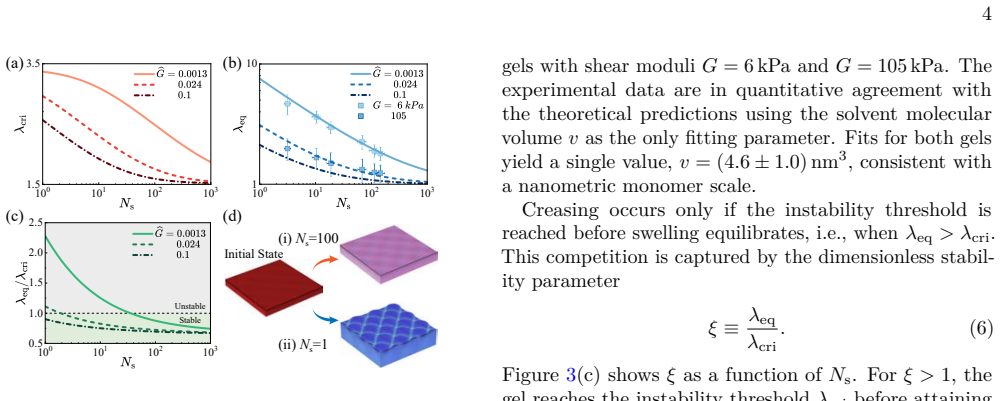
Polymeric solvents reduce the mixing entropy between gel and solvent, thereby modifying the osmotic pressure that drives swelling against the elastic network. This modification allows the solvent polymerization degree Ns to tune the equilibrium swelling and the critical condition for surface creasing as two distinct quantities. Experiments show the transition from creased to stable surfaces occurs with increasing Ns at fixed network properties, and the coupled thermodynamic-mechanical model reproduces the observed stability boundary across both Ns and crosslink density.
What carries the argument
The coupling of swelling thermodynamics to mechanical stability, in which Ns lowers the entropy of mixing and thereby shifts the osmotic pressure relative to the elastic restoring force.
If this is right
- The stability boundary in the plane of solvent polymerization degree and network elasticity is quantitatively captured by the entropy-modified osmotic pressure model.
- Crease suppression is achieved without altering swelling speed or the final through-thickness solvent profile.
- Equilibrium swelling ratio and mechanical instability threshold can be set independently by choice of Ns.
Where Pith is reading between the lines
- Designers could select solvent chain length to reach a target swollen thickness while keeping the surface flat, which would matter for thin-film coatings or microfluidic channels.
- The same entropy-tuning route might stabilize other swelling-driven instabilities such as wrinkling or folding if the mechanical criterion is replaced by the appropriate one.
- Varying temperature would provide a further test, since entropy terms in the mixing free energy are temperature-dependent and should shift the crease threshold predictably.
Load-bearing premise
The change in crease threshold with Ns arises from the reduction in mixing entropy rather than from differences in solvent viscosity, chain mobility, or other unaccounted interactions.
What would settle it
An experiment that measures the actual mixing free energy or osmotic pressure as a function of Ns and finds no shift large enough to explain the observed change in crease onset, or a test in which crease threshold remains fixed while Ns is varied but entropy contributions are held constant by another means.
Figures


read the original abstract
Surface creasing in swelling polymer gels is commonly attributed to compressive strain or interlayer mismatch, yet its general control remains unclear. Here we show that solvent polymerization degree $N_{\rm s}$ provides an independent control parameter for crease onset in surface-bound polydimethylsiloxane gels swollen by silicone oils. Despite nearly identical swelling kinetics and through-thickness solvent concentration profiles, we observe a transition from creased to stable surfaces with increasing $N_{\rm s}$. A theory coupling swelling thermodynamics and mechanical stability reveals that polymeric solvents reduce the mixing entropy and thereby modify the osmotic pressure, allowing $N_{\rm s}$ to tune separately the equilibrium swelling and the crease threshold. This framework captures the stability boundary across solvent polymerization degree and network elasticity. These results identify polymeric solvents as active thermodynamic-mechanical regulators of swelling-induced surface.
Editorial analysis
A structured set of objections, weighed in public.
Referee Report
Summary. The manuscript claims that the polymerization degree Ns of polymeric solvents acts as an independent control parameter for the onset of swelling-induced surface creasing in surface-bound PDMS gels swollen by silicone oils. Experiments reveal a transition from creased to stable surfaces with increasing Ns, despite nearly identical swelling kinetics and through-thickness solvent concentration profiles. A theory that couples swelling thermodynamics (via reduced mixing entropy in the free energy) with mechanical stability analysis shows that Ns modifies the osmotic pressure contribution to stress, allowing separate tuning of equilibrium swelling and the crease threshold; the framework accounts for the observed stability boundary across Ns and network elasticity.
Significance. If the central claim holds, the work identifies a thermodynamic mechanism for controlling surface instabilities that is decoupled from the local deformation gradient, offering a new design handle for soft materials. The experimental demonstration of identical φ(z) profiles yet differing stability, combined with the entropy-based explanation, strengthens understanding of swelling-induced creasing beyond strain-mismatch models and could inform applications in coatings and responsive gels.
minor comments (3)
- [Abstract] The abstract states that the theory 'captures the stability boundary across solvent polymerization degree and network elasticity,' but the manuscript would benefit from an explicit statement of the quantitative metric used for agreement (e.g., predicted vs. observed critical Ns) and the range of network moduli tested.
- [Theory] In the theory development, the incremental stability operator is said to shift with Ns at fixed φ(z); include a brief derivation sketch or reference to the precise form of the osmotic-pressure term (arising from the φ/Ns ln φ contribution) to make the decoupling transparent.
- [Experiments] Figure captions or the experimental section should report the number of independent samples and any error bars on the observed transition Ns to allow assessment of reproducibility.
Simulated Author's Rebuttal
We thank the referee for the positive assessment of our work and the recommendation for minor revision. The summary accurately captures the central claim that polymerization degree Ns serves as an independent control parameter decoupling swelling from mechanical instability via reduced mixing entropy. As the report lists no specific major comments, we have no individual points to rebut or revise at this stage, though we will incorporate any minor editorial improvements in the revised version.
Circularity Check
No significant circularity; derivation is self-contained
full rationale
The paper derives the effect of Ns on crease threshold from the standard Flory-Huggins mixing free energy term (φ/Ns ln φ) that reduces solvent entropy and thereby shifts osmotic pressure in the total stress, even at fixed local volume fraction φ(z) and deformation gradient. This thermodynamic contribution is then inserted into the incremental stability operator for surface creasing. The resulting boundary is independent of the observed swelling profiles, which the experiments hold fixed while varying Ns. No parameter is fitted to the target crease data and then renamed a prediction, no self-citation supplies a uniqueness theorem or ansatz, and the central claim does not reduce to its inputs by construction. The framework therefore remains externally falsifiable against the reported stability boundary across Ns and network elasticity.
Axiom & Free-Parameter Ledger
axioms (1)
- domain assumption Swelling thermodynamics can be directly coupled to mechanical stability criteria for surface creasing
Reference graph
Works this paper leans on
-
[1]
Ben Amar, Wrinkles, creases, and cusps in growing soft matter, Rev
M. Ben Amar, Wrinkles, creases, and cusps in growing soft matter, Rev. Mod. Phys.97, 015004 (2025)
2025
-
[2]
B. Li, F. Jia, Y.-P. Cao, X.-Q. Feng, and H. Gao, Surface wrinkling patterns on a core-shell soft sphere, Phys. Rev. Lett. 106, 234301 (2011)
2011
-
[3]
Dervaux and M
J. Dervaux and M. B. Amar, Mechanical instabilities of gels, Annu. Rev. Condens. Matter Phys3, 311 (2012)
2012
-
[4]
Lestringant, C
C. Lestringant, C. Maurini, A. Lazarus, and B. Audoly, Buckling of an elastic ridge: Competition between wrin- kles and creases, Phys. Rev. Lett.118, 165501 (2017)
2017
-
[5]
J. Li, N. Arora, and S. Rudykh, Elastic instabilities, mi- crostructure transformations, and pattern formations in soft materials, Curr. Opin. Solid. St. M.25, 100898 (2021)
2021
-
[6]
T. Wang, Z. Dai, M. Potier-Ferry, and F. Xu, Curvature- regulated multiphase patterns in tori, Phys. Rev. Lett. 130, 048201 (2023)
2023
-
[7]
Hwang, M
J. Hwang, M. Altomare, and H. A. Stone, Surface fur- rowing instability in everting soft solids, Phys. Rev. Lett. 134, 058205 (2025)
2025
-
[8]
Tanaka, S.-T
T. Tanaka, S.-T. Sun, Y. Hirokawa, S. Katayama, J. Kucera, Y. Hirose, and T. Amiya, Mechanical insta- bility of gels at the phase transition, Nature325, 796 (1987)
1987
-
[9]
Guvendiren, S
M. Guvendiren, S. Yang, and J. A. Burdick, Swelling- induced surface patterns in hydrogels with gradient crosslinking density, Adv. Funct. Mater.19, 3038 (2009)
2009
-
[10]
H. Lee, J. Zhang, H. Jiang, and N. X. Fang, Prescribed pattern transformation in swelling gel tubes by elastic instability, Phys. Rev. Lett.108, 214304 (2012)
2012
-
[11]
Bertrand, J
T. Bertrand, J. Peixinho, S. Mukhopadhyay, and C. W. MacMinn, Dynamics of swelling and drying in a spherical gel, Phys. Rev. Applied6, 064010 (2016)
2016
-
[12]
Kopecz-Muller, C
C. Kopecz-Muller, C. Gaunand, Y. Tran, M. Labousse, E. Raphaël, T. Salez, F. Box, and J. D. McGraw, Swelling and evaporation determine surface morphology of grafted hydrogel thin films, Langmuir41, 2400 (2025)
2025
-
[13]
Savin, N
T. Savin, N. A. Kurpios, A. E. Shyer, P. Florescu, H. Liang, L. Mahadevan, and C. J. Tabin, On the growth and form of the gut, Nature476, 57 (2011)
2011
-
[14]
Tallinen, J
T. Tallinen, J. Y. Chung, F. Rousseau, N. Girard, J. Lefèvre, and L. Mahadevan, On the growth and form of cortical convolutions, Nat. Phys.12, 588 (2016)
2016
-
[15]
Martínez-Calvo, T
A. Martínez-Calvo, T. Bhattacharjee, R. K. Bay, H. N. Luu, A. M. Hancock, N. S. Wingreen, and S. S. Datta, Morphological instability and roughening of growing 3d bacterial colonies, Proc. Natl. Acad. Sci. U.S.A. 119, 6 e2208019119 (2022)
2022
-
[16]
Guha Ray and P
C. Guha Ray and P. A. Haas, Unbuckling mechanics of epithelial monolayers under compression, Phys. Rev. Lett. 134, 118402 (2025)
2025
-
[17]
X. Wen, S. Sun, and P. Wu, Dynamic wrinkling of a hydrogel–elastomer hybrid microtube enables blood vessel- like hydraulic pressure sensing and flow regulation, Mater. Horiz. 7, 2150 (2020)
2020
-
[18]
L. Tang, J. Shang, and X. Jiang, Multilayered electronic transfer tattoo that can enable the crease amplification effect, Sci. Adv.7, eabe3778 (2021)
2021
-
[19]
C. Wang, D. Wang, V. Kozhevnikov, X. Dai, G. Turnbull, X. Chen, J. Kong, B. Z. Tang, Y. Li, and B. B. Xu, A flexible topo-optical sensing technology with ultra-high contrast, Nat. Commun.11, 1448 (2020)
2020
-
[20]
H. F. Chan, R. Zhao, G. A. Parada, H. Meng, K. W. Leong, L. G. Griffith, and X. Zhao, Folding artificial mucosa with cell-laden hydrogels guided by mechanics models, Proc. Natl. Acad. Sci. U.S.A.115, 7503 (2018)
2018
-
[21]
J. Ko, C. Kim, D. Kim, Y. Song, S. Lee, B. Yeom, J. Huh, S. Han, D. Kang, J.-S. Koh, and J. Cho, High-performance electrified hydrogel actuators based on wrinkled nanomem- brane electrodes for untethered insect-scale soft aquabots, Sci. Robot. 7, eabo6463 (2022)
2022
-
[22]
S. Yan, K. Hu, S. Chen, T. Li, W. Zhang, J. Yin, and X.Jiang,Photo-inducedstressrelaxationinreconfigurable disulfide-crosslinked supramolecular films visualized by dynamic wrinkling, Nat. Commun.13, 7434 (2022)
2022
-
[23]
J. D. Glover, X. Yang, R. Long, and J. T. Pham, Creasing in microscale, soft static friction, Nat. Commun.14, 2362 (2023)
2023
-
[24]
A. N. Gent and I. S. Cho, Surface instabilities in com- pressed or ben rubber blocks, Rubber Chem. Technol.72, 253 (1999)
1999
-
[25]
Hohlfeld and L
E. Hohlfeld and L. Mahadevan, Unfolding the sulcus, Phys. Rev. Lett.106, 105702 (2011)
2011
-
[26]
Hohlfeld and L
E. Hohlfeld and L. Mahadevan, Scale and nature of sulci- fication patterns, Phys. Rev. Lett.109, 025701 (2012)
2012
-
[27]
M. J. Razavi, R. Pidaparti, and X. Wang, Surface and interfacial creases in a bilayer tubular soft tissue, Phys. Rev. E 94, 022405 (2016)
2016
-
[28]
S. Mora, M. Abkarian, H. Tabuteau, and Y. Pomeau, Surface instability of soft solids under strain, Soft Matter 7, 10612 (2011)
2011
-
[29]
Dervaux, Y
J. Dervaux, Y. Couder, M.-A. Guedeau-Boudeville, and M. Ben Amar, Shape transition in artificial tumors: From smooth buckles to singular creases, Phys. Rev. Lett.107, 018103 (2011)
2011
-
[30]
J. Bico, É. Reyssat, and B. Roman, Elastocapillarity: When surface tension deforms elastic solids, Annu. Rev. Fluid Mech. 50, 629 (2018)
2018
-
[31]
M. A. J. van Limbeek, M. H. Essink, A. Pandey, J. H. Snoeijer, and S. Karpitschka, Pinning-induced folding- unfolding asymmetry in adhesive creases, Phys. Rev. Lett. 127, 028001 (2021)
2021
-
[32]
Karpitschka, J
S. Karpitschka, J. Eggers, A. Pandey, and J. H. Snoeijer, Cusp-shaped elastic creases and furrows, Phys. Rev. Lett. 119, 198001 (2017)
2017
-
[33]
J. Yoon, J. Kim, and R. C. Hayward, Nucleation, growth, and hysteresis of surface creases on swelled polymer gels, Soft Matter 6, 5807 (2010)
2010
-
[34]
D. Chen, S. Cai, Z. Suo, and R. C. Hayward, Surface energy as a barrier to creasing of elastomer films: An elastic analogy to classical nucleation, Phys. Rev. Lett. 109, 038001 (2012)
2012
-
[35]
Hohlfeld, Coexistence of scale-invariant states in in- compressible elastomers, Phys
E. Hohlfeld, Coexistence of scale-invariant states in in- compressible elastomers, Phys. Rev. Lett.111, 185701 (2013)
2013
-
[36]
D. Chen, L. Jin, Z. Suo, and R. C. Hayward, Controlled formation and disappearance of creases, Mater. Horiz.1, 207 (2014)
2014
-
[37]
V. V. Mohanan, H. Y. L. Mak, N. Gurung, and Q. Xu, Multiscale soft surface instabilities for adhesion enhance- ment, Materials 15, 852 (2022)
2022
-
[38]
M. A. Biot, Surface instability of rubber in compression, Appl. Sci. Res.12, 168 (1963)
1963
-
[39]
W. Hong, X. Zhao, and Z. Suo, Formation of creases on the surfaces of elastomers and gels, Appl. Phys. Lett.95, 111901 (2009)
2009
-
[40]
Cao and J
Y. Cao and J. W. Hutchinson, Wrinkling phenomena in neo-hookean film/substrate bilayers, J. Appl. Mech.79, 031019 (2012)
2012
-
[41]
Tallinen, J
T. Tallinen, J. S. Biggins, and L. Mahadevan, Surface sulci in squeezed soft solids, Phys. Rev. Lett.110, 024302 (2013)
2013
-
[42]
Zalachas, S
N. Zalachas, S. Cai, Z. Suo, and Y. Lapusta, Crease in a ring of a ph-sensitive hydrogel swelling under constraint, Int. J. Solids Struct.50, 920 (2013)
2013
-
[43]
Ciarletta, Matched asymptotic solution for crease nu- cleation in soft solids, Nat
P. Ciarletta, Matched asymptotic solution for crease nu- cleation in soft solids, Nat. Commun.9, 496 (2018)
2018
-
[44]
Ciarletta and L
P. Ciarletta and L. Truskinovsky, Soft nucleation of an elastic crease, Phys. Rev. Lett.122, 248001 (2019)
2019
-
[45]
Trujillo, J
V. Trujillo, J. Kim, and R. C. Hayward, Creasing insta- bility of surface-attached hydrogels, Soft Matter4, 564 (2008)
2008
-
[46]
M. K. Kang and R. Huang, Effect of surface tension on swell-induced surface instability of substrate-confined hydrogel layers, Soft Matter6, 5736 (2010)
2010
-
[47]
Q. Liu, T. Ouchi, L. Jin, R. Hayward, and Z. Suo, Elas- tocapillary crease, Phys. Rev. Lett.122, 098003 (2019)
2019
-
[48]
J. J. Webber and M. G. Worster, Wrinkling instabilities of swelling hydrogels, Phys. Rev. E109, 044602 (2024)
2024
-
[49]
D. J. Beebe, J. S. Moore, J. M. Bauer, Q. Yu, R. H. Liu, C. Devadoss, and B.-H. Jo, Functional hydrogel structures for autonomous flow control inside microfluidic channels, Nature 404, 588 (2000)
2000
-
[50]
Drozdov, A
A. Drozdov, A. Papadimitriou, J. Liely, and C.-G. San- porean, Constitutive equations for the kinetics of swelling of hydrogels, Mach. Mater.102, 61 (2016)
2016
-
[51]
VanZanten, S.-Y
A. VanZanten, S.-Y. Chen, M. M. Driscoll, and C. R. Szczepanski, Unconstrained dynamic gel swelling gener- ates transient surface deformations, Soft Matter20, 6742 (2024)
2024
-
[52]
S. E. Sheppard and F. A. Elliott, The reticulation of gelatine., Ind. Eng. Chem.10, 727 (1918)
1918
-
[53]
F. J. Aangenendt, M. T. J. J. M. Punter, B. M. Mul- der, P. van der Schoot, and H. M. Wyss, Nonmonotonic swelling and compression dynamics of hydrogels in poly- mer solutions, Phys. Rev. E102, 062606 (2020)
2020
-
[54]
M. T. J. J. M. Punter, H. M. Wyss, and B. M. Mul- der, Compression and swelling of hydrogels in polymer solutions: A dominant-mode model, Phys. Rev. E102, 062607 (2020)
2020
-
[55]
M. M. Flapper, A. Pandey, M. H. Essink, E. H. van Brummelen, S. Karpitschka, and J. H. Snoeijer, Reversal of solvent migration in poroelastic folds, Phys. Rev. Lett. 130, 228201 (2023). 7
2023
-
[56]
Y. Xu, W. C. Engl, E. R. Jerison, K. J. Wallenstein, C. Hyland, L. A. Wilen, and E. R. Dufresne, Imaging in-plane and normal stresses near an interface crack using traction force microscopy, Proc. Natl. Acad. Sci. U.S.A. 107, 14964 (2010)
2010
-
[57]
Smith-Mannschott, Q
K. Smith-Mannschott, Q. Xu, S. Heyden, N. Bain, J. H. Snoeijer, E. R. Dufresne, and R. W. Style, Droplets sit and slide anisotropically on soft, stretched substrates, Phys. Rev. Lett.126, 158004 (2021)
2021
-
[58]
Tyagi, C
S. Tyagi, C. Monteux, and S. Deville, Solute effects on the dynamics and deformation of emulsion droplets during freezing, Soft Matter18, 4178 (2022)
2022
-
[59]
S. Yang, D. Gerber, Y. Feng, N. Bain, M. Kuster, L. de Lorenzis, Y. Xu, E. R. Dufresne, and R. W. Style, Dehydration drives damage in the freezing of brittle hy- drogels, Sci. Adv.10, eado7750 (2024)
2024
-
[60]
S. Yang, Y. Liu, Y. Su, H. Gao, K. Sun, Q. Xu, Q. Zhang, and Y. Xu, Three-dimensional imaging and measure- ment of the microscale deformation in soft thin films under micro-indentation, Extreme Mech. Lett.78, 102355 (2025)
2025
-
[61]
Rubinstein and R
M. Rubinstein and R. H. Colby,Polymer Physics (OUP Oxford, 2003)
2003
-
[62]
Cai and J
Z. Cai and J. T. Pham, How swelling, cross-linking, and aging affect drop pinning on lubricant-infused, low modu- lus elastomers, ACS Appl. Polym. Mater.4, 3013 (2022)
2022
discussion (0)
Sign in with ORCID, Apple, or X to comment. Anyone can read and Pith papers without signing in.