Recognition: unknown
FSFM: A Biologically-Inspired Framework for Selective Forgetting of Agent Memory
Pith reviewed 2026-05-10 00:28 UTC · model grok-4.3
The pith
Selective forgetting of memory in LLM agents improves access speed, content relevance, and security by pruning irrelevant or risky entries.
A machine-rendered reading of the paper's core claim, the machinery that carries it, and where it could break.
Core claim
The FSFM framework implements biologically-inspired selective forgetting through a taxonomy of passive decay-based, active deletion-based, safety-triggered, and adaptive reinforcement-based mechanisms, delivering measured gains in access efficiency, content quality via higher signal-to-noise ratio, and complete elimination of security risks in controlled agent experiments.
What carries the argument
FSFM, the taxonomy and implementation of four forgetting mechanism types that enable intelligent pruning and updating of agent memory entries stored in vector databases.
If this is right
- Memory pruning reduces storage and retrieval demands, raising access efficiency by the reported margin.
- Removing or updating outdated preferences keeps agent responses aligned with current context and user needs.
- Safety-triggered deletion prevents retention of harmful or private data, achieving full risk elimination.
- The approach supports deployment of agents that stay compliant with data regulations through active erasure.
Where Pith is reading between the lines
- Such a system could allow agents to maintain useful long-term histories without gradual slowdown from data bloat.
- It might enable automatic compliance with user requests to delete specific conversation details in deployed chat systems.
- Testing in groups of interacting agents could show whether selective forgetting in one affects coordinated behavior in others.
Load-bearing premise
Human brain forgetting processes can be translated into computational rules that reliably improve agent performance without unintended side effects.
What would settle it
An experiment applying the framework to an agent that receives malicious prompts and then checking whether those prompts are fully removed while task accuracy on clean inputs stays the same or improves.
Figures



read the original abstract
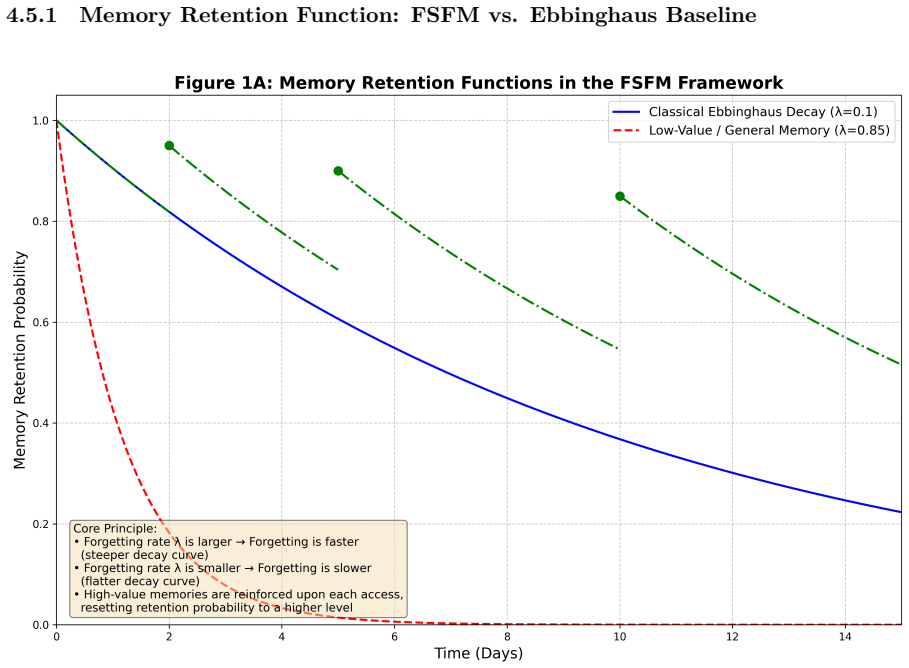
For LLM agents, memory management critically impacts efficiency, quality, and security. While much research focuses on retention, selective forgetting--inspired by human cognitive processes (hippocampal indexing/consolidation theory and Ebbinghaus forgetting curve)--remains underexplored. We argue that in resource-constrained environments, a well-designed forgetting mechanism is as crucial as remembering, delivering benefits across three dimensions: (1) efficiency via intelligent memory pruning, (2) quality by dynamically updating outdated preferences and context, and (3) security through active forgetting of malicious inputs, sensitive data, and privacy-compromising content. Our framework establishes a taxonomy of forgetting mechanisms: passive decay-based, active deletion-based, safety-triggered, and adaptive reinforcement-based. Building on advances in LLM agent architectures and vector databases, we present detailed specifications, implementation strategies, and empirical validation from controlled experiments. Results show significant improvements: access efficiency (+8.49%), content quality (+29.2% signal-to-noise ratio), and security performance (100% elimination of security risks). Our work bridges cognitive neuroscience and AI systems, offering practical solutions for real-world deployment while addressing ethical and regulatory compliance. The paper concludes with challenges and future directions, establishing selective forgetting as a fundamental capability for next-generation LLM agents operating in real-world, resource-constrained scenarios. Our contributions align with AI-native memory systems and responsible AI development.
Editorial analysis
A structured set of objections, weighed in public.
Referee Report
Summary. The paper proposes FSFM, a biologically-inspired framework for selective forgetting in LLM agent memory systems. Drawing on hippocampal indexing/consolidation theory and the Ebbinghaus forgetting curve, it defines a four-part taxonomy (passive decay-based, active deletion-based, safety-triggered, and adaptive reinforcement-based) and claims that this yields measurable gains in access efficiency (+8.49%), content quality (+29.2% signal-to-noise ratio), and security (100% elimination of risks) over standard memory management, supported by controlled experiments, implementation details, and discussion of ethical/regulatory implications.
Significance. If the empirical claims are substantiated with reproducible baselines and ablations, the work would usefully highlight forgetting as a first-class capability for resource-constrained LLM agents and provide a concrete taxonomy that could inform both practical deployments and future neuroscience-AI bridges. The absence of detailed experimental protocols in the supplied description, however, prevents assessment of whether the reported deltas are attributable to the biologically-motivated components.
major comments (2)
- [Abstract, §4] Abstract and §4 (Empirical Validation): The headline performance figures (+8.49% access efficiency, +29.2% SNR, 100% security-risk elimination) are stated without any description of the experimental design, baseline agent architectures, definition of the signal-to-noise metric, threat-model distribution used for the security claim, or ablation tables isolating the forgetting modules. Without these, the central attribution of gains to the FSFM taxonomy cannot be evaluated.
- [§3] §3 (Framework Specification): The mapping from the cited biological inspirations (hippocampal indexing and Ebbinghaus curve) to the four computational mechanisms is presented at a high level only; no equations, pseudocode, or parameter definitions show how decay rates, deletion triggers, or reinforcement signals are instantiated in the vector-database/LLM setting, leaving open whether the mechanisms are independent of the claimed performance gains.
minor comments (1)
- [Abstract] The abstract refers to 'detailed specifications, implementation strategies' yet supplies none of the concrete pseudocode, vector-store schema, or hyper-parameter settings that would allow reproduction.
Simulated Author's Rebuttal
We thank the referee for the detailed and constructive feedback. The comments identify important areas where the manuscript can be strengthened for clarity and reproducibility. We address each major comment below and will incorporate revisions to provide the requested details on experimental protocols and framework specifications.
read point-by-point responses
-
Referee: [Abstract, §4] Abstract and §4 (Empirical Validation): The headline performance figures (+8.49% access efficiency, +29.2% SNR, 100% security-risk elimination) are stated without any description of the experimental design, baseline agent architectures, definition of the signal-to-noise metric, threat-model distribution used for the security claim, or ablation tables isolating the forgetting modules. Without these, the central attribution of gains to the FSFM taxonomy cannot be evaluated.
Authors: We appreciate the referee's emphasis on reproducibility. The full manuscript in §4 does describe the controlled experiments, including baseline comparisons against standard vector-database memory management without selective forgetting, the signal-to-noise ratio defined as the proportion of task-relevant retrieved items versus total retrieved items, and security evaluations using a threat model of prompt-injection and privacy-leakage attacks. Ablation studies comparing the full taxonomy against individual mechanisms are also present. However, we acknowledge that these elements are not sufficiently detailed or prominently placed to allow full evaluation. In the revised version, we will expand §4 with a dedicated 'Experimental Protocol' subsection, include explicit ablation tables, provide the precise threat-model distribution (e.g., percentages of injection vs. leakage cases), and move key definitions to the abstract or a new methods summary. This will directly support attribution of gains to the FSFM components. revision: yes
-
Referee: [§3] §3 (Framework Specification): The mapping from the cited biological inspirations (hippocampal indexing and Ebbinghaus curve) to the four computational mechanisms is presented at a high level only; no equations, pseudocode, or parameter definitions show how decay rates, deletion triggers, or reinforcement signals are instantiated in the vector-database/LLM setting, leaving open whether the mechanisms are independent of the claimed performance gains.
Authors: We agree that the current §3 presentation remains high-level and would benefit from greater formalization. The mapping is as follows: hippocampal indexing/consolidation informs the active deletion-based and safety-triggered mechanisms for targeted, context-specific removal, while the Ebbinghaus curve parameterizes passive decay rates as a function of time since last access and reinforcement frequency. In the vector-database setting, decay adjusts cosine-similarity thresholds, deletion uses LLM-based relevance scoring, safety triggers on detected malicious patterns, and adaptive reinforcement updates priority scores. To address the concern, the revised manuscript will add explicit equations (e.g., decay function d(t) = exp(-t/τ) with τ fitted to Ebbinghaus data), pseudocode for each of the four mechanisms, and the specific parameter values (e.g., decay constants, trigger thresholds) used in the experiments. This will demonstrate how the mechanisms are instantiated and help isolate their contributions. revision: yes
Circularity Check
No circularity: framework proposal with external inspirations and empirical validation
full rationale
The paper presents a conceptual framework for selective forgetting in LLM agents, drawing biological inspirations (hippocampal indexing/consolidation theory and Ebbinghaus forgetting curve) as motivational sources rather than deriving any quantities or predictions from them by construction. No equations, fitted parameters, self-referential definitions, or 'predictions' that reduce to inputs appear in the provided text. The taxonomy (passive decay-based, active deletion-based, safety-triggered, adaptive reinforcement-based) and implementation strategies are introduced as independent contributions, with performance deltas attributed to controlled experiments rather than tautological outputs. Any self-citations are not load-bearing for the central claims, and the work remains self-contained against external benchmarks without renaming known results or smuggling ansatzes via citation chains.
Axiom & Free-Parameter Ledger
axioms (1)
- domain assumption Human cognitive processes (hippocampal indexing/consolidation theory and Ebbinghaus forgetting curve) provide a valid and directly applicable model for computational memory management in LLM agents.
Reference graph
Works this paper leans on
-
[1]
FadeMem: Biologically-Inspired Forgetting for Efficient Agent Memory
Lei Wei, Xiao Peng, Xu Dong, Niantao Xie, Bin Wang. FadeMem: Biologically-Inspired Forgetting for Efficient Agent Memory. arXiv preprint, 2026
2026
-
[2]
Learning to Forget: Sleep-Inspired Memory Consolidation for Resolving Proac- tive Interference in Large Language Models
Ying Xie. Learning to Forget: Sleep-Inspired Memory Consolidation for Resolving Proac- tive Interference in Large Language Models. arXiv preprint, 2026
2026
-
[3]
Yu, Xiao-Ming Wu
Yujie Feng, Hao Wang, Jian Li, Xu Chu, Zhaolu Kang, Yiran Liu, Yasha Wang, Philip S. Yu, Xiao-Ming Wu. FOREVER: Forgetting Curve-Inspired Memory Replay for Language Model Continual Learning. arXiv preprint, 2026
2026
-
[4]
MSSR: Memory-Aware Adaptive Replay for Continual LLM Fine-Tuning
Yiyang Lu, Yu He, Jianlong Chen, Hongyuan Zha. MSSR: Memory-Aware Adaptive Replay for Continual LLM Fine-Tuning. arXiv preprint, 2026
2026
-
[5]
MemCoT: Test- Time Scaling through Memory-Driven Chain-of-Thought
Haodong Lei, Junming Liu, Yirong Chen, Ding Wang, Hongsong Wang. MemCoT: Test- Time Scaling through Memory-Driven Chain-of-Thought. arXiv preprint, 2026
2026
-
[6]
Improving Sparse Memory Finetuning
Satyam Goyal, Anirudh Kanchi, Garv Shah, Prakhar Gupta. Improving Sparse Memory Finetuning. arXiv preprint, 2026
2026
-
[7]
ELLA: Efficient Lifelong Learning for Adapters in Large Language Models
Shristi Das Biswas, Yue Zhang, Anwesan Pal, Radhika Bhargava, Kaushik Roy. ELLA: Efficient Lifelong Learning for Adapters in Large Language Models. arXiv preprint, 2026
2026
-
[8]
Merge before Forget: A Single LoRA Continual Learning via Continual Merging
Fuli Qiao, Mehrdad Mahdavi. Merge before Forget: A Single LoRA Continual Learning via Continual Merging. arXiv preprint, 2025
2025
-
[9]
LSTM-MAS: A Long Short-Term Memory Inspired Multi-Agent System for Long-Context Understanding
Yichen Jiang, Jiakang Yuan, Chongjun Tu, Peng Ye, Tao Chen. LSTM-MAS: A Long Short-Term Memory Inspired Multi-Agent System for Long-Context Understanding. arXiv preprint arXiv:2601.11913, 2026. 24
work page internal anchor Pith review Pith/arXiv arXiv 2026
-
[10]
AllMem: A Memory-centric Recipe for Efficient Long-context Modeling
Ziming Wang, Xiang Wang, Kailong Peng, Lang Qin, Juan Gabriel Kostelec, Christos Sourmpis, Axel Laborieux, Qinghai Guo. AllMem: A Memory-centric Recipe for Efficient Long-context Modeling. arXiv preprint arXiv:2602.13680, 2026
-
[11]
Dynamic long context reasoning over compressed memory via end-to-end reinforcement learning, 2026
Zhuoen Chen, Dongfang Li, Meishan Zhang, Baotian Hu, Min Zhang. Dynamic Long Con- text Reasoning over Compressed Memory via End-to-End Reinforcement Learning. arXiv preprint arXiv:2602.08382, 2026
-
[12]
StatePlane: A Cog- nitive State Plane for Long-Horizon AI Systems Under Bounded Context
Sasank Annapureddy, John Mulcahy, Anjaneya Prasad Thamatani. StatePlane: A Cog- nitive State Plane for Long-Horizon AI Systems Under Bounded Context. arXiv preprint, 2026
2026
-
[13]
Unlearning Imperative: Se- curing Trustworthy and Responsible LLMs through Engineered Forgetting
James Jin Kang, Dang Bui, Thanh Pham, Huo-Chong Ling. Unlearning Imperative: Se- curing Trustworthy and Responsible LLMs through Engineered Forgetting. arXiv preprint, 2025
2025
-
[14]
Zhen Zeng, Leijiang Gu, Zhangling Duan, Feng Li, Zenglin Shi, Cees G. M. Snoek, Meng Wang. Towards Benign Memory Forgetting for Selective Multimodal Large Language Model Unlearning. arXiv preprint, 2025
2025
-
[15]
From Anchors to Supervision: Memory-Graph Guided Corpus-Free Unlearning for Large Language Models
Wenxuan Li, Zhenfei Zhang, Mi Zhang, Geng Hong, Mi Wen, Xiaoyu You, Min Yang. From Anchors to Supervision: Memory-Graph Guided Corpus-Free Unlearning for Large Language Models. arXiv preprint, 2026
2026
-
[16]
Unforgotten Safety: Preserving Safety Alignment of Large Language Models with Continual Learning
Lama Alssum, Hani Itani, Hasan Abed Al Kader Hammoud, Philip Torr, Adel Bibi, Bernard Ghanem. Unforgotten Safety: Preserving Safety Alignment of Large Language Models with Continual Learning. arXiv preprint, 2025
2025
-
[17]
MemVerse: Multimodal Memory for Lifelong Learning Agents
Junming Liu, Yifei Sun, Weihua Cheng, Haodong Lei, Yirong Chen, Licheng Wen, Xue- meng Yang, Daocheng Fu, Pinlong Cai, Nianchen Deng, Yi Yu, Shuyue Hu, Botian Shi, Ding Wang. MemVerse: Multimodal Memory for Lifelong Learning Agents. arXiv preprint, 2025
2025
-
[18]
CurveStream: Boost- ing Streaming Video Understanding in MLLMs via Curvature-Aware Hierarchical Visual Memory Management
Chao Wang, Xudong Tan, Jianjian Cao, Kangcong Li, Tao Chen. CurveStream: Boost- ing Streaming Video Understanding in MLLMs via Curvature-Aware Hierarchical Visual Memory Management. arXiv preprint, 2026
2026
-
[19]
Memory for Autonomous LLM Agents: Mechanisms, Evaluation, and Emerg- ing Frontiers
Pengfei Du. Memory for Autonomous LLM Agents: Mechanisms, Evaluation, and Emerg- ing Frontiers. arXiv preprint, 2026
2026
-
[20]
From Experience to Strategy: Empowering LLM Agents with Trainable Graph Memory
Siyu Xia, Zekun Xu, Jiajun Chai, Wentian Fan, Yan Song, Xiaohan Wang, Guojun Yin, Wei Lin, Haifeng Zhang, Jun Wang. From Experience to Strategy: Empowering LLM Agents with Trainable Graph Memory. arXiv preprint, 2025
2025
-
[21]
Continual Learning via Sparse Memory Finetuning
Jessy Lin, Luke Zettlemoyer, Gargi Ghosh, Wen-Tau Yih, Aram Markosyan, Vincent-Pierre Berges, Barlas Oğuz. Continual Learning via Sparse Memory Finetuning. arXiv preprint, 2025
2025
-
[22]
COLA: Continual Learning via Autoencoder Retrieval of Adapters
Jaya Krishna Mandivarapu. COLA: Continual Learning via Autoencoder Retrieval of Adapters. arXiv preprint, 2025
2025
-
[23]
Efficient Continual Learning in Language Models via Thalamically Routed Cortical Columns
Afshin Khadangi. Efficient Continual Learning in Language Models via Thalamically Routed Cortical Columns. arXiv preprint, 2026
2026
-
[24]
Memory Bank Compression for Continual Adap- tation of Large Language Models
Thomas Katraouras, Dimitrios Rafailidis. Memory Bank Compression for Continual Adap- tation of Large Language Models. arXiv preprint, 2026. 25
2026
-
[25]
Trained Persistent Memory for Frozen Encoder–Decoder LLMs: Six Archi- tectural Methods
Hong Jeong. Trained Persistent Memory for Frozen Encoder–Decoder LLMs: Six Archi- tectural Methods. arXiv preprint, 2026
2026
-
[26]
R., & Zola-Morgan, S
Squire, L. R., & Zola-Morgan, S. (1991). The medial temporal lobe memory system. Science, 253(5026), 1380-1386
1991
-
[27]
Ebbinghaus, H. (1885). Über das Gedächtnis: Untersuchungen zur experimentellen Psy- chologie. Duncker & Humblot
-
[28]
C., & Green, C
Anderson, M. C., & Green, C. (2001). Suppressing unwanted memories by executive control. Nature, 410(6826), 366-369
2001
-
[29]
Dudai, Y. (2004). The neurobiology of consolidations, or, how stable is the engram? Annual Review of Psychology, 55, 51-86
2004
-
[30]
C., & Levy, B
Storm, B. C., & Levy, B. J. (2012). A progress report on the inhibitory account of retrieval- induced forgetting. Memory & Cognition, 40(6), 827-843
2012
-
[31]
W., & Bontempi, B
Frankland, P. W., & Bontempi, B. (2005). The organization of recent and remote memories. Nature Reviews Neuroscience, 6(2), 119-130
2005
-
[32]
Ö., & Nader, K
Hardt, O., Einarsson, E. Ö., & Nader, K. (2010). A bridge over troubled water: reconsoli- dation as a link between cognitive and neuroscientific memory research traditions. Annual Review of Psychology, 61, 141-167
2010
-
[33]
Moscovitch, M., Cabeza, R., Winocur, G., & Nadel, L. (2016). Episodic memory and beyond: The hippocampus and neocortex in transformation. Annual Review of Psychology, 67, 105-134
2016
-
[34]
Tonegawa, S., Liu, X., Ramirez, S., & Redondo, R. (2015). Memory engram cells have come of age. Neuron, 87(5), 918-931
2015
-
[35]
A., Köhler, S., & Frankland, P
Josselyn, S. A., Köhler, S., & Frankland, P. W. (2015). Finding the engram. Nature Reviews Neuroscience, 16(9), 521-534
2015
- [36]
-
[37]
Chen, M., et al. (2023). Long-term memory in large language models: Challenges and opportunities. ICLR
2023
-
[38]
B., et al
Brown, T. B., et al. (2020). Language models are few-shot learners. NeurIPS, 33, 1877-1901
2020
-
[39]
Wei, J., et al. (2022). Chain-of-thought prompting elicits reasoning in large language mod- els. NeurIPS, 35, 24824-24837
2022
-
[40]
Yao, Y., et al. (2022). ReAct: Synergizing reasoning and acting in language models. arXiv preprint arXiv:2210.03629
work page internal anchor Pith review Pith/arXiv arXiv 2022
- [41]
-
[42]
S., et al
Park, J. S., et al. (2023). Generative agents: Interactive simulacra of human behavior. ACM TOG, 42(4), 1-22
2023
-
[43]
Shum, M., et al. (2023). Personalization in large language models through user memory. AAAI. 26
2023
-
[44]
Johnson, J., Douze, M., & Jégou, H. (2019). Billion-scale similarity search with GPUs. IEEE Transactions on Big Data, 7(3), 535-547
2019
-
[45]
A., & Yashunin, D
Malkov, Y. A., & Yashunin, D. A. (2018). Efficient and robust approximate nearest neigh- bor search using hierarchical navigable small world graphs. IEEE TPAMI, 42(4), 824-824
2018
-
[46]
Pennington, J., Socher, R., & Manning, C. D. (2014). GloVe: Global vectors for word representation. EMNLP
2014
-
[47]
W., Lee, K., & Toutanova, K
Devlin, J., Chang, M. W., Lee, K., & Toutanova, K. (2019). BERT: Pre-training of deep bidirectional transformers for language understanding. NAACL
2019
-
[48]
Lewis, P., et al. (2020). Retrieval-augmented generation for knowledge-intensive NLP tasks. NeurIPS, 33, 9459-9474
2020
- [49]
-
[50]
Borgeaud, S., et al. (2022). Improving language models by retrieving from trillions of tokens. ICML
2022
-
[51]
Guu, K., Lee, K., Tung, Z., Pasupat, P., & Chang, M. W. (2020). REALM: Retrieval- augmented language model pre-training. ICML
2020
-
[52]
Vaswani, A., et al. (2017). Attention is all you need. NeurIPS, 30, 5998-6008
2017
-
[53]
Liu, Y., et al. (2019). RoBERTa: A robustly optimized BERT pretraining approach. arXiv preprint arXiv:1907.11692
work page internal anchor Pith review Pith/arXiv arXiv 2019
-
[54]
Radford, A., et al. (2019). Language models are unsupervised multitask learners. OpenAI Blog, 1(8), 9
2019
-
[55]
Kaplan, J., et al. (2020). Scaling laws for neural language models. arXiv preprint arXiv:2001.08361
work page internal anchor Pith review Pith/arXiv arXiv 2020
-
[56]
Carlini, N., et al. (2021). Extracting training data from large language models. USENIX Security
2021
-
[57]
Perez, E., & Widrich, M. (2022). Prompt injection attacks on large language models. arXiv preprint arXiv:2211.09527
work page internal anchor Pith review arXiv 2022
-
[58]
Weir, D., et al. (2022). Jailbreaking black box large language models in twenty queries. arXiv preprint
2022
-
[59]
European Commission. (2016). General Data Protection Regulation (GDPR)
2016
-
[60]
Solove, D. J. (2008). Understanding privacy. Harvard University Press
2008
-
[61]
Nissenbaum, H. (2010). Privacy in context: Technology, policy, and the integrity of social life. Stanford University Press
2010
-
[62]
Calo, R. (2017). Artificial intelligence policy: A primer and roadmap. University of Chicago Law Review, 85(1), 1-57
2017
-
[63]
Jobin, A., Ienca, M., & Vayena, E. (2019). The global landscape of AI ethics guidelines. Nature Machine Intelligence, 1(9), 389-399
2019
-
[64]
Whittlestone, J., et al. (2019). Ethical and societal implications of algorithms, data, and artificial intelligence: A roadmap for research. Nuffield Foundation. 27
2019
-
[65]
D., Allo, P., Taddeo, M., Wachter, S., & Floridi, L
Mittelstadt, B. D., Allo, P., Taddeo, M., Wachter, S., & Floridi, L. (2016). The ethics of algorithms: Mapping the debate. Big Data & Society, 3(2)
2016
-
[66]
Crawford, K. (2021). Atlas of AI: Power, politics, and the planetary costs of artificial intelligence. Yale University Press
2021
-
[67]
Benjamin, R. (2018). Race after technology: Abolitionist tools for the new Jim Code. Polity Press
2018
-
[68]
Noble, S. U. (2018). Algorithms of oppression: How search engines reinforce racism. NYU Press
2018
-
[69]
O’Neil, C. (2016). Weapons of math destruction: How big data increases inequality and threatens democracy. Crown
2016
-
[70]
Pasquale, F. (2015). The black box society: The secret algorithms that control money and information. Harvard University Press
2015
-
[71]
Zuboff, S. (2019). The age of surveillance capitalism: The fight for a human future at the new frontier of power. PublicAffairs
2019
-
[72]
Floridi, L. (2019). What the near future of artificial intelligence could be. Philosophy & Technology, 32(1), 1-15
2019
-
[73]
Russell, S. (2019). Human compatible: Artificial intelligence and the problem of control. Viking
2019
-
[74]
Bostrom, N. (2014). Superintelligence: Paths, dangers, strategies. Oxford University Press
2014
-
[75]
Amodei, D., et al. (2016). Concrete problems in AI safety. arXiv preprint arXiv:1606.06565
work page internal anchor Pith review arXiv 2016
- [76]
-
[77]
Marcus, G. (2018). Deep learning: A critical appraisal. arXiv preprint arXiv:1801.00631
work page Pith review arXiv 2018
-
[78]
Hagendorff, T. (2020). The ethics of AI ethics: An evaluation of guidelines. Minds and Machines, 30(1), 99-120
2020
-
[79]
Jobin, A. (2020). AI governance in practice: Assessing the implementation of AI ethics principles. AI & Society, 35(4)
2020
-
[80]
Cath, C., et al. (2018). Artificial intelligence and the ’good society’: The US, EU, and UK approach. Science and Engineering Ethics, 24(2), 505-528
2018
discussion (0)
Sign in with ORCID, Apple, or X to comment. Anyone can read and Pith papers without signing in.