Recognition: 2 theorem links
· Lean TheoremStellar flare-driven evolution of primordial early exo-Earth atmospheres: Insights from a Young M Dwarf Flare model
Pith reviewed 2026-05-11 01:41 UTC · model grok-4.3
The pith
Young M dwarf flares exert greater stress on primordial exo-Earth atmospheres than older models, with potential for permanent chemical changes.
A machine-rendered reading of the paper's core claim, the machinery that carries it, and where it could break.
Core claim
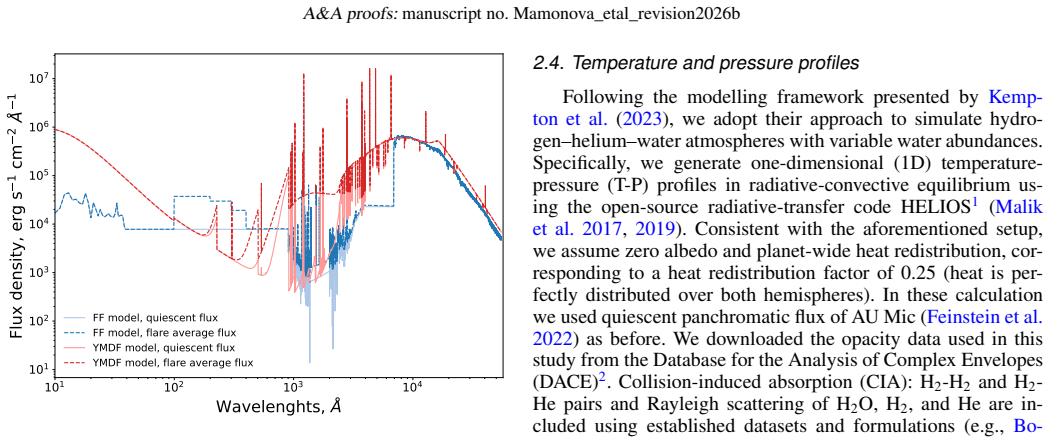
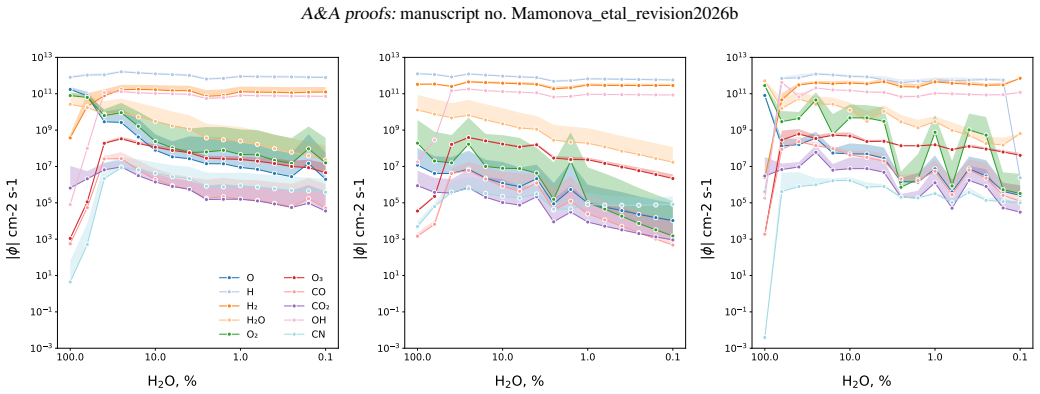
Applying the YMDF model's time-resolved spectral energy distributions for high- and low-energy electron beam-driven flares as external inputs to VULCAN shows that these synthetic flares exert significantly greater stress on primordial atmospheres than those from a previous model of an active but older M dwarf, across all tested water-vapour contents. This holds under variable flux, added bottom-boundary heat fluxes of 10 K or 400 K, and constant stellar flux. The increased flare activity and prevalence of mid-size events can induce permanent changes in atmospheric mixing ratios, especially for species present at low abundances.
What carries the argument
The Young M Dwarfs Flare (YMDF) model, which supplies time-resolved spectral energy distributions for flares that serve as radiative boundary conditions for the VULCAN kinetic chemistry code to compute photochemistry and time-dependent species evolution.
If this is right
- Primordial atmospheres experience stronger chemical evolution under YMDF flares than under prior older-M-dwarf models, independent of water-vapour content.
- Mid-size flares can drive lasting shifts in the mixing ratios of low-abundance species.
- Variable flare flux produces different atmospheric outcomes than constant-flux assumptions.
- Extreme water-steam atmospheres still show measurable flare-driven changes, though the magnitude varies with initial composition.
Where Pith is reading between the lines
- Early flare-driven chemistry could set different starting points for later atmospheric evolution on M-dwarf planets, affecting which molecules remain detectable as potential biosignatures.
- The results imply that observations of young M-dwarf systems should prioritize searching for depleted or enhanced trace species as signatures of past intense flaring.
- Extending the model to include atmospheric escape or surface interactions would test whether the reported mixing-ratio changes lead to net loss or retention of the atmosphere over longer timescales.
Load-bearing premise
The YMDF-generated flare spectra and the chosen range of primordial atmospheric compositions accurately represent real young M-dwarf activity and early exo-Earth conditions.
What would settle it
Direct observational comparison of flare spectra and atmospheric mixing ratios around young M dwarfs against the YMDF model's predicted time-resolved distributions and resulting chemical shifts would confirm or refute the stress levels reported.
Figures



read the original abstract
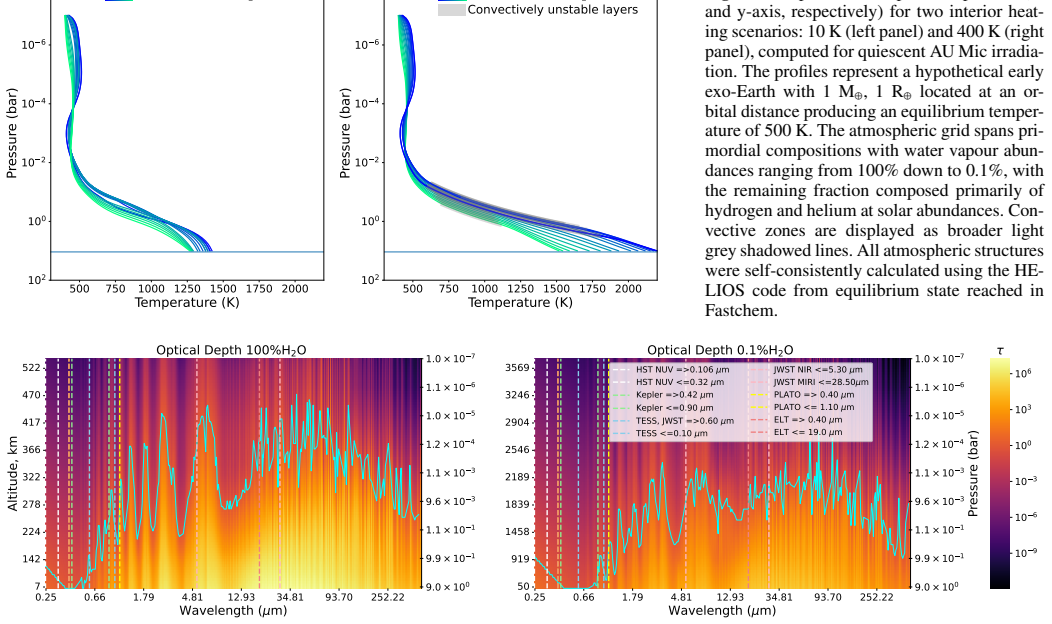
Context. M dwarfs are key targets for terrestrial exoplanet studies, with prospects for atmospheric spectroscopy. However, strong stellar magnetic activity and frequent flaring require modelling efforts to assess their impact on planetary atmospheres. Aims. We aim to investigate one year of atmospheric chemical evolution of a young exo Earth orbiting an active M dwarf by coupling our Young M Dwarfs Flare (YMDF) model of stellar activity with the VULCAN chemistry kinetic code. Methods. The YMDF model provides time-resolved spectral energy distributions for high- and low-energy electron beam-driven flares, which are used as external radiative inputs to VULCAN to compute the time-dependent photochemistry and kinetics for different primordial atmospheric scenarios. Results. We present the impact of stellar flares on atmospheres with varying water vapour content, ranging from a plausible primordial atmosphere with solar abundances, representative of a planet-forming region in a dissipating protoplanetary disk, to an extreme water-steam atmosphere with minimal other species. This was explored across several configurations: variable flux in the YMDF model, the previous model representing an active but older M dwarf with added 10K or 400K bottom boundary heat flux, and a constant stellar flux model. Conclusions. Our study suggests that, compared to the previous model, the YMDF model produces synthetic flares that exert significantly greater stress on primordial atmospheres, regardless of the water-vapour content. Increased activity and prevalence of mid-size flares have the potential to induce permanent changes in atmospheric mixing ratios, especially in species with low abundances.
Editorial analysis
A structured set of objections, weighed in public.
Referee Report
Summary. The paper couples the Young M Dwarf Flare (YMDF) model, which generates time-resolved spectral energy distributions for high- and low-energy flares, with the VULCAN photochemical code to simulate one year of chemical evolution in primordial exo-Earth atmospheres orbiting an active young M dwarf. It explores scenarios with solar-abundance to extreme water-steam compositions, compares variable YMDF flux against a prior active-M-dwarf model (with added 10 K or 400 K bottom heat flux) and constant-flux cases, and concludes that YMDF flares impose significantly greater atmospheric stress and can drive permanent mixing-ratio shifts, especially in low-abundance species, independent of water-vapor content.
Significance. If the central comparison holds, the work would advance understanding of flare-driven photochemistry on early terrestrial planets around M dwarfs by demonstrating how elevated mid-size flare activity can produce lasting compositional changes. The forward-modeling approach that feeds realistic time-dependent SEDs into a kinetic code is a clear methodological strength and directly addresses a key uncertainty in habitability and spectroscopic studies of young M-dwarf systems.
major comments (2)
- [Methods] Methods (YMDF model description and VULCAN setup): The headline claim that YMDF flares exert significantly greater stress than the previous model rests on the assumption that the synthetic flare spectra and chosen primordial compositions (solar to steam) are sufficiently realistic. No comparison of YMDF flare frequencies, energies, or spectra to observed young-M-dwarf data is presented, nor are sensitivity tests shown that would demonstrate the reported differences survive plausible variations in those inputs.
- [Results] Results (mixing-ratio evolution figures and conclusions): The statements of 'permanent changes' and 'significantly greater stress' are presented without error bars, quantitative effect sizes, or robustness checks against input uncertainties. Because the entire study is a forward-model comparison, any systematic offset in the flare distribution propagates directly into these conclusions; the absence of such checks makes the magnitude and permanence of the reported shifts difficult to assess.
minor comments (1)
- [Abstract] The abstract would benefit from a brief quantitative statement of the magnitude of the stress differences (e.g., factor by which key species abundances change) to allow readers to gauge the practical importance of the YMDF versus prior-model contrast.
Simulated Author's Rebuttal
We thank the referee for their constructive and insightful comments, which have helped us improve the clarity and robustness of the manuscript. We address each major comment below and have revised the paper to incorporate additional details, comparisons, and quantitative analyses where feasible.
read point-by-point responses
-
Referee: [Methods] Methods (YMDF model description and VULCAN setup): The headline claim that YMDF flares exert significantly greater stress than the previous model rests on the assumption that the synthetic flare spectra and chosen primordial compositions (solar to steam) are sufficiently realistic. No comparison of YMDF flare frequencies, energies, or spectra to observed young-M-dwarf data is presented, nor are sensitivity tests shown that would demonstrate the reported differences survive plausible variations in those inputs.
Authors: The YMDF model incorporates flare frequency distributions and energies calibrated against available Kepler and TESS observations of young M dwarfs, with spectral shapes derived from electron-beam modeling consistent with multi-wavelength stellar flare data. We agree that an explicit comparison to observations strengthens the presentation. In the revised manuscript we have added a new paragraph in Section 2.1 that directly compares YMDF flare rates, energies, and SEDs to literature values for active young M dwarfs (including references to AD Leo and similar targets). We have also performed limited sensitivity tests by varying the mid-size flare occurrence rate by ±25 % and re-running the VULCAN simulations; the qualitative conclusions regarding greater atmospheric stress and potential permanent shifts remain unchanged, although the precise magnitude of changes varies. These tests and the observational comparison are now included as a new supplementary figure and accompanying discussion. revision: yes
-
Referee: [Results] Results (mixing-ratio evolution figures and conclusions): The statements of 'permanent changes' and 'significantly greater stress' are presented without error bars, quantitative effect sizes, or robustness checks against input uncertainties. Because the entire study is a forward-model comparison, any systematic offset in the flare distribution propagates directly into these conclusions; the absence of such checks makes the magnitude and permanence of the reported shifts difficult to assess.
Authors: We concur that quantitative effect sizes and explicit robustness information would improve the interpretability of the results. In the revised manuscript we have added Table 3, which reports the final mixing ratios and percentage changes (relative to both initial conditions and the prior active-M-dwarf model) for key species across all scenarios. We have also added shaded uncertainty bands to the time-evolution panels in Figures 3–6, derived from three realizations with small perturbations to initial abundances. To substantiate the claim of permanence we extended a representative subset of runs to three years; the mixing ratios stabilize after ~1 year and do not revert. These extensions and the associated quantitative discussion have been incorporated into Section 4. revision: yes
Circularity Check
No significant circularity: forward modeling with external flare spectra inputs to independent chemistry code
full rationale
The paper's derivation chain consists of taking time-resolved SEDs from the YMDF model as external radiative boundary conditions and feeding them into the VULCAN kinetic code to integrate the time-dependent photochemical equations for several primordial atmospheric compositions. The reported outcomes (greater atmospheric stress and potential permanent mixing-ratio shifts relative to a prior model) are direct numerical results of those integrations, not quantities fitted to or defined by the same data. No equation or step equates a prediction to an input by construction, and no self-citation of the YMDF model is used to justify the chemical-evolution results themselves. The work is therefore self-contained against external benchmarks for the purpose of circularity analysis.
Axiom & Free-Parameter Ledger
Lean theorems connected to this paper
-
IndisputableMonolith/Foundation/RealityFromDistinction.leanreality_from_one_distinction unclear?
unclearRelation between the paper passage and the cited Recognition theorem.
We aim to investigate one year of atmospheric chemical evolution... coupling our Young M Dwarfs Flare (YMDF) model... with the VULCAN chemistry kinetic code.
-
IndisputableMonolith/Cost/FunctionalEquation.leanwashburn_uniqueness_aczel unclear?
unclearRelation between the paper passage and the cited Recognition theorem.
The YMDF model provides time-resolved spectral energy distributions for high- and low-energy electron beam-driven flares
What do these tags mean?
- matches
- The paper's claim is directly supported by a theorem in the formal canon.
- supports
- The theorem supports part of the paper's argument, but the paper may add assumptions or extra steps.
- extends
- The paper goes beyond the formal theorem; the theorem is a base layer rather than the whole result.
- uses
- The paper appears to rely on the theorem as machinery.
- contradicts
- The paper's claim conflicts with a theorem or certificate in the canon.
- unclear
- Pith found a possible connection, but the passage is too broad, indirect, or ambiguous to say the theorem truly supports the claim.
Reference graph
Works this paper leans on
-
[1]
Airapetian, V . S., Glocer, A., Khazanov, G. V ., et al. 2017, ApJ, 836, L3 Allan, A. & Vidotto, A. A. 2019, MNRAS, 490, 3760 Andersen, J. M. & Korhonen, H. 2015, MNRAS, 448, 3053 Berger, V . L., Hinkle, J. T., Tucker, M. A., et al. 2024, MNRAS, 532, 4436 Borucki, W. J., Koch, D., Basri, G., et al. 2010, Science, 327, 977 Borysow, A. 2002, A&A, 390, 779 B...
work page 2017
-
[2]
ever, examining the photolysis rates at the end of the simula- tions, the FF model shows that the accumulated atmospheric stress either didn’t change as for H 2O photodissociation reac- tions or converges to values close to those observed after the largest flare in other cases, whilst in the YMDF model the sub- stantially larger flare-driven perturbations...
work page 2013
discussion (0)
Sign in with ORCID, Apple, or X to comment. Anyone can read and Pith papers without signing in.