Recognition: unknown
Self-Awareness before Action: Mitigating Logical Inertia via Proactive Cognitive Awareness
Pith reviewed 2026-05-10 00:24 UTC · model grok-4.3
The pith
SABA adds explicit self-awareness of missing premises to LLM reasoning, blocking early-hypothesis errors before they spread.
A machine-rendered reading of the paper's core claim, the machinery that carries it, and where it could break.
Core claim
SABA formulates reasoning as a recursive process that alternates between structured state construction and obstacle resolution: it first applies Information Fusion to consolidate the narrative into a verifiable base state, and then uses Query-driven Structured Reasoning to identify and resolve missing or underspecified premises by turning them into queries and progressively completing the reasoning state through hypothesis construction and state refinement.
What carries the argument
Recursive alternation between Information Fusion, which builds a consolidated verifiable state from the narrative, and Query-driven Structured Reasoning, which converts gaps into explicit queries for progressive state completion.
If this is right
- Early wrong hypotheses no longer lock the model into a single faulty path once missing premises are surfaced as queries.
- Performance gains appear consistently across easy, medium, and hard splits of the non-interactive Detective Puzzle benchmark.
- The same recursive state-completion loop produces top-ranked results on multiple existing public reasoning benchmarks.
- Reasoning becomes a sequence of verifiable state refinements rather than a single forward pass from partial input.
Where Pith is reading between the lines
- The same query-driven completion loop could be paired with external retrieval tools so that generated queries are answered automatically rather than left for the model to guess.
- The approach may transfer to scientific hypothesis generation, where missing experimental premises are common and early commitments are costly.
- Limiting the depth of recursion could serve as a tunable knob for trading accuracy against latency in deployed systems.
- Because the framework keeps an explicit record of resolved gaps, it offers a natural route to more inspectable reasoning traces.
Load-bearing premise
That forcing models to name and resolve missing premises through these recursive steps will reliably stop error propagation without creating fresh mistakes or prohibitive extra computation.
What would settle it
Run SABA on the Detective Puzzle benchmark after disabling the query-generation step; if scores drop to the level of standard chain-of-thought baselines on the same splits, the self-awareness mechanism is not the source of the reported gains.
Figures
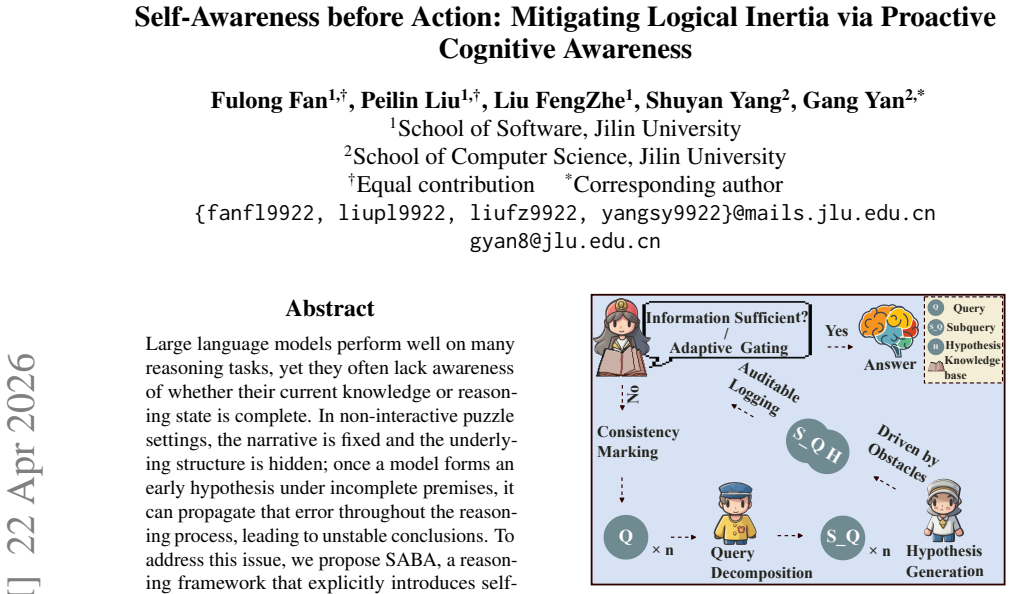


read the original abstract
Large language models perform well on many reasoning tasks, yet they often lack awareness of whether their current knowledge or reasoning state is complete. In non-interactive puzzle settings, the narrative is fixed and the underlying structure is hidden; once a model forms an early hypothesis under incomplete premises, it can propagate that error throughout the reasoning process, leading to unstable conclusions. To address this issue, we propose SABA, a reasoning framework that explicitly introduces self-awareness of missing premises before making the final decision. SABA formulates reasoning as a recursive process that alternates between structured state construction and obstacle resolution: it first applies Information Fusion to consolidate the narrative into a verifiable base state, and then uses Query-driven Structured Reasoning to identify and resolve missing or underspecified premises by turning them into queries and progressively completing the reasoning state through hypothesis construction and state refinement. Across multiple evaluation metrics, SABA achieves the best performance on all three difficulty splits of the non-interactive Detective Puzzle benchmark, and it also maintains leading results on multiple public benchmarks.
Editorial analysis
A structured set of objections, weighed in public.
Referee Report
Summary. The manuscript proposes the SABA framework for LLM reasoning in non-interactive settings. It formulates reasoning as a recursive alternation between Information Fusion (to consolidate narrative into a verifiable base state) and Query-driven Structured Reasoning (to surface missing premises as queries, construct hypotheses, and refine the state). The central claim is that this explicit self-awareness of incomplete premises mitigates logical inertia and early-hypothesis error propagation. Empirically, SABA reports the highest accuracy, stability, and completeness on all three difficulty splits of the Detective Puzzle benchmark and leading results on multiple public benchmarks, supported by ablations against baselines.
Significance. If the results hold under the reported conditions, the work offers a concrete mechanism for addressing a recognized limitation in LLM reasoning—premature commitment under incomplete information—without relying on external interaction. The clear tiering of the Detective Puzzle benchmark and the inclusion of ablations that isolate the contribution of the query-driven component provide reproducible grounding for the performance claims.
minor comments (3)
- Section 4.2: the description of the three difficulty splits would benefit from an explicit table listing the number of premises, hidden facts, and average query count per split to allow direct comparison with prior puzzle benchmarks.
- Figure 3: the ablation removing Query-driven Structured Reasoning shows a large drop in stability; adding per-run standard deviations or confidence intervals would strengthen the statistical interpretation of the reported gains.
- Section 3.1: the pseudocode for Information Fusion does not specify the exact stopping criterion for recursion; a short paragraph clarifying whether recursion depth is bounded by narrative length or by a fixed threshold would improve reproducibility.
Simulated Author's Rebuttal
We thank the referee for the positive summary, for recognizing the significance of addressing premature commitment under incomplete information in non-interactive settings, and for the recommendation of minor revision. We are pleased that the tiered Detective Puzzle benchmark, ablations, and performance claims are viewed as providing reproducible grounding.
Circularity Check
No significant circularity
full rationale
The paper proposes SABA as a reasoning framework that alternates Information Fusion and Query-driven Structured Reasoning to surface missing premises before final decisions. No equations, fitted parameters, or predictions are defined in the provided text. The central claims rest on explicit algorithmic steps (recursive state construction, query generation, hypothesis refinement) and empirical benchmark results rather than any self-referential derivation, self-citation chain, or renaming of known results. The method is presented as a constructive procedure whose correctness is evaluated externally against fixed benchmarks and baselines, with no load-bearing step reducing to its own inputs by construction.
Axiom & Free-Parameter Ledger
axioms (1)
- domain assumption LLMs form early hypotheses from incomplete premises and propagate those errors unless explicitly prompted to detect gaps.
invented entities (1)
-
SABA framework
no independent evidence
Reference graph
Works this paper leans on
-
[1]
2024 , eprint=
Understanding Reasoning Ability of Language Models From the Perspective of Reasoning Paths Aggregation , author=. 2024 , eprint=
2024
-
[2]
2023 , eprint=
GPT-4 Doesn't Know It's Wrong: An Analysis of Iterative Prompting for Reasoning Problems , author=. 2023 , eprint=
2023
-
[3]
2023 , eprint=
Reflexion: Language Agents with Verbal Reinforcement Learning , author=. 2023 , eprint=
2023
-
[4]
2023 , eprint=
Decomposed Prompting: A Modular Approach for Solving Complex Tasks , author=. 2023 , eprint=
2023
-
[5]
2023 , eprint=
Faith and Fate: Limits of Transformers on Compositionality , author=. 2023 , eprint=
2023
-
[6]
Survey of hallucination in natural language generation,
Ji, Ziwei and Lee, Nayeon and Frieske, Rita and Yu, Tiezheng and Su, Dan and Xu, Yan and Ishii, Etsuko and Bang, Ye Jin and Madotto, Andrea and Fung, Pascale , title =. ACM Comput. Surv. , month = mar, articleno =. 2023 , issue_date =. doi:10.1145/3571730 , abstract =
-
[7]
Measuring and Improving BERT ' s Mathematical Abilities by Predicting the Order of Reasoning
Pi e kos, Piotr and Malinowski, Mateusz and Michalewski, Henryk. Measuring and Improving BERT ' s Mathematical Abilities by Predicting the Order of Reasoning. Proceedings of the 59th Annual Meeting of the Association for Computational Linguistics and the 11th International Joint Conference on Natural Language Processing (Volume 2: Short Papers). 2021. doi...
-
[8]
2024 , eprint=
Exploring Collaboration Mechanisms for LLM Agents: A Social Psychology View , author=. 2024 , eprint=
2024
-
[9]
2024 , eprint=
Large Language Models Cannot Self-Correct Reasoning Yet , author=. 2024 , eprint=
2024
-
[10]
2023 , eprint=
True Detective: A Deep Abductive Reasoning Benchmark Undoable for GPT-3 and Challenging for GPT-4 , author=. 2023 , eprint=
2023
-
[11]
2025 , eprint=
S ^2 R: Teaching LLMs to Self-verify and Self-correct via Reinforcement Learning , author=. 2025 , eprint=
2025
-
[12]
2024 , eprint=
CRITIC: Large Language Models Can Self-Correct with Tool-Interactive Critiquing , author=. 2024 , eprint=
2024
-
[13]
In: Wooldridge, M.J., Dy, J.G., Natarajan, S
Besta, Maciej and Blach, Nils and Kubicek, Ales and Gerstenberger, Robert and Podstawski, Michal and Gianinazzi, Lukas and Gajda, Joanna and Lehmann, Tomasz and Niewiadomski, Hubert and Nyczyk, Piotr and Hoefler, Torsten , year=. Graph of Thoughts: Solving Elaborate Problems with Large Language Models , volume=. Proceedings of the AAAI Conference on Artif...
-
[14]
2024 , eprint=
Self-Discover: Large Language Models Self-Compose Reasoning Structures , author=. 2024 , eprint=
2024
-
[15]
2022 , eprint=
Challenging BIG-Bench Tasks and Whether Chain-of-Thought Can Solve Them , author=. 2022 , eprint=
2022
-
[16]
2021 , eprint=
Did Aristotle Use a Laptop? A Question Answering Benchmark with Implicit Reasoning Strategies , author=. 2021 , eprint=
2021
-
[17]
2024 , eprint=
Exploring Large Language Models for Communication Games: An Empirical Study on Werewolf , author=. 2024 , eprint=
2024
-
[18]
2018 , eprint=
HotpotQA: A Dataset for Diverse, Explainable Multi-hop Question Answering , author=. 2018 , eprint=
2018
-
[19]
2024 , url=
Language Agents with Reinforcement Learning for Strategic Play in the Werewolf Game , author=. 2024 , url=
2024
-
[20]
2025 , eprint=
PLAYER*: Enhancing LLM-based Multi-Agent Communication and Interaction in Murder Mystery Games , author=. 2025 , eprint=
2025
-
[21]
Wu, Dekun and Shi, Haochen and Sun, Zhiyuan and Liu, Bang. Deciphering Digital Detectives: Understanding LLM Behaviors and Capabilities in Multi-Agent Mystery Games. Findings of the Association for Computational Linguistics: ACL 2024. 2024. doi:10.18653/v1/2024.findings-acl.490
-
[22]
2023 , eprint=
Avalon's Game of Thoughts: Battle Against Deception through Recursive Contemplation , author=. 2023 , eprint=
2023
-
[23]
O’Brien, Carrie Jun Cai, Meredith Ringel Morris, Percy Liang, and Michael S
Park, Joon Sung and O'Brien, Joseph and Cai, Carrie Jun and Morris, Meredith Ringel and Liang, Percy and Bernstein, Michael S. , title =. Proceedings of the 36th Annual ACM Symposium on User Interface Software and Technology , articleno =. 2023 , isbn =. doi:10.1145/3586183.3606763 , abstract =
-
[24]
2025 , eprint=
Beyond Survival: Evaluating LLMs in Social Deduction Games with Human-Aligned Strategies , author=. 2025 , eprint=
2025
-
[25]
Karen and Sadigh, Dorsa , title =
Sarkar, Bidipta and Xia, Warren and Liu, C. Karen and Sadigh, Dorsa , title =. Proceedings of the 24th International Conference on Autonomous Agents and Multiagent Systems , pages =. 2025 , isbn =
2025
-
[26]
2021 , eprint=
RLupus: Cooperation through emergent communication in The Werewolf social deduction game , author=. 2021 , eprint=
2021
-
[27]
2023 , eprint=
Voyager: An Open-Ended Embodied Agent with Large Language Models , author=. 2023 , eprint=
2023
-
[28]
Wichmann , title =
Robert Geirhos and Jörn-Henrik Jacobsen and Claudio Michaelis and Richard Zemel and Wieland Brendel and Matthias Bethge and Felix A. Wichmann , title =. Nature Machine Intelligence , volume =. 2020 , doi =
2020
-
[29]
2023 , eprint=
Language Models Don't Always Say What They Think: Unfaithful Explanations in Chain-of-Thought Prompting , author=. 2023 , eprint=
2023
-
[30]
and Le, Quoc V
Wei, Jason and Wang, Xuezhi and Schuurmans, Dale and Bosma, Maarten and Ichter, Brian and Xia, Fei and Chi, Ed H. and Le, Quoc V. and Zhou, Denny , title =. Proceedings of the 36th International Conference on Neural Information Processing Systems , articleno =. 2022 , isbn =
2022
-
[31]
2023 , eprint=
Self-Consistency Improves Chain of Thought Reasoning in Language Models , author=. 2023 , eprint=
2023
-
[32]
2023 , eprint=
Tree of Thoughts: Deliberate Problem Solving with Large Language Models , author=. 2023 , eprint=
2023
-
[33]
2023 , eprint=
Self-Refine: Iterative Refinement with Self-Feedback , author=. 2023 , eprint=
2023
-
[34]
2023 , eprint=
ReAct: Synergizing Reasoning and Acting in Language Models , author=. 2023 , eprint=
2023
-
[35]
2024 , eprint=
Can Stories Help LLMs Reason? Curating Information Space Through Narrative , author=. 2024 , eprint=
2024
-
[36]
The Eleventh International Conference on Learning Representations , year=
Least-to-Most Prompting Enables Complex Reasoning in Large Language Models , author=. The Eleventh International Conference on Learning Representations , year=
-
[37]
Document-Level Event Argument Extraction by Conditional Generation
Li, Sha and Ji, Heng and Han, Jiawei. Document-Level Event Argument Extraction by Conditional Generation. Proceedings of the 2021 Conference of the North American Chapter of the Association for Computational Linguistics: Human Language Technologies. 2021. doi:10.18653/v1/2021.naacl-main.69
-
[38]
2024 , eprint=
LawGPT: A Chinese Legal Knowledge-Enhanced Large Language Model , author=. 2024 , eprint=
2024
-
[39]
International Conference on Learning Representations , year=
The Curious Case of Neural Text Degeneration , author=. International Conference on Learning Representations , year=
-
[40]
A Survey of Generative Information Extraction
Zhang, Zikang and You, Wangjie and Wu, Tianci and Wang, Xinrui and Li, Juntao and Zhang, Min. A Survey of Generative Information Extraction. Proceedings of the 31st International Conference on Computational Linguistics. 2025
2025
-
[41]
Annepaka, Yadagiri and Pakray, Partha , title =. Knowl. Inf. Syst. , month = dec, pages =. 2025 , issue_date =. doi:10.1007/s10115-024-02310-4 , abstract =
-
[42]
Proceedings of the 31st ACM SIGKDD Conference on Knowledge Discovery and Data Mining V.1 , pages =
Tan, Xiaoyu and Wang, Haoyu and Qiu, Xihe and Cheng, Leijun and Cheng, Yuan and Chu, Wei and Xu, Yinghui and Qi, Yuan , title =. Proceedings of the 31st ACM SIGKDD Conference on Knowledge Discovery and Data Mining V.1 , pages =. 2025 , isbn =. doi:10.1145/3690624.3709381 , abstract =
-
[43]
Sentence- BERT : Sentence Embeddings using S iamese BERT -Networks
Reimers, Nils and Gurevych, Iryna. Sentence- BERT : Sentence Embeddings using S iamese BERT -Networks. Proceedings of the 2019 Conference on Empirical Methods in Natural Language Processing and the 9th International Joint Conference on Natural Language Processing (EMNLP-IJCNLP). 2019. doi:10.18653/v1/D19-1410
-
[44]
Hypothesis Generation with Large Language Models , url=
Zhou, Yangqiaoyu and Liu, Haokun and Srivastava, Tejes and Mei, Hongyuan and Tan, Chenhao , year=. Hypothesis Generation with Large Language Models , url=. doi:10.18653/v1/2024.nlp4science-1.10 , booktitle=
-
[45]
2023 , eprint=
Lost in the Middle: How Language Models Use Long Contexts , author=. 2023 , eprint=
2023
-
[46]
2023 , eprint=
Large Language Models are Zero-Shot Reasoners , author=. 2023 , eprint=
2023
discussion (0)
Sign in with ORCID, Apple, or X to comment. Anyone can read and Pith papers without signing in.