Recognition: unknown
Likelihood-based inference for birth-death processes with composite birth mechanisms
Pith reviewed 2026-05-09 23:00 UTC · model grok-4.3
The pith
Doob h-transform enables consistent likelihood inference for unmarked composite birth-death processes
A machine-rendered reading of the paper's core claim, the machinery that carries it, and where it could break.
Core claim
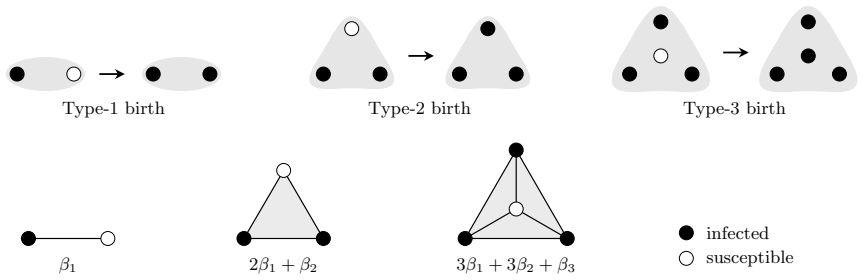
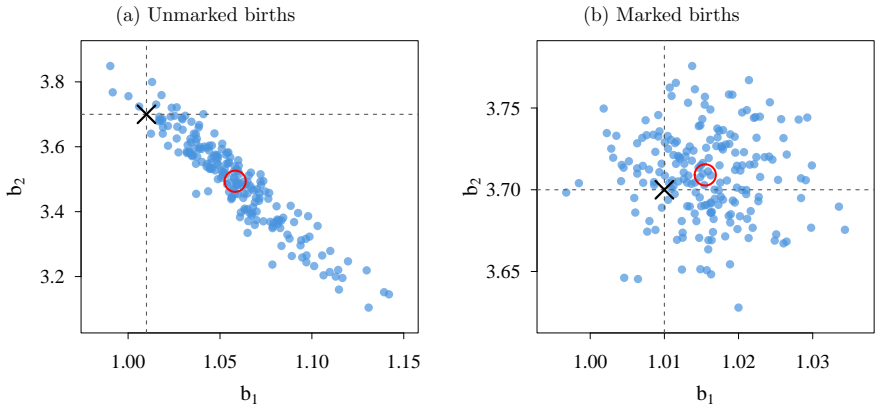
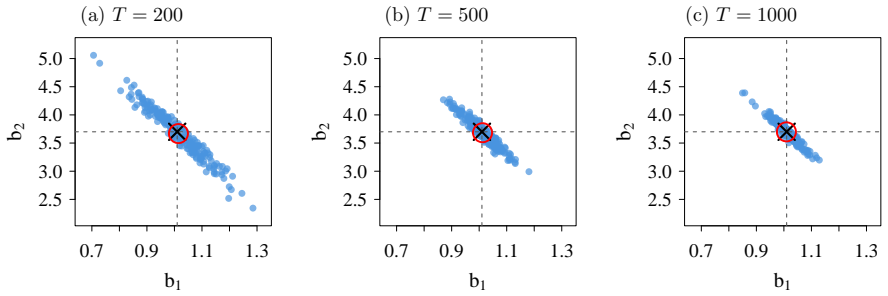
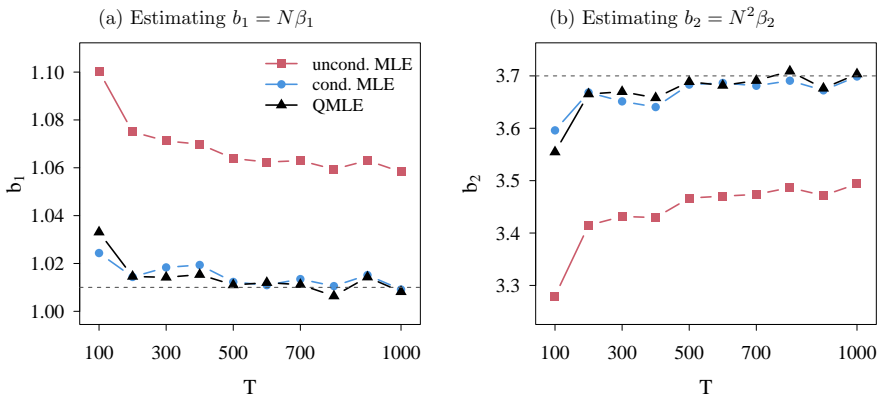
Under the Doob h-transformed Q-process the conditional maximum likelihood estimator and the quasi-maximum likelihood estimator are consistent and asymptotically normal for the parameters of composite birth rates, with the asymptotic covariance matrices given by the inverses of the Fisher information and Godambe information matrices, respectively. The approach is illustrated on an SIS epidemic model with pairwise and higher-order transmission, where births are unmarked, and a one-dimensional test statistic is derived to detect specific higher-order mechanisms.
What carries the argument
The Doob h-transformed Q-process, a time-homogeneous ergodic Markov chain that serves as an asymptotic surrogate for the original birth-death process conditioned on long-term survival.
If this is right
- The estimators recover the true birth-rate parameters consistently from a single long unmarked trajectory.
- Asymptotic normality allows construction of confidence intervals using the inverse Fisher or Godambe matrices.
- A practical one-dimensional test can determine whether a particular higher-order birth mechanism is active.
- Inference remains feasible even when the state space is one-dimensional and mechanism labels are absent.
Where Pith is reading between the lines
- The same conditioning-plus-transform technique could be applied to other survival-biased processes in ecology or chemistry.
- Numerical methods for computing the h-function would extend the approach to larger state spaces.
- Applied to real epidemic data the method could test whether higher-order interactions improve transmission models beyond pairwise contacts.
Load-bearing premise
The Doob h-transformed Q-process provides a valid time-homogeneous ergodic surrogate for the law of the original process conditioned on long survival.
What would settle it
Simulate long trajectories from the original process conditioned on survival, apply the estimators, and check whether they converge to the true parameter values with the predicted asymptotic covariance as the trajectory length grows.
Figures




read the original abstract
We develop a likelihood-based inference for finite-state birth-death processes with composite birth rates, in which multiple distinct mechanisms contribute additively to the total birth intensity. Our main motivating example is an SIS epidemic model with pairwise and higher-order transmission. The process is observed through a single aggregate trajectory, and in the main setting of interest, birth events are unmarked. This creates a deconvolution problem in event space: the state is one-dimensional, but the mechanism underlying each birth is latent. We formulate the inference under a Doob $h$-transformed $Q$-process, which is time-homogeneous and ergodic and which provides a time-homogeneous asymptotic surrogate for the law of the original process conditioned on long survival. We derive the corresponding conditional likelihood and study both the conditional maximum likelihood estimator and a quasi-maximum likelihood estimator which is based on a simplified working score. Under the Doob-transform law, we prove consistency and asymptotic normality for both estimators, with asymptotic covariance determined by the inverse Fisher and inverse Godambe information matrices, respectively. We also showcase a practical one-dimensional test for the presence of a specific higher-order birth mechanism.
Editorial analysis
A structured set of objections, weighed in public.
Referee Report
Summary. The paper develops likelihood-based inference for finite-state birth-death processes with composite (additive) birth rates observed via a single unmarked aggregate trajectory. It formulates the problem under a Doob h-transformed Q-process that is claimed to be time-homogeneous and ergodic, serving as an asymptotic surrogate for the original process conditioned on long survival. Conditional MLE and quasi-MLE estimators are derived, with proofs of consistency and asymptotic normality (covariances via inverse Fisher and Godambe matrices) under the transformed law; a one-dimensional test for higher-order birth mechanisms is also presented. The motivating example is an SIS epidemic model with pairwise and higher-order transmission.
Significance. If the Doob-transform validity and transfer of asymptotic results hold, the work supplies a rigorous framework for parameter inference and mechanism deconvolution in unmarked composite birth-death processes. This is particularly relevant for epidemic modeling and population dynamics, where single trajectories without event marking are common, and could enable practical tests for higher-order interactions without requiring multi-dimensional state augmentation.
major comments (2)
- [Doob h-transform and asymptotic results section] The central consistency and asymptotic normality claims (abstract and the section deriving the estimators) rest on the Doob h-transformed Q-process being a valid ergodic surrogate for the law conditioned on long survival. For composite birth intensities, the manuscript does not explicitly verify that the eigenfunction h solving the transform preserves the one-dimensional state space while correctly embedding the latent mechanism deconvolution; this step is load-bearing for transferring the Fisher/Godambe information matrices to the original conditional likelihood.
- [Quasi-MLE derivation] The quasi-maximum likelihood estimator based on the simplified working score (section on QMLE) uses the Godambe matrix for its asymptotic covariance. It is unclear whether the working score remains unbiased under the composite-rate generator when the latent birth mechanisms are unmarked; a concrete check against the full conditional score would be needed to confirm the sandwich form applies without additional bias terms.
minor comments (2)
- [Model setup] Notation for the composite birth intensity (sum of mechanisms) should be introduced earlier and used consistently when defining the generator Q.
- [Numerical illustration] The practical test for higher-order mechanisms would benefit from a small simulation study showing power under the transformed law, even if not required for the main theorems.
Simulated Author's Rebuttal
We thank the referee for the careful reading of our manuscript and the constructive comments, which help clarify the presentation of the Doob h-transform and the quasi-MLE. We address each major comment below and indicate the revisions we will make.
read point-by-point responses
-
Referee: [Doob h-transform and asymptotic results section] The central consistency and asymptotic normality claims (abstract and the section deriving the estimators) rest on the Doob h-transformed Q-process being a valid ergodic surrogate for the law conditioned on long survival. For composite birth intensities, the manuscript does not explicitly verify that the eigenfunction h solving the transform preserves the one-dimensional state space while correctly embedding the latent mechanism deconvolution; this step is load-bearing for transferring the Fisher/Godambe information matrices to the original conditional likelihood.
Authors: We appreciate the referee drawing attention to this foundational verification. The underlying birth-death process is defined on the finite one-dimensional state space {0, 1, ..., N} with the composite birth intensity entering additively into the total birth rate function. The Doob h-transform is obtained from the principal eigenpair of the infinitesimal generator Q of this chain; because the state space is finite and the chain is irreducible under the standing assumptions, the eigenfunction h is strictly positive and the transformed generator remains a birth-death generator on exactly the same state space. The latent mechanism deconvolution is encoded in the likelihood via the decomposition of the total intensity, and the h-transform applies uniformly to the aggregate process, thereby preserving the transfer of the Fisher and Godambe information matrices. To make the argument fully explicit, we will insert a short dedicated paragraph (with a brief proof sketch) immediately after the definition of the transformed generator, confirming preservation of the state space and ergodicity for composite rates. revision: yes
-
Referee: [Quasi-MLE derivation] The quasi-maximum likelihood estimator based on the simplified working score (section on QMLE) uses the Godambe matrix for its asymptotic covariance. It is unclear whether the working score remains unbiased under the composite-rate generator when the latent birth mechanisms are unmarked; a concrete check against the full conditional score would be needed to confirm the sandwich form applies without additional bias terms.
Authors: We thank the referee for this observation on the unbiasedness of the working score. The working score is constructed by retaining only the terms that depend on the total (observed) intensity while discarding cross-derivative contributions that would require knowledge of the latent mechanism labels. Under the Doob-transformed measure the resulting process is a time-homogeneous Markov chain whose transitions are driven solely by the aggregate rates; consequently the expectation of the working score equals the derivative of the expected log-transition probability and is therefore identically zero. This martingale property carries over directly from the full conditional score because the simplification does not alter the compensator of the observed counting process. To address the referee's request for an explicit check, we will add a short calculation in the QMLE section that verifies E[working score] = 0 under the composite generator and confirms that the Godambe sandwich remains valid without extra bias terms. revision: yes
Circularity Check
No circularity: derivation relies on standard ergodic theory applied to Doob transform
full rationale
The paper formulates inference under the Doob h-transformed Q-process as a time-homogeneous ergodic surrogate for the conditioned process, then derives the conditional likelihood and proves consistency/asymptotic normality via inverse Fisher and Godambe matrices. This chain uses standard results for ergodic Markov chains and does not reduce any prediction or estimator to a fitted input by construction, nor does it depend on load-bearing self-citations or imported uniqueness theorems. The composite birth mechanism is incorporated directly into the generator and likelihood without renaming or smuggling ansatzes.
Axiom & Free-Parameter Ledger
Reference graph
Works this paper leans on
-
[1]
U. Alvarez-Rodriguez, F. Battiston, G. F. de Arruda, Y. Moreno, M. Perc, and V. Latora. Evolutionary dynamics of higher-order interactions in social networks.Nature Human Behaviour, 5(5):586–595, 2021. doi: 10.1038/s41562-020-01024-1
-
[2]
P. K. Andersen, O. Borgan, R. D. Gill, and N. Keiding.Statistical models based on counting processes. Springer, 1993
1993
-
[3]
F. Battiston, G. Cencetti, I. Iacopini, V. Latora, M. Lucas, A. Patania, J.-G. Young, and G. Petri. Networks beyond pairwise interactions: Structure and dynamics.Physics Reports, 874:1–92, 2020. doi: 10.1016/j.physrep.2020.05.004
-
[4]
Battiston, E
F. Battiston, E. Amico, A. Barrat, G. Bianconi, G. Ferraz de Arruda, B. Franceschiello, I. Iacopini, S. K´ efi, V. Latora, Y. Moreno, et al. The physics of higher-order inter- actions in complex systems.Nature Physics, 17(10):1093–1098, 2021. doi: 10.1038/ s41567-021-01371-4
2021
-
[5]
Bianconi.Higher-order Networks
G. Bianconi.Higher-order Networks. Cambridge University Press, 2021
2021
-
[6]
C. Bick, E. Gross, H. A. Harrington, and M. T. Schaub. What are higher-order networks? SIAM Review, 65(3):686–731, 2023. doi: 10.1137/21M1414024
-
[7]
Braunsteins, S
P. Braunsteins, S. Hautphenne, and C. Minuesa. Parameter estimation in branching pro- cesses with almost sure extinction.Bernoulli, 28(1):33–63, 2022
2022
-
[8]
Braunsteins, S
P. Braunsteins, S. Hautphenne, and C. Minuesa. Consistent least squares estimation in population-size-dependent branching processes.Journal of the American Statistical Asso- ciation, pages 1–13, 2025
2025
-
[9]
Britton, E
T. Britton, E. Pardoux, F. Ball, C. Laredo, D. Sirl, and V. C. Tran.Stochastic Epidemic Models with Inference, volume 2255. Springer, 2019
2019
-
[10]
Centola and M
D. Centola and M. Macy. Complex contagions and the weakness of long ties.American Journal of Sociology, 113(3):702–734, 2007
2007
-
[11]
Champagnat and D
N. Champagnat and D. Villemonais. Exponential convergence to quasi-stationary distri- bution and Q-process.Probability Theory and Related Fields, 164(1):243–283, 2016. 29
2016
-
[12]
Civilini, N
A. Civilini, N. Anbarci, and V. Latora. Evolutionary Game Model of Group Choice Dilemmas on Hypergraphs.Physical Review Letters, 127(26):268301, 2021. doi: 10.1103/ PhysRevLett.127.268301
2021
-
[13]
A. Civilini, O. Sadekar, F. Battiston, J. G´ omez-Garde˜ nes, and V. Latora. Explosive co- operation in social dilemmas on higher-order networks.Physical Review Letters, 132(16): 167401, 2024. doi: 10.1103/PhysRevLett.132.167401
-
[14]
Collet, S
P. Collet, S. Mart´ ınez, and J. San Mart´ ın.Quasi-stationary Distributions: Markov Chains, Diffusions and Dynamical Systems. Springer, 2013
2013
-
[15]
F. W. Crawford, V. N. Minin, and M. A. Suchard. Estimation for general birth-death processes.Journal of the American Statistical Association, 109(506):730–747, 2014
2014
-
[16]
J. N. Darroch and E. Seneta. On quasi-stationary distributions in absorbing continuous- time finite Markov chains.Journal of Applied Probability, 4(1):192–196, 1967
1967
-
[17]
Erban and S
R. Erban and S. J. Chapman.Stochastic Modelling of Reaction–Diffusion Processes. Cam- bridge University Press, 2020
2020
-
[18]
G. Ferraz de Arruda, G. Petri, P. M. Rodriguez, and Y. Moreno. Multistability, intermit- tency, and hybrid transitions in social contagion models on hypergraphs.Nature Commu- nications, 14(1):1375, 2023. doi: 10.1038/s41467-023-37118-3
-
[19]
Ferraz de Arruda, A
G. Ferraz de Arruda, A. Aleta, and Y. Moreno. Contagion dynamics on higher-order networks.Nature Reviews Physics, 6(8):468–482, 2024
2024
-
[20]
D. T. Gillespie. Exact stochastic simulation of coupled chemical reactions.The Journal of Physical Chemistry, 81(25):2340–2361, 1977. doi: 10.1021/j100540a008
- [21]
-
[22]
S. Hautphenne and E. Horton. Consistent estimation in subcritical birth-and-death pro- cesses, 2025. URL https://arxiv.org/abs/2511.01153
-
[23]
N. O. Hodas and K. Lerman. The simple rules of social contagion.Scientific Reports, 4 (1):4343, 2014
2014
-
[24]
I. Iacopini, G. Petri, A. Barrat, and V. Latora. Simplicial models of social contagion. Nature Communications, 10(1):2485, 2019. doi: 10.1038/s41467-019-10431-6
-
[25]
Iacopini, G
I. Iacopini, G. Petri, A. Baronchelli, and A. Barrat. Group interactions modulate critical mass dynamics in social convention.Communications Physics, 5(1):64, 2022. doi: 10.1038/ s42005-022-00845-y
2022
-
[26]
Kato.Perturbation Theory for Linear Operators
T. Kato.Perturbation Theory for Linear Operators. Classics in Mathematics. Springer, Berlin Heidelberg, 1995
1995
-
[27]
N. Keiding. Maximum likelihood estimation in the birth-and-death process.The Annals of Statistics, 3(2):363–372, 1975
1975
-
[28]
D. G. Kendall. On the generalized ”birth-and-death” process.The Annals of Mathematical Statistics, 19(1):1–15, 1948. 30
1948
-
[29]
Kim and K.-I
J.-H. Kim and K.-I. Goh. Higher-order components dictate higher-order contagion dy- namics in hypergraphs.Physical Review Letters, 132(8):087401, 2024. doi: 10.1103/ PhysRevLett.132.087401
2024
-
[30]
I. Z. Kiss, I. Iacopini, P. L. Simon, and N. Georgiou. Insights from exact social contagion dynamics on networks with higher-order structures.Journal of Complex Networks, 11(6): cnad044, 2023. doi: 10.1093/comnet/cnad044
-
[31]
C. Kuehn and C. Bick. A universal route to explosive phenomena.Science Advances, 7 (16):eabe3824, 2021. doi: 10.1126/sciadv.abe3824
-
[32]
N. W. Landry and J. G. Restrepo. The effect of heterogeneity on hypergraph contagion models.Chaos, 30(10):103117, 2020. doi: 10.1063/5.0020034
-
[33]
Impact of population size on early adaptation in rugged fitness landscapes
S. Majhi, M. Perc, and D. Ghosh. Dynamics on higher-order networks: A review.Journal of the Royal Society Interface, 19(188):20220043, 2022. doi: 10.1098/rsif.2022.0043
-
[34]
M. Mancastroppa, I. Iacopini, G. Petri, and A. Barrat. Hyper-cores promote localization and efficient seeding in higher-order processes.Nature Communications, 14(1):6223, 2023. doi: 10.1038/s41467-023-41888-9
-
[35]
N. Masuda and C. L. Vestergaard. Gillespie algorithms for stochastic multiagent dynamics in populations and networks.arXiv preprint arXiv:2112.05293, 2021
-
[36]
D. A. McQuarrie. Stochastic approach to chemical kinetics.Journal of Applied Probability, 4(3):413–478, 1967
1967
-
[37]
A. P. Mill´ an, J. J. Torres, and G. Bianconi. Explosive higher-order Kuramoto dynamics on simplicial complexes.Physical Review Letters, 124(21):218301, 2020. doi: 10.1103/ PhysRevLett.124.218301
2020
-
[38]
S. Nandy and B. B. Bhattacharya. Degree Heterogeneity in Higher-Order Networks: Infer- ence in the Hypergraphβ-model.IEEE Transactions on Information Theory, 2024. doi: 10.1109/TIT.2024.3379526
-
[39]
D. M. Raup. Extinction from a paleontological perspective.European Review, 1(3):207–216, 1993
1993
-
[40]
F. E. Rosas, P. A. M. Mediano, A. I. Luppi, T. F. Varley, J. T. Lizier, S. Stramaglia, H. J. Jensen, and D. Marinazzo. Disentangling high-order mechanisms and high-order behaviours in complex systems.Nature Physics, 18(5):476–477, 2022. doi: 10.1038/s41567-022-01548-5
-
[41]
S. G. Self and K.-Y. Liang. Asymptotic properties of maximum likelihood estimators and likelihood ratio tests under nonstandard conditions.Journal of the American Statistical Association, 82(398):605–610, 1987
1987
-
[42]
P. S. Skardal and A. Arenas. Higher order interactions in complex networks of phase oscillators promote abrupt synchronization switching.Communications Physics, 3(1):218,
-
[43]
doi: 10.1038/s42005-020-00485-0
-
[44]
P. S. Skardal, S. Adhikari, and J. G. Restrepo. Multistability in coupled oscillator systems with higher-order interactions and community structure.Chaos, 33(2):023128, 2023. doi: 10.1063/5.0136353. 31
-
[45]
G. St-Onge, H. Sun, A. Allard, L. H´ ebert-Dufresne, and G. Bianconi. Universal nonlinear infection kernel from heterogeneous exposure on higher-order networks.Physical Review Letters, 127(15):158301, 2021. doi: 10.1103/PhysRevLett.127.158301
-
[46]
G. St-Onge, I. Iacopini, V. Latora, A. Barrat, G. Petri, A. Allard, and L. H´ ebert-Dufresne. Influential groups for seeding and sustaining nonlinear contagion in heterogeneous hyper- graphs.Communications Physics, 5(1):25, 2022. doi: 10.1038/s42005-021-00788-w
-
[47]
H. Sun, F. Radicchi, J. Kurths, and G. Bianconi. The dynamic nature of percolation on networks with triadic interactions.Nature Communications, 14(1):1308, 2023. doi: 10.1038/s41467-023-36910-3
-
[48]
Tanaka and T
T. Tanaka and T. Aoyagi. Multistable attractors in a network of phase oscillators with three-body interactions.Physical Review Letters, 106(22):224101, 2011. doi: 10.1103/ PhysRevLett.106.224101
2011
-
[49]
Torres, A
L. Torres, A. S. Blevins, D. Bassett, and T. Eliassi-Rad. The why, how, and when of representations for complex systems.SIAM Review, 63(3):435–485, 2021. doi: 10.1137/ 20M1355896
2021
-
[50]
Zhang, P
Y. Zhang, P. S. Skardal, F. Battiston, G. Petri, and M. Lucas. Deeper but smaller: Higher- order interactions increase linear stability but shrink basins.Science Advances, 10(40): eado8049, 2024. 32
2024
discussion (0)
Sign in with ORCID, Apple, or X to comment. Anyone can read and Pith papers without signing in.