Recognition: unknown
Random Walk on Point Clouds for Feature Detection
Pith reviewed 2026-05-10 01:13 UTC · model grok-4.3
The pith
A random walk performed on disk-sampled neighborhood graphs extracts feature points from point clouds by jointly modeling spatial distribution, topology, and local geometry.
A machine-rendered reading of the paper's core claim, the machinery that carries it, and where it could break.
Core claim
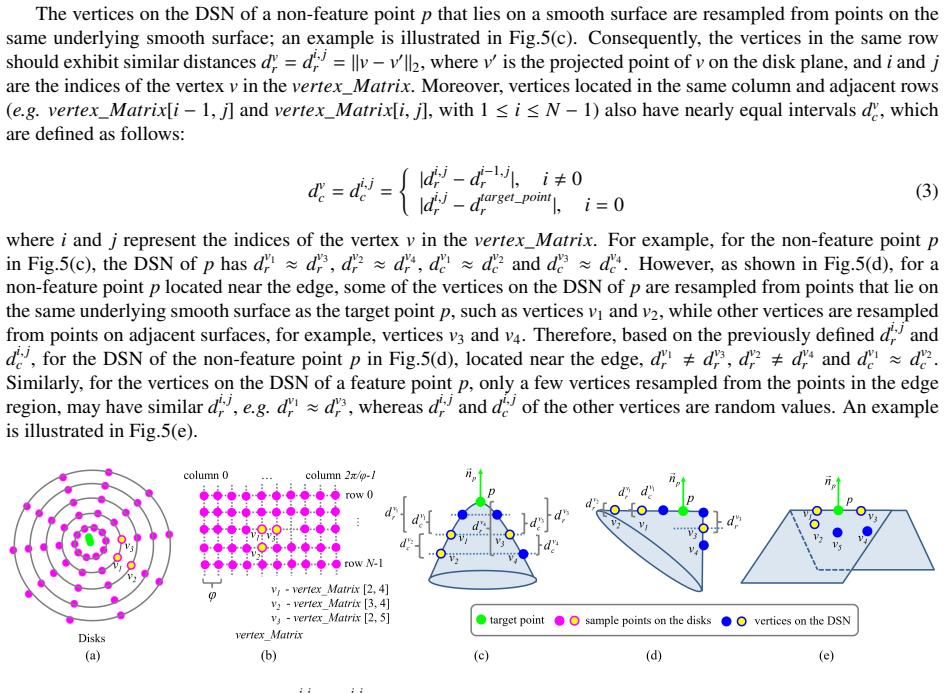
Feature extraction is treated as a context-dependent graph problem: a Disk Sampling Neighborhood is formed around each point to preserve neighborhood relations in matrix form, after which a random walk on that neighborhood graph produces a score that simultaneously encodes spatial distribution, topological connectivity, and geometric variation, allowing reliable selection of the points that define the overall shape.
What carries the argument
The Disk Sampling Neighborhood graph, on which a random walk aggregates spatial, topological, and geometric information to rank each point's importance.
If this is right
- The method produces a recall of 0.769 and precision of 0.784 while handling transitions across scales and feature types.
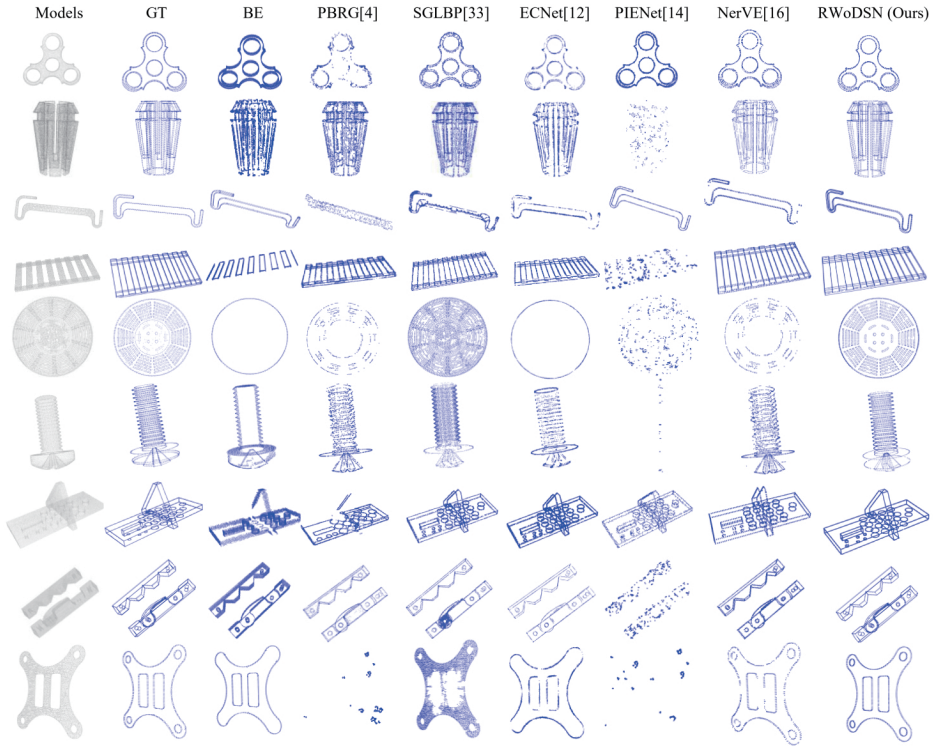
- It outperforms both traditional hand-crafted descriptors and deep-learning baselines on eight evaluation metrics.
- Feature points located this way can serve directly as input for downstream tasks such as registration, reconstruction, and CAD operations.
- Because the walk operates on an explicitly constructed graph, the approach avoids the need for large training sets or post-processing heuristics.
Where Pith is reading between the lines
- If the graph construction generalizes across acquisition modalities, the same pipeline could be applied to noisy or incomplete scans without retraining.
- The explicit separation of neighborhood definition from the walk step makes it straightforward to substitute alternative neighborhood samplers and measure their isolated effect on detection quality.
- Because the scoring is deterministic once the graph is built, the method could be inserted as a lightweight preprocessing stage before learned descriptors are applied.
Load-bearing premise
That the random walk on the DSN graph reliably surfaces feature points by incorporating spatial, topological, and geometric cues without any dataset-specific parameter tuning.
What would settle it
On any standard point-cloud feature-detection benchmark, a measured recall lower than the current best published method would falsify the performance claim.
Figures






read the original abstract
The points on the point clouds that can entirely outline the shape of the model are of critical importance, as they serve as the foundation for numerous point cloud processing tasks and are widely utilized in computer graphics and computer-aided design. This study introduces a novel method, RWoDSN, for extracting such feature points, incorporating considerations of sharp-to-smooth transitions, large-to-small scales, and textural-to-detailed features. We approach feature extraction as a two-stage context-dependent analysis problem. In the first stage, we propose a novel neighborhood descriptor, termed the Disk Sampling Neighborhood (DSN), which, unlike traditional spatially and geometrically invariant approaches, preserves a matrix structure while maintaining normal neighborhood relationships. In the second stage, a random walk is performed on the DSN (RWoDSN), yielding a graph-based DSN that simultaneously accounts for the spatial distribution, topological properties, and geometric characteristics of the local surface surrounding each point. This enables the effective extraction of feature points. Experimental results demonstrate that the proposed RWoDSN method achieves a recall of 0.769-22% higher than the current state-of-the-art-alongside a precision of 0.784. Furthermore, it significantly outperforms several traditional and deep-learning techniques across eight evaluation metrics.
Editorial analysis
A structured set of objections, weighed in public.
Referee Report
Summary. The manuscript introduces RWoDSN, a two-stage method for feature point extraction from point clouds. Stage one defines a Disk Sampling Neighborhood (DSN) descriptor that preserves matrix structure while retaining normal neighborhood relations, unlike traditional invariant approaches. Stage two performs a random walk on the DSN to produce a graph-based representation that simultaneously encodes spatial distribution, topological properties, and geometric characteristics of local surfaces. The authors report that this yields a recall of 0.769 (22% above current SOTA) and precision of 0.784, with significant outperformance over traditional and deep-learning baselines across eight evaluation metrics.
Significance. If the central claims hold after proper validation, the work offers a potentially useful graph-based perspective on multi-aspect feature detection in point clouds, which could benefit downstream tasks in computer graphics and CAD. The DSN construction is a concrete, novel contribution worth exploring for its matrix-preserving property. No machine-checked proofs or parameter-free derivations are present, but the two-stage framing and random-walk integration represent an original synthesis if the implementation details prove reproducible.
major comments (3)
- Abstract: The superiority claims (recall 0.769 with 22% improvement, precision 0.784, outperformance on eight metrics) are presented without any reference to the datasets used, the specific baselines compared, implementation details of those baselines, or statistical measures such as error bars or significance tests. This information is load-bearing for the empirical claims and must be supplied for the results to be verifiable.
- Abstract (second-stage description): The random walk is asserted to 'simultaneously account for the spatial distribution, topological properties, and geometric characteristics' yet no transition probabilities, walk length, absorption criteria, or explicit mapping from DSN matrix to weighted graph are provided. Without these, it is unclear whether the procedure truly integrates curvature or scale transitions or instead relies on unstated design choices that would make the reported metrics conditional on tuning.
- Abstract: The claim that DSN 'preserves a matrix structure while maintaining normal neighborhood relationships' and is 'unlike traditional spatially and geometrically invariant approaches' requires a concrete comparison (e.g., to standard k-NN or ball neighborhoods) and a demonstration that no scale or sampling parameters are implicitly fitted to the evaluation data; otherwise the independence from post-hoc adjustments cannot be assessed.
minor comments (1)
- Abstract contains a typographical error: 'state-of-the-art-alongside' should read 'state-of-the-art alongside'.
Simulated Author's Rebuttal
We thank the referee for the constructive and detailed comments. We agree that the abstract requires additional context to make the empirical claims more verifiable and will revise it to address the points raised while preserving its conciseness. We respond to each major comment below.
read point-by-point responses
-
Referee: Abstract: The superiority claims (recall 0.769 with 22% improvement, precision 0.784, outperformance on eight metrics) are presented without any reference to the datasets used, the specific baselines compared, implementation details of those baselines, or statistical measures such as error bars or significance tests. This information is load-bearing for the empirical claims and must be supplied for the results to be verifiable.
Authors: We will revise the abstract to explicitly reference the benchmark datasets and the specific traditional and deep-learning baselines used for comparison. Implementation details of the baselines are already provided in the Experiments section; we will add a brief note in the abstract directing readers there. Regarding statistical measures, we will incorporate error bars or significance tests from our existing analysis (or compute them if needed) to support the reported metrics. revision: yes
-
Referee: Abstract (second-stage description): The random walk is asserted to 'simultaneously account for the spatial distribution, topological properties, and geometric characteristics' yet no transition probabilities, walk length, absorption criteria, or explicit mapping from DSN matrix to weighted graph are provided. Without these, it is unclear whether the procedure truly integrates curvature or scale transitions or instead relies on unstated design choices that would make the reported metrics conditional on tuning.
Authors: The transition probabilities, walk length, absorption criteria, and the explicit mapping from the DSN matrix to the weighted graph are fully specified in the Method section. To improve the abstract, we will add a concise clause referencing these elements and how they enable integration of spatial, topological, and geometric properties, while keeping the abstract brief and pointing to the detailed description. revision: yes
-
Referee: Abstract: The claim that DSN 'preserves a matrix structure while maintaining normal neighborhood relationships' and is 'unlike traditional spatially and geometrically invariant approaches' requires a concrete comparison (e.g., to standard k-NN or ball neighborhoods) and a demonstration that no scale or sampling parameters are implicitly fitted to the evaluation data; otherwise the independence from post-hoc adjustments cannot be assessed.
Authors: We will revise the abstract to include a direct comparison of DSN against standard k-NN and ball neighborhoods, emphasizing the matrix-structure preservation. We will also add a statement clarifying that DSN construction uses fixed sampling without fitting to evaluation data, with supporting analysis and parameter settings provided in the Method section to demonstrate independence from post-hoc adjustments. revision: yes
Circularity Check
No circularity: method is a two-stage descriptor plus walk with external experimental validation
full rationale
The paper presents RWoDSN as a novel DSN matrix descriptor followed by a random walk that produces a graph encoding spatial/topological/geometric properties, then validates via recall/precision on benchmark data. No equations or steps reduce by construction to fitted inputs or self-citations; the central claim is an empirical procedure whose performance is measured against independent test sets rather than derived tautologically from its own parameters. No self-definitional, fitted-prediction, or uniqueness-imported patterns appear in the provided description.
Axiom & Free-Parameter Ledger
axioms (1)
- domain assumption Random walks on a graph derived from local neighborhoods can encode spatial, topological, and geometric information sufficient to distinguish feature points.
invented entities (1)
-
Disk Sampling Neighborhood (DSN)
no independent evidence
Reference graph
Works this paper leans on
-
[1]
Deep learning for 3d point clouds: A survey
Guo Y, Wang H, Hu Q, Liu H, Liu L, Bennamoun M. Deep learning for 3d point clouds: A survey. IEEE Trans Pattern Anal 2020;43(12):4338–64.http://dx.doi.org/10.1109/TPAMI.2020.3005434. 17
-
[2]
Feature extraction from point clouds
Gumhold S, Wang X, MacLeod RS, et al. Feature extraction from point clouds. In: 10th International Meshing Roundtable. 2001, p. 293–305.https://api.semanticscholar.org/CorpusID:18343879
2001
-
[3]
Detection of closed sharp edges in point clouds using normal estimation and graph theory
Demarsin K, Vanderstraeten D, V olodine T, Roose D. Detection of closed sharp edges in point clouds using normal estimation and graph theory. Comput Aided Design 2007;39(4):276–83.http://dx.doi.org/10.10 16/j.cad.2006.12.005
2007
-
[4]
A statistical approach for extraction of feature lines from point clouds
Zhang Y, Geng G, Wei X, Zhang S, Li S. A statistical approach for extraction of feature lines from point clouds. Comput Graph-UK 2016;56:31–45.http://dx.doi.org/10.1016/j.cag.2016.01.004
-
[5]
Information Fusion 124, 103332 (2025) https://doi.org/10.1016/j.inffus.2025.103332
Hu E, Sun L. Daniel: A fast and robust consensus maximization method for point cloud registration with high outlier ratios. Inform Sciences 2022;614:563–79.http://dx.doi.org/https://doi.org/10.1016/j.in s.2022.10.086
-
[6]
Type-based outlier removal framework for point clouds
Ge L, Feng J. Type-based outlier removal framework for point clouds. Inform Sciences 2021;580:436–59. http://dx.doi.org/https://doi.org/10.1016/j.ins.2021.08.090
-
[7]
Matsumura H, Premachandra C. Deep-learning-based stair detection using 3d point cloud data for preventing walking accidents of the visually impaired. IEEE Access 2022;10:56249–55.http://dx.doi.org/10.1109 /ACCESS.2022.3178154
-
[8]
Depth-gyro sensor-based extended face orientation estimation using deep learn- ing
Premachandra C, Funahashi Y. Depth-gyro sensor-based extended face orientation estimation using deep learn- ing. IEEE Sensors Journal 2023;23(17):20199–206.http://dx.doi.org/10.1109/JSEN.2023.3296531
-
[9]
Sharp feature detection in point clouds
Weber C, Hahmann S, Hagen H. Sharp feature detection in point clouds. In: 2010 Shape Modeling International Conference. IEEE; 2010, p. 175–86.http://dx.doi.org/10.1109/SMI.2010.32
-
[10]
Computer Graphics Forum29(2), 419–428 (2010) https://doi.org/10.1111/j.1467-8659.2009.01611.x
Weinkauf T, Guenther D. Separatrix persistence: extraction of salient edges on surfaces using topological methods. Comput Graph Forum 2009;28(5):1519–28.http://dx.doi.org/10.1111/j.1467-8659.2009 .01528.x
-
[11]
Ec-net: an edge-aware point set consolidation network
Yu L, Li X, Fu CW, Cohen-Or D, Heng PA. Ec-net: an edge-aware point set consolidation network. In: Proceedings of the European Conference on Computer Vision (ECCV). 2018, p. 386–402.http://dx.doi.o rg/10.1007/978-3-030-01234-2_24
-
[12]
Learning part boundaries from 3d point clouds
Loizou M, Averkiou M, Kalogerakis E. Learning part boundaries from 3d point clouds. Comput Graph Forum 2020;39(5):183–195.http://dx.doi.org/10.1111/cgf.14078.http://dx.doi.org/10.1111/cgf.1 4078
work page doi:10.1111/cgf.14078.http://dx.doi.org/10.1111/cgf.1 2020
-
[13]
Pie-net: Parametric inference of point cloud edges
Wang X, Xu Y, Xu K, Tagliasacchi A, Zhou B, Mahdavi-Amiri A, et al. Pie-net: Parametric inference of point cloud edges. In: NeurIPS Proceedings 2020; vol. 33. 2020, p. 20167–78.http://dx.doi.org/10.48550/ar Xiv.2007.04883
work page doi:10.48550/ar 2020
-
[14]
Spiral aggregation map (splam): A new descriptor for robust template matching with fast algorithm
Shih HC, Yu KC. Spiral aggregation map (splam): A new descriptor for robust template matching with fast algorithm. Pattern Recogn 2015;48(5):1707–23.http://dx.doi.org/10.1016/j.patcog.2014.11.004
-
[15]
Ho HT, Gibbins D. Curvature-based approach for multi-scale feature extraction from 3d meshes and unstructured point clouds. IET Comput Vis 2009;3(4):201–12.http://dx.doi.org/10.1049/iet-cvi.2009.0044
-
[16]
Extracting Sharp Features from RGB-D Images
Cao Y, Ju T, Xu J, Hu S. Extracting Sharp Features from RGB-D Images. Comput Graph Forum 2017;36(8):138–52.http://dx.doi.org/10.1111/cgf.13069
-
[17]
Robust smooth feature extraction from point clouds
Daniels JI, Ha LK, Ochotta T, Silva CT. Robust smooth feature extraction from point clouds. In: IEEE International Conference on Shape Modeling and Applications 2007 (SMI’07). 2007, p. 123–36.http: //dx.doi.org/10.1109/SMI.2007.32. 18
-
[18]
Pattern Recog- nition153, 110500 (2024).https://doi.org/https://doi.org/10.1016/j
Wang Y, Feng HY, Étienne Delorme F, Engin S. An adaptive normal estimation method for scanned point clouds with sharp features. Comput Aided Design 2013;45(11):1333–48.http://dx.doi.org/10.1016/j .cad.2013.06.003
work page doi:10.1016/j 2013
-
[19]
Huang QX, Flöry S, Gelfand N, Hofer M, Pottmann H. Reassembling fractured objects by geometric matching. ACM Trans Graph 2006;25(3):569–78.http://dx.doi.org/10.1145/1141911.1141925
-
[20]
Multi-scale tensor voting for feature extraction from unstructured point clouds
Park MK, Lee SJ, Lee KH. Multi-scale tensor voting for feature extraction from unstructured point clouds. Graph Models 2012;74(4):197–208.http://dx.doi.org/10.1016/j.gmod.2012.04.008
-
[21]
Multi- scale feature extraction on point-sampled surfaces
Pauly M, Keiser R, Gross M. Multi-scale feature extraction on point-sampled surfaces. Comput Graph Forum 2003;22(3):281–9.http://dx.doi.org/10.1111/1467-8659.00675
-
[22]
Computer Graphics Forum 25(3), 547–556 (2006) https://doi.org/10.1111/ j.1467-8659.2006.00974.x
Jenke P, Wand M, Bokeloh M, Schilling A, Straßer W. Bayesian point cloud reconstruction. Comput Graph Forum 2006;25(3):379–88.http://dx.doi.org/10.1111/j.1467-8659.2006.00957.x
-
[23]
Fast and robust edge extraction in unorganized point clouds
Bazazian D, Casas JR, Ruiz-Hidalgo J. Fast and robust edge extraction in unorganized point clouds. In: 2015 International Conference on Digital Image Computing: Techniques and Applications (DICTA). 2015, p. 1–8. http://dx.doi.org/10.1109/DICTA.2015.7371262
-
[24]
Edge and corner detection for unorganized 3d point clouds with application to robotic welding
Ahmed SM, Tan YZ, Chew CM, Mamun AA, Wong FS. Edge and corner detection for unorganized 3d point clouds with application to robotic welding. In: 2018 IEEE/RSJ International Conference on Intelligent Robots and Systems (IROS). 2018, p. 7350–5.http://dx.doi.org/10.1109/IROS.2018.8593910
-
[25]
Robust and accurate feature detection on point clouds
Liu Z, Xin X, Xu Z, Zhou W, Wang C, Chen R, et al. Robust and accurate feature detection on point clouds. Comput Aided Design 2023;164:103592.http://dx.doi.org/https://doi.org/10.1016/j.cad.2023 .103592
-
[26]
Sglbp: subgraph-based local binary patterns for feature extraction on point clouds
Guo B, Zhang Y, Gao J, Li C, Hu Y. Sglbp: subgraph-based local binary patterns for feature extraction on point clouds. Comput Graph Forum 2022;41(6):51–66.http://dx.doi.org/10.1111/cgf.14500
-
[27]
V oronoi-based curvature and feature estimation from point clouds
Mérigot Q, Ovsjanikov M, Guibas LJ. V oronoi-based curvature and feature estimation from point clouds. IEEE Trans Vis Comput Graphic 2011;17(6):743–56.http://dx.doi.org/10.1109/TVCG.2010.261
-
[28]
V olumetric and multi-view cnns for object classification on 3d data
Qi CR, Su H, Nießner M, Dai A, Yan M, Guibas LJ. V olumetric and multi-view cnns for object classification on 3d data. In: 2016 IEEE Conference on Computer Vision and Pattern Recognition (CVPR). 2016, p. 5648–56. http://dx.doi.org/10.1109/CVPR.2016.609
-
[29]
Shape completion using 3d-encoder-predictor cnns and shape synthesis
Dai A, Qi CR, Nießner M. Shape completion using 3d-encoder-predictor cnns and shape synthesis. In: 2017 IEEE Conference on Computer Vision and Pattern Recognition (CVPR). 2017, p. 6545–54.http://dx.doi.o rg/10.1109/CVPR.2017.693
-
[30]
Jsenet: joint semantic segmentation and edge detection network for 3d point clouds
Hu Z, Zhen M, Bai X, Fu H, Tai Cl. Jsenet: joint semantic segmentation and edge detection network for 3d point clouds. In: Proceedings of the European Conference on Computer Vision (ECCV). 2020, p. 222–39. http://dx.doi.org/10.1007/978-3-030-58565-5_14
-
[31]
Edc-net: edge detection capsule network for 3d point clouds
Bazazian D, Parés ME. Edc-net: edge detection capsule network for 3d point clouds. Applied Sciences 2021;11(4):1833.http://dx.doi.org/10.3390/app11041833
-
[32]
Pcednet: a lightweight neural network for fast and interactive edge detection in 3d point clouds
Himeur CE, Lejemble T, Pellegrini T, Paulin M, Barthe L, Mellado N. Pcednet: a lightweight neural network for fast and interactive edge detection in 3d point clouds. ACM Trans Graph 2021;41(1):1–21.http://dx.d oi.org/10.1145/3481804
-
[33]
Def: Deep estimation of sharp geometric features in 3d shapes
Matveev A, Rakhimov R, Artemov A, Bobrovskikh G, Egiazarian V, Bogomolov E, et al. Def: Deep estimation of sharp geometric features in 3d shapes. ACM Trans Graph 2022;41(4).http://dx.doi.org/10.1145/352 8223.3530140. 19
work page doi:10.1145/352 2022
-
[34]
Vision transformers are parameter- efficient audio-visual learners
Zhu X, Du D, Chen W, Zhao Z, Nie Y, Han X. Nerve: Neural volumetric edges for parametric curve extraction from point cloud. In: 2023 IEEE/CVF Conference on Computer Vision and Pattern Recognition (CVPR). 2023, p. 13601–10.http://dx.doi.org/10.1109/CVPR52729.2023.01307
-
[35]
Vision transformers are parameter- efficient audio-visual learners
Ye Y, Yi R, Gao Z, Zhu C, Cai Z, Xu K. Nef: Neural edge fields for 3d parametric curve reconstruction from multi-view images. In: 2023 IEEE/CVF Conference on Computer Vision and Pattern Recognition (CVPR). 2023, p. 8486–95.http://dx.doi.org/10.1109/CVPR52729.2023.00820
-
[36]
Random walks and random environments
Hughes BD. Random walks and random environments. Oxford University Press; 1996
1996
-
[37]
Random walks for image segmentation
Grady L. Random walks for image segmentation. IEEE Trans Pattern Anal 2006;28(11):1768–83.http: //dx.doi.org/10.1109/TPAMI.2006.233
-
[38]
Rapid and effective segmentation of 3d models using random walks
Lai YK, Hu SM, Martin RR, Rosin PL. Rapid and effective segmentation of 3d models using random walks. Comput Aided Geom D 2009;26(6):665–79.http://dx.doi.org/10.1016/j.cagd.2008.09.007
-
[39]
Community detection using restrained random-walk similarity
Okuda M, Satoh S, Sato Y, Kidawara Y. Community detection using restrained random-walk similarity. IEEE Trans Pattern Anal 2021;43(1):89–103.http://dx.doi.org/10.1109/TPAMI.2019.2926033
-
[40]
Meshwalker: deep mesh understanding by random walks
Lahav A, Tal A. Meshwalker: deep mesh understanding by random walks. ACM Trans Graph 2020;39(6):1–13. http://dx.doi.org/10.1145/3414685.3417806
-
[41]
Cloudwalker: Random walks for 3d point cloud shape analysis
Mesika A, Ben-Shabat Y, Tal A. Cloudwalker: Random walks for 3d point cloud shape analysis. Comput Graph-UK 2022;106(C):110–8.http://dx.doi.org/10.1016/j.cag.2022.06.001
-
[42]
Editing conditional radiance fields
Xiang T, Zhang C, Song Y, Yu J, Cai W. Walk in the cloud: Learning curves for point clouds shape analysis. In: 2021 IEEE/CVF International Conference on Computer Vision (ICCV). 2021, p. 895–904.http://dx.d oi.org/10.1109/ICCV48922.2021.00095
-
[43]
Li R, Lin G, Xie L. Self-point-flow: Self-supervised scene flow estimation from point clouds with optimal transport and random walk. In: 2021 IEEE/CVF Conference on Computer Vision and Pattern Recognition (CVPR). 2021, p. 15572–81.http://dx.doi.org/10.1109/CVPR46437.2021.01532
-
[44]
Contour detection in unstructured 3d point clouds
Hackel T, Wegner JD, Schindler K. Contour detection in unstructured 3d point clouds. In: 2016 IEEE Confer- ence on Computer Vision and Pattern Recognition (CVPR). 2016, p. 1610–8.http://dx.doi.org/10.1109 /CVPR.2016.178
2016
-
[45]
Numerical analysis of differential operators on raw point clouds
Digne JJ, Morel JM. Numerical analysis of differential operators on raw point clouds. Numerische Mathematik 2014;127(2):255–89.http://dx.doi.org/10.1007/s00211-013-0584-y
-
[46]
Stable and efficient differential estimators on oriented point clouds
Lejemble T, Coeurjolly D, Barthe L, Mellado N. Stable and efficient differential estimators on oriented point clouds. Comput Graph Forum 2021;40(5):205–16.http://dx.doi.org/10.1111/cgf.14368
-
[47]
Abc: A big cad model dataset for geometric deep learning
Koch S, Matveev A, Jiang Z, Williams F, Artemov A, Burnaev E, et al. Abc: A big cad model dataset for geometric deep learning. In: 2019 IEEE/CVF Conference on Computer Vision and Pattern Recognition (CVPR). 2019, p. 9593–603.http://dx.doi.org/10.1109/CVPR.2019.00983
-
[48]
3d is here: Point cloud library (pcl)
Rusu RB, Cousins S. 3d is here: Point cloud library (pcl). In: 2011 IEEE International Conference on Robotics and Automation. 2011, p. 1–4.http://dx.doi.org/10.1109/ICRA.2011.5980567
-
[49]
Feature curve extraction on triangle meshes
Moscoso Thompson E, Arvanitis G, Moustakas K, Hoang-Xuan N, Nguyen ER, Tran M, et al. Feature curve extraction on triangle meshes. In: 12th EG Workshop 3D Object Retrieval (2019). 2019, p. 1–8.http: //dx.doi.org/10.2312/3dor.20191066. 20
discussion (0)
Sign in with ORCID, Apple, or X to comment. Anyone can read and Pith papers without signing in.