Recognition: unknown
Charged-Current Neutrino-Induced Single-Pion Production in the Superscaling Approach and Relativistic Distorted-Wave Impulse Approximation
Pith reviewed 2026-05-09 23:22 UTC · model grok-4.3
The pith
SuSAv2 and RDWIA models are compared directly to charged-current neutrino single-pion production data from T2K, MINERvA and MiniBooNE on carbon targets.
A machine-rendered reading of the paper's core claim, the machinery that carries it, and where it could break.
Core claim
The SuSAv2 model applies superscaling to scale the single-nucleon inelastic structure functions from the ANL-Osaka DCC calculation, allowing explicit separation of pi+, pi0 and pi- channels, while the RDWIA model uses relativistic distorted waves for the final nucleon and the Ghent hybrid vertex; both are evaluated in the impulse approximation and compared to measured differential and total cross sections from T2K, MINERvA and MiniBooNE on 12C, revealing kinematic regions where the two frameworks diverge.
What carries the argument
The central mechanisms are the SuSAv2 superscaling relations combined with ANL-Osaka structure functions for channel separation, and the RDWIA relativistic distorted-wave treatment of final-state nucleons paired with the Ghent hybrid boson-pion-nucleon vertex.
If this is right
- The comparison identifies specific energy and angle ranges where one model reproduces data better than the other, guiding selection of theoretical input for neutrino event generators.
- Channel-separated predictions from SuSAv2 allow direct tests against neutral-pion and charged-pion data to constrain the underlying nucleon resonance contributions.
- Discrepancies between the models highlight the need to incorporate consistent treatments of final-state interactions when extracting neutrino oscillation parameters.
- Extension of both frameworks to other nuclear targets becomes feasible once the carbon benchmark is established.
Where Pith is reading between the lines
- If the models continue to underpredict or overpredict data at higher energies, it would indicate that explicit two-nucleon currents or pion absorption channels must be added beyond the impulse approximation.
- The separation of pion charge states in SuSAv2 could be used to test isospin symmetry assumptions when comparing neutrino and antineutrino data sets from the same experiment.
- A joint fit of both models to the combined T2K, MINERvA and MiniBooNE data sets might reveal a common energy-dependent correction factor that could be applied to improve predictions for future experiments like DUNE.
Load-bearing premise
The calculations assume the impulse approximation remains valid and that the chosen single-nucleon structure functions or vertex models capture the dominant physics without large corrections from final-state interactions or multi-nucleon processes over the full energy range.
What would settle it
A high-statistics measurement of the differential cross section in a kinematic bin (for example, low momentum transfer and forward pion angle) where the two models differ by more than 30 percent, if the data lie outside the uncertainty band of both predictions.
Figures






read the original abstract
In this work, we present a detailed comparison of the SuSAv2 (SuperScaling Approach version 2) and RDWIA (Relativistic Distorted-Wave Impulse Approximation) models with measurements of charged-current neutrino-induced single-pion production from different experiments (T2K, MINERvA and MiniBooNE), studying the differences between the two theoretical descriptions. The neutrino energy range in these experiments spans from hundreds of MeV to roughly 20 GeV, and the nuclear targets are mainly composed of $^{12}$C. The SuSAv2 model uses the single-nucleon inelastic structure functions from the ANL-Osaka DCC model, which allows for a separation of pion production channels, distinguishing between the $\pi^+$, $\pi^-$ and $\pi^0$ final states. In the RDWIA approach, the Hybrid model developed by the Ghent group is used for the description of the boson-pion-nucleon vertex.
Editorial analysis
A structured set of objections, weighed in public.
Referee Report
Summary. The manuscript compares the SuSAv2 superscaling approach (using ANL-Osaka DCC single-nucleon structure functions that separate π⁺, π⁻, and π⁰ channels) with the RDWIA model (using the Ghent hybrid boson-pion-nucleon vertex) for charged-current neutrino-induced single-pion production on carbon targets. Predictions are confronted with data from T2K, MINERvA, and MiniBooNE across neutrino energies from hundreds of MeV to ~20 GeV, with the goal of quantifying differences between the two theoretical frameworks under the impulse approximation.
Significance. A clear, quantitative side-by-side assessment of these two models against the same data sets would help neutrino-oscillation experiments select appropriate generators for single-pion backgrounds. The explicit channel separation in SuSAv2 and the relativistic treatment of final-state distortions in RDWIA are both strengths; however, the significance hinges on whether the paper supplies differential distributions, integrated cross sections, and goodness-of-fit metrics rather than qualitative statements alone.
major comments (2)
- [Abstract and results] The abstract states that a 'detailed comparison' is presented, yet supplies no quantitative measures (e.g., χ² values, integrated cross-section ratios, or kinematic coverage statements). If the results section (presumably §4 or §5) likewise omits error bands, baseline comparisons to other generators, or explicit discussion of kinematic acceptance, the central claim that the two models differ in a physically meaningful way cannot be evaluated.
- [Theory sections (SuSAv2 and RDWIA descriptions)] The models are constructed within the impulse approximation. The manuscript should explicitly state (in the theory or discussion section) whether multi-nucleon contributions or additional final-state interactions beyond the distorted-wave treatment are expected to be negligible in the reported energy range; otherwise the comparison risks underestimating systematic uncertainties at the higher end of the MiniBooNE/MINERvA coverage.
minor comments (2)
- [§2] Notation for the single-nucleon structure functions and the boson-pion-nucleon vertex should be unified across the two model descriptions to facilitate direct comparison.
- [Figures] Figure captions should include the specific kinematic cuts applied to each data set (e.g., W < 1.4 GeV or Q² range) so that readers can judge the overlap with the models' validity domains.
Simulated Author's Rebuttal
We thank the referee for the careful reading of our manuscript and the constructive comments. We have revised the paper to address the points raised regarding quantitative aspects of the comparison and the discussion of model limitations.
read point-by-point responses
-
Referee: The abstract states that a 'detailed comparison' is presented, yet supplies no quantitative measures (e.g., χ² values, integrated cross-section ratios, or kinematic coverage statements). If the results section (presumably §4 or §5) likewise omits error bands, baseline comparisons to other generators, or explicit discussion of kinematic acceptance, the central claim that the two models differ in a physically meaningful way cannot be evaluated.
Authors: We thank the referee for this observation. The manuscript already includes multiple figures showing differential cross sections for key observables from T2K, MINERvA, and MiniBooNE, with the two models overlaid on the data to highlight differences. To make the comparison more quantitative, we have added integrated cross-section ratios (model/data) for selected bins in the revised results section, along with a table summarizing the kinematic coverage and acceptance for each experiment. Error bands reflecting theoretical uncertainties are present in the figures; we have clarified this in the text. While we have not computed χ² values (due to the correlated systematics in the data and the absence of a single global fit), the side-by-side distributions allow direct evaluation of where the models agree or diverge. A brief reference to the GENIE generator has also been included for context. revision: partial
-
Referee: The models are constructed within the impulse approximation. The manuscript should explicitly state (in the theory or discussion section) whether multi-nucleon contributions or additional final-state interactions beyond the distorted-wave treatment are expected to be negligible in the reported energy range; otherwise the comparison risks underestimating systematic uncertainties at the higher end of the MiniBooNE/MINERvA coverage.
Authors: We agree that this clarification is necessary. In the revised manuscript we have added an explicit paragraph in the theory section and expanded the discussion to state that both SuSAv2 and RDWIA are formulated within the impulse approximation. Multi-nucleon (2p2h) contributions are not included and are expected to become non-negligible above ~1 GeV, potentially affecting the description of the higher-energy MiniBooNE and MINERvA data. For RDWIA, the relativistic optical potential accounts for final-state distortions of the outgoing nucleon, but additional pion final-state interactions (e.g., absorption or charge exchange) are not modeled beyond the single-nucleon vertex. We now note these limitations and their implications for the energy range up to ~20 GeV. revision: yes
Circularity Check
No significant circularity identified
full rationale
The paper performs a model-to-data comparison of SuSAv2 (using ANL-Osaka DCC structure functions) and RDWIA (using Ghent Hybrid vertex) against external measurements from T2K, MINERvA, and MiniBooNE on carbon targets. No load-bearing step in the presented analysis reduces a prediction to a fitted parameter or definition drawn from the same data; the impulse-approximation framework and single-nucleon inputs are referenced from prior independent literature, and the central activity is external validation rather than self-referential derivation.
Axiom & Free-Parameter Ledger
axioms (2)
- domain assumption Impulse approximation holds for the kinematics studied
- domain assumption ANL-Osaka DCC model provides accurate single-nucleon inelastic structure functions
Reference graph
Works this paper leans on
-
[1]
and RDWIA (Relativistic Distorted-Wave Impulse Approximation) models with measurements of charged-current neutrino-induced single-pion production from different experiments (T2K, MIN- ERvA and MiniBooNE), studying the differences between the two theoretical descriptions. The neutrino energy range in these experiments spans from hundreds of MeV to roughly ...
work page internal anchor Pith review Pith/arXiv arXiv 2026
-
[2]
MiniBooNE The MiniBooNE experiment uses mineral oil, CH 2, as a target. Fig. 3 shows the associated neutrino flux for CC1πstudies. The flux ranges from 0 to 3 GeV, although only values between 0.5 and 2 GeV are considered for the experimental analyses [57, 58]. The flux peaks around Eν ∼0.5 GeV. Fig. 4 presents the CC1π 0 single-differential cross sec- ti...
-
[3]
As shown in Fig
MINERvA In this experiment, the target material is hydrocarbon (CH). As shown in Fig. 9, the flux for the different pion production channels peaks at approximately 3.5 GeV and extends up to 20 GeV, although it becomes negligible above 7 GeV. This energy range is significantly larger than that of the MiniBooNE experiment discussed pre- viously. In Fig. 10,...
-
[4]
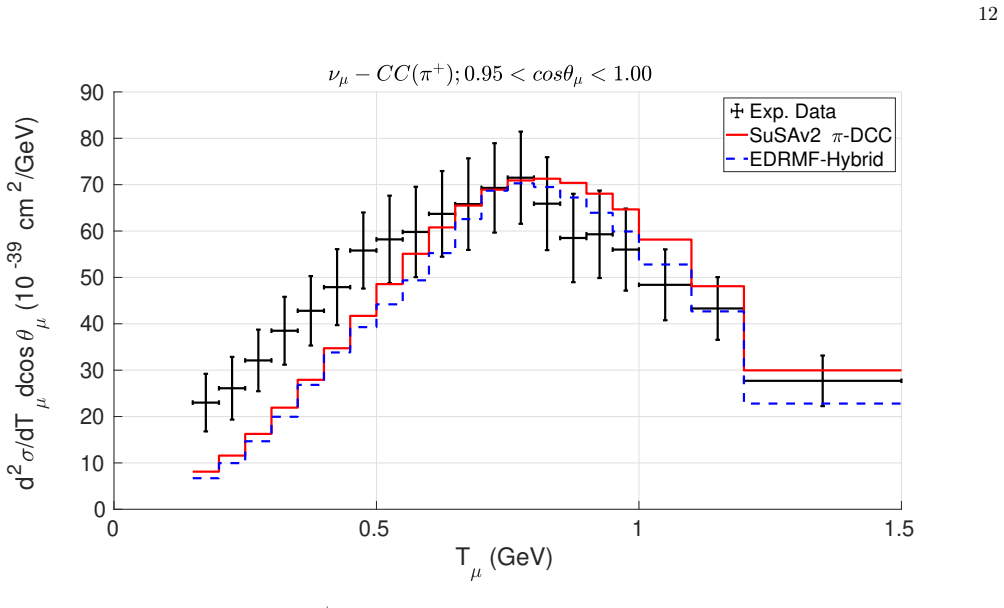
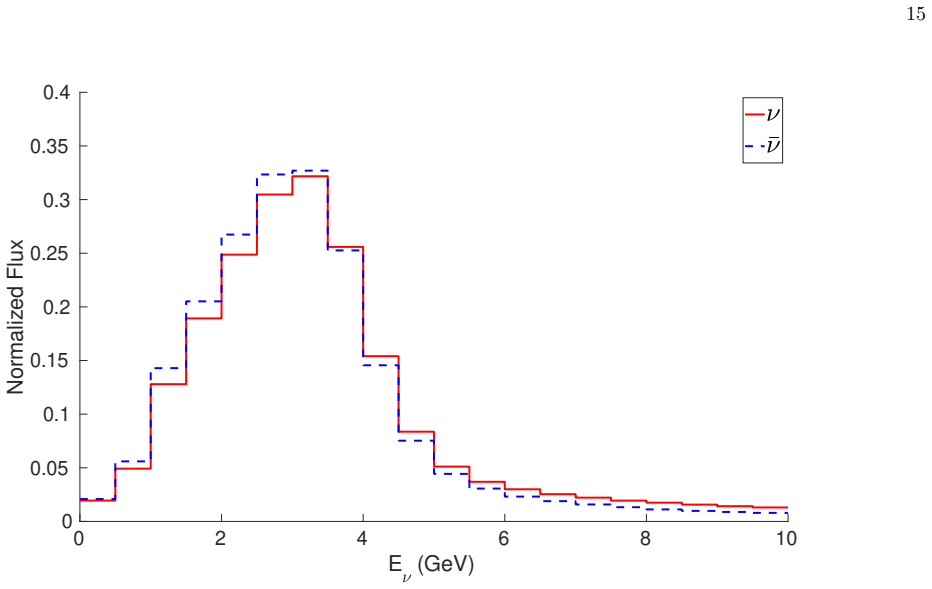
T2K In this section, the results for CC1π + at T2K kine- matics are shown. The target of the T2K experiment is C8H8. The normalized neutrino flux is shown in Fig. 14. It peaks at around 0.6 GeV, covering an energy range similar to the MiniBooNE flux (Sect. III 1). In this case, the restrictionW exp <2.0 GeV is applied, so contribu- tions from processes be...
-
[5]
Taroni, Nature Physics11, 891 (2015)
A. Taroni, Nature Physics11, 891 (2015)
2015
-
[6]
Abeet al.(T2K), Nature580, 339 (2020), [Erratum: Nature 583, E16 (2020)], arXiv:1910.03887 [hep-ex]
K. Abe et al. (T2K Collaboration), Nature580, 339 (2020), [Erratum: Nature 583, E16 (2020)], arXiv:1910.03887 [hep-ex]
-
[7]
S. Abubakar et al. (The NOvA Collaboration and The T2K Collaboration), Nature646, 818 (2025), arXiv:2510.19888 [hep-ex]
-
[8]
A. A. Aguilar-Arevalo, “The MiniBooNE Experiment,” (2004), arXiv:hep-ex/0408074
-
[9]
Website of the Mi- croBooNE Experiment(https://microboone.fnal.gov/),
MicroBooNE Collaboration, “Website of the Mi- croBooNE Experiment(https://microboone.fnal.gov/),” (2025), last accessed January 2025
2025
-
[10]
Website of the T2K Experiment(https://T2K-experiment.org/),
T2K Collaboration, “Website of the T2K Experiment(https://T2K-experiment.org/),” (2025), last accessed January 2025
2025
-
[11]
Website of the MINERvA Experiment(https://minerva.fnal.gov/) ,
MINERvA Collaboration, “Website of the MINERvA Experiment(https://minerva.fnal.gov/) ,” (2025), last accessed January 2025
2025
-
[12]
Website of the NOvA Experi- ment(https://novaexperiment.fnal.gov/),
NOvA Collaboration, “Website of the NOvA Experi- ment(https://novaexperiment.fnal.gov/),” (2025), last accessed January 2025
2025
-
[13]
Hyper-Kamiokande Design Report
K. Abe et al. (Hyper-Kamiokande Collaboration), (2018), arXiv:1805.04163 [physics.ins-det]
work page Pith review arXiv 2018
-
[14]
Masud, M
M. Masud, M. Bishai, and P. Mehta, Scientific Reports 9, 352 (2019)
2019
-
[15]
ArgoNeuT: A Liquid Argon Time Pro- jection Chamber Test in the NuMI Beamline,
M. Soderberg, “ArgoNeuT: A Liquid Argon Time Pro- jection Chamber Test in the NuMI Beamline,” (2009), arXiv:0910.3433 [physics]
-
[16]
Rein and L
D. Rein and L. M. Sehgal, Annals of Physics133, 79 (1981)
1981
-
[17]
Fogli and G
G. Fogli and G. Nardulli, Nuclear Physics B160, 116 (1979)
1979
-
[18]
Lalakulich, E
O. Lalakulich, E. A. Paschos, and G. Piranishvili, Phys. Rev. D74, 014009 (2006)
2006
-
[19]
P. A. Schreiner and F. von Hippel, Physical Review Let- ters30, 339 (1973)
1973
-
[20]
Matsui, T
K. Matsui, T. Sato, and T. S. H. Lee, Physical Review C 72, 025204 (2005), publisher: American Physical Society
2005
-
[21]
Hern´ andez, J
E. Hern´ andez, J. Nieves, and M. J. V. Vacas, Phys. Rev. D87, 113009 (2013)
2013
-
[22]
Martini and M
M. Martini and M. Ericson, Phys. Rev. C90, 025501 (2014)
2014
-
[23]
D.-L. Yao, L. Alvarez-Ruso, and M. Vicente Vacas, Physics Letters B794, 109 (2019)
2019
-
[24]
Sogarwal and P
H. Sogarwal and P. Shukla, Nuclear Physics A1027, 122494 (2022)
2022
-
[25]
Garc´ ıa-Marcos, T
J. Garc´ ıa-Marcos, T. Franco-Munoz, R. Gonz´ alez- Jim´ enez, A. Nikolakopoulos, N. Jachowicz, and J. M. Ud´ ıas, Phys. Rev. C109, 024608 (2024)
2024
-
[26]
Q. Yan, K. Niewczas, A. Nikolakopoulos, R. Gonz´ alez- Jim´ enez, N. Jachowicz, X. Lu, J. Sobczyk, and Y. Zheng, Journal of High Energy Physics2024, 141 (2024)
2024
-
[27]
C. J. Horowitz, H. Kim, D. P. Murdock, and S. Pollock, Phys. Rev. C48, 3078 (1993)
1993
-
[28]
W. M. Alberico, M. B. Barbaro, S. M. Bilenky, J. A. C. C. Giunti, C. Maieron, E. M. d. Guerra, and J. M. Ud´ ıas, Nucl. Phys. A623, 471 (1997)
1997
-
[29]
Nieves, I
J. Nieves, I. R. Simo, and M. J. V. Vacas, Physical Re- view C83, 045501 (2011)
2011
-
[30]
Rocco, S
N. Rocco, S. X. Nakamura, T.-S. H. Lee, and A. Lovato, Phys. Rev. C100, 045503 (2019)
2019
-
[31]
Gonz´ alez-Jim´ enez, A
R. Gonz´ alez-Jim´ enez, A. Nikolakopoulos, N. Jachowicz, and J. M. Ud´ ıas, Phys. Rev. C100, 045501 (2019), pub- lisher: American Physical Society
2019
-
[32]
Hern´ andez, J
E. Hern´ andez, J. Nieves, and M. Valverde, Phys. Rev. D76, 033005 (2007)
2007
-
[33]
Gonz´ alez-Jim´ enez, N
R. Gonz´ alez-Jim´ enez, N. Jachowicz, K. Niewczas, J. Nys, V. Pandey, T. Van Cuyck, and N. Van Dessel, Phys. Rev. 8 D95, 113007 (2017)
2017
-
[34]
Gonz´ alez-Jim´ enez, K
R. Gonz´ alez-Jim´ enez, K. Niewczas, and N. Jachowicz, Phys. Rev. D97, 013004 (2018)
2018
-
[35]
A. Nikolakopoulos, R. Gonz´ alez-Jim´ enez, N. Jachow- icz, and J. Ud´ ıas, Physical Review D107(2023), 10.1103/physrevd.107.053007
-
[36]
Nakamura, H
S. Nakamura, H. Kamano, and T. Sato, Physical Review D92, 074024 (2015)
2015
-
[37]
Nakamura, H
S. Nakamura, H. Kamano, and T. Sato, Physical Review D99, 031301 (2019)
2019
-
[38]
Website of the ANL-Osaka DCC model(https://www.rcnp.osaka-u.ac.jp/ anl-osk/),
Osaka University, “Website of the ANL-Osaka DCC model(https://www.rcnp.osaka-u.ac.jp/ anl-osk/),” (2021), last accessed October 2023
2021
-
[39]
T. Sato, D. Uno, and T.-S. H. Lee, Phys. Rev. C67, 065201 (2003)
2003
-
[40]
Kamano, S
H. Kamano, S. X. Nakamura, T.-S. H. Lee, and T. Sato, Phys. Rev. C88, 035209 (2013)
2013
-
[41]
Gonzalez-Rosa, G
J. Gonzalez-Rosa, G. D. Megias, J. A. Caballero, M. B. Barbaro, and J. M. Franco-Patino, Phys. Rev. D108, 113008 (2023)
2023
-
[42]
J. Isaacson, W. Jay, A. Lovato, P. Machado, A. Niko- lakopoulos, N. Rocco, and N. Steinberg, Phys. Rev. D 113, 036005 (2026), arXiv:2508.19213 [hep-ph]
-
[43]
Kabirnezhad, Physical Review D97, 013002 (2018)
M. Kabirnezhad, Physical Review D97, 013002 (2018)
2018
-
[44]
Y. Hayato and L. Pickering, Eur. Phys. J. ST230, 4469 (2021), arXiv:2106.15809 [hep-ph]
-
[45]
Gonzalez-Rosa, G
J. Gonzalez-Rosa, G. D. Megias, J. A. Caballero, and M. B. Barbaro, Phys. Rev. D111, 073002 (2025)
2025
-
[46]
Nikolakopoulos, R
A. Nikolakopoulos, R. Gonz´ alez-Jim´ enez, K. Niewczas, J. Sobczyk, and N. Jachowicz, Phys. Rev. D97, 093008 (2018)
2018
-
[47]
T. W. Donnelly and I. Sick, Physical Review C60, 065502 (1999)
1999
-
[48]
J. E. Amaro, M. B. Barbaro, J. A. Caballero, R. Gonz´ alez-Jim´ enez, G. D. Megias, and I. R. Simo, Journal of Physics G: Nuclear and Particle Physics47, 124001 (2020), publisher: IOP Publishing
2020
- [49]
-
[50]
Megias, J
G. Megias, J. Amaro, M. Barbaro, J. Caballero, and T. Donnelly, Physical Review D94, 013012 (2016)
2016
-
[51]
G. D. Megias, J. E. Amaro, M. B. Barbaro, J. A. Ca- ballero, T. W. Donnelly, and I. R. Simo, Phys. Rev. D 94, 093004 (2016), publisher: American Physical Society
2016
-
[52]
G. D. Megias, M. B. Barbaro, J. A. Caballero, J. E. Amaro, T. W. Donnelly, I. R. Simo, and J. W. V. Or- den, J. Phys. G: Nucl. Part. Phys.46, 015104 (2018), publisher: IOP Publishing
2018
-
[53]
G. D. Megias, M. B. Barbaro, J. A. Caballero, and S. Dolan, Phys. Rev. D99, 113002 (2019)
2019
-
[54]
Megias, T
G. Megias, T. Donnelly, O. Moreno, C. Williamson, J. Caballero, R. Gonz´ alez-Jim´ enez, A. De Pace, M. Bar- baro, W. Alberico, M. Nardi, and J. Amaro, Physical Review D91, 073004 (2015)
2015
-
[55]
Extensions of Superscaling from Relativistic Mean Field Theory: the SuSAv2 Model
R. Gonzal´ ez-Jim´ enez, G. D. Megias, M. B. Barbaro, J. A. Caballero, and T. W. Donnelly, Phys. Rev. C90, 035501 (2014), eprint: 1407.8346
work page Pith review arXiv 2014
-
[56]
Gonzalez-Rosa, G
J. Gonzalez-Rosa, G. Megias, J. Caballero, and M. Bar- baro, Physical Review D105, 093009 (2022)
2022
-
[57]
Charged-current neutrino interactions with nucleons and nuclei at intermediate energies (PhD thesis),
G. D. Megias, “Charged-current neutrino interactions with nucleons and nuclei at intermediate energies (PhD thesis),” (2017)
2017
-
[58]
M. B. Barbaro, J. A. Caballero, T. W. Donnelly, and C. Maieron, Physical Review C69, 035502 (2004)
2004
-
[59]
Towards a more complete descrip- tion of final-state interactions in electroweak single pion production off atomic nuclei (PhD Thesis),
A. Nikolakopoulos, “Towards a more complete descrip- tion of final-state interactions in electroweak single pion production off atomic nuclei (PhD Thesis),” (2021)
2021
-
[60]
Gonz´ alez-Jim´ enezet al., Phys
R. Gonz´ alez-Jim´ enezet al., Phys. Rev. C101, 015503 (2020), publisher: American Physical Society
2020
-
[61]
Aguilar-Arevalo et al
A. Aguilar-Arevalo et al. (MiniBooNE Collaboration), Phys. Rev. D83, 052007 (2011)
2011
-
[62]
A. A. Aguilar-Arevalo et al. (MiniBooNE Collaboration), Phys. Rev. D83, 052009 (2011)
2011
-
[63]
Abratenko et al
P. Abratenko et al. (MicroBooNE Collaboration), Phys. Rev. D110, 092014 (2024)
2024
-
[64]
C. L. McGivern et al. (MINERvA Collaboration), Phys. Rev. D94, 052005 (2016)
2016
-
[65]
Altinok et al., Phys
O. Altinok et al., Phys. Rev. D96, 072003 (2017)
2017
-
[66]
Le et al
T. Le et al. (MINERvA Collaboration), Phys. Rev. D 100, 052008 (2019)
2019
-
[67]
Sato, Eur
T. Sato, Eur. Phys. J. ST230, 4409 (2021)
2021
-
[68]
Updated 1pi production data. MINERvA Collab- oration
“Updated 1pi production data. MINERvA Collab- oration.”https://minerva.fnal.gov/wp-content/ uploads/2017/03/Updated_1pi_data.pdf, Last ac- cessed: January 2026
2017
-
[69]
Abe et al
K. Abe et al. (The T2K Collaboration), Phys. Rev. D 101, 012007 (2020)
2020
-
[70]
S. Abubakar et al. (NOvA Collaboration), (2025), arXiv:2511.05807 [hep-ex]
work page internal anchor Pith review arXiv 2025
- [71]
-
[72]
A. Lozano et al. (MINERvA Collaboration), (2025), arXiv:2503.20043 [hep-ex]
-
[73]
P. Abratenko et al. (MicroBooNE Collaboration), Phys. Rev. Lett.135, 061802 (2025), arXiv:2503.23384 [hep- ex]
-
[74]
Abe et al
K. Abe et al. (T2K Collaboration), Phys. Rev. D95, 012010 (2017)
2017
- [75]
-
[76]
A. Papadopoulou et al. (e4nu Collaboration), Phys. Rev. D103, 113003 (2021), arXiv:2009.07228 [nucl-th]
-
[77]
McKean, R
J. McKean, R. Gonz´ alez-Jim´ enez, M. Kabirnezhad, J. M. Ud´ ıas, and Y. Uchida, Phys. Rev. D112, 032009 (2025)
2025
-
[78]
Khachatryan et al
M. Khachatryan et al. (CLAS and e4nu Collaborations), Nature599, 565 (2021)
2021
-
[79]
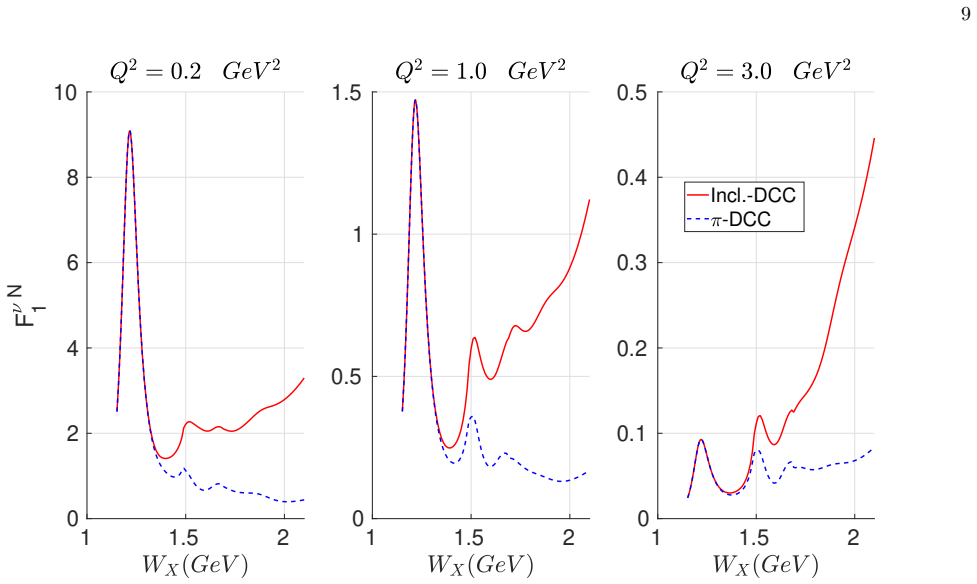
J. M. Franco-Patino, R. Gonz´ alez-Jim´ enez, S. Dolan, M. B. Barbaro, J. A. Caballero, G. D. Megias, and J. M. Udias, Phys. Rev. D106, 113005 (2022). 9 1 1.5 2 0 2 4 6 8 10 F1 N 1 1.5 2 0 0.5 1 1.5 1 1.5 2 0 0.1 0.2 0.3 0.4 0.5 Incl.-DCC -DCC FIG. 1. Inclusive-DCC (red continuous line) andπ-DCC (blue dashed line) inelastic structure functionsF 1 =m N W1 ...
2022
discussion (0)
Sign in with ORCID, Apple, or X to comment. Anyone can read and Pith papers without signing in.