Recognition: unknown
Animator-Centric Skeleton Generation on Objects with Fine-Grained Details
Pith reviewed 2026-05-09 22:45 UTC · model grok-4.3
The pith
A framework using semantic tokenization and density control generates high-quality skeletons for complex 3D objects while allowing direct animator control.
A machine-rendered reading of the paper's core claim, the machinery that carries it, and where it could break.
Core claim
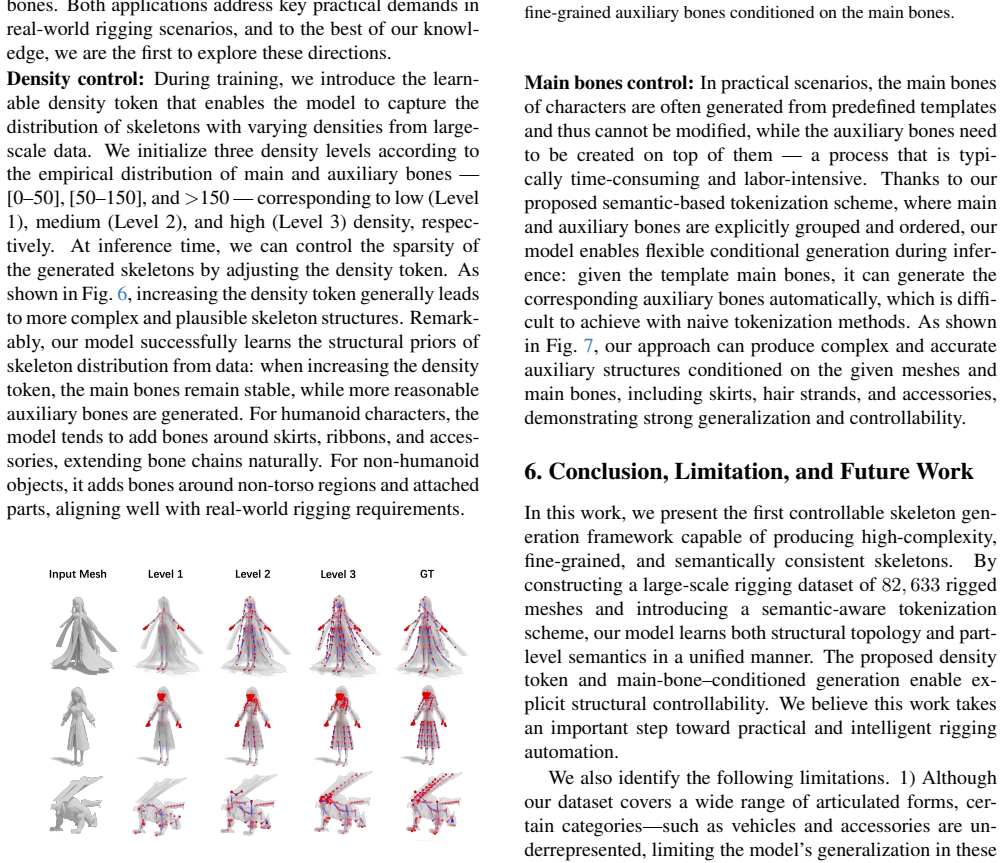
The framework curates a large-scale dataset of 82,633 rigged meshes and employs a semantic-aware tokenization scheme for auto-regressive modeling that subdivides bones into semantically meaningful groups to enhance robustness, along with a learnable density interval module for control, resulting in high-quality skeleton generation on challenging inputs that fulfills critical animator requirements.
What carries the argument
Semantic-aware tokenization scheme that subdivides bones into semantically meaningful groups for auto-regressive modeling, paired with a learnable density interval module for soft control over bone density.
If this is right
- Produces high-quality skeletons for objects with complicated structures.
- Provides intuitive control handles to animators.
- Allows soft, direct control over bone density via the density module.
- Complements purely geometric prior methods through semantic grouping.
- Fulfills two critical requirements from professional animators.
Where Pith is reading between the lines
- The tokenization approach might be adapted to other 3D generative tasks involving part-based structures.
- Professional animators could use the density control to quickly prototype different skeleton densities for the same model.
- If the dataset captures sufficient diversity, the method could reduce the need for manual skeleton editing in production.
- Extending the framework to handle dynamic or deforming meshes remains an open direction suggested by the focus on static rigged objects.
Load-bearing premise
The dataset of 82,633 rigged meshes captures the structural diversity and semantic groupings required for the tokenization to generalize to new complex models.
What would settle it
Evaluating the generated skeletons on a held-out collection of rigged meshes with fine-grained details, measuring agreement with expert animator skeletons and the usability of the control features.
Figures


read the original abstract
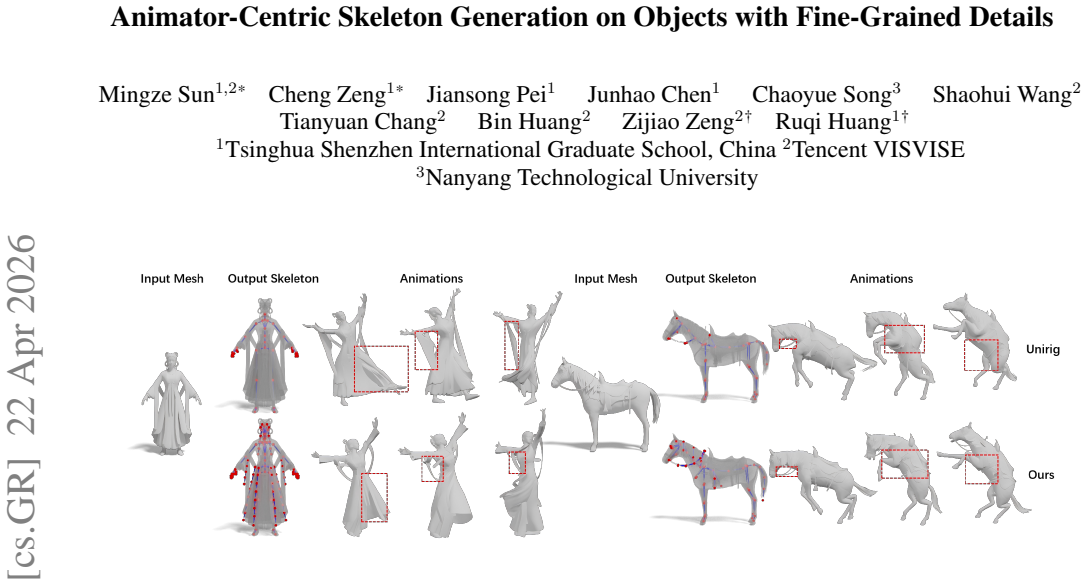
Skeleton generation is essential for animating 3D assets, but current deep learning methods remain limited: they cannot handle the growing structural complexity of modern models and offer minimal controllability, creating a major bottleneck for real-world animation workflows. To address this, we propose an animator-centric SG framework that achieves high-quality skeleton prediction on complex inputs while providing intuitive control handles. Our contributions are threefold. First, we curate a large-scale dataset of 82,633 rigged meshes with diverse and complicated structures. Second, we introduce a novel semantic-aware tokenization scheme for auto-regressive modeling. This scheme effectively complements purely geometric prior methods by subdividing bones into semantically meaningful groups, thereby enhancing robustness to structural complexity and enabling a key control mechanism. Third, we design a learnable density interval module that allows animators to exert soft, direct control over bone density. Extensive experiments demonstrate that our framework not only generates high-quality skeletons for challenging inputs but also successfully fulfills two critical requirements from professional animators.
Editorial analysis
A structured set of objections, weighed in public.
Referee Report
Summary. The paper proposes an animator-centric skeleton generation framework for 3D objects with fine-grained details. It curates a dataset of 82,633 rigged meshes, introduces a semantic-aware tokenization scheme for auto-regressive modeling that subdivides bones into semantically meaningful groups to complement geometric priors, and designs a learnable density interval module for soft control over bone density. The central claim is that the framework generates high-quality skeletons for challenging inputs while fulfilling two critical requirements from professional animators, as shown by extensive experiments.
Significance. If the empirical claims hold with proper validation, the work could meaningfully advance skeleton generation in computer graphics by addressing structural complexity and adding animator-controllable mechanisms, potentially easing bottlenecks in animation pipelines. The scale of the curated dataset and the tokenization approach represent potential strengths for generalization if they are shown to capture semantic groupings beyond memorization.
major comments (2)
- [Abstract] Abstract: The claim that 'extensive experiments demonstrate that our framework not only generates high-quality skeletons for challenging inputs but also successfully fulfills two critical requirements from professional animators' provides no quantitative metrics, baselines, error bars, ablation studies, or details on how the two animator requirements were measured or evaluated. This absence is load-bearing for the central claim of success and controllability.
- [Dataset and tokenization description] Dataset curation and semantic-aware tokenization sections: The semantic-aware tokenization scheme is presented as effectively complementing geometric priors by subdividing bones into meaningful groups, but the manuscript supplies only the dataset size (82,633 rigged meshes) with no curation criteria, semantic taxonomy, coverage statistics, diversity analysis, or hold-out tests on fine-grained structures. This leaves the generalization assumption unverified and risks the scheme merely memorizing the training distribution rather than enabling robust control.
minor comments (2)
- [Abstract] The abstract mentions 'two critical requirements from professional animators' without enumerating them; adding a brief explicit list would improve clarity for readers.
- [Method] Notation for the learnable density interval module and tokenization scheme could be more precisely defined (e.g., explicit equations for interval sampling and group subdivision) to aid reproducibility.
Simulated Author's Rebuttal
We thank the referee for the detailed and constructive feedback. The comments highlight important areas where the manuscript can be strengthened for clarity and verifiability. We address each major comment below and commit to revisions that directly respond to the concerns raised.
read point-by-point responses
-
Referee: [Abstract] Abstract: The claim that 'extensive experiments demonstrate that our framework not only generates high-quality skeletons for challenging inputs but also successfully fulfills two critical requirements from professional animators' provides no quantitative metrics, baselines, error bars, ablation studies, or details on how the two animator requirements were measured or evaluated. This absence is load-bearing for the central claim of success and controllability.
Authors: We agree that the abstract is too high-level and does not sufficiently substantiate the central claims. In the revised version, we will rewrite the abstract to incorporate key quantitative results from the experiments, including specific performance metrics against baselines, error bars for reported values, references to ablation studies, and explicit details on the evaluation protocol for the two animator requirements (e.g., the design of any user studies or quantitative proxies used). These additions will be drawn from the existing experimental section while ensuring the abstract remains concise. We will also cross-reference the main text for full methodological details on controllability and quality assessment. revision: yes
-
Referee: [Dataset and tokenization description] Dataset curation and semantic-aware tokenization sections: The semantic-aware tokenization scheme is presented as effectively complementing geometric priors by subdividing bones into meaningful groups, but the manuscript supplies only the dataset size (82,633 rigged meshes) with no curation criteria, semantic taxonomy, coverage statistics, diversity analysis, or hold-out tests on fine-grained structures. This leaves the generalization assumption unverified and risks the scheme merely memorizing the training distribution rather than enabling robust control.
Authors: We acknowledge that the current manuscript provides insufficient detail on dataset curation and the semantic-aware tokenization process. We will expand the relevant sections to include: (1) explicit curation criteria and sources for the 82,633 rigged meshes, (2) the semantic taxonomy employed for bone grouping, (3) coverage statistics and diversity analysis across object categories and structural complexities, and (4) results from hold-out evaluations specifically targeting fine-grained structures. These additions will be supported by new figures or tables as needed. Regarding the risk of memorization, we will strengthen the experimental discussion to show how the tokenization complements geometric priors through controlled comparisons and generalization tests, thereby clarifying the mechanism for robust control. revision: yes
Circularity Check
No circularity detected; derivation is self-contained
full rationale
The paper's core claims rest on curating an external dataset of 82,633 rigged meshes, proposing a semantic-aware tokenization scheme for auto-regressive modeling, and adding a learnable density interval module. These are presented as independent contributions trained and evaluated on the dataset, with no equations, predictions, or uniqueness arguments that reduce by construction to fitted parameters or self-citations. The framework is described as generalizing from the curated data rather than deriving outputs tautologically from its own inputs.
Axiom & Free-Parameter Ledger
Reference graph
Works this paper leans on
-
[1]
Automatic rigging and anima- tion of 3d characters.ACM Transactions on graphics (TOG), 26(3):72–es, 2007
Ilya Baran and Jovan Popovi´c. Automatic rigging and anima- tion of 3d characters.ACM Transactions on graphics (TOG), 26(3):72–es, 2007. 2
2007
-
[2]
Meshxl: Neural coordinate field for generative 3d foundation models.Advances in Neural Information Pro- cessing Systems, 37:97141–97166, 2024
Sijin Chen, Xin Chen, Anqi Pang, Xianfang Zeng, Wei Cheng, Yijun Fu, Fukun Yin, Billzb Wang, Jingyi Yu, Gang Yu, et al. Meshxl: Neural coordinate field for generative 3d foundation models.Advances in Neural Information Pro- cessing Systems, 37:97141–97166, 2024. 2
2024
-
[3]
arXiv preprint arXiv:2406.10163 , year=
Yiwen Chen, Tong He, Di Huang, Weicai Ye, Sijin Chen, Ji- axiang Tang, Xin Chen, Zhongang Cai, Lei Yang, Gang Yu, et al. Meshanything: Artist-created mesh generation with au- toregressive transformers.arXiv preprint arXiv:2406.10163,
-
[4]
Yiwen Chen, Zhihao Li, Yikai Wang, Hu Zhang, Qin Li, Chi Zhang, and Guosheng Lin. Ultra3d: Efficient and high- fidelity 3d generation with part attention.arXiv preprint arXiv:2507.17745, 2025. 2
-
[5]
Human- rig: Learning automatic rigging for humanoid character in a large scale dataset
Zedong Chu, Feng Xiong, Meiduo Liu, Jinzhi Zhang, Mingqi Shao, Zhaoxu Sun, Di Wang, and Mu Xu. Human- rig: Learning automatic rigging for humanoid character in a large scale dataset. InProceedings of the Computer Vision and Pattern Recognition Conference, pages 304–313, 2025. 3
2025
-
[6]
Videopoet: A large language model for zero-shot video generation.arXiv:2312.14125,
Kondratyuk Dan, Yu Lijun, Gu Xiuye, Lezama Jos ´e, et al. Videopoet: A large language model for zero-shot video gen- eration.arXiv preprint arXiv:2312.14125, 2023. 2
-
[7]
Jingfeng Guo, Jian Liu, Jinnan Chen, Shiwei Mao, Changrong Hu, Puhua Jiang, Junlin Yu, Jing Xu, Qi Liu, Lixin Xu, et al. Auto-connect: Connectivity-preserving rig- former with direct preference optimization.arXiv preprint arXiv:2506.11430, 2025. 3
-
[8]
Make-it-animatable: An effi- cient framework for authoring animation-ready 3d charac- ters
Zhiyang Guo, Jinxu Xiang, Kai Ma, Wengang Zhou, Houqiang Li, and Ran Zhang. Make-it-animatable: An effi- cient framework for authoring animation-ready 3d charac- ters. InProceedings of the Computer Vision and Pattern Recognition Conference, pages 10783–10792, 2025. 3
2025
-
[9]
Free- man William
Chang Huiwen, Zhang Han, Jiang Lu, Liu Ce, and T. Free- man William. Maskgit: Masked generative image trans- former. InThe IEEE Conference on Computer Vision and Pattern Recognition, pages 11315–11325, 2022. 2
2022
-
[10]
arXiv preprint arXiv:2509.21245 (2025) 3, 4, 12, 14, 8, 11
Team Hunyuan3D, Bowen Zhang, Chunchao Guo, Haolin Liu, Hongyu Yan, Huiwen Shi, Jingwei Huang, Junlin Yu, Kunhong Li, Penghao Wang, et al. Hunyuan3d-omni: A unified framework for controllable generation of 3d assets. arXiv preprint arXiv:2509.21245, 2025. 2
-
[11]
arXiv preprint arXiv:2506.16504 , year=
Zeqiang Lai, Yunfei Zhao, Haolin Liu, Zibo Zhao, Qingxi- ang Lin, Huiwen Shi, Xianghui Yang, Mingxin Yang, Shuhui Yang, Yifei Feng, et al. Hunyuan3d 2.5: Towards high- fidelity 3d assets generation with ultimate details.arXiv preprint arXiv:2506.16504, 2025. 2
-
[12]
Learning skeletal ar- ticulations with neural blend shapes.ACM Transactions on Graphics (TOG), 40(4):1–15, 2021
Peizhuo Li, Kfir Aberman, Rana Hanocka, Libin Liu, Olga Sorkine-Hornung, and Baoquan Chen. Learning skeletal ar- ticulations with neural blend shapes.ACM Transactions on Graphics (TOG), 40(4):1–15, 2021. 2
2021
-
[13]
Xiaochuan Li, Guoguang Du, Runze Zhang, Liang Jin, Qi Jia, Lihua Lu, Zhenhua Guo, Yaqian Zhao, Haiyang Liu, Tianqi Wang, et al. Droplet3d: Commonsense pri- ors from videos facilitate 3d generation.arXiv preprint arXiv:2508.20470, 2025. 2
-
[14]
Riganything: Template-free autoregressive rigging for diverse 3d assets
Isabella Liu, Zhan Xu, Wang Yifan, Hao Tan, Zexiang Xu, Xiaolong Wang, Hao Su, and Zifan Shi. Riganything: Template-free autoregressive rigging for diverse 3d assets. ACM Transactions on Graphics (TOG), 44(4):1–12, 2025. 3
2025
-
[15]
Tarig: Adaptive template- aware neural rigging for humanoid characters.Computers & Graphics, 114:158–167, 2023
Jing Ma and Dongliang Zhang. Tarig: Adaptive template- aware neural rigging for humanoid characters.Computers & Graphics, 114:158–167, 2023. 1, 3
2023
-
[16]
Generative pretraining from pixels
Chen Mark, Radford Alec, Child Rewon, Wu Jeff, Jun Hee- woo, Luan Prafulla, Dhariwaland David, and Sutskever Ilya. Generative pretraining from pixels. InProceedings of the 37th International Conference on Machine Learning, pages 1691 – 1703, 2020. 2
2020
-
[17]
Meshgpt: Generating triangle meshes with decoder-only transformers
Yawar Siddiqui, Antonio Alliegro, Alexey Artemov, Ta- tiana Tommasi, Daniele Sirigatti, Vladislav Rosov, Angela Dai, and Matthias Nießner. Meshgpt: Generating triangle meshes with decoder-only transformers. InProceedings of the IEEE/CVF conference on computer vision and pattern recognition, pages 19615–19625, 2024. 2
2024
-
[18]
arXiv preprint arXiv:2508.10898 , year=
Chaoyue Song, Xiu Li, Fan Yang, Zhongcong Xu, Jiacheng Wei, Fayao Liu, Jiashi Feng, Guosheng Lin, and Jianfeng Zhang. Puppeteer: Rig and animate your 3d models.arXiv preprint arXiv:2508.10898, 2025. 1, 2, 3, 4, 6, 7
-
[19]
Magicarticulate: Make your 3d mod- els articulation-ready
Chaoyue Song, Jianfeng Zhang, Xiu Li, Fan Yang, Yiwen Chen, Zhongcong Xu, Jun Hao Liew, Xiaoyang Guo, Fayao Liu, Jiashi Feng, et al. Magicarticulate: Make your 3d mod- els articulation-ready. InProceedings of the Computer Vision and Pattern Recognition Conference, pages 15998–16007,
-
[20]
Drive: Diffusion-based rigging em- powers generation of versatile and expressive characters
Mingze Sun, Junhao Chen, Junting Dong, Yurun Chen, Xinyu Jiang, Shiwei Mao, Puhua Jiang, Jingbo Wang, Bo Dai, and Ruqi Huang. Drive: Diffusion-based rigging em- powers generation of versatile and expressive characters. In Proceedings of the Computer Vision and Pattern Recognition Conference, pages 21170–21180, 2025. 3
2025
-
[21]
Puppeteer: Rig and Animate Your 3D Models
Mingze Sun, Shiwei Mao, Keyi Chen, Yurun Chen, Shunlin Lu, Jingbo Wang, Junting Dong, and Ruqi Huang. Armo: Autoregressive rigging for multi-category objects.arXiv preprint arXiv:2503.20663, 2025. 1, 2, 3, 4
-
[22]
arXiv preprint arXiv:2409.18114 , year=
Jiaxiang Tang, Zhaoshuo Li, Zekun Hao, Xian Liu, Gang Zeng, Ming-Yu Liu, and Qinsheng Zhang. Edgerunner: Auto-regressive auto-encoder for artistic mesh generation. arXiv preprint arXiv:2409.18114, 2024. 5
-
[23]
VideoGPT: Video Generation using VQ-VAE and Transformers
Yan Wilson, Zhang Yunzhi, Abbeel Pieter, and Srinivas Ar- avind. Videogpt: Video generation using vq-vae and trans- formers.arXiv preprint arXiv:2104.10157, 2021. 2
work page internal anchor Pith review arXiv 2021
-
[24]
Lumina-mgpt 2.0: Stand- alone autoregressive image modeling.arXiv preprint arXiv:2507.17801, 2025
Yi Xin, Juncheng Yan, Qi Qin, Zhen Li, Dongyang Liu, Shicheng Li, Victor Shea-Jay Huang, Yupeng Zhou, Ren- rui Zhang, Le Zhuo, et al. Lumina-mgpt 2.0: Stand- alone autoregressive image modeling.arXiv preprint arXiv:2507.17801, 2025. 2
-
[25]
Rignet: Neural rigging for articu- lated characters.arXiv preprint arXiv:2005.00559, 2020
Zhan Xu, Yang Zhou, Evangelos Kalogerakis, Chris Lan- dreth, and Karan Singh. Rignet: Neural rigging for articu- lated characters.arXiv preprint arXiv:2005.00559, 2020. 1, 2, 3
-
[26]
One model to rig them all: Diverse skeleton rigging with unirig.ACM Transactions on Graphics (TOG), 44(4):1–18, 2025
Jia-Peng Zhang, Cheng-Feng Pu, Meng-Hao Guo, Yan-Pei Cao, and Shi-Min Hu. One model to rig them all: Diverse skeleton rigging with unirig.ACM Transactions on Graphics (TOG), 44(4):1–18, 2025. 3, 6, 7
2025
-
[27]
OPT: Open Pre-trained Transformer Language Models
Susan Zhang, Stephen Roller, Naman Goyal, Mikel Artetxe, Moya Chen, Shuohui Chen, Christopher Dewan, Mona Diab, Xian Li, Xi Victoria Lin, et al. Opt: Open pre-trained trans- former language models.arXiv preprint arXiv:2205.01068,
work page internal anchor Pith review arXiv
-
[28]
Michelangelo: Conditional 3d shape generation based on shape-image-text aligned latent representation.Advances in neural information processing systems, 36:73969–73982,
Zibo Zhao, Wen Liu, Xin Chen, Xianfang Zeng, Rui Wang, Pei Cheng, Bin Fu, Tao Chen, Gang Yu, and Shenghua Gao. Michelangelo: Conditional 3d shape generation based on shape-image-text aligned latent representation.Advances in neural information processing systems, 36:73969–73982,
discussion (0)
Sign in with ORCID, Apple, or X to comment. Anyone can read and Pith papers without signing in.