Recognition: unknown
Polytropic stellar wind models with strongly localized heating
Pith reviewed 2026-05-09 23:09 UTC · model grok-4.3
The pith
Polytropic stellar wind models can incorporate strongly localized heating while preserving a simple energy balance without explicit transport details.
A machine-rendered reading of the paper's core claim, the machinery that carries it, and where it could break.
Core claim
The central claim is that strongly localized heating can be folded into the polytropic framework so that the wind expands adiabatically outside the heating region while the integrated energy input stays plausible relative to flare energies and negligible relative to gravitational binding. Previous analytic and numerical treatments were restricted to the fully adiabatic extreme; the present work relaxes that restriction to cover a continuous range of heating strengths while retaining the polytropic simplicity.
What carries the argument
A polytropic energy equation augmented by a spatially and temporally localized heating term that permits non-adiabatic behavior only inside the heated zone.
If this is right
- The models describe wind streams that expand adiabatically outside the heating region while still receiving flare-scale energy input.
- The added heating remains low enough relative to gravity that the overall wind acceleration is only modestly altered.
- The framework applies to both solar and other stellar winds that exhibit acoustic-wave activity and variable streams.
- Solutions can be compared directly with Parker Solar Probe observations of near-Sun wind variability without invoking full transport physics.
Where Pith is reading between the lines
- The same localized-heating term could be used to estimate mass-loss rates on other stars where flare statistics are known but detailed wave modeling is unavailable.
- Comparison of these solutions with MHD simulations of wave damping would test how much the polytropic approximation omits in the transition zone.
- If future observations tighten the energy budget near the Sun, the models could be inverted to place upper limits on the spatial scale of the heating regions.
Load-bearing premise
That the effects of strongly localized heating can be captured inside the polytropic energy balance without needing to resolve the detailed transport processes that actually deliver the heat.
What would settle it
Parker Solar Probe measurements showing that the energy deposited in near-Sun localized regions either greatly exceeds typical flare energies or becomes comparable to the local gravitational binding energy of the plasma.
Figures


read the original abstract
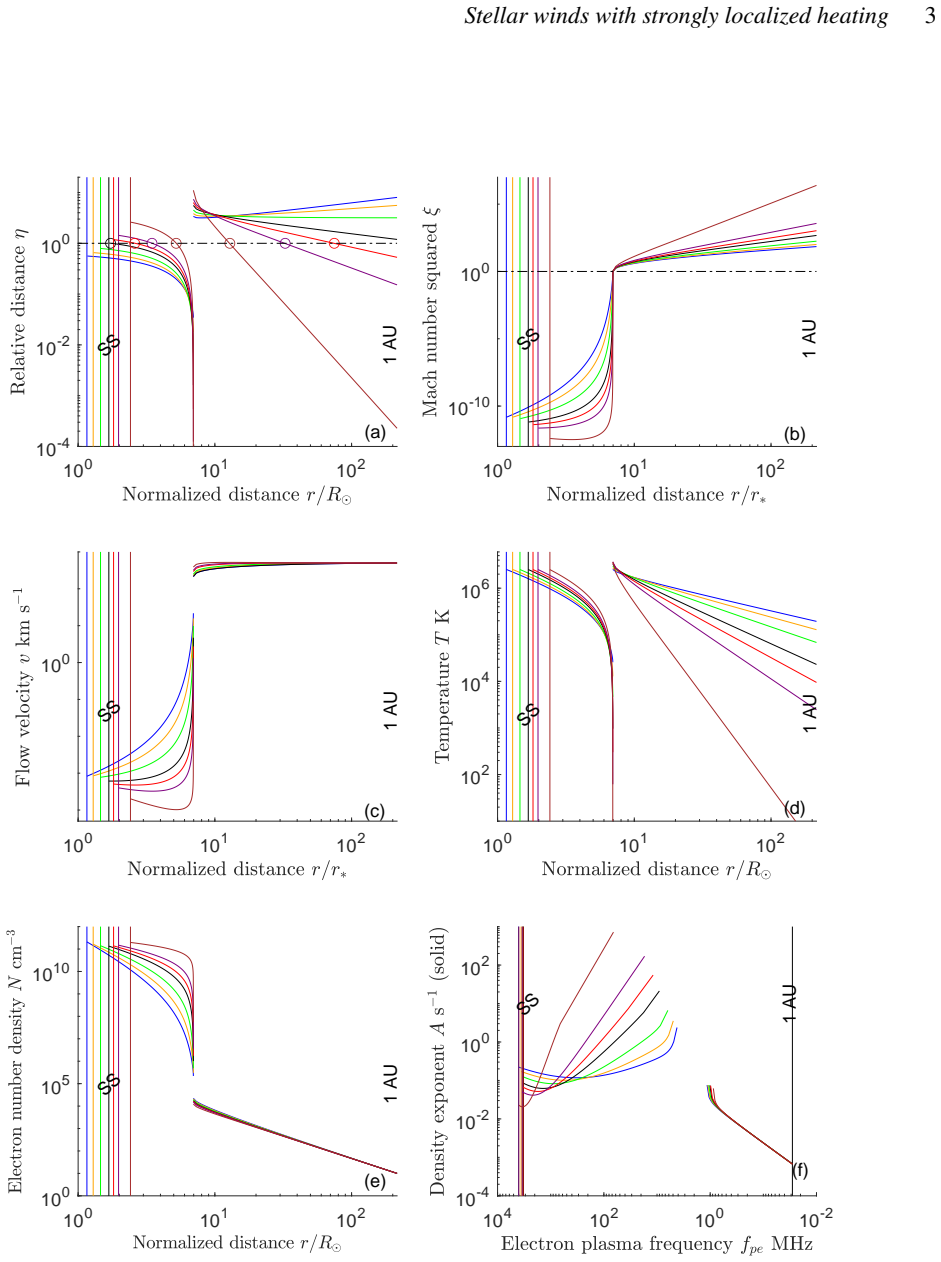
Polytropic models of stellar winds remain to be useful tools because they allow for a simple description of the energy balance of the expanding plasma without explicitly specifying potentially complex energy transport processes like, e.g., heat conduction or extended wave heating. Among recent applications to stellar winds and to the solar wind was a study of the consequences of strongly localized heating in the latter, possibly due to acoustic waves. Such 'nonuniform' heating can result from a time- and space-localized damping of wave modes and allows, as an extreme case, an adiabatic expansion of particular wind streams outside the heating region. The present study generalizes the modeling from the first analytical as well as numerical studies, that were limited to this extreme case, towards a more realistic non-adiabatic behaviour. The additional energy due to heating is demonstrated to be in a plausible range in view of typical flare energies and low compared to the gravitational energy of the plasma in this region. The corresponding solutions may be of interest for stellar winds, in general, and w.r.t. recent observations made with the Parker Solar Probe, which revealed strongly varying wind streams and the presence of acoustic waves near the Sun, for the solar wind, in particular. Potential observational evidence for the solar wind is discussed.
Editorial analysis
A structured set of objections, weighed in public.
Referee Report
Summary. The paper generalizes polytropic stellar wind models by adding a spatially localized heating term to the energy equation, extending prior work limited to the adiabatic extreme case. This allows non-adiabatic behavior while retaining the polytropic closure. The additional energy supplied by the heating is shown to lie in a plausible range relative to typical flare energies and to be small compared to the gravitational binding energy of the plasma. Relevance to Parker Solar Probe observations of variable solar wind streams and acoustic waves is discussed.
Significance. If the central consistency between localized heating and the global polytropic relation holds, the work supplies a computationally simple framework for stellar winds that incorporates realistic heating without explicit transport modeling. It could help interpret PSP data on stream variability and wave damping, and the energy-scale comparisons provide a useful plausibility check against observations.
major comments (2)
- [§2] §2 (model equations): The addition of the localized heating term to the energy equation is presented as preserving the polytropic closure P ∝ ρ^γ with fixed γ. However, no explicit integration or proof is given showing that the spatially confined source does not induce local departures from the global polytropic relation outside the heating region. This verification is load-bearing for the subsequent energy-balance comparisons.
- [§4] §4 (energy comparison): The claim that the integrated heating energy is 'low compared to the gravitational energy' and 'plausible' relative to flare energies relies on the integrated energy balance remaining valid under the polytropic assumption. If the heating forces a local violation of the polytropic index, the reported ratios would require re-derivation; the manuscript does not provide this check or a sensitivity test to heating-region width.
minor comments (2)
- [§2.1] Notation for the heating function Q(r) is introduced without a clear statement of its functional form (e.g., Gaussian width parameter) in the text preceding the first results figure.
- [Figure 2] Figure 2 caption does not specify the range of polytropic indices γ explored or the normalization used for the velocity profiles.
Simulated Author's Rebuttal
We thank the referee for their thorough review and valuable feedback on our manuscript concerning polytropic stellar wind models with localized heating. Their comments highlight important aspects of the model's assumptions that we will clarify in the revised version. Below, we provide point-by-point responses to the major comments.
read point-by-point responses
-
Referee: §2 (model equations): The addition of the localized heating term to the energy equation is presented as preserving the polytropic closure P ∝ ρ^γ with fixed γ. However, no explicit integration or proof is given showing that the spatially confined source does not induce local departures from the global polytropic relation outside the heating region. This verification is load-bearing for the subsequent energy-balance comparisons.
Authors: We acknowledge the referee's point that an explicit verification would be beneficial. In our model, the heating is confined to a specific spatial region. Outside this region, the energy equation reverts to the standard form without the source term, which integrates to the polytropic relation P ∝ ρ^γ with constant γ. The global polytropic closure is thus preserved by the structure of the equations. We will include a brief derivation in the revised manuscript demonstrating this explicitly, perhaps as a short appendix, to confirm no local departures occur outside the heating zone. revision: yes
-
Referee: §4 (energy comparison): The claim that the integrated heating energy is 'low compared to the gravitational energy' and 'plausible' relative to flare energies relies on the integrated energy balance remaining valid under the polytropic assumption. If the heating forces a local violation of the polytropic index, the reported ratios would require re-derivation; the manuscript does not provide this check or a sensitivity test to heating-region width.
Authors: We appreciate the concern regarding the robustness of the energy comparisons. The calculations of integrated heating energy and gravitational binding energy are based on the density and velocity profiles obtained from solving the model equations under the polytropic assumption. As clarified in our response to the §2 comment, the polytropic relation holds consistently, with the localized heating term incorporated without violating the closure outside the source region. Regarding sensitivity to the heating-region width, while the total integrated heating is constrained by the flare energy comparison, we agree that exploring variations in width provides additional insight. We will add a sensitivity analysis in the revised version showing that the key conclusions remain unchanged for reasonable widths. revision: partial
Circularity Check
No circularity detected; derivation remains self-contained
full rationale
The paper generalizes prior polytropic wind models by introducing a spatially localized heating term into the energy equation while retaining the polytropic closure P ∝ ρ^γ. The central demonstration—that the integrated additional energy lies in a plausible range relative to observed flare energies and is small compared to gravitational binding energy—relies on direct comparison with external observational benchmarks rather than any internal fit or self-referential definition. No equation reduces to its own input by construction, no parameter is fitted to a subset and then relabeled as a prediction, and any prior self-citations serve only as background for the extreme adiabatic case being generalized. The modeling assumptions are stated explicitly as choices, not derived from the target result.
Axiom & Free-Parameter Ledger
Reference graph
Works this paper leans on
-
[1]
Quasi-thermal Noise Spectroscopy Analysis of Parker Solar Probe Data: Improved Electron Density Model for Solar Wind. , keywords =. doi:10.3847/1538-4357/acf572 , adsurl =
-
[2]
An Introduction with Problems and Solutions (2nd edition)
Physics of the Solar Corona. An Introduction with Problems and Solutions (2nd edition). doi:10.1007/3-540-30766-4 , adsurl =
-
[3]
Radiative processes in astrophysics
-
[4]
The equilibrium of distorted polytropes. I. The rotational problem. , year = 1933, month = mar, volume =. doi:10.1093/mnras/93.5.390 , adsurl =
-
[5]
Long-Term Independence of Solar Wind Polytropic Index on Plasma Flow Speed. Entropy , keywords =. doi:10.3390/e20100799 , adsurl =
-
[6]
On the Origin of Polytropic Behavior in Space and Astrophysical Plasmas. , keywords =. doi:10.3847/1538-4357/ab05b7 , adsurl =
-
[7]
Connection of Turbulence with Polytropic Index in the Solar Wind Proton Plasma. Entropy , keywords =. doi:10.3390/e21111041 , adsurl =
-
[8]
Journal of Geophysical Research (Space Physics) , keywords =
Using Kappa Distributions to Identify the Potential Energy. Journal of Geophysical Research (Space Physics) , keywords =. doi:10.1002/2017JA024978 , adsurl =
-
[9]
Revealing super-adiabatic features of interplanetary coronal mass ejections at 1 au. , keywords =. doi:10.1051/0004-6361/202451372 , adsurl =
-
[10]
Stability of Parker's Steady Solar Wind Solution in the Subcritical Region. , keywords =. doi:10.3847/1538-4357/acb537 , archivePrefix =. 2007.06545 , primaryClass =
-
[11]
Potential Flow Theory Formulation of Parker's Unsteady Solar Wind Model and Nonlinear Stability of Parker's Steady Solar Wind Solution. , keywords =. doi:10.3847/1538-4357/adcd64 , archivePrefix =. 2406.13838 , primaryClass =
-
[12]
and Meyer-Vernet, N
Le Chat, Gaétan and Issautier, K. and Meyer-Vernet, N. , year =. The Solar Wind Energy Flux , volume =. Solar Physics , doi =
-
[13]
Physics of Plasmas , keywords =
Effective adiabatic index in a wave structure of the solar wind: A case study for 17 December 1990. Physics of Plasmas , keywords =. doi:10.1063/1.1313569 , adsurl =
-
[14]
Observational determination of the adiabatic index in the quiet time plasma sheet. , keywords =. doi:10.1029/GL016i006p00563 , adsurl =
-
[15]
Steady-state and time-dependent numerical solutions
Models of quasi-discontinuous solar-wind streams. Steady-state and time-dependent numerical solutions. , keywords =. doi:10.1051/0004-6361/202347491 , adsurl =
-
[16]
Nonequilibrium relation between potential and stationary distribution for driven diffusion. , keywords =. doi:10.1103/PhysRevE.80.011121 , archivePrefix =. 0902.3555 , primaryClass =
-
[17]
Lecture Notes in Mathematics, Berlin Springer Verlag , year = 2009, volume =
A selection of nonequilibrium issues. Lecture Notes in Mathematics, Berlin Springer Verlag , year = 2009, volume =. doi:10.1007/978-3-540-92796-9_6 , adsurl =
-
[18]
``Swing Absorption'' of fast magnetosonic waves in inhomogeneous media. , keywords =. doi:10.1051/0004-6361:20041494 , archivePrefix =. astro-ph/0408114 , primaryClass =
-
[21]
Predicting the Solar Wind at the Parker Solar Probe Using an Empirically Driven MHD Model. , keywords =. doi:10.3847/1538-4365/ab58c9 , archivePrefix =. 1912.02397 , primaryClass =
-
[22]
Solar Wind Electrons Alphas and Protons (SWEAP) Investigation: Design of the Solar Wind and Coronal Plasma Instrument Suite for Solar Probe Plus. , keywords =. doi:10.1007/s11214-015-0206-3 , adsurl =
-
[23]
Relating Streamer Flows to Density and Magnetic Structures at the Parker Solar Probe. , keywords =. doi:10.3847/1538-4365/ab579a , archivePrefix =. 2001.01993 , primaryClass =
-
[24]
Solar Energetic Particles Produced by a Slow Coronal Mass Ejection at 0.25 au. , keywords =. doi:10.3847/1538-4365/ab5221 , adsurl =
-
[25]
WISPR Imaging of a Pristine CME. , keywords =. doi:10.3847/1538-4365/ab4ff0 , archivePrefix =. 1912.02255 , primaryClass =
-
[26]
Morphological Reconstruction of a Small Transient Observed by Parker Solar Probe on 2018 November 5. , keywords =. doi:10.3847/1538-4365/ab5219 , archivePrefix =. 2001.08716 , primaryClass =
-
[27]
First In Situ Measurements of Electron Density and Temperature from Quasi-thermal Noise Spectroscopy with Parker Solar Probe/FIELDS. , keywords =. doi:10.3847/1538-4365/ab5a84 , archivePrefix =. 1912.02518 , primaryClass =
-
[28]
Decameter Type III Bursts with Changing Frequency Drift-Rate Signs. , keywords =. doi:10.1007/s11207-014-0577-8 , archivePrefix =. 1802.08336 , primaryClass =
-
[29]
Unusual Solar Radio Burst Observed at Decameter Wavelengths. , keywords =. doi:10.1007/s11207-013-0328-2 , adsurl =
-
[30]
Comparative analysis of solar radio bursts before and during CME propagation. , keywords =. doi:10.1051/0004-6361/201629489 , archivePrefix =. 1903.12279 , primaryClass =
-
[31]
Bursts in emission and absorption as a fine structure of Type IV bursts. , year = 2010, series =. doi:10.1063/1.3292553 , adsurl =
-
[32]
Fine Structure of Solar Radio Bursts Observed at Decametric and Hectometric Waves. , keywords =. doi:10.1007/s11207-007-0258-y , adsurl =
-
[33]
Low-Frequency Type III Bursts and Solar Energetic Particle Events. , keywords =. doi:10.1088/0004-637X/690/1/598 , adsurl =
-
[34]
Journal of Geophysical Research (Space Physics) , keywords =
Solar flares, type III radio bursts, coronal mass ejections, and energetic particles. Journal of Geophysical Research (Space Physics) , keywords =. doi:10.1029/2001JA000320 , adsurl =
-
[35]
Russian Radio Physics and Radio Astronomy , year = 2014, month = dec, volume = 19, pages =
Decameter Type IV Bursts, Fiber-Bursts and Type III Bursts Associated with Group of Solar Active Regions. Russian Radio Physics and Radio Astronomy , year = 2014, month = dec, volume = 19, pages =. doi:10.15407/rpra19.04.295 , adsurl =
-
[36]
ArXiv e-prints , archivePrefix = "arXiv", eprint =
On the Directivity of Low-Frequency Type IV Radio Bursts. ArXiv e-prints , archivePrefix = "arXiv", eprint =
-
[37]
Generation of intermediate drift bursts in solar type IV radio continua through coupling of whistlers and Langmuir waves. , keywords =. doi:10.1007/BF00156854 , adsurl =
-
[38]
Fine Structure of Solar Radio Bursts. ASSL , year = 2011, series =. doi:10.1007/978-3-642-20015-1 , adsurl =
-
[39]
On Solar Intermediate Drift Radio Bursts at Decimeter and Meter Wavelength. , keywords =. doi:10.1007/s11207-007-9036-0 , adsurl =
-
[40]
Solar Radiophysics: Studies of Emission from the Sun at Metre Wavelengths , year = 1985, editor =
Moving Type IV bursts. Solar Radiophysics: Studies of Emission from the Sun at Metre Wavelengths , year = 1985, editor =
1985
-
[41]
Solar Radio Bursts with Drifting Stripes in Emission and Absorption. , keywords =. doi:10.1007/s11214-006-9141-7 , adsurl =
-
[42]
AZh , year = 1958, volume = 35, pages =
On the Possible Mechanisms of Sporadic Solar Radio Emission (Radiation in an Isotropic Plasma). AZh , year = 1958, volume = 35, pages =
1958
-
[43]
Observations of Powerful Type III Bursts in the Frequency Range 10 - 30 MHz. , keywords =. doi:10.1007/s11207-010-9703-4 , adsurl =
-
[44]
Research in Astronomy and Astrophysics , year = 2014, month = jul, volume = 14, eid =
A review of solar type III radio bursts. Research in Astronomy and Astrophysics , year = 2014, month = jul, volume = 14, eid =. doi:10.1088/1674-4527/14/7/003 , adsurl =
-
[45]
A heliospheric density model and type III radio bursts. , keywords =. doi:10.1051/0004-6361/202245050 , adsurl =
-
[46]
Solar radio burst and in situ determination of interplanetary electron density. , keywords =. doi:10.1007/BF00173965 , adsurl =
-
[47]
Solar Physics Research Trends , year = 2008, editor =
Solar Type IV Bursts at Frequencies 10-30 MHz. Solar Physics Research Trends , year = 2008, editor =
2008
-
[48]
Decameter Type III-Like Bursts. , keywords =. doi:10.1007/s11207-008-9166-z , adsurl =
-
[49]
Decameter Type IV bursts: properties of fiber bursts in emission. Eur. Plan. Sci. Cong. 2008 , year = 2008, month = sep, pages =
2008
-
[50]
Solar Radiophysics: Studies of Emission from the Sun at Metre Wavelengths , year = 1985, editor =
Bursts of Type III and Type V. Solar Radiophysics: Studies of Emission from the Sun at Metre Wavelengths , year = 1985, editor =
1985
-
[51]
Solar sporadic radio emission in the decametre waveband. Astron. Astrophys. Trans. , keywords =. doi:10.1080/10556790600568854 , adsurl =
-
[52]
Solar Radiophysics: Studies of Emission from the Sun at Metre Wavelengths , year = 1985, editor =
Metrewave solar radio bursts. Solar Radiophysics: Studies of Emission from the Sun at Metre Wavelengths , year = 1985, editor =
1985
-
[53]
The Sun and the Heliosphere as an Integrated System , year = 2004, series =
The Sun and the Heliosphere as an Integrated System. The Sun and the Heliosphere as an Integrated System , year = 2004, series =. doi:10.1007/978-1-4020-2831-9 , adsurl =
-
[54]
Exploring the Sun-Heliosphere Connection
Solar Orbiter . Exploring the Sun-Heliosphere Connection. , archivePrefix = "arXiv", eprint =. doi:10.1007/s11207-012-0085-7 , adsurl =
-
[55]
The Solar Probe Plus Mission: Humanity's First Visit to Our Star. , keywords =. doi:10.1007/s11214-015-0211-6 , adsurl =
-
[56]
The Magnetic Field at the Inner Boundary of the Heliosphere Around Solar Minimum. , keywords =. doi:10.1007/s11207-010-9618-0 , adsurl =
-
[57]
MHD simulation of the inner-heliospheric magnetic field. J. Geophys. Res. , archivePrefix = "arXiv", eprint =. doi:10.1029/2012JA018089 , adsurl =
-
[58]
Cosmic Ray Transport in Heliospheric Magnetic Structures. I. Modeling Background Solar Wind Using the CRONOS Magnetohydrodynamic Code. , archivePrefix = "arXiv", eprint =. doi:10.1088/0004-637X/788/1/80 , adsurl =
-
[59]
, archivePrefix = "arXiv", eprint =
On the Low-frequency Boundary of Sun-generated Magnetohydrodynamic Turbulence in the Slow Solar Wind. , archivePrefix = "arXiv", eprint =. doi:10.1088/0004-637X/752/2/142 , adsurl =
-
[60]
Implementing Turbulence Transport in the CRONOS Framework and Application to the Propagation of CMEs. Astrophys. J , archivePrefix = "arXiv", eprint =. doi:10.1088/0004-637X/805/2/155 , adsurl =
-
[61]
, archivePrefix = "arXiv", eprint =
A Generalized Two-component Model of Solar Wind Turbulence and ab initio Diffusion Mean-Free Paths and Drift Lengthscales of Cosmic Rays. , archivePrefix = "arXiv", eprint =. doi:10.3847/0004-637X/833/1/17 , adsurl =
-
[62]
Numerical investigation of the turbulent ISM
-
[63]
Cosmic-Ray Transport in Heliospheric Magnetic Structures. II. Modeling Particle Transport through Corotating Interaction Regions. , keywords =. doi:10.3847/1538-4357/aa603b , adsurl =
-
[64]
, archivePrefix = "arXiv", eprint =
Obtaining Potential Field Solutions with Spherical Harmonics and Finite Differences. , archivePrefix = "arXiv", eprint =. doi:10.1088/0004-637X/732/2/102 , adsurl =
-
[65]
The influence of pickup protons, from interstellar neutral hydrogen, on the propagation of interplanetary shocks from the Halloween 2003 solar events to ACE and Ulysses: A 3-D MHD modeling study. J. Geophys. Res. , keywords =. doi:10.1029/2010JA015803 , adsurl =
-
[66]
, archivePrefix = "arXiv", eprint =
Modeling the Sun's Open Magnetic Flux and the Heliospheric Current Sheet. , archivePrefix = "arXiv", eprint =. doi:10.1088/0004-637X/709/1/301 , adsurl =
-
[67]
Improved Method for Specifying Solar Wind Speed Near the Sun. Solar Wind Ten , year = 2003, series =. doi:10.1063/1.1618574 , adsurl =
-
[68]
, archivePrefix = "arXiv", eprint =
The CRONOS Code for Astrophysical Magnetohydrodynamics. , archivePrefix = "arXiv", eprint =. doi:10.3847/1538-4365/aabe75 , adsurl =
-
[69]
Physics of Plasmas , year = 2018, month = jun, volume = 25, number = 6, eid =
MHD Kelvin-Helmholtz instability in the anisotropic solar wind plasma. Physics of Plasmas , year = 2018, month = jun, volume = 25, number = 6, eid =. doi:10.1063/1.5032161 , adsurl =
-
[70]
, archivePrefix = "arXiv", eprint =
Evidence for Precursors of the Coronal Hole Jets in Solar Bright Points. , archivePrefix = "arXiv", eprint =. doi:10.3847/2041-8213/aab08b , adsurl =
-
[71]
, archivePrefix = "arXiv", eprint =
Quasi-oscillatory dynamics observed in ascending phase of the flare on March 6, 2012. , archivePrefix = "arXiv", eprint =. doi:10.1051/0004-6361/201629495 , adsurl =
-
[72]
, archivePrefix = "arXiv", eprint =
Long-period oscillations of active region patterns: least-squares mapping on second-order curves. , archivePrefix = "arXiv", eprint =. doi:10.1051/0004-6361/201628213 , adsurl =
-
[73]
Physics of Plasmas , archivePrefix = "arXiv", eprint =
Overstability of acoustic waves in strongly magnetized anisotropic magnetohydrodynamic shear flows. Physics of Plasmas , archivePrefix = "arXiv", eprint =. doi:10.1063/1.4892402 , adsurl =
-
[74]
Amplification of compressional magnetohydrodynamic waves in systems with forced entropy oscillations. Phys. Rev. E. , archivePrefix = "arXiv", eprint =. doi:10.1103/PhysRevE.76.046404 , adsurl =
-
[75]
Nonmodal Cascade in the Compressible Solar Atmosphere: Self-Heating, an Alternative Way to Enhance Wave Heating. , keywords =. doi:10.1086/504350 , adsurl =
-
[76]
Coronal magnetic-field model with non-spherical source surface. , keywords =. doi:10.1007/BF00152334 , adsurl =
-
[77]
, archivePrefix = "arXiv", eprint =
Quantifying the Difference Between the Flux-Tube Expansion Factor at the Source Surface and at the Alfv \'e n Surface Using a Global MHD Model for the Solar Wind. , archivePrefix = "arXiv", eprint =. doi:10.1007/s11207-015-0739-3 , adsurl =
-
[78]
A Comparison between Global Solar Magnetohydrodynamic and Potential Field Source Surface Model Results. , keywords =. doi:10.1086/508565 , adsurl =
-
[79]
Magnetic Fields and the Structure of the Solar Corona. I: Methods of Calculating Coronal Fields. Sol. Phys. , year = 1969, month = sep, volume = 9, pages =. doi:10.1007/BF00145734 , adsurl =
-
[80]
A model of interplanetary and coronal magnetic fields. Sol. Phys. , year = 1969, month = mar, volume = 6, pages =. doi:10.1007/BF00146478 , adsurl =
-
[81]
Theory and Transport of Nearly Incompressible Magnetohydrodynamic Turbulence. IV. Solar Coronal Turbulence. , keywords =. doi:10.3847/1538-4357/aaa763 , adsurl =
-
[82]
Coronal Magnetic Field Models. Space Sci. Rev. , keywords =. doi:10.1007/s11214-015-0178-3 , adsurl =
discussion (0)
Sign in with ORCID, Apple, or X to comment. Anyone can read and Pith papers without signing in.