Recognition: unknown
Exact analytical edge states in the extended Su-Schrieffer-Heeger model
Pith reviewed 2026-05-09 22:50 UTC · model grok-4.3
The pith
Exact analytical expressions for edge states in the extended Su-Schrieffer-Heeger model decay exponentially from the boundary with a unit-cell factor z.
A machine-rendered reading of the paper's core claim, the machinery that carries it, and where it could break.
Core claim
The authors establish that the edge states of a semi-infinite extended Su-Schrieffer-Heeger chain admit exact analytical forms as exponentially decaying functions with a complex decay factor z per unit cell. The topological phase diagram follows from the winding number of the bulk Hamiltonian under periodic boundary conditions, and the bulk-boundary correspondence is verified because winding-number jumps occur at the same parameter values where the gap closes and where |z| reaches unity. Approximate analytical expressions for low-energy edge states on finite chains are also obtained and shown to be highly accurate.
What carries the argument
The unit-cell decay factor z, which parametrizes the exact exponential localization of the edge-state wave function and marks topological transitions when its modulus equals one.
Load-bearing premise
The extended hopping terms do not introduce topological invariants beyond the winding number, and the single-factor exponential decay ansatz for the semi-infinite boundary captures every possible edge mode.
What would settle it
Numerical diagonalization of a large finite chain that produces edge-state wave functions whose spatial decay profile deviates from the predicted form set by z, or a parameter sweep in which the winding number changes without a corresponding gap closing or |z|=1 point.
Figures



read the original abstract
We investigate the topology of the different phases of the extended Su-Schrieffer-Heeger (eSSH) model, which includes hopping processes between translationally inequivalent atoms beyond nearest neighbors. Exact analytical expressions for the edge states of a semi-infinite eSSH chain are derived, with wave functions that decay exponentially from the boundary with a unit-cell decay factor z. From the winding number of the bulk Hamiltonian under periodic boundary conditions, we determine the topological phase diagram and establish the bulk-boundary correspondence: changes in the winding number coincide with bulk gap closings and with the condition |z|=1 for the edge-state solutions. For finite chains, we further obtain analytical, approximate expressions for the low-energy edge states, which are shown to be highly accurate.
Editorial analysis
A structured set of objections, weighed in public.
Referee Report
Summary. The manuscript derives exact analytical expressions for the edge states of a semi-infinite extended Su-Schrieffer-Heeger (eSSH) chain, with wave functions decaying exponentially from the boundary via a single unit-cell factor z. It computes the winding number of the bulk periodic Hamiltonian to obtain the topological phase diagram and verifies bulk-boundary correspondence by showing that winding-number jumps coincide with bulk gap closings and the condition |z|=1. Approximate analytical expressions are also given for low-energy edge states on finite chains.
Significance. If the derivations are rigorous, the exact closed-form edge-state solutions and explicit confirmation of bulk-boundary correspondence for generic extended hoppings would provide a valuable analytical benchmark for 1D topological models beyond the standard SSH chain, aiding both theoretical understanding and numerical validation in condensed-matter physics.
major comments (2)
- [edge-state derivation section] The central derivation of edge states (likely in the section presenting the semi-infinite chain solutions) employs a single-z exponential ansatz of the form decaying with unit-cell factor z. For the extended SSH model with next-nearest-neighbor or further hoppings, the recurrence relation for the two-component amplitudes is of order higher than 2; the characteristic polynomial therefore admits multiple roots. The manuscript must explicitly demonstrate that boundary conditions at the chain end force the coefficients of all other |z_i|<1 roots to vanish, otherwise the reported single-z expressions are incomplete and additional localized modes may exist.
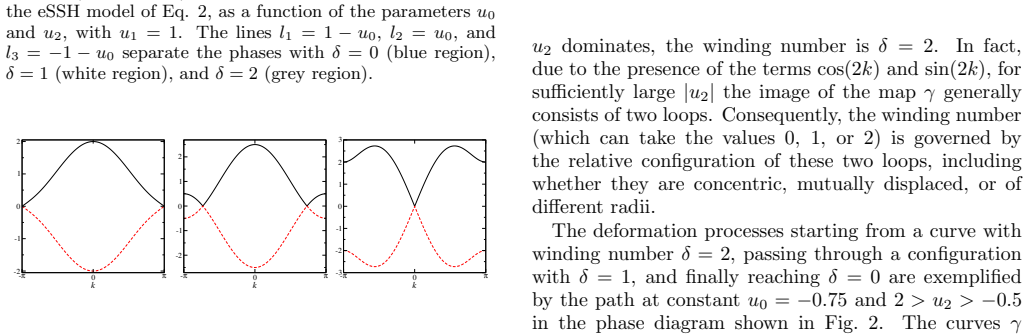
- [topological phase diagram and bulk-boundary correspondence section] The claim of exact coincidence between winding-number changes, gap closings, and |z|=1 (stated in the abstract and phase-diagram discussion) relies on the bulk winding number being the sole topological invariant. With extended hoppings, it is necessary to confirm that no additional invariants arise and that the chosen ansatz captures all decaying solutions without omission; otherwise the bulk-boundary correspondence proof is incomplete.
minor comments (2)
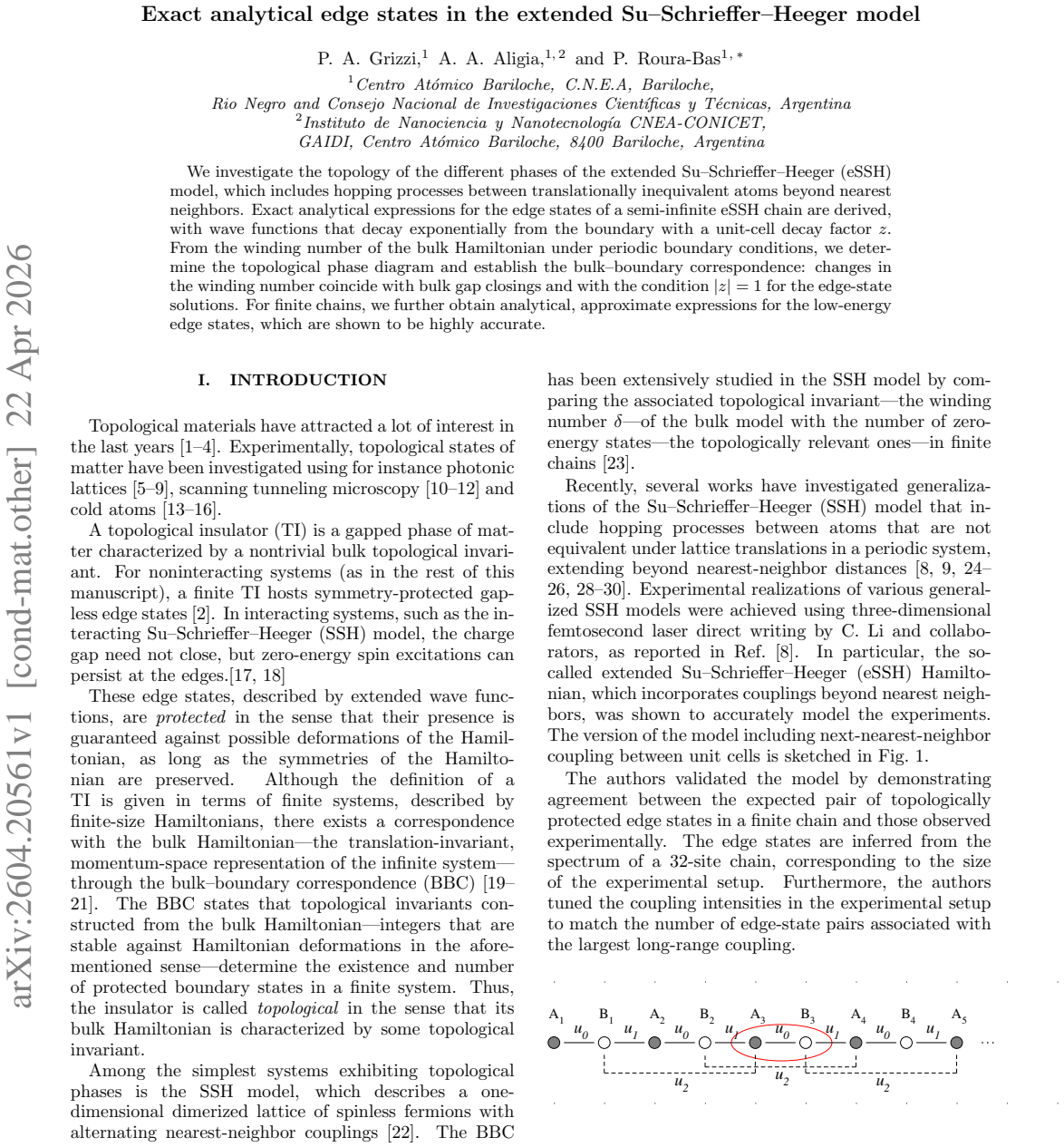
- [model definition] Notation for the extended hopping parameters should be defined explicitly at first use with a clear diagram of the lattice.
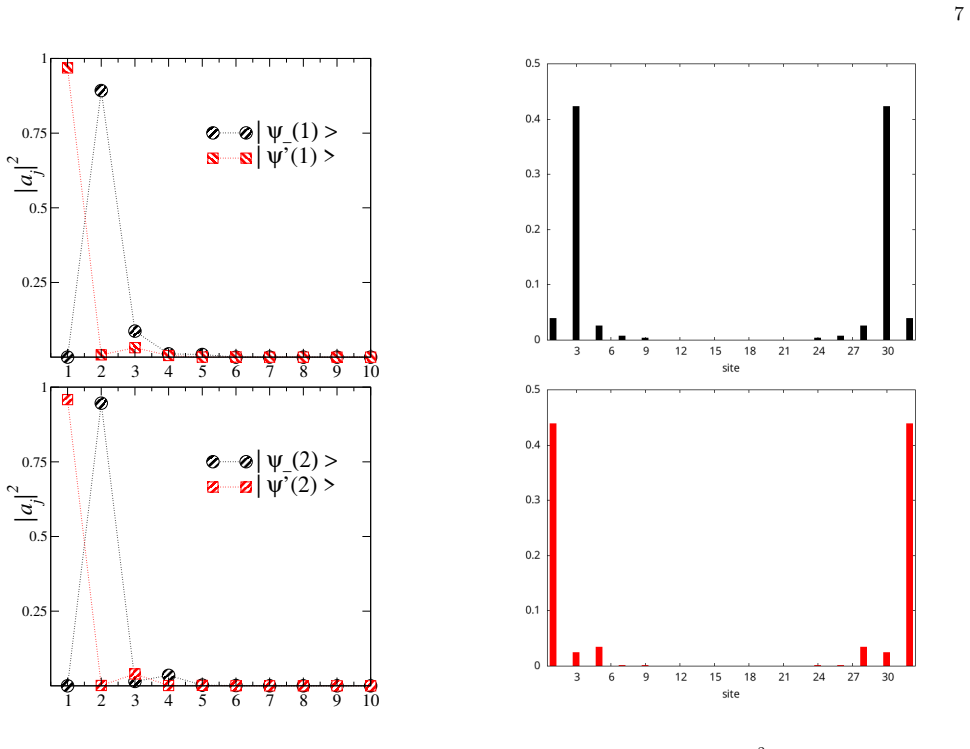
- [finite-chain section] The finite-chain approximate expressions would benefit from an explicit error bound or comparison to exact diagonalization for at least one parameter set.
Simulated Author's Rebuttal
We thank the referee for the careful reading of our manuscript and the constructive comments, which help clarify the presentation of our results on the extended SSH model. We address each major comment point by point below, indicating the revisions we will make to strengthen the manuscript.
read point-by-point responses
-
Referee: [edge-state derivation section] The central derivation of edge states (likely in the section presenting the semi-infinite chain solutions) employs a single-z exponential ansatz of the form decaying with unit-cell factor z. For the extended SSH model with next-nearest-neighbor or further hoppings, the recurrence relation for the two-component amplitudes is of order higher than 2; the characteristic polynomial therefore admits multiple roots. The manuscript must explicitly demonstrate that boundary conditions at the chain end force the coefficients of all other |z_i|<1 roots to vanish, otherwise the reported single-z expressions are incomplete and additional localized modes may exist.
Authors: We appreciate this important observation regarding the order of the recurrence. While the extended hoppings do lead to a higher-order characteristic equation, the specific boundary condition at the open end of the semi-infinite chain uniquely constrains the solution to a single decaying mode. We will revise the edge-state derivation section to explicitly solve the characteristic polynomial, identify all roots, and demonstrate that the boundary conditions set the coefficients of any additional |z_i|<1 roots to zero, confirming that the single-z ansatz captures the complete localized solution without omission. revision: yes
-
Referee: [topological phase diagram and bulk-boundary correspondence section] The claim of exact coincidence between winding-number changes, gap closings, and |z|=1 (stated in the abstract and phase-diagram discussion) relies on the bulk winding number being the sole topological invariant. With extended hoppings, it is necessary to confirm that no additional invariants arise and that the chosen ansatz captures all decaying solutions without omission; otherwise the bulk-boundary correspondence proof is incomplete.
Authors: We agree that explicit confirmation is needed for rigor. In one-dimensional chiral-symmetric systems (class BDI), the winding number remains the complete topological invariant regardless of hopping range. We will add a dedicated paragraph in the topological phase diagram section recalling this symmetry classification and verifying that no additional invariants appear. We will also cross-reference the revised edge-state analysis to confirm that the ansatz exhausts all decaying solutions, thereby completing the bulk-boundary correspondence argument. revision: yes
Circularity Check
No significant circularity; standard bulk-boundary analysis with explicit ansatz solution
full rationale
The derivation computes the winding number directly from the periodic bulk Hamiltonian and solves the open-boundary recurrence via the single-z exponential ansatz, yielding explicit z from the characteristic equation. Neither step reduces to a fitted parameter, self-definition, or self-citation chain; the bulk-boundary link follows the conventional 1D procedure without the result being presupposed by the inputs. The paper remains self-contained.
Axiom & Free-Parameter Ledger
axioms (2)
- domain assumption The system is described by a single-particle tight-binding Hamiltonian with translationally inequivalent atoms and hoppings beyond nearest neighbors.
- standard math The topological phase is classified by the winding number of the bulk Bloch Hamiltonian under periodic boundary conditions.
Reference graph
Works this paper leans on
-
[1]
Qi and S-C
X-L. Qi and S-C. Zhang, Topological insulators and su- perconductors, Rev. Mod. Phys.83, 1057 (2011)
2011
-
[2]
S. Ryu, A. P. Schnyder, A. Furusaki, and A. W. W. Lud- wig, Topological insulators and superconductors: tenfold way and dimensional hierarchy, New Journal of Physics 12, (2010) 065010
2010
-
[3]
Shen,Topological Insulators: Dirac Equation in Condensed Matter, Springer Press, New York 2012
S.-Q. Shen,Topological Insulators: Dirac Equation in Condensed Matter, Springer Press, New York 2012
2012
-
[4]
Ando, Topological Insulator Materials, J
Y. Ando, Topological Insulator Materials, J. Phys. Soc. Jpn.82, 102001 (2013)
2013
-
[5]
M. C. Rechtsman, J. M. Zeuner, Y. Plotnik, Y. Lumer, D. Podolsky, F. Dreisow, S. Nolte, M. Segev, and A. Szameit, Photonic floquet topological insulators, Nature (London)496, 196 (2013)
2013
-
[6]
L. Lu, J. D. Joannopoulos, and M. Soljaˇ ci´ c, Topological photonics, Nat. Photonics8, 821 (2014)
2014
-
[7]
El Hassan, F
A. El Hassan, F. K. Kunst, A. Moritz, G. Andler, E. J. Bergholtz, and M. Bourennane, Corner states of light in photonic waveguides, Nat. Photonics13, 697(2019)
2019
-
[8]
C. Li, R. Wang, Q. Gong, and Y. Li, Manipulating winding numbers and multiple topological bound states via long-range coupling in chiral photonic lattices, Phys. Rev. Research6, 043087 (2024)
2024
-
[9]
al., Topological flat band with higher wind- ing number in a superradiance lattice, Annals of Physics 471, 169837 (2024)
Shuai Li, et. al., Topological flat band with higher wind- ing number in a superradiance lattice, Annals of Physics 471, 169837 (2024)
2024
-
[10]
Mishra, G
S. Mishra, G. Catarina, F. Wu, R. Ortiz, D. Jacob, K. Eimre, J. Ma, C.A. Pignedoli, X. Feng, P. Ruffieux, J. Fern´ andez-Rossier, and R. Fasel, Observation of frac- tional edge excitations in nanographene spin chains, Na- ture (London)598, 287 (2021)
2021
-
[11]
C. Zhao, G. Catarina, J.-J. Zhang, J.C.G. Henriques, L. Yang, J. Ma, X. Feng, O. Gr¨ oning, P. Ruffieux, J. Fern´ andez-Rossier, and R. Fasel, Tunable topologi- cal phases in nanographene- based spin-1/2 alternating- exchange Heisenberg chains, Nat. Nanotechnol.19, 1789 (2024)
2024
-
[12]
Edens, F
L. Edens, F. Romero-Lara, T. Sai, K. Biswas, M. Vilas- Varela, T. Frederiksen, D. Pe˜ na, F. Schulz, and J. I. Pas- cual, Spin and charge control of topological end states in chiral graphene nanoribbons on a 2D ferromagnet, Adv. Mater. 2025, e10753 (2025)
2025
-
[13]
Atala, M
M. Atala, M. Aidelsburger, J. T. Barreiro, D. Abanin, T. Kitagawa, E. Demler, and Immanuel Bloch, Direct mea- surement of the Zak phase in topological Bloch bands, Nat. Physics9, 795 (2013)
2013
-
[14]
Lohse, C
M. Lohse, C. Schweizer, O. Zilberberg, M. Aidelsburger, and I. Bloch, A Thouless quantum pump with ultracold bosonic atoms in an optical superlattice, Nat. Phys.12, 350 (2016)
2016
-
[15]
Nakajima, T
S. Nakajima, T. Tomita, S. Taie, T. Ichinose, H. Ozawa, L. Wang, M. Troyer, and Y. Takahashi, Topological Thouless pumping of ultracold fermions, Nat. Phys.12, 296 (2016)
2016
-
[16]
Viebahn, A.-S
K. Viebahn, A.-S. Walter, E. Bertok, Z. Zhu, M. G¨ achter, A. A. Aligia, F. Heidrich-Meisner, and T. Esslinger, Interaction-induced charge pumping in a topological many-body system Phys. Rev. X14, 021049 (2024)
2024
-
[17]
S. R. Manmana, A. M. Essin, R. M. Noack, and V. Gurarie, Topological invariants and interacting one- dimensional fermionic systems, Phys. Rev. B86, 205119 (2012)
2012
-
[18]
A. A. Aligia, A. M. Lobos, L. Peralta Gavensky, and C. J. Gazza, Probing boundary spins in the Su-Schrieffer- Heeger-Hubbard model, Phys. Rev. B112, 235156 (2025)
2025
-
[19]
Hatsugai, Chern number and edge states in the integer quantum Hall effect, Phys
Y. Hatsugai, Chern number and edge states in the integer quantum Hall effect, Phys. Rev. Lett.71, (1993) 3697
1993
-
[20]
Ryu and Y
S. Ryu and Y. Hatsugai, Topological Origin of Zero- Energy Edge States in Particle-Hole Symmetric Systems, Phys. Rev. Lett.89, 077002 (2002)
2002
-
[21]
C. L. Kane and E. J. Mele, Quantum Spin Hall Effect in Graphene, Phys. Rev. Lett.95, (2005) 226801
2005
-
[22]
W. P. Su, J. R. Schrieffer, and A. J. Heeger, Solitons in Polyaeetylene, Phys. Rev. Lett.42, 1698 (1979)
1979
-
[23]
Asb´ oth, J´ anos K. ; Oroszl´ any, L´ aszl´ o ; P´ alyi, Andr´ as,A Short Course on Topological Insulators: Band Structure and Edge States in One and Two Dimensions, Lecture Notes in Physics, Volume 919. ISBN 978-3-319-25605-4. Springer International Publishing Switzerland, 2016
2016
-
[24]
Maffei, A
M. Maffei, A. Dauphin, F. Cardano, M. Lewenstein, and P. Massignan; Topological characterization of chiral mod- els through their long time dynamics, New J. Phys.20 (2018) 013023
2018
-
[25]
Ghosh, A
A. Ghosh, A. M. Martin, and S. Majumder, Quench dy- namics of edge states in a finite extended Su-Schrieffer- Heeger system, Phys. Rev. E108, 034102 (2023)
2023
-
[26]
R. K. Malakar and A. K. Ghosh, Engineering topological phases of any winding and Chern numbers in extended Su–Schrieffer–Heeger models, J. Phys.: Condens. Matter 35, 335401 (2023)
2023
-
[27]
J. E. Avron and A. M. Turner, Homotopy of periodic 2×2 matrices, J. Math. Phys.65, 051902 (2024)
2024
-
[28]
Joshi and T
D. Joshi and T. Nag, Adiabatic charge transport in ex- tended Su-Schrieffer-Heeger models, Phys. Rev. B112, 075411 (2025)
2025
-
[29]
Chang, J
P-J. Chang, J. Pi, M. Zheng, Y-T. Lei, X. Pan, D. Ruan and G-L. Long, Topological phases of extended Su- Schrieffer-Heeger-Hubbard model, Scientific Reports15, 18023 (2025)
2025
- [30]
-
[31]
Alase, E
A. Alase, E. Cobanera, G. Ortiz, and L. Viola, Ex- act Solution of Quadratic Fermionic Hamiltonians for Arbitrary Boundary Conditions, Phys. Rev. Lett.117, 076804 (2016)
2016
-
[32]
Alase, E
A. Alase, E. Cobanera, G. Ortiz, and L. Viola, General- ization of Bloch’s theorem for Arbitrary Boundary Con- ditions: Theory, Phys. Rev. B96, 195133 (2017)
2017
-
[33]
A. A. Aligia, and L. Arrachea, Entangled end states with fractionalized spin projection in a time-reversal- invariant topological superconducting wire, Phys. Rev. B98, 174507 (2018)
2018
-
[34]
FromP b +P e = 1, one obtainsP bH|ψ⟩+P eH|ψ⟩= EPb|ψ⟩+EP e|ψ⟩
Note thatP bPe =P ePb = 0 andP 2 b =P 2 e = 1. FromP b +P e = 1, one obtainsP bH|ψ⟩+P eH|ψ⟩= EPb|ψ⟩+EP e|ψ⟩. ApplyingP b to this equation, we ob- tainP bH|ψ⟩=EP b|ψ⟩. Similarly, applyingP e leads to PeH|ψ⟩=EP e|ψ⟩
-
[35]
For the states localized at the right end of the chain|z i|>1
Note that in a finite chain, the edge states appear in pairs, with each one localized at one end of the chain. For the states localized at the right end of the chain|z i|>1
discussion (0)
Sign in with ORCID, Apple, or X to comment. Anyone can read and Pith papers without signing in.