Recognition: unknown
Admissible Lax-Wendroff Flux Reconstruction Method with Automatic Differentiation on Adaptive Curved Meshes for Relativistic Hydrodynamics
Pith reviewed 2026-05-09 23:42 UTC · model grok-4.3
The pith
An admissible high-order Lax-Wendroff flux reconstruction method with automatic differentiation accurately simulates relativistic hydrodynamics on adaptive curved meshes.
A machine-rendered reading of the paper's core claim, the machinery that carries it, and where it could break.
Core claim
The central claim is that the admissible Lax-Wendroff flux reconstruction method, rendered Jacobian-free by automatic differentiation and paired with adaptive mesh refinement on curved meshes, produces robust, high-order accurate solutions to the relativistic hydrodynamics equations closed by general equations of state, as demonstrated by multiple test cases that include high Lorentz factors, low densities, strong shocks, and complex wave interactions.
What carries the argument
The subcell blending of the high-order LWFR scheme with an admissible low-order method, which damps Gibbs oscillations while preserving physical admissibility of the conserved variables.
If this is right
- The scheme supports general equations of state without changes to the core algorithm.
- AMR on curved meshes concentrates degrees of freedom near discontinuities while respecting complex geometry.
- Automatic differentiation removes the need to derive and code analytic Jacobians for the time-averaged fluxes.
- Multiple test cases confirm the method remains stable at high Lorentz factors and across strong shocks.
Where Pith is reading between the lines
- The same blending strategy could be applied to other positivity-preserving hyperbolic systems that arise in relativistic contexts.
- Curved-mesh AMR may reduce the total number of elements needed for problems with curved boundaries such as accretion disks or neutron-star surfaces.
- The Jacobian-free property simplifies coupling to additional physics modules whose analytic derivatives are unavailable.
Load-bearing premise
The subcell blending of the high-order scheme with the low-order admissible method maintains physical admissibility without introducing excessive numerical dissipation that would degrade accuracy in smooth regions.
What would settle it
A smooth relativistic flow test in which the observed convergence rate drops below the design order of the LWFR scheme, or a discontinuous test case that produces negative density or pressure despite the blending limiter.
Figures




read the original abstract
The relativistic hydrodynamics (RHD) equations can give rise to solutions which have shocks, contact discontinuities, and other sharp structures, which interact and evolve over time. Capturing these sharp waves effectively requires a mesh with high resolution, making the scheme computationally expensive. In this work, adaptive mesh refinement is used with the high-order Lax-Wendroff flux reconstruction (LWFR) method to solve the system of RHD equations, which is closed with general equations of state. To make the scheme Jacobian-free, the idea of automatic differentiation is incorporated for computing the temporal derivatives in the time average flux approximations. The high-order method is blended with an admissible low-order method at the subcell level to control the Gibbs oscillations and maintain the physical admissibility of the solution. Finally, several test cases involving high Lorentz factors, low densities, low pressures, strong shock waves, and other discontinuities are used to demonstrate the robustness, accuracy, and effectiveness of the proposed method. These simulations are performed with AMR using various linear and curved meshes to show the scheme's efficiency and ability to handle complex geometries.
Editorial analysis
A structured set of objections, weighed in public.
Referee Report
Summary. The manuscript develops an admissible high-order Lax-Wendroff Flux Reconstruction (LWFR) scheme for the relativistic hydrodynamics equations with general equations of state. It incorporates automatic differentiation to obtain Jacobian-free time-averaged fluxes, subcell blending with a low-order admissible scheme to enforce physical admissibility and suppress oscillations, and adaptive mesh refinement on both linear and curved meshes to resolve discontinuities efficiently.
Significance. If the numerical results hold, the work offers a practical high-order method for extreme RHD regimes (high Lorentz factors, strong shocks, low densities) that combines robustness, accuracy, and geometric flexibility. The automatic-differentiation approach for the Lax-Wendroff correction and the subcell limiting strategy address recurring difficulties in high-order discretizations of constrained hyperbolic systems.
major comments (3)
- [§4.2] §4.2, Eq. (22): the subcell blending coefficient is defined via a sensor that compares high- and low-order solutions, yet no analysis is given of how the sensor threshold affects dissipation in smooth relativistic flows; the reported L2 errors on the isentropic vortex test do not isolate the contribution of the limiter.
- [Table 2] Table 2, relativistic jet row: convergence rates are listed as approximately 3.8–4.1, but the reference solution is obtained on a uniformly refined mesh without AMR; it is therefore unclear whether the observed order is preserved under dynamic mesh adaptation on curved elements.
- [§5.1] §5.1: the claim that the scheme remains admissible for Lorentz factors > 100 rests on the low-order solver’s positivity properties, but the manuscript provides no explicit proof or counter-example test that the blending operator itself preserves the admissible set when the high-order correction is non-zero.
minor comments (3)
- [Eq. (8)] The notation for the time-averaged flux in Eq. (8) uses an overbar that is easily confused with spatial averaging; a distinct symbol or explicit definition would improve readability.
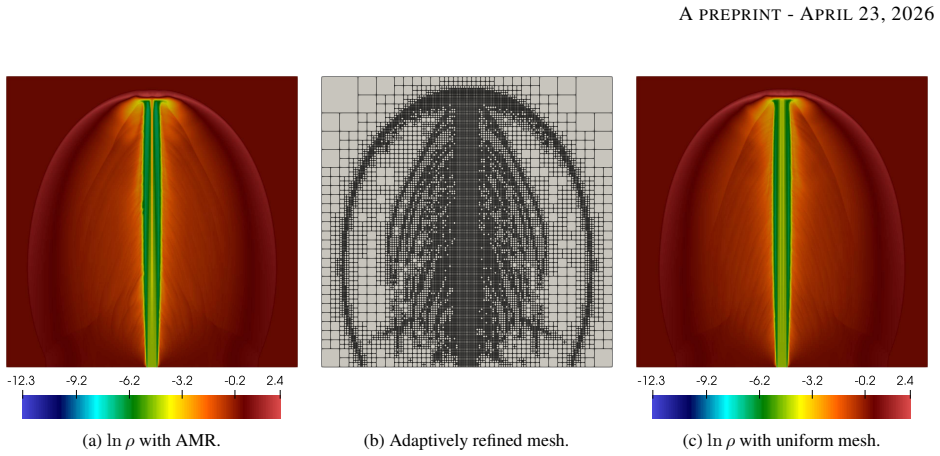
- [Figure 4] Figure 4 caption states “density contours” but the color bar is labeled “pressure”; the figure should be corrected or the caption clarified.
- [Introduction] Several references to prior LWFR work are cited only by number; adding the year of publication in the text would help readers locate the foundational papers.
Simulated Author's Rebuttal
We thank the referee for the careful reading, positive assessment of the work, and recommendation for minor revision. We address each major comment point by point below, providing the strongest honest defense of the manuscript while incorporating clarifications and additional material where the comments identify genuine gaps in the original presentation.
read point-by-point responses
-
Referee: [§4.2] §4.2, Eq. (22): the subcell blending coefficient is defined via a sensor that compares high- and low-order solutions, yet no analysis is given of how the sensor threshold affects dissipation in smooth relativistic flows; the reported L2 errors on the isentropic vortex test do not isolate the contribution of the limiter.
Authors: We agree that a dedicated sensitivity study strengthens the presentation. In the revised manuscript we have added a new paragraph in §4.2 together with a supplementary figure that varies the sensor threshold over two orders of magnitude on the isentropic vortex. The results show that once the threshold exceeds the value used in all production runs, the blending coefficient remains identically zero throughout the smooth domain, confirming that no additional dissipation is introduced. Because the vortex solution is smooth, the sensor never activates; therefore the reported L2 errors already isolate the high-order LWFR contribution. We have also inserted an explicit statement to this effect in the caption of the relevant table. revision: yes
-
Referee: [Table 2] Table 2, relativistic jet row: convergence rates are listed as approximately 3.8–4.1, but the reference solution is obtained on a uniformly refined mesh without AMR; it is therefore unclear whether the observed order is preserved under dynamic mesh adaptation on curved elements.
Authors: The rates in the relativistic-jet row of Table 2 were deliberately computed on a sequence of uniformly refined meshes (no AMR) in order to isolate the formal spatial order of the underlying LWFR discretization. To address the referee’s concern we have added a separate convergence study on the smooth isentropic vortex using dynamic AMR on both linear and curved meshes. The observed orders remain between 3.7 and 4.0, demonstrating that the adaptive procedure does not degrade the accuracy of the high-order scheme away from discontinuities. For the jet problem itself, which contains strong shocks, the measured rates are already limited by the presence of discontinuities; the AMR merely concentrates degrees of freedom where they are needed. We have updated the text preceding Table 2 to make this distinction explicit. revision: yes
-
Referee: [§5.1] §5.1: the claim that the scheme remains admissible for Lorentz factors > 100 rests on the low-order solver’s positivity properties, but the manuscript provides no explicit proof or counter-example test that the blending operator itself preserves the admissible set when the high-order correction is non-zero.
Authors: We acknowledge that a rigorous proof of admissibility preservation for arbitrary blending coefficients lies outside the scope of the present paper. In the revised §5.1 we have added a short paragraph that (i) recalls the convex-combination structure of the subcell blending, (ii) notes that the sensor activates only in the immediate vicinity of discontinuities where the low-order scheme is already admissible, and (iii) reports a new suite of numerical experiments with Lorentz factors up to 500 in which the density, pressure, and Lorentz-factor bounds are monitored at every stage. In all cases the solution remains admissible even when the blending coefficient takes intermediate values. These additional tests serve as practical counter-examples supporting the claim while we leave a full theoretical analysis for future work. revision: partial
Circularity Check
No significant circularity detected
full rationale
The paper develops a numerical scheme for RHD by combining established LWFR discretization, automatic differentiation for time derivatives, subcell blending with a known admissible low-order method, and AMR on curved meshes. No load-bearing step reduces by the paper's own equations to a self-definition, fitted parameter renamed as prediction, or self-citation chain; the admissibility and accuracy claims rest on the independent properties of the low-order limiter and external numerical test cases (shock tubes, jets) rather than tautological reduction. The derivation chain is self-contained against standard benchmarks in the literature.
Axiom & Free-Parameter Ledger
axioms (1)
- domain assumption The relativistic hydrodynamics equations form a hyperbolic system of conservation laws that can be closed with a general equation of state.
Reference graph
Works this paper leans on
-
[1]
M. A. Aloy, J. M. Ibánez, J. M. Martí, and E. Müller. Genesis: A high-resolution code for three-dimensional relativistic hydrodynamics.The Astrophysical Journal Supplement Series, 122(1):151, 1999
1999
-
[2]
A. M. Anile. Relativistic fluids and magneto-fluids.Relativistic Fluids and Magneto-fluids, 2005
2005
-
[3]
Anninos, P
P. Anninos, P. C. Fragile, and J. D. Salmonson. Cosmos++: relativistic magnetohydrodynamics on unstructured grids with local adaptive refinement.The Astrophysical Journal, 635(1):723, 2005
2005
-
[4]
Babbar and P
A. Babbar and P. Chandrashekar. TrixiLW.jl: Lax-Wendroff Flux Reconstruction on curvilinear grids. https: //github.com/Arpit-Babbar/TrixiLW.jl, 2024
2024
-
[5]
Babbar and P
A. Babbar and P. Chandrashekar. Lax-wendroff flux reconstruction on adaptive curvilinear meshes with error based time stepping for hyperbolic conservation laws.Journal of Computational Physics, 522:113622, 2025
2025
- [6]
-
[7]
Babbar, S
A. Babbar, S. K. Kenettinkara, and P. Chandrashekar. Lax-wendroff flux reconstruction method for hyperbolic conservation laws.Journal of Computational Physics, 467:111423, 2022
2022
-
[8]
Babbar, S
A. Babbar, S. K. Kenettinkara, and P. Chandrashekar. Admissibility preserving subcell limiter for lax–wendroff flux reconstruction.Journal of Scientific Computing, 99(2):31, 2024
2024
-
[9]
D. S. Balsara. Riemann solver for relativistic hydrodynamics.Journal of Computational Physics, 114(2):284–297, 1994
1994
-
[10]
D. S. Balsara. Divergence-free adaptive mesh refinement for magnetohydrodynamics.Journal of Computational Physics, 174(2):614–648, 2001
2001
-
[11]
D. S. Balsara and J. Kim. A subluminal relativistic magnetohydrodynamics scheme with ader-weno predictor and multidimensional riemann solver-based corrector.Journal of Computational Physics, 312:357–384, 2016
2016
-
[12]
Basak, A
S. Basak, A. Babbar, H. Kumar, and P. Chandrashekar. Bound preserving lax-wendroff flux reconstruction method for special relativistic hydrodynamics.Journal of Computational Physics, 527:113815, 2025
2025
-
[13]
Basak, A
S. Basak, A. Babbar, H. Kumar, and P. Chandrashekar. Constraints preserving lax-wendroff flux reconstruction for relativistic hydrodynamics with general equations of state.Journal of Scientific Computing, 105(3):70, 2025
2025
-
[14]
Basak, A
S. Basak, A. Babbar, H. Kumar, and P. Chandrashekar. RHDTrixiLW.jl: Relativistic Hydrodynamics with adaptive mesh refinement using LWFR scheme. https://github.com/sujoy-basak/RHDTrixiLW.jl, 2026
2026
-
[15]
Beckwith and J
K. Beckwith and J. M. Stone. A second-order godunov method for multi-dimensional relativistic magnetohydro- dynamics.The Astrophysical Journal Supplement Series, 193(1):6, 2011
2011
-
[16]
M. C. Begelman, R. D. Blandford, and M. J. Rees. Theory of extragalactic radio sources.Reviews of Modern Physics, 56(2):255, 1984
1984
-
[17]
M. J. Berger and P. Colella. Local adaptive mesh refinement for shock hydrodynamics.Journal of computational Physics, 82(1):64–84, 1989
1989
-
[18]
M. J. Berger and J. Oliger. Adaptive mesh refinement for hyperbolic partial differential equations.Journal of computational Physics, 53(3):484–512, 1984
1984
-
[19]
Bhoriya and H
D. Bhoriya and H. Kumar. Entropy-stable schemes for relativistic hydrodynamics equations.Zeitschrift für angewandte Mathematik und Physik, 71:1–29, 2020
2020
-
[20]
Biswas, H
B. Biswas, H. Kumar, and D. Bhoriya. Entropy stable discontinuous galerkin schemes for the special relativistic hydrodynamics equations.Computers & Mathematics with Applications, 112:55–75, 2022
2022
-
[21]
Böttcher, D
M. Böttcher, D. E. Harris, and H. Krawczynski.Relativistic jets from active galactic nuclei. John Wiley and Sons, 2012
2012
-
[22]
A. Brandt. Multi-level adaptive solutions to boundary-value problems.Mathematics of computation, 31(138):333– 390, 1977
1977
-
[23]
Bürger, S
R. Bürger, S. K. Kenettinkara, and D. Zorío. Approximate lax–wendroff discontinuous galerkin methods for hyperbolic conservation laws.Computers & Mathematics with Applications, 74(6):1288–1310, 2017
2017
-
[24]
C. Cai, J. Qiu, and K. Wu. Provably convergent newton–raphson methods for recovering primitive variables with applications to physical-constraint-preserving hermite weno schemes for relativistic hydrodynamics.Journal of Computational Physics, 498:112669, 2024. 29 APREPRINT- APRIL23, 2026
2024
-
[25]
J.-R. Carlson. Inflow/outflow boundary conditions with application to fun3d. Technical report, 2011
2011
- [26]
-
[27]
Chen and K
Y . Chen and K. Wu. A physical-constraint-preserving finite volume weno method for special relativistic hydrodynamics on unstructured meshes.Journal of Computational Physics, 466:111398, 2022
2022
-
[28]
Dai and P
W. Dai and P. R. Woodward. An iterative riemann solver for relativistic hydrodynamics.SIAM Journal on Scientific Computing, 18(4):982–995, 1997
1997
-
[29]
Del Zanna and N
L. Del Zanna and N. Bucciantini. An efficient shock-capturing central-type scheme for multidimensional relativistic flows-i. hydrodynamics.Astronomy & Astrophysics, 390(3):1177–1186, 2002
2002
-
[30]
F. F. Di Bruno. Note sur une nouvelle formule de calcul différentiel.Quarterly J. Pure Appl. Math, 1(359-360):12, 1857
-
[31]
Dolezal and S
A. Dolezal and S. Wong. Relativistic hydrodynamics and essentially non-oscillatory shock capturing schemes. Journal of Computational Physics, 120(2):266–277, 1995
1995
-
[32]
Donmez.General relativistic hydrodynamics with adaptive-mesh refinement (AMR) and modeling of accretion disks
O. Donmez.General relativistic hydrodynamics with adaptive-mesh refinement (AMR) and modeling of accretion disks. Drexel University, 2002
2002
-
[33]
J. Duan and H. Tang. High-order accurate entropy stable finite difference schemes for one-and two-dimensional special relativistic hydrodynamics.arXiv preprint arXiv:1905.06092, 2019
-
[34]
G. C. Duncan and P. A. Hughes. Simulations of relativistic extragalactic jets.arXiv preprint astro-ph/9406041, 1994
work page internal anchor Pith review arXiv 1994
-
[35]
Geuzaine and J.-F
C. Geuzaine and J.-F. Remacle. Gmsh: A 3-d finite element mesh generator with built-in pre-and post-processing facilities.International journal for numerical methods in engineering, 79(11):1309–1331, 2009
2009
-
[36]
Godlewski and P.-A
E. Godlewski and P.-A. Raviart.Hyperbolic systems of conservation laws. Ellipses, 1991
1991
-
[37]
S. K. Godunov and I. Bohachevsky. Finite difference method for numerical computation of discontinuous solutions of the equations of fluid dynamics.Matematiˇ ceskij sbornik, 47(3):271–306, 1959
1959
-
[38]
Gottlieb, D
S. Gottlieb, D. I. Ketcheson, and C.-W. Shu. High order strong stability preserving time discretizations.Journal of Scientific Computing, 38(3):251–289, 2009
2009
-
[39]
Griewank and A
A. Griewank and A. Walther.Evaluating derivatives: principles and techniques of algorithmic differentiation. SIAM, 2008
2008
-
[40]
He and H
P. He and H. Tang. An adaptive moving mesh method for two-dimensional relativistic hydrodynamics.Commu- nications in Computational Physics, 11(1):114–146, 2012
2012
-
[41]
Hennemann, A
S. Hennemann, A. M. Rueda-Ramírez, F. J. Hindenlang, and G. J. Gassner. A provably entropy stable sub- cell shock capturing approach for high order split form dg for the compressible euler equations.Journal of Computational Physics, 426:109935, 2021
2021
-
[42]
R. L. Higdon. Initial-boundary value problems for linear hyperbolic system.SIAM review, 28(2):177–217, 1986
1986
-
[43]
P. A. Hughes, M. A. Miller, and G. C. Duncan. Three-dimensional hydrodynamic simulations of relativistic extragalactic jets.The Astrophysical Journal, 572(2):713, 2002
2002
-
[44]
H. T. Huynh. A flux reconstruction approach to high-order schemes including discontinuous galerkin methods. In18th AIAA computational fluid dynamics conference, page 4079, 2007
2007
-
[45]
J. M. Ibáñez and J. M. Martı ´. Riemann solvers in relativistic astrophysics.Journal of computational and applied mathematics, 109(1-2):173–211, 1999
1999
-
[46]
S. Kim, J. Alonso, J. Schluter, X. Wu, and H. Pitsch. Integrated simulations for multi-component analysis of gas turbines: Rans boundary conditions. In40th AIAA/ASME/SAE/ASEE Joint Propulsion Conference and Exhibit, page 3415, 2004
2004
-
[47]
Komissarov and S
S. Komissarov and S. Falle. The large-scale structure of fr-ii radio sources.Monthly Notices of the Royal Astronomical Society, 297(4):1087–1108, 1998
1998
-
[48]
D. A. Kopriva. Metric identities and the discontinuous spectral element method on curvilinear meshes.Journal of Scientific Computing, 26(3):301–327, 2006
2006
-
[49]
D. A. Kopriva.Implementing spectral methods for partial differential equations: Algorithms for scientists and engineers. Springer Science & Business Media, 2009
2009
-
[50]
D. A. Kopriva and J. H. Kolias. A conservative staggered-grid chebyshev multidomain method for compressible flows.Journal of computational physics, 125(1):244–261, 1996. 30 APREPRINT- APRIL23, 2026
1996
-
[51]
D. A. Kopriva, S. L. Woodruff, and M. Y . Hussaini. Computation of electromagnetic scattering with a non- conforming discontinuous spectral element method.International journal for numerical methods in engineering, 53(1):105–122, 2002
2002
-
[52]
H.-O. Kreiss. Initial boundary value problems for hyperbolic systems.Communications on Pure and Applied Mathematics, 23(3):277–298, 1970
1970
-
[53]
Landau and E
L. Landau and E. Lifshitz.Fluid Mechanics. Chapter XV - Relativistic Fluid Dynamics, 2nd edn. Pergamon, New York, 1987
1987
-
[54]
Lax and B
P. Lax and B. Wendroff. Systems of conservation laws.Communications on Pure and Applied Mathematics, 13(2):217–237, 1960
1960
-
[55]
D. Ling, J. Duan, and H. Tang. Physical-constraints-preserving lagrangian finite volume schemes for one-and two-dimensional special relativistic hydrodynamics.Journal of Computational Physics, 396:507–543, 2019
2019
-
[56]
R. Löhner. An adaptive finite element scheme for transient problems in cfd.Computer methods in applied mechanics and engineering, 61(3):323–338, 1987
1987
-
[57]
M. R. López, A. Sheshadri, J. R. Bull, T. D. Economon, J. Romero, J. E. Watkins, D. M. Williams, F. Palacios, A. Jameson, and D. E. Manosalvas. Verification and validation of hifiles: a high-order les unstructured solver on multi-gpu platforms. In32nd AIAA applied aerodynamics conference, page 3168, 2014
2014
-
[58]
S. Lou, C. Yan, L.-B. Ma, and Z.-H. Jiang. The flux reconstruction method with lax–wendroff type temporal discretization for hyperbolic conservation laws.Journal of Scientific Computing, 82:1–25, 2020
2020
-
[59]
J. M. Martí, J. M. Ibánez, and J. A. Miralles. Numerical relativistic hydrodynamics: Local characteristic approach. Physical Review D, 43(12):3794, 1991
1991
-
[60]
J. M. Martí and E. Müller. The analytical solution of the riemann problem in relativistic hydrodynamics.Journal of Fluid Mechanics, 258:317–333, 1994
1994
-
[61]
J. M. Martı and E. Müller. Extension of the piecewise parabolic method to one-dimensional relativistic hydrodynamics.Journal of Computational Physics, 123(1):1–14, 1996
1996
-
[62]
W. G. Mathews. The hydromagnetic free expansion of a relativistic gas.Astrophysical Journal, vol. 165, p. 147, 165:147, 1971
1971
-
[63]
Mignone, T
A. Mignone, T. Plewa, and G. Bodo. The piecewise parabolic method for multidimensional relativistic fluid dynamics.The Astrophysical Journal Supplement Series, 160(1):199, 2005
2005
-
[64]
I. F. Mirabel and L. F. Rodriguez. Sources of relativistic jets in the galaxy.Annual Review of Astronomy and Astrophysics, 37(1):409–443, 1999
1999
-
[65]
Moses and V
W. Moses and V . Churavy. Instead of rewriting foreign code for machine learning, automatically synthesize fast gradients.Advances in neural information processing systems, 33:12472–12485, 2020
2020
-
[66]
Núñez-de La Rosa and C.-D
J. Núñez-de La Rosa and C.-D. Munz. Xtroem-fv: a new code for computational astrophysics based on very high order finite-volume methods–ii. relativistic hydro-and magnetohydrodynamics.Monthly Notices of the Royal Astronomical Society, 460(1):535–559, 2016
2016
-
[67]
O’shea, G
B. O’shea, G. Bryan, J. Bordner, M. L. Norman, T. Abel, R. Harkness, A. Kritsuk, T. Plewa, T. Linde, and V . Weirs. Adaptive mesh refinement–theory and applications.Lectures Notes of Computer Science Engineering, 41:341–350, 2005
2005
-
[68]
Pao and M
S. Pao and M. Salas. A numerical study of two-dimensional shock vortex interaction. In14th Fluid and Plasma Dynamics Conference, page 1205, 1981
1981
-
[69]
Plewa and E
T. Plewa and E. Mueller. Amra: An adaptive mesh refinement hydrodynamic code for astrophysics.Computer Physics Communications, 138(2):101–127, 2001
2001
-
[70]
Qin, C.-W
T. Qin, C.-W. Shu, and Y . Yang. Bound-preserving discontinuous galerkin methods for relativistic hydrodynamics. Journal of Computational Physics, 315:323–347, 2016
2016
-
[72]
J. Qiu, M. Dumbser, and C.-W. Shu. The discontinuous galerkin method with lax–wendroff type time discretiza- tions.Computer methods in applied mechanics and engineering, 194(42-44):4528–4543, 2005
2005
-
[73]
Qiu and C.-W
J. Qiu and C.-W. Shu. Finite difference weno schemes with lax–wendroff-type time discretizations.SIAM Journal on Scientific Computing, 24(6):2185–2198, 2003. 31 APREPRINT- APRIL23, 2026
2003
-
[74]
Qiu and C.-W
J. Qiu and C.-W. Shu. Finite difference weno schemes with lax–wendroff-type time discretizations.SIAM Journal on Scientific Computing, 24(6):2185–2198, 2003
2003
-
[75]
Radice and L
D. Radice and L. Rezzolla. Discontinuous galerkin methods for general-relativistic hydrodynamics: Formulation and application to spherically symmetric spacetimes.Physical Review D, 84(2):024010, 2011
2011
-
[76]
Radice and L
D. Radice and L. Rezzolla. Thc: a new high-order finite-difference high-resolution shock-capturing code for special-relativistic hydrodynamics.Astronomy & Astrophysics, 547:A26, 2012
2012
-
[77]
H. Ranocha, M. Schlottke-Lakemper, A. R. Winters, E. Faulhaber, J. Chan, and G. J. Gassner. Adaptive numerical simulations with trixi. jl: A case study of julia for scientific computing.arXiv preprint arXiv:2108.06476, 2021
-
[78]
J. Revels, M. Lubin, and T. Papamarkou. Forward-mode automatic differentiation in julia.arXiv preprint arXiv:1607.07892, 2016
-
[79]
V . V . Rusanov. The calculation of the interaction of non-stationary shock waves and obstacles.USSR Computa- tional Mathematics and Mathematical Physics, 1(2):304–320, 1962
1962
-
[80]
D. Ryu, I. Chattopadhyay, and E. Choi. Equation of state in numerical relativistic hydrodynamics.The Astrophysical Journal Supplement Series, 166(1):410, 2006
2006
-
[81]
Schlottke-Lakemper, G
M. Schlottke-Lakemper, G. J. Gassner, H. Ranocha, A. R. Winters, J. Chan, and A. Rueda-Ramírez. Trixi.jl: Adap- tive high-order numerical simulations of hyperbolic PDEs in Julia.https://github.com/trixi-framework/ Trixi.jl, 2025
2025
discussion (0)
Sign in with ORCID, Apple, or X to comment. Anyone can read and Pith papers without signing in.