Recognition: unknown
Time evolution of a Nambu-Goto string coiling around a Kerr black hole
Pith reviewed 2026-05-09 23:50 UTC · model grok-4.3
The pith
A Nambu-Goto string coiling around a Kerr black hole extracts energy only briefly before settling into a steady state with total extracted energy bounded by string tension times black hole mass.
A machine-rendered reading of the paper's core claim, the machinery that carries it, and where it could break.
Core claim
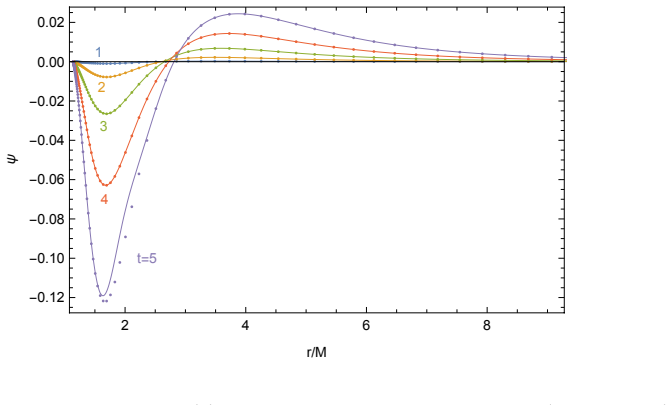
The time evolution shows that negative energy falls into the black hole initially but positive energy follows, so energy extraction occurs only for a short period. Outside the horizon a wave is generated that propagates to infinity carrying the extracted energy. After the wave passes, the system approaches the time-independent configuration found by Boos and Frolov, and the total extracted energy is estimated as E_ext ≲ μ M.
What carries the argument
The condition that the string on the horizon must share the horizon's angular velocity to keep the worldsheet timelike, which forces coiling and produces the transient energy flow.
If this is right
- The string coils around the black hole as it is dragged by the horizon.
- Negative energy enters the black hole first, enabling temporary extraction.
- A wave forms and carries the extracted energy to spatial infinity.
- The system settles into the stationary coiled configuration studied earlier.
- The net energy extracted remains bounded by μ M.
Where Pith is reading between the lines
- If the attachment condition could be relaxed without losing timelikeness, longer extraction intervals might become possible.
- The outgoing wave could produce detectable signals at large distances for sufficiently energetic strings.
- Similar transient extraction might occur for other extended objects with tension near rotating black holes.
Load-bearing premise
The string remains stuck to the horizon with its angular velocity locked exactly to the horizon angular velocity in order to preserve the timelike property of the worldsheet.
What would settle it
A simulation or calculation in which the total energy crossing the horizon exceeds μ M while the string stays attached and timelike would show the bound does not hold.
Figures


read the original abstract
The interaction between a Nambu-Goto string and a Kerr black hole gives one of the methods of energy extraction from a rotating black hole. Although the properties of such processes have been well studied for rigidly rotating strings, little is known for non-rigidly rotating strings. In this paper, we study time evolution of a Nambu-Goto string on the equatorial plane of a Kerr spacetime, which sticks on the horizon and extends to spatial infinity. The time evolution is studied by the series expansion with respect to $t$ and the numerical simulations, which give reliable results for $t\lesssim 4M$ and $t\lesssim 38M$, respectively, where $M$ is the black hole mass. Since the angular velocity of the string on the horizon must coincide with the horizon angular velocity to keep the timelike property, the string is dragged into rotation and coils around the black hole. The negative energy is observed to fall into the black hole, but the positive energy follows after that, meaning that the energy extraction occurs for a short period of time. In the outside region, a wave is generated and propagates to the distant region carrying the extracted energy. After the propagation of the wave, the system approaches the time-independent configuration found by Boos and Frolov, and the total extracted energy is estimated as $E_{\rm ext}\lesssim \mu M$, where $\mu$ is the tension of the string.
Editorial analysis
A structured set of objections, weighed in public.
Referee Report
Summary. The paper studies the time evolution of a Nambu-Goto string in the equatorial plane of a Kerr black hole, with one end stuck to the horizon and the other extending to infinity. Using a perturbative series expansion for early times (t ≲ 4M) and numerical simulations for later times (t ≲ 38M), it shows that the string is dragged into co-rotation with the horizon to preserve timelike worldsheet signature, leading to coiling motion. Negative energy falls into the black hole followed by positive energy, producing only transient extraction; an outward wave carries the energy, and the system relaxes to the static Boos-Frolov configuration with total extracted energy E_ext ≲ μ M.
Significance. If the results hold, this provides a dynamical example of non-rigid string-mediated energy extraction from rotating black holes, showing it is short-lived and quantitatively limited (E_ext ≲ μ M). The combination of analytic expansion and numerics, plus relaxation to a known static solution, adds credibility and could inform models of cosmic strings near astrophysical Kerr black holes.
major comments (2)
- [Abstract / numerical results] Abstract and numerical results: the central quantitative claim E_ext ≲ μ M is presented as an inequality without accompanying error analysis, convergence tests, or uncertainty estimates from the series expansion (t ≲ 4M) and numerical runs (t ≲ 38M). This is load-bearing for the conclusion on limited extraction.
- [Setup and early-time expansion] The condition that the string sticks to the horizon with angular velocity fixed to Ω_H (to maintain timelike signature) is stated as required by the Nambu-Goto dynamics; an explicit derivation from the equations of motion or worldsheet constraints in the early-time expansion would strengthen this.
minor comments (2)
- [Methods] The transition between the series expansion and numerical regime would benefit from an explicit overlap interval or matching check to confirm continuity of the solution and its derivatives.
- [Introduction] Notation for the string tension μ and black-hole mass M is introduced in the abstract but should be restated with units or normalization in the introduction for clarity.
Simulated Author's Rebuttal
We thank the referee for their careful reading of our manuscript and for the constructive comments. We appreciate the positive evaluation of the work's significance and address each major comment below, indicating the revisions planned for the resubmitted version.
read point-by-point responses
-
Referee: [Abstract / numerical results] Abstract and numerical results: the central quantitative claim E_ext ≲ μ M is presented as an inequality without accompanying error analysis, convergence tests, or uncertainty estimates from the series expansion (t ≲ 4M) and numerical runs (t ≲ 38M). This is load-bearing for the conclusion on limited extraction.
Authors: We agree that additional details on the reliability of the bound would strengthen the presentation. The estimate E_ext ≲ μ M follows from the numerical evolution showing that, after the initial transient phase and the passage of the outward wave, the string relaxes to the static Boos-Frolov configuration whose energy is known analytically; the simulations up to t ≲ 38M indicate no further net extraction beyond this scale. In the revised manuscript we will add convergence tests (varying spatial resolution and time-step size in the numerical code), a brief assessment of truncation error in the early-time series expansion, and a more explicit description of how the integrated extracted energy is computed from the simulation data, including a qualitative discussion of associated uncertainties. revision: yes
-
Referee: [Setup and early-time expansion] The condition that the string sticks to the horizon with angular velocity fixed to Ω_H (to maintain timelike signature) is stated as required by the Nambu-Goto dynamics; an explicit derivation from the equations of motion or worldsheet constraints in the early-time expansion would strengthen this.
Authors: We concur that an explicit derivation will improve clarity. In the revised version we will insert a short derivation in the early-time expansion section, showing directly from the Nambu-Goto action and the requirement that the induced worldsheet metric have Lorentzian signature that the angular velocity of the string at the horizon must equal Ω_H; this follows from the vanishing of the appropriate component of the worldsheet stress-energy tensor and the constraint equations at the boundary. revision: yes
Circularity Check
No significant circularity detected in derivation chain
full rationale
The central results—the short-duration energy extraction with negative energy infalling first followed by positive energy, the outward-propagating wave, and the bound E_ext ≲ μ M—are obtained by direct integration of the Nambu-Goto equations of motion via series expansion (t ≲ 4M) and numerical evolution (t ≲ 38M). The horizon boundary condition (angular velocity fixed to Ω_H to preserve timelike signature) is derived from the worldsheet metric requirement rather than fitted or self-defined; it is an input that then drives the coiling dynamics. The system relaxes to the independently known Boos-Frolov static solution as a consistency check, not a reduction. No load-bearing self-citations, no parameters fitted to a data subset and then relabeled as predictions, and no ansatz or uniqueness theorem imported from the authors' prior work. The energy accounting follows from the simulated stress-energy flux across the horizon and at infinity.
Axiom & Free-Parameter Ledger
free parameters (2)
- string tension μ
- black hole mass M
axioms (3)
- domain assumption The string obeys the Nambu-Goto action in Kerr spacetime.
- domain assumption The string lies in the equatorial plane.
- domain assumption The string segment on the horizon rotates at the horizon angular velocity to preserve timelike character.
Reference graph
Works this paper leans on
-
[1]
Energy The energy is the conserved quantity associated with the Killing vectorξ ν = (∂t)ν (i.e., the stationarity of the spacetime), and we adopt the minus sign in Eq. (A1). We calculate the energy density with respect torandr ∗, and the energy flux. a. Energy density with respect torandr ∗ The energy in the Kerr spacetime is given by E(t) =− Z t drdθdϕ√−...
-
[2]
Angular momentum The angular momentum is the conserved quantity associated with the Killing vector ξν = (∂ ϕ)ν (i.e., the axial symmetry of the spacetime), and we adopt the plus sign in Eq. (A1). We calculate the angular momentum density with respect torandr ∗, and the angular momentum flux. a. Angular momentum density with respect torandr ∗ The angular m...
-
[3]
(20), the first term of Eq
is given as F3 = 2(gtϕ +g ϕϕΩ1) grr Ω′2 1 + g′ tt + 2g′ tϕΩ1 +g ′ ϕϕΩ2 1 2grr Ω′ 1 − gtt + 2gtϕΩ1 +g ϕϕΩ2 1 grr Ω′′ 1 − g′ rr 2grr − ∆′ ∆ Ω′ 1 .(B1) Recalling the fact that we have chosen Ω 1 as Ω 1 =−g tϕ/gϕϕ in Eq. (20), the first term of Eq. (B1) can be eliminated. The formulas forF 5 andF 7 are F5 = 2(gtϕ +g ϕϕΩ1) grr 4Ω′ 1Ω′ 3 −3Ω 3Ω′′ 1 + 3 g′ rr 2g...
-
[4]
+ 15g′ ϕϕ grr Ω2 3Ω′ 1 + 30∆′ g2 rr Ω′2 1 Ω′ 3.(B2b) Again, the first terms of these equations can be omitted for the choice Ω 1 =−g tϕ/gϕϕ
-
[5]
Penrose and R
R. Penrose and R. M. Floyd, Nature229, 177-179 (1971)
1971
- [6]
-
[7]
Stuchl´ ık, M
Z. Stuchl´ ık, M. Koloˇ s and A. Tursunov, Universe7, no.11, 416 (2021)
2021
-
[8]
R. D. Blandford and R. L. Znajek, Mon. Not. Roy. Astron. Soc.179, 433-456 (1977)
1977
- [9]
-
[10]
Lonsdale and I
S. Lonsdale and I. Moss, Nucl. Phys. B298, 693-700 (1988)
1988
-
[11]
V. P. Frolov, V. Skarzhinsky, A. Zelnikov and O. Heinrich, Phys. Lett. B224, 255-258 (1989)
1989
-
[12]
V. P. Frolov, S. Hendy and A. L. Larsen, Phys. Rev. D54, 5093 (1996)
1996
- [13]
- [14]
- [15]
- [16]
-
[17]
M. Snajdr and V. P. Frolov, Class. Quant. Grav.20, 1303-1320 (2003) [arXiv:gr-qc/0211018 [gr-qc]]
- [18]
- [19]
-
[20]
S. Kinoshita, T. Igata and K. Tanabe, Phys. Rev. D94, no.12, 124039 (2016) [arXiv:1610.08006 [gr-qc]]
- [21]
- [22]
-
[23]
S. Kinoshita and T. Igata, PTEP2018, no.3, 033E02 (2018) [arXiv:1710.09152 [gr-qc]]
- [24]
- [25]
-
[26]
S. Noda and M. Takahashi, Phys. Rev. D112, no.8, 084066 (2025) [arXiv:2508.04771 [astro- ph.HE]]
-
[27]
Vilenkin and E
A. Vilenkin and E. P. S. Shellard, Cambridge University Press, 2000
2000
-
[28]
J. Boos and V. P. Frolov, Phys. Rev. D97, no.2, 024024 (2018) [arXiv:1711.06357 [gr-qc]]. 23
discussion (0)
Sign in with ORCID, Apple, or X to comment. Anyone can read and Pith papers without signing in.