Recognition: unknown
Wall-crossing of Instantons on the Blow-up
Pith reviewed 2026-05-09 23:37 UTC · model grok-4.3
The pith
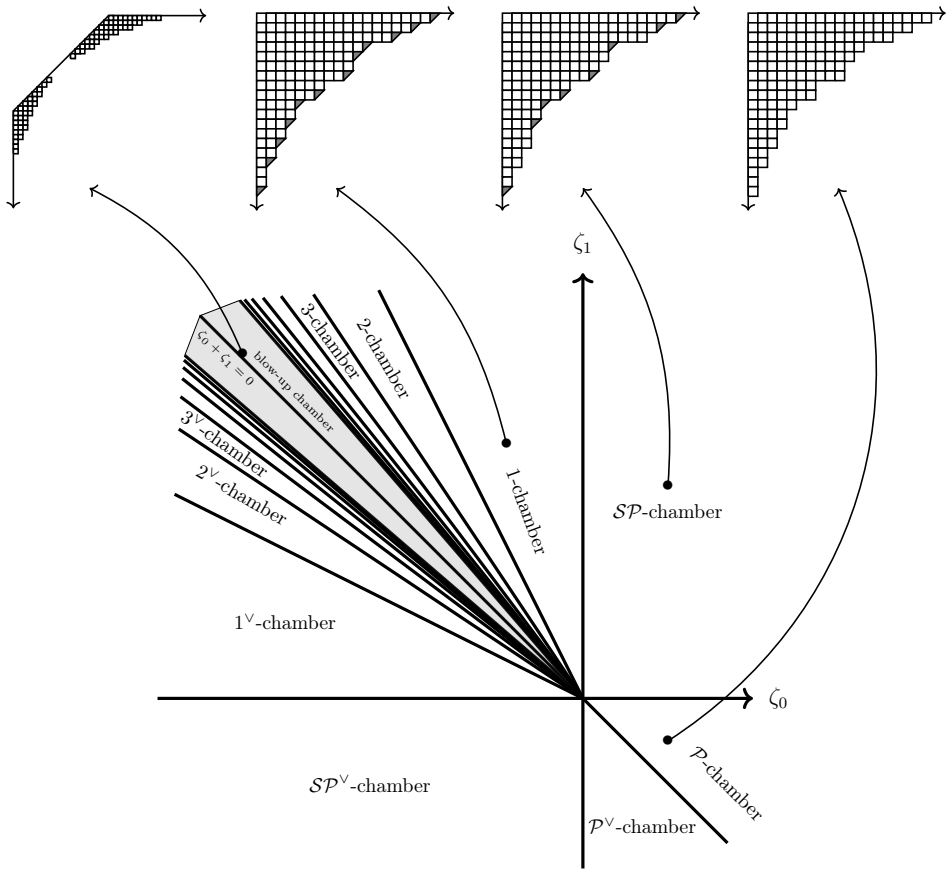
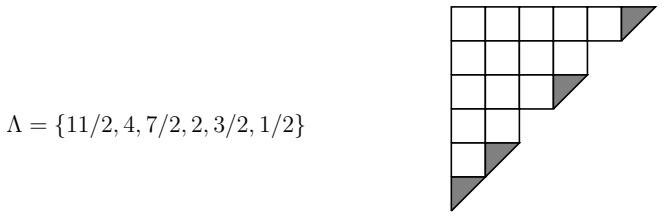
Super-partitions select the contributions to the instanton partition function on the blow-up according to stability conditions in each chamber of a quiver variety.
A machine-rendered reading of the paper's core claim, the machinery that carries it, and where it could break.
Core claim
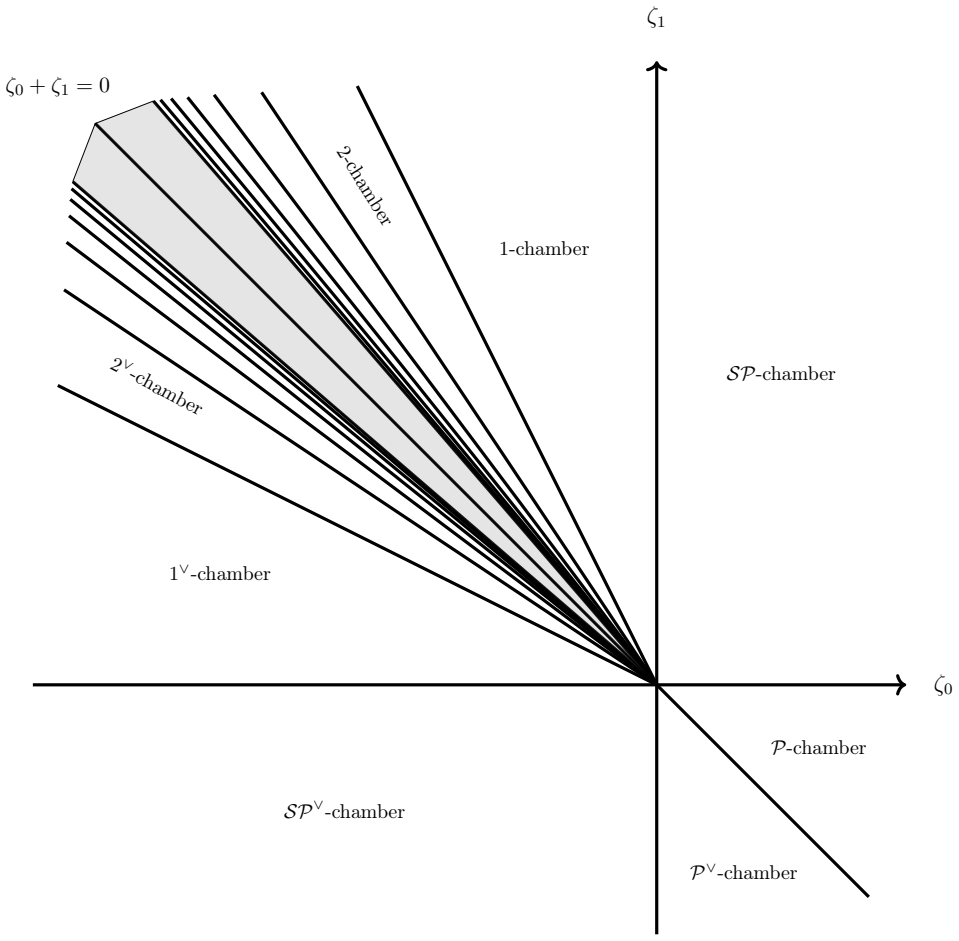
The authors establish that the instanton moduli space on the blow-up of C^2 can be realized as a quiver variety regularized by two stability parameters. This endows the space with infinitely many chambers. Within a given chamber the partition function is a contour integral whose relevant residues correspond to super-partitions obeying chamber-specific selection rules. These rules are equivalent to previously known stability conditions. Crossing walls between chambers produces explicit changes in the counting, and the construction reproduces the Nakajima-Yoshioka formula in a suitable limit.
What carries the argument
The quiver variety with two stability parameters that defines chambers and walls, together with the super-partitions whose selection rules classify the Jeffrey-Kirwan residues and match stability conditions.
If this is right
- Explicit partition functions for each chamber follow directly from the super-partition classification.
- Crossing a wall changes the instanton counting by the addition or removal of specific super-partition terms.
- The construction reproduces the Nakajima-Yoshioka blow-up formula as a limiting case.
- The same super-partition rules implement the stability conditions previously proposed in the literature.
Where Pith is reading between the lines
- The combinatorial language of super-partitions may supply a systematic way to track wall-crossing in other instanton moduli spaces.
- The equivalence between residue selection and stability conditions suggests the quiver-variety approach could be tested on related geometries or gauge theories.
Load-bearing premise
The contributions selected by applying the Jeffrey-Kirwan residue prescription to the contour integral of the quiver variety with chosen stability parameters are exactly the physically relevant terms in the instanton partition function.
What would settle it
A direct calculation of the instanton partition function in one specific chamber that includes nonzero contributions from super-partitions violating the stability selection criteria would show the equivalence fails.
Figures





read the original abstract
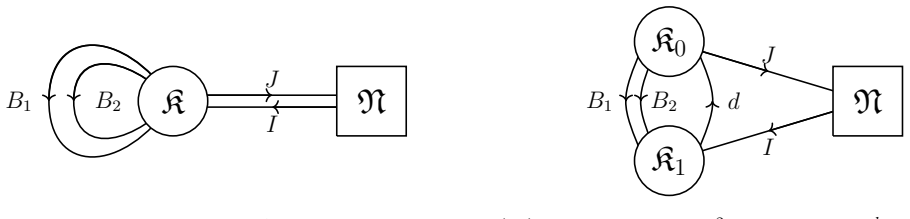
We study the instanton counting in four dimensional $\mathcal{N}=2$ supersymmetric gauge theories on the blow-up of $\mathbb{C}^2$: we start by formulating the instanton moduli space as a quiver variety, which we regularise by introducing two stability parameters, thus endowing it with a structure of infinitely many chambers separated by walls. Within a given chamber, we formulate the instanton partition function as a contour integral, which can be evaluated using the Jeffrey-Kirwan residue prescription. We characterise the physically relevant contributions in terms of bipartite oriented graphs and show that they can more efficiently be classified in terms of combinatorial objects called super-partitions. Within a given chamber, only certain types of super-partitions contribute and we show that the corresponding selection criteria are equivalent to stability conditions that have previously been proposed in the literature. We use this formalism to compare how the instanton counting changes when moving across walls between neighbouring chambers and provide explicit expressions for the corresponding partition functions. In a limiting chamber and using our approach, we show how to reproduce the Nakajima-Yoshioka blow-up formula.
Editorial analysis
A structured set of objections, weighed in public.
Referee Report
Summary. The paper formulates the instanton moduli space on the blow-up of C² as a quiver variety regularized by two stability parameters, which partitions the parameter space into chambers separated by walls. Within each chamber the instanton partition function is expressed as a contour integral evaluated by the Jeffrey-Kirwan residue prescription. Contributions are classified first via bipartite oriented graphs and then more efficiently via super-partitions; explicit selection rules on these super-partitions are derived and shown to be equivalent to previously proposed stability conditions. Wall-crossing formulas between adjacent chambers are obtained by comparing the sets of contributing super-partitions, and the construction recovers the Nakajima-Yoshioka blow-up formula in a limiting chamber.
Significance. If the derivations hold, the work supplies a systematic combinatorial framework that makes the chamber structure and wall-crossing of instanton counting on the blow-up fully explicit. The equivalence between the Jeffrey-Kirwan selection rules and earlier stability conditions, together with the explicit wall-crossing expressions and the reproduction of the Nakajima-Yoshioka formula, constitute concrete technical advances that can be used to test or extend other approaches to BPS counting and moduli-space geometry in four-dimensional N=2 theories.
minor comments (3)
- §3.2: the definition of a super-partition is given combinatorially but an explicit low-rank example (e.g., rank 2 with small instanton number) would clarify how the bipartite-graph and super-partition descriptions map onto each other.
- §4.1, Eq. (4.3): the contour-integral representation is stated without a brief reminder of the precise Jeffrey-Kirwin residue prescription used; adding one sentence would make the subsequent selection-rule derivations easier to follow for readers outside the immediate subfield.
- §5.3: the wall-crossing formula between chambers C and C' is written as a difference of two sums over super-partitions; it would be helpful to include a small numerical check (e.g., first few instanton numbers) that the difference reproduces the expected change in the partition function.
Simulated Author's Rebuttal
We thank the referee for their thorough and positive summary of our manuscript. We are pleased that the combinatorial framework based on super-partitions, the explicit wall-crossing formulas, and the recovery of the Nakajima-Yoshioka blow-up formula have been recognized as concrete technical advances. As no specific major comments or criticisms were raised, we see no need for revisions.
Circularity Check
No significant circularity; derivation relies on explicit calculations from standard tools
full rationale
The paper constructs the instanton moduli space on the blow-up as a quiver variety regularized by two stability parameters, yielding chambers and walls. Within each chamber the partition function is expressed as a contour integral evaluated by the Jeffrey-Kirwan residue prescription. Contributions are classified via bipartite graphs and then super-partitions; selection rules are derived combinatorially and shown equivalent to prior stability conditions through direct comparison rather than by definition or fitting. Wall-crossing formulas follow from explicit set differences between adjacent chambers, and the Nakajima-Yoshioka formula is recovered in a limiting case by the same residue evaluation. All load-bearing steps use independent mathematical machinery (quiver varieties, JK residues) whose validity does not depend on the present results, with no self-referential definitions, fitted inputs renamed as predictions, or load-bearing self-citations that reduce the claims to tautologies.
Axiom & Free-Parameter Ledger
free parameters (1)
- two stability parameters
axioms (2)
- domain assumption The instanton moduli space on the blow-up can be formulated as a quiver variety.
- domain assumption The Jeffrey-Kirwin residue prescription correctly extracts the physically relevant contributions from the contour integral in each chamber.
invented entities (1)
-
super-partitions
no independent evidence
Reference graph
Works this paper leans on
-
[1]
On the Variation in the cohomology of the sym- plectic form of the reduced phase space
J. J. Duistermaat and G. J. Heckman. “On the Variation in the cohomology of the sym- plectic form of the reduced phase space”. In:Invent. Math.69 (1982), pp. 259–268.doi: 10.1007/BF01399506
-
[2]
Classes caractéristiques équivariantes. Formule de localisation en cohomologie équivariante
Nicole Berline and Michèle Vergne. “Classes caractéristiques équivariantes. Formule de localisation en cohomologie équivariante”. In:CR Acad. Sci. Paris295.2 (1982), pp. 539– 541
1982
-
[3]
The moment map and equivariant cohomology
M. F. Atiyah and R. Bott. “The moment map and equivariant cohomology”. In:Topology 23 (1984), pp. 1–28.doi:10.1016/0040-9383(84)90021-1
-
[4]
Localization techniques in quantum field theories
Vasily Pestun, Maxime Zabzine, et al. “Localization techniques in quantum field theories”. In:J. Phys. A50.44 (2017), p. 440301.doi:10.1088/1751-8121/aa63c1. arXiv:1608. 02952 [hep-th]
-
[5]
Seiberg-Witten prepotential from instanton counting
Nikita A. Nekrasov. “Seiberg-Witten prepotential from instanton counting”. In:Adv. Theor. Math. Phys.7.5 (2003), pp. 831–864.doi:10 . 4310 / ATMP . 2003 . v7 . n5 . a4. arXiv:hep-th/0206161
-
[6]
Seiberg-Witten theory and random partitions
Nikita Nekrasov and Andrei Okounkov. “Seiberg-Witten theory and random partitions”. In:Prog. Math.244 (2006), pp. 525–596.doi:10 . 1007 / 0 - 8176 - 4467 - 9 _ 15. arXiv: hep-th/0306238
work page internal anchor Pith review arXiv 2006
-
[7]
HirakuNakajimaandKotaYoshioka.“Instantoncountingonblowup.1.” In:Invent. Math. 162 (2005), pp. 313–355.doi:10.1007/s00222-005-0444-1. arXiv:math/0306198
-
[8]
Calculating thep-canonical basis of Hecke algebras
Hiraku Nakajima and Kota Yoshioka. “Instanton counting on blowup. II. K-theoretic partitionfunction”.In:Transform. Groups10(2005),pp.489–519.doi:10.1007/s00031- 005-0406-0. arXiv:math/0505553
-
[9]
Blowup Equations for Refined Topological Strings
Min-xin Huang, Kaiwen Sun, and Xin Wang. “Blowup Equations for Refined Topological Strings”. In:JHEP10 (2018), p. 196.doi:10.1007/JHEP10(2018)196. arXiv:1711. 09884 [hep-th]
-
[10]
Blowup Equations for 6d SCFTs. I
Jie Gu, Babak Haghighat, Kaiwen Sun, and Xin Wang. “Blowup Equations for 6d SCFTs. I”. In:JHEP03 (2019), p. 002.doi:10.1007/JHEP03(2019)002. arXiv:1811.02577 [hep-th]
-
[11]
Elliptic blowup equations for 6d SCFTs. Part II. Exceptional cases
Jie Gu, Albrecht Klemm, Kaiwen Sun, and Xin Wang. “Elliptic blowup equations for 6d SCFTs. Part II. Exceptional cases”. In:JHEP12 (2019), p. 039.doi:10 . 1007 / JHEP12(2019)039. arXiv:1905.00864 [hep-th]
-
[12]
Elliptic blowup equations for 6d SCFTs. Part III. E-strings, M-strings and chains
Jie Gu, Babak Haghighat, Albrecht Klemm, Kaiwen Sun, and Xin Wang. “Elliptic blowup equations for 6d SCFTs. Part III. E-strings, M-strings and chains”. In:JHEP07 (2020), p. 135.doi:10.1007/JHEP07(2020)135. arXiv:1911.11724 [hep-th]
-
[13]
Elliptic blowup equations for 6d SCFTs. Part IV. Matters
Jie Gu, Babak Haghighat, Albrecht Klemm, Kaiwen Sun, and Xin Wang. “Elliptic blowup equations for 6d SCFTs. Part IV. Matters”. In:JHEP11 (2021), p. 090.doi:10.1007/ JHEP11(2021)090. arXiv:2006.03030 [hep-th]. 34
-
[14]
Joonho Kim, Sung-Soo Kim, Ki-Hong Lee, Kimyeong Lee, and Jaewon Song. “Instantons from Blow-up”. In:JHEP11 (2019). [Erratum: JHEP 06, 124 (2020)], p. 092.doi:10. 1007/JHEP11(2019)092. arXiv:1908.11276 [hep-th]
-
[15]
Blowup equations for little strings
Hee-Cheol Kim, Minsung Kim, and Yuji Sugimoto. “Blowup equations for little strings”. In:JHEP05 (2023), p. 029.doi:10 . 1007 / JHEP05(2023 ) 029. arXiv:2301 . 04151 [hep-th]
2023
-
[16]
5d/6d Wilson loops from blowups
Hee-Cheol Kim, Minsung Kim, and Sung-Soo Kim. “5d/6d Wilson loops from blowups”. In:JHEP08 (2021), p. 131.doi:10 . 1007 / JHEP08(2021 ) 131. arXiv:2106 . 04731 [hep-th]
2021
-
[17]
N= 2 gauge theories on toric singularities, blow-up formulae and W-algebrae
Giulio Bonelli, Kazunobu Maruyoshi, Alessandro Tanzini, and Futoshi Yagi. “N= 2 gauge theories on toric singularities, blow-up formulae and W-algebrae”. In:JHEP01 (2013), p. 014.doi:10.1007/JHEP01(2013)014. arXiv:1208.0790 [hep-th]
-
[18]
A blowup formula for virtual enumerative invariants on projective surfaces
Nikolas Kuhn and Yuuji Tanaka. “A blowup formula for virtual enumerative invariants on projective surfaces”. In: (July 2021). arXiv:2107.08155 [math.AG]
-
[19]
The Blowup Formula for the Instanton Part of Vafa-Witten Invariants on Projective Surfaces
Nikolas Kuhn, Oliver Leigh, and Yuuji Tanaka. “The Blowup Formula for the Instanton Part of Vafa-Witten Invariants on Projective Surfaces”. In: (May 2022). arXiv:2205 . 12953 [math.AG]
2022
-
[20]
Exact Quantization Conditions, Toric Calabi-Yau and Nonperturbative Topological String
Kaiwen Sun, Xin Wang, and Min-xin Huang. “Exact Quantization Conditions, Toric Calabi-Yau and Nonperturbative Topological String”. In:JHEP01 (2017), p. 061.doi: 10.1007/JHEP01(2017)061. arXiv:1606.07330 [hep-th]
-
[21]
Quantization of Integrable Systems and Four Dimensional Gauge Theories
Nikita A. Nekrasov and Samson L. Shatashvili. “Quantization of Integrable Systems and Four Dimensional Gauge Theories”. In:16th International Congress on Mathematical Physics. 2010, pp. 265–289.doi:10 . 1142 / 9789814304634 _ 0015. arXiv:0908 . 4052 [hep-th]
2010
-
[22]
BPS relations from spectral problems and blowup equations
Alba Grassi and Jie Gu. “BPS relations from spectral problems and blowup equations”. In:Lett. Math. Phys.109.6 (2019), pp. 1271–1302.doi:10.1007/s11005-019-01163-1. arXiv:1609.05914 [hep-th]
-
[23]
Relations between Stokes constants of unrefined and Nekrasov-Shatashvili topo- logical strings
Jie Gu. “Relations between Stokes constants of unrefined and Nekrasov-Shatashvili topo- logical strings”. In:JHEP05 (2024), p. 199.doi:10.1007/JHEP05(2024)199. arXiv: 2307.02079 [hep-th]
-
[24]
Painlevé Kernels and Surface Defects at Strong Cou- pling
Matijn François and Alba Grassi. “Painlevé Kernels and Surface Defects at Strong Cou- pling”. In:Annales Henri Poincare26.6 (2025), pp. 2117–2172.doi:10.1007/s00023- 024-01469-4. arXiv:2310.09262 [hep-th]
-
[25]
Towards the glueball spectrum from unquenched latticeQCD
O. Gamayun, N. Iorgov, and O. Lisovyy. “Conformal field theory of Painlevé VI”. In: JHEP10 (2012). [Erratum: JHEP 10, 183 (2012)], p. 038.doi:10.1007/JHEP10(2012)
- [26]
-
[27]
HowinstantoncombinatoricssolvesPainlevéVI, VandIIIs
O.Gamayun,N.Iorgov,andO.Lisovyy.“HowinstantoncombinatoricssolvesPainlevéVI, VandIIIs”.In:J. Phys. A46(2013),p.335203.doi:10.1088/1751-8113/46/33/335203. arXiv:1302.1832 [hep-th]
-
[28]
M. A. Bershtein and A. I. Shchechkin. “Bilinear equations on Painlevéτfunctions from CFT”. In:Commun. Math. Phys.339.3 (2015), pp. 1021–1061.doi:10.1007/s00220- 015-2427-4. arXiv:1406.3008 [math-ph]. 35
-
[29]
Blowups in BPS/CFT Correspondence, and Painlevé VI
Nikita Nekrasov. “Blowups in BPS/CFT Correspondence, and Painlevé VI”. In:Annales Henri Poincare25.1 (2024), pp. 1123–1213.doi:10.1007/s00023-023-01301-5. arXiv: 2007.03646 [hep-th]
-
[30]
Riemann-Hilbert correspondence and blown up surface defects
Saebyeok Jeong and Nikita Nekrasov. “Riemann-Hilbert correspondence and blown up surface defects”. In:JHEP12 (2020), p. 006.doi:10.1007/JHEP12(2020)006. arXiv: 2007.03660 [hep-th]
-
[31]
Giulio Bonelli, Pavlo Gavrylenko, Ideal Majtara, and Alessandro Tanzini. “Surface Ob- servables in Gauge Theories, Modular Painlevé Tau Functions and Non-perturbative Topological Strings”. In:Commun. Math. Phys.407.5 (2026), p. 93.doi:10 . 1007 / s00220-026-05568-7. arXiv:2410.17868 [hep-th]
-
[32]
Blowing- up the edge: connection formulae and stability chart of the Lamé equation
Giulio Bonelli, Pavlo Gavrylenko, Tommaso Pedroni, and Alessandro Tanzini. “Blowing- up the edge: connection formulae and stability chart of the Lamé equation”. In: (July 2025). arXiv:2507.04860 [hep-th]
-
[33]
GiulioBonelli,AntonShchechkin,andAlessandroTanzini.“Bilineartauformsofquantum Painlevé equations andC2/Z2 blowup relations in SUSY gauge theories”. In: (Dec. 2025). arXiv:2512.25051 [math-ph]
-
[34]
G. Bonelli, A. Shchechkin, and A. Tanzini. “Refined Painlevé/gauge theory correspon- dence and quantum tau functions”. In: (Feb. 2025). arXiv:2502.01499 [hep-th]
-
[35]
Instantons and Holomorphic Bundles on the Blow-up Plane
Alastair D. King. “Instantons and Holomorphic Bundles on the Blow-up Plane”. PhD thesis. Oxford, 1989
1989
-
[36]
Perverse coherent sheaves on blow-up. I. A quiver description
Hiraku Nakajima and K¯ ota Yoshioka. “Perverse coherent sheaves on blow-up. I. A quiver description”. In:Exploring New Structures and Natural Constructions in Mathematical Physics. Mathematical Society of Japan, pp. 349–386.doi:10.2969/aspm/06110349. arXiv:0802.3120 [math.AG]
-
[37]
Perverse coherent sheaves on blow-up. II. Wall- crossing and Betti numbers formula
Hiraku Nakajima and Kota Yoshioka. “Perverse coherent sheaves on blow-up. II. Wall- crossing and Betti numbers formula”. In:J. Alg. Geom.20 (2011), pp. 47–100.doi: 10.1090/S1056-3911-10-00534-5. arXiv:0806.0463 [math.AG]
-
[38]
Perverse coherent sheaves on blowup, III: Blow-up formula from wall-crossing
Hiraku Nakajima and Kota Yoshioka. “Perverse coherent sheaves on blowup, III: Blow-up formula from wall-crossing”. In:Kyoto J. Math.51.2 (2011), pp. 263–335.doi:10.1215/ 21562261-1214366. arXiv:0911.1773 [math.AG]
-
[39]
Localization for nonabelian group actions
Lisa C. Jeffrey and Frances C. Kirwan. “Localization for nonabelian group actions”. In: Topology34.2 (1995), pp. 291–327.doi:10 . 1016 / 0040 - 9383(94 ) 00028 - j. arXiv: alg-geom/9307001
-
[40]
Super-Schur polynomials for Affine Super Yangian Y(bgl1|1)
Dmitry Galakhov, Alexei Morozov, and Nikita Tselousov. “Super-Schur polynomials for Affine Super Yangian Y(bgl1|1)”. In:JHEP08 (2023), p. 049.doi:10.1007/JHEP08(2023)
- [41]
-
[42]
Wall-crossing effects on quiver BPS algebras
Dmitry Galakhov, Alexei Morozov, and Nikita Tselousov. “Wall-crossing effects on quiver BPS algebras”. In:JHEP05 (2024), p. 118.doi:10 . 1007 / JHEP05(2024 ) 118. arXiv: 2403.14600 [hep-th]
-
[43]
Nuclear ab initio calculations of 6He β -decay for beyond the Standard Model studies
Dmitry Galakhov, Alexei Morozov, and Nikita Tselousov. “Macdonald polynomials for super-partitions”. In:Phys. Lett. B856 (2024), p. 138911.doi:10.1016/j.physletb. 2024.138911. arXiv:2407.03301 [hep-th]. 36
-
[44]
Super-Hamiltonians for super- Macdonald polynomials
Dmitry Galakhov, Alexei Morozov, and Nikita Tselousov. “Super-Hamiltonians for super- Macdonald polynomials”. In:Phys. Lett. B865 (2025), p. 139481.doi:10 . 1016 / j . physletb.2025.139481. arXiv:2501.14714 [hep-th]
-
[45]
Super Macdonald polynomials and BPS state counting on the blow-up
Hiroaki Kanno, Ryo Ohkawa, and Jun’ichi Shiraishi. “Super Macdonald polynomials and BPS state counting on the blow-up”. In: (June 2025). arXiv:2506.01415 [hep-th]
-
[46]
Lectures on instanton counting
Hiraku Nakajima and Kota Yoshioka. “Lectures on instanton counting”. In:CRM Work- shop on Algebraic Structures and Moduli Spaces. Nov. 2003. arXiv:math/0311058
-
[47]
M. F. Atiyah, Nigel J. Hitchin, V. G. Drinfeld, and Yu. I. Manin. “Construction of In- stantons”. In:Phys. Lett. A65 (1978). Ed. by Mikhail A. Shifman, pp. 185–187.doi: 10.1016/0375-9601(78)90141-X
-
[48]
Instantons on ALE spaces, quiver varieties, and Kac-Moody algebras
Hiraku Nakajima. “Instantons on ALE spaces, quiver varieties, and Kac-Moody algebras”. In:Duke Math. J.76.2 (1994), pp. 365–416.doi:10.1215/S0012-7094-94-07613-8
-
[49]
Integrating over quiver variety and BPS/CFT correspondence
Taro Kimura. “Integrating over quiver variety and BPS/CFT correspondence”. In:Lett. Math. Phys.110.6 (2020), pp. 1237–1255.doi:10.1007/s11005-020-01261-5. arXiv: 1910.03247 [hep-th]
-
[50]
Double Quiver Gauge Theory and BPS/CFT Correspondence
Taro Kimura. “Double Quiver Gauge Theory and BPS/CFT Correspondence”. In:SIGMA 19 (2023), p. 039.doi:10.3842/SIGMA.2023.039. arXiv:2212.03870 [hep-th]
-
[51]
Gauge origami and quiver W-algebras
Taro Kimura and Go Noshita. “Gauge origami and quiver W-algebras”. In:JHEP05 (2024), p. 208.doi:10.1007/JHEP05(2024)208. arXiv:2310.08545 [hep-th]
-
[52]
The large N factorization does not hold for arbitrary multi-trace observables in random tensors
Taro Kimura and Vasily Pestun. “Quiver elliptic W-algebras”. In:Lett. Math. Phys. 108.6 (2018), pp. 1383–1405.doi:10.1007/s11005- 018- 1073- 0. arXiv:1608.04651 [hep-th]
-
[53]
Taro Kimura and Vasily Pestun. “Quiver W-algebras”. In:Lett. Math. Phys.108.6 (2018), pp. 1351–1381.doi:10.1007/s11005-018-1072-1. arXiv:1512.08533 [hep-th]
-
[54]
Symmetric functions in superspace
P. Desrosiers, L. Lapointe, and P. Mathieu. “Symmetric functions in superspace”. In: (Dec. 2004). arXiv:math/0412306
-
[55]
A Strong coupling test of S duality
Cumrun Vafa and Edward Witten. “A Strong coupling test of S duality”. In:Nucl. Phys. B431 (1994), pp. 3–77.doi:10.1016/0550-3213(94)90097-3. arXiv:hep-th/9408074
-
[56]
Supersymmetric gauge theories, intersecting branes and free fermions
Robbert Dijkgraaf, Lotte Hollands, Piotr Sulkowski, and Cumrun Vafa. “Supersymmetric gauge theories, intersecting branes and free fermions”. In:JHEP02 (2008), p. 106.doi: 10.1088/1126-6708/2008/02/106. arXiv:0709.4446 [hep-th]
-
[57]
Divisors of Numbers and their Continuations in the Theory of Par- titions
P. A. MacMahon. “Divisors of Numbers and their Continuations in the Theory of Par- titions”. In:Proceedings of the London Mathematical Societys2-19.1 (1921), pp. 75–113. doi:https://doi.org/10.1112/plms/s2-19.1.75
-
[58]
Liouville Correlation Functions from Four-dimensional Gauge Theories
Luis F. Alday, Davide Gaiotto, and Yuji Tachikawa. “Liouville Correlation Functions from Four-dimensional Gauge Theories”. In:Lett. Math. Phys.91 (2010), pp. 167–197. doi:10.1007/s11005-010-0369-5. arXiv:0906.3219 [hep-th]
-
[59]
Quiver Yangian from Crystal Melting
Wei Li and Masahito Yamazaki. “Quiver Yangian from Crystal Melting”. In:JHEP11 (2020), p. 035.doi:10.1007/JHEP11(2020)035. arXiv:2003.08909 [hep-th]
-
[60]
A note on quiver quantum toroidal algebra
Go Noshita and Akimi Watanabe. “A note on quiver quantum toroidal algebra”. In:JHEP 05 (2022), p. 011.doi:10.1007/JHEP05(2022)011. arXiv:2108.07104 [hep-th]. 37
-
[61]
Reading between the lines of four- dimensional gauge theories
Ofer Aharony, Nathan Seiberg, and Yuji Tachikawa. “Reading between the lines of four- dimensional gauge theories”. In:JHEP08 (2013), p. 115.doi:10.1007/JHEP08(2013)
- [62]
-
[63]
Noncommutative Jacobi identity, and gauge the- ory
Andrei Grekov and Nikita Nekrasov. “Noncommutative Jacobi identity, and gauge the- ory”. In: (Nov. 2024). arXiv:2411.17144 [math-ph]
-
[64]
Local Calabi-Yau manifolds of type ˜Avia SYZ mirror symmetry
Atsushi Kanazawa and Siu-Cheong Lau. “Local Calabi-Yau manifolds of type ˜Avia SYZ mirror symmetry”. In:J. Geom. Phys.139 (2019), pp. 103–138.doi:10 . 1016 / j.geomphys.2018.12.015. arXiv:1605.00342 [math.AG]
-
[65]
The Curve of compactified 6-D gauge theories and integrable systems
Harry W. Braden and Timothy J. Hollowood. “The Curve of compactified 6-D gauge theories and integrable systems”. In:JHEP12 (2003), p. 023.doi:10 . 1088 / 1126 - 6708/2003/12/023. arXiv:hep-th/0311024
-
[66]
Seiberg-Witten curves ofˆD- type Little Strings
Baptiste Filoche, Stefan Hohenegger, and Taro Kimura. “Seiberg-Witten curves ofˆD- type Little Strings”. In:JHEP05 (2025), p. 039.doi:10.1007/JHEP05(2025)039. arXiv: 2407.11164 [hep-th]
-
[67]
Surface defects in A-type Little String Theories
Baptiste Filoche, Stefan Hohenegger, and Taro Kimura. “Surface defects in A-type Little String Theories”. In:JHEP07 (2025), p. 004.doi:10.1007/JHEP07(2025)004. arXiv: 2412.15048 [hep-th]
-
[68]
Quantum spin systems and supersymmetric gauge theories. Part I
Norton Lee and Nikita Nekrasov. “Quantum spin systems and supersymmetric gauge theories. Part I”. In:JHEP03 (2021), p. 093.doi:10.1007/JHEP03(2021)093. arXiv: 2009.11199 [hep-th]
-
[69]
Structure of States Which Satisfy Strong Subadditivity of Quantum Entropy with Equality
Mina Aganagic, Albrecht Klemm, Marcos Marino, and Cumrun Vafa. “The Topological vertex”. In:Commun. Math. Phys.254 (2005), pp. 425–478.doi:10.1007/s00220-004- 1162-z. arXiv:hep-th/0305132
-
[70]
The Refined topological vertex
Amer Iqbal, Can Kozcaz, and Cumrun Vafa. “The Refined topological vertex”. In:JHEP 10 (2009), p. 069.doi:10.1088/1126-6708/2009/10/069. arXiv:hep-th/0701156
-
[71]
Global Magni4icence, or: 4G Networks
Nikita Nekrasov and Nicolò Piazzalunga. “Global Magni4icence, or: 4G Networks”. In: SIGMA20 (2024), p. 106.doi:10.3842/SIGMA.2024.106. arXiv:2306.12995 [hep-th]. 38
discussion (0)
Sign in with ORCID, Apple, or X to comment. Anyone can read and Pith papers without signing in.