Recognition: unknown
Bayesian approach for uncertainty quantification of hybrid spectral unmixing in γ-ray spectrometry
Pith reviewed 2026-05-09 22:36 UTC · model grok-4.3
The pith
Markov Chain Monte Carlo sampling yields accurate coverage intervals for spectral unmixing estimates under active constraints while Laplace approximation does not.
A machine-rendered reading of the paper's core claim, the machinery that carries it, and where it could break.
Core claim
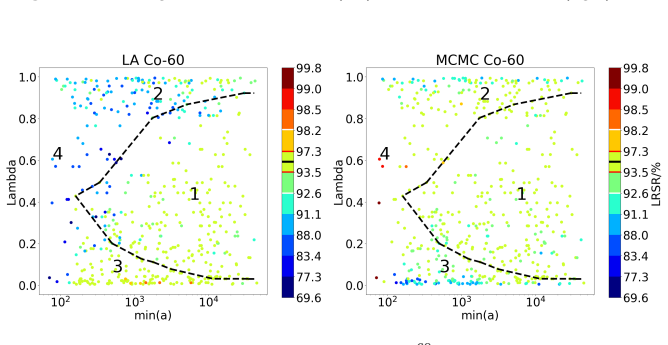
The study shows that the Markov Chain Monte Carlo method provides robust uncertainty quantification for the counting and the variable λ characterizing spectral signatures, maintaining the expected coverage success rate of 95.4% even when constraints related to spectral signatures deformation and counting are active or when background counting dominates, whereas the Laplace approximation deviates due to the non-Gaussian nature of the posterior distribution.
What carries the argument
Bayesian posterior sampling using either Laplace Gaussian approximation or Markov Chain Monte Carlo, applied to the hybrid spectral unmixing model with constraints on spectral deformation.
If this is right
- When constraints are inactive both methods achieve coverage close to 95.4 percent.
- Laplace approximation deviates under active constraints or dominant background.
- Markov Chain Monte Carlo remains accurate regardless of constraint activation.
- This distinction supports choosing the appropriate method for reliable radionuclide quantification decisions.
Where Pith is reading between the lines
- Practitioners facing real gamma spectra with variable backgrounds should default to MCMC for uncertainty estimates to avoid under- or over-coverage.
- The results point to a need for diagnostic checks on posterior shape before applying Laplace approximations in constrained inverse problems.
- Future work could develop adaptive methods that use Laplace when safe and switch to MCMC otherwise.
Load-bearing premise
The posterior distribution of the counting and spectral signature parameters is sufficiently close to Gaussian that the Laplace approximation accurately captures the coverage intervals even when deformation and counting constraints are active.
What would settle it
Simulate repeated datasets with active spectral deformation constraints and dominant background, compute the empirical coverage success rate of the Laplace intervals, and check whether it differs substantially from 95.4 percent.
Figures






read the original abstract
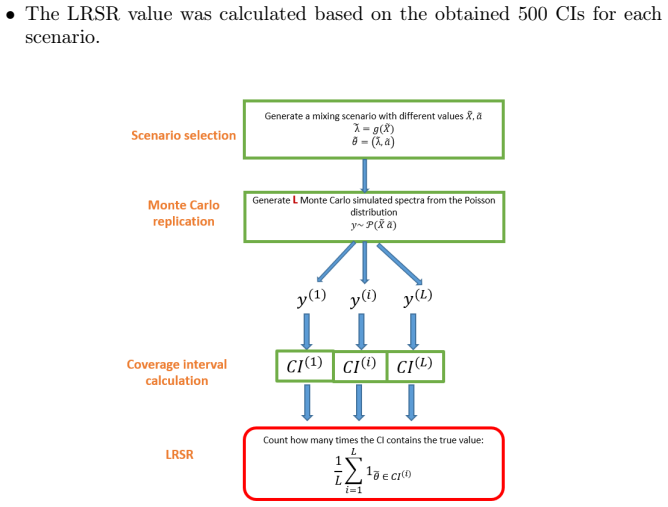
Identifying and quantifying $\gamma$-emitting radionuclides, considering spectral deformation from $\gamma$-interactions in radioactive source surroundings, present a significant challenge in $\gamma$-ray spectrometry. In that context, a hybrid machine learning method has been previously proposed to jointly estimate the counting and spectral signatures of $\gamma$-emitters under conditions of spectral variability. This paper addresses the uncertainty quantification of the estimators (i.e., the counting and the variable $\lambda$ which characterizes the spectral signatures) obtained by this spectral unmixing algorithm. The focus is on the coverage interval, as defined by the GUM, which corresponds closely to a credible interval in the Bayesian framework. Given the inverse problem and the constraints associated with spectral deformation, two Bayesian methods - Laplace approximation and Markov Chain Monte Carlo - have been developed for uncertainty quantification to ensure robust decision-making. The Laplace approximation technique approximates the posterior distribution by a Gaussian distribution, while the Markov Chain Monte Carlo technique samples the posterior distribution. This study evaluates these two methods in terms of precision of coverage interval based on repeated Monte Carlo samples using the long-run success rate. Numerical experiments show that both methods yield similar results close to the expected success rate of 95.4$\%$ when constraints related to spectral signatures deformation and counting are inactive. However, when constraints are active or the background counting significantly dominates other radionuclides, the Laplace approximation method deviates from the expected long-run success rate due to the non-Gaussian posterior distribution. In such cases, the Markov Chain Monte Carlo method still provides robust results.
Editorial analysis
A structured set of objections, weighed in public.
Referee Report
Summary. The paper develops two Bayesian approaches—Laplace approximation and Markov Chain Monte Carlo—for uncertainty quantification of counting rates and spectral deformation parameters in a previously proposed hybrid machine-learning spectral unmixing algorithm for γ-ray spectrometry. It evaluates coverage properties of the resulting credible intervals via repeated Monte Carlo trials on synthetic data, reporting that both methods achieve the nominal 95.4 % long-run success rate when deformation and counting constraints are inactive, but that the Laplace method deviates (due to non-Gaussian posteriors) once those constraints are active or background dominates, while MCMC remains reliable.
Significance. If the Monte Carlo coverage results generalize, the work supplies concrete guidance on method selection for reliable uncertainty quantification in constrained inverse problems that arise in operational γ-ray spectrometry. The repeated-sampling protocol that directly measures long-run success rate is a methodological strength that allows falsifiable assessment of interval calibration.
major comments (2)
- [Section 4] Section 4 (Numerical experiments) and the associated figures: all reported coverage rates are obtained exclusively from synthetic spectra generated under the model; no empirical coverage frequencies are shown for real measured γ-ray spectra under active spectral-deformation or background-dominant regimes, leaving open whether the observed Laplace under-coverage is practically relevant in operational data.
- [Section 3.2] Section 3.2 (Laplace approximation) and the constraint definitions in Section 2: the claim that the posterior becomes non-Gaussian when constraints are active is demonstrated only qualitatively in the simulations; the manuscript does not quantify how often or by how much the Gaussian approximation fails (e.g., via posterior skewness or coverage deficit magnitude) across the range of realistic background-to-signal ratios.
minor comments (2)
- [Abstract] The abstract states that the coverage interval “corresponds closely to a credible interval,” but the precise mapping between GUM coverage and Bayesian credible intervals under the hybrid unmixing model is not restated in the methods; a short clarifying sentence would help readers.
- Notation for the spectral deformation parameter λ and the counting vector is introduced without an explicit table of symbols; adding one would improve readability when comparing the two Bayesian procedures.
Simulated Author's Rebuttal
We thank the referee for the detailed and constructive review. We address each major comment below and indicate planned revisions.
read point-by-point responses
-
Referee: [Section 4] Section 4 (Numerical experiments) and the associated figures: all reported coverage rates are obtained exclusively from synthetic spectra generated under the model; no empirical coverage frequencies are shown for real measured γ-ray spectra under active spectral-deformation or background-dominant regimes, leaving open whether the observed Laplace under-coverage is practically relevant in operational data.
Authors: We agree that validation on real data would strengthen applicability claims. However, real measured γ-ray spectra lack known ground-truth counting rates and deformation parameters, precluding direct empirical coverage computation. Synthetic data enable the repeated-sampling protocol needed to measure long-run success rates. In revision we will expand Section 4 with a dedicated discussion of this limitation, its implications for operational use, and an illustrative comparison of Laplace and MCMC uncertainty estimates on an example real spectrum. revision: partial
-
Referee: [Section 3.2] Section 3.2 (Laplace approximation) and the constraint definitions in Section 2: the claim that the posterior becomes non-Gaussian when constraints are active is demonstrated only qualitatively in the simulations; the manuscript does not quantify how often or by how much the Gaussian approximation fails (e.g., via posterior skewness or coverage deficit magnitude) across the range of realistic background-to-signal ratios.
Authors: We accept that a quantitative characterization is needed. The revised manuscript will augment Section 3.2 (and the associated numerical results) with explicit metrics: average posterior skewness and kurtosis, plus tabulated coverage-deficit magnitudes, evaluated across a grid of background-to-signal ratios. These additions will make the conditions under which the Laplace approximation degrades more precise. revision: yes
- Direct empirical coverage frequencies on real measured γ-ray spectra, because true parameter values are unavailable in operational data.
Circularity Check
Standard Bayesian UQ procedures evaluated on external Monte Carlo ground truth; prior hybrid method referenced but not load-bearing
full rationale
The paper applies the standard Laplace approximation and MCMC sampling to quantify uncertainty in the outputs of a previously proposed hybrid unmixing algorithm. Coverage properties are assessed via repeated Monte Carlo trials that compare estimated intervals against known synthetic truth, which is external to any fitted parameter inside the present work. No equation reduces a claimed prediction to a fitted input by construction, and the referenced prior method supplies the forward model rather than defining the UQ results themselves. The single self-citation is therefore minor and non-load-bearing, yielding only a low circularity score.
Axiom & Free-Parameter Ledger
axioms (2)
- domain assumption The posterior distribution can be approximated by a multivariate Gaussian when constraints are inactive
- domain assumption MCMC sampling converges to the true posterior under the given constraints
Reference graph
Works this paper leans on
-
[1]
Gilmore, Practical gamma-ray spectroscopy, John Wiley & Sons, 2008
G. Gilmore, Practical gamma-ray spectroscopy, John Wiley & Sons, 2008
2008
-
[2]
Atomic Energy Agency, 1998
A.AC02459866, Radiologicalcharacterizationofshutdownnuclearreactors for decommissioning purposes, Internat. Atomic Energy Agency, 1998
1998
-
[3]
International Atomic Energy Agency, Combating illicit trafficking in nu- clear and other radioactive material, IAEA Nuclear Security 6 (2007) 3–12
2007
-
[4]
André, C
R. André, C. Bobin, J. Bobin, J. Xu, A. de Vismes Ott, Metrological approach ofγ-emitting radionuclides identification at low statistics: ap- plication of sparse spectral unmixing to scintillation detectors, Metrologia 58 (1) (2021) 015011
2021
-
[5]
J. Xu, J. Bobin, A. de Vismes Ott, C. Bobin, Sparse spectral unmixing for activity estimation inγ-ray spectrometry applied to environmental mea- surements, Applied Radiation and Isotopes 156 (2020) 108903
2020
-
[6]
Malfrait, J
P. Malfrait, J. Bobin, A. de Vismes Ott, Spectral unmixing of multi- temporal data in gamma-ray spectrometry, Nuclear Instruments and Meth- ods in Physics Research Section A: Accelerators, Spectrometers, Detectors and Associated Equipment 1045 (2023) 167547
2023
-
[7]
Malfrait, J
P. Malfrait, J. Bobin, A. de Vismes Ott, Online spectral unmixing in gamma-ray spectrometry, Applied Radiation and Isotopes 201 (2023) 111011
2023
-
[8]
C. Mano, C. Chapelle, A. D. M. Kabakian, P. Gross, H. Paradis, O. De- laune, L.Patryl, Algorithmdevelopmentforlowlevelradioxenon2dspectra analysis: A first case of study using spectral unmixing for aβ-γdetector, Applied Radiation and Isotopes 203 (2024) 111079
2024
-
[9]
D. T. Phan, J. Bobin, C. Thiam, C. Bobin, A hybrid machine learning un- mixing method for automatic analysis ofγ-spectra with spectral variability, Nuclear Instruments and Methods in Physics Research Section A: Accel- erators, Spectrometers, Detectors and Associated Equipment 1060 (2024) 169028
2024
-
[10]
BIPM, IEC, IFCC, ILAC, ISO, IUPAC, IUPAP and OIML, Evaluation of measurement data—Guide to the expression of uncertainty in measure- ment, Bureau International des Poids et Mesures JCGM 100 (2008)
2008
-
[11]
BIPM, IEC, IFCC, ILAC, ISO, IUPAC, IUPAP and OIML, Evaluation of measurement data-Supplement 1 to the Guide to the Expression of Uncer- tainty in Measurement, Propagation of distributions using a Monte Carlo method (2008)
2008
-
[12]
Stoudt, A
S. Stoudt, A. Pintar, A. Possolo, Coverage intervals, Journal of Research of the National Institute of Standards and Technology 126 (2021) 1–22. 19
2021
-
[13]
Elster, Bayesian uncertainty analysis compared with the application of the GUM and its supplements, Metrologia 51 (4) (2014) S159
C. Elster, Bayesian uncertainty analysis compared with the application of the GUM and its supplements, Metrologia 51 (4) (2014) S159
2014
-
[14]
Giaquinto, L
N. Giaquinto, L. Fabbiano, Examples of S1 coverage intervals with very good and very bad long-run success rate, Metrologia 53 (2) (2016) S65
2016
-
[15]
Klauenberg, C
K. Klauenberg, C. Elster, Markov chain Monte Carlo methods: an intro- ductory example, Metrologia 53 (1) (2016) S32
2016
-
[16]
Hall, Evaluating methods of calculating measurement uncertainty, Metrologia 45 (2) (2008) L5
B. Hall, Evaluating methods of calculating measurement uncertainty, Metrologia 45 (2) (2008) L5
2008
-
[17]
Willink, Probability, belief and success rate: comments on ‘on the mean- ing of coverage probabilities’, Metrologia 47 (3) (2010) 343
R. Willink, Probability, belief and success rate: comments on ‘on the mean- ing of coverage probabilities’, Metrologia 47 (3) (2010) 343
2010
-
[18]
Bobin, R
J. Bobin, R. C. Gertosio, C. Bobin, C. Thiam, An autoencoder-based model for learning regularizations in unmixing problems, Digital Signal Processing (2023) 104058
2023
-
[19]
Agostinelli, J
S. Agostinelli, J. Allison, K. a. Amako, J. Apostolakis, H. Araujo, P. Arce, M. Asai, D. Axen, S. Banerjee, G. Barrand, et al., GEANT4—a simulation toolkit, Nuclear instruments and methods in physics research section A: Accelerators, Spectrometers, Detectors and Associated Equipment 506 (3) (2003) 250–303
2003
-
[20]
D. T. Phan, J. Bobin, C. Thiam, C. Bobin, Automatic identification and quantification ofγ-emitting radionuclides with spectral variability using a hybrid machine learning unmixing method, Radiation Physics and Chem- istry 232 (2025) 112654
2025
-
[21]
A. W. Van der Vaart, Asymptotic statistics, Vol. 3, Cambridge university press, 2000
2000
-
[22]
M. J. Beal, Variational algorithms for approximate Bayesian inference, Uni- versity of London, University College London (United Kingdom), 2003
2003
-
[23]
R. E. Kass, A. E. Raftery, Bayes factors, Journal of the american statistical association 90 (430) (1995) 773–795
1995
-
[24]
R. A. Fisher, On the mathematical foundations of theoretical statistics, Philosophical transactions of the Royal Society of London. Series A, con- taining papers of a mathematical or physical character 222 (594-604) (1922) 309–368
1922
-
[25]
R. A. Fisher, Theory of statistical estimation, in: Mathematical proceed- ings of the Cambridge philosophical society, Vol. 22, Cambridge University Press, 1925, pp. 700–725. 20
1925
-
[26]
Paszke, S
A. Paszke, S. Gross, F. Massa, A. Lerer, J. Bradbury, G. Chanan, T. Killeen, Z. Lin, N. Gimelshein, L. Antiga, A. Desmaison, A. Kopf, E. Yang, Z. DeVito, M. Raison, A. Tejani, S. Chilamkurthy, B. Steiner, L. Fang, J. Bai, S. Chintala, Pytorch: An imperative style, high- performance deep learning library, in: Advances in Neural Information Processing Syste...
2019
-
[27]
Metropolis, A
N. Metropolis, A. W. Rosenbluth, M. N. Rosenbluth, A. H. Teller, E. Teller, Equation of state calculations by fast computing machines, The journal of chemical physics 21 (6) (1953) 1087–1092
1953
-
[28]
Duane, A
S. Duane, A. D. Kennedy, B. J. Pendleton, D. Roweth, Hybrid monte carlo, Physics letters B 195 (2) (1987) 216–222
1987
-
[29]
D. J. MacKay, Information theory, inference and learning algorithms, Cam- bridge university press, 2003
2003
-
[30]
M. D. Hoffman, A. Gelman, et al., The No-U-Turn sampler: adaptively setting path lengths in Hamiltonian Monte Carlo, J. Mach. Learn. Res. 15 (1) (2014) 1593–1623
2014
-
[31]
Bingham, J
E. Bingham, J. P. Chen, M. Jankowiak, F. Obermeyer, N. Pradhan, T. Kar- aletsos, R. Singh, P. Szerlip, P. Horsfall, N. D. Goodman, Pyro: Deep universal probabilistic programming, Journal of machine learning research 20 (28) (2019) 1–6
2019
-
[32]
Marchand, W
É. Marchand, W. E. Strawderman, On Bayesian credible sets, restricted parameter spaces and frequentist coverage (2013). 21
2013
discussion (0)
Sign in with ORCID, Apple, or X to comment. Anyone can read and Pith papers without signing in.