Recognition: unknown
Tokenised Flow Matching for Hierarchical Simulation Based Inference
Pith reviewed 2026-05-10 01:00 UTC · model grok-4.3
The pith
Likelihood factorisation allows tokenised flow matching to train hierarchical posterior estimators from single-site simulations.
A machine-rendered reading of the paper's core claim, the machinery that carries it, and where it could break.
Core claim
By factorising the likelihood rather than the posterior and using a per-site neural surrogate to generate synthetic multi-site observations, tokenised flow matching amortises inference over the full hierarchical posterior from single-site simulations alone, producing well-calibrated posteriors on hierarchical benchmarks, infectious disease models, and computational fluid dynamics problems while reducing the number of simulator evaluations.
What carries the argument
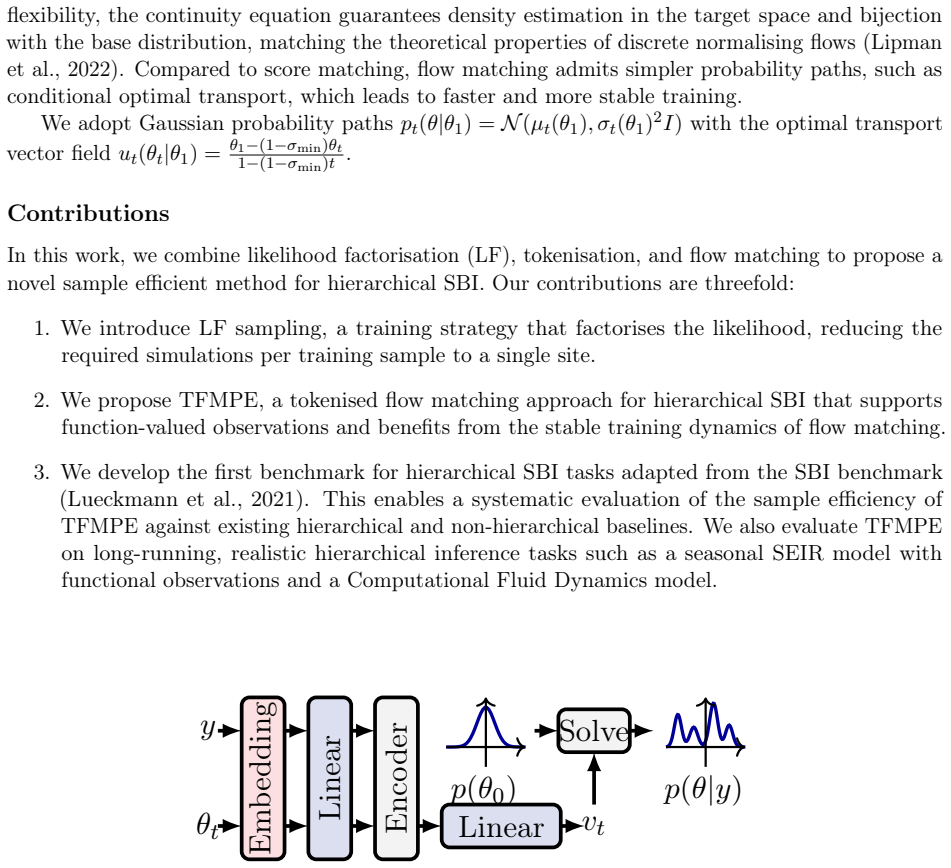
Likelihood factorisation, in which a learned per-site neural surrogate assembles synthetic multi-site observations for training a tokenised flow matching posterior estimator.
If this is right
- Posterior estimation for hierarchical models requires fewer full simulator runs during training.
- Function-valued observations are handled directly inside the flow matching setup.
- Well-calibrated posteriors are obtained on both synthetic hierarchical benchmarks and realistic models.
- The method applies to any setting with exchangeable site-level parameters and shared globals.
Where Pith is reading between the lines
- The same likelihood factorisation could be paired with other amortised inference techniques beyond flow matching.
- The introduced benchmark offers a standard testbed for comparing future hierarchical SBI algorithms.
- If the surrogate generalises across sites, the approach might support sequential addition of new sites without retraining from scratch.
Load-bearing premise
A learned per-site neural surrogate of the simulator can be used to assemble synthetic multi-site observations that preserve sufficient information to amortise inference for the full hierarchical posterior.
What would settle it
Generate synthetic multi-site data from the trained surrogate, estimate the posterior with the flow matching model, then compare posterior calibration and predictive coverage on held-out real multi-site observations from the same hierarchical simulator; systematic miscalibration relative to a multi-site trained baseline would falsify the claim.
Figures






read the original abstract
The cost of simulator evaluations is a key practical bottleneck for Simulation Based Inference (SBI). In hierarchical settings with shared global parameters and exchangeable site-level parameters and observations, this structure can be exploited to improve simulation efficiency. Existing hierarchical SBI approaches factorise the posterior yet still simulate across multiple sites per training sample; We instead explore likelihood factorisation (LF) to train from single-site simulations. In LF sampling we learn a per-site neural surrogate of the simulator and then assemble synthetic multi-site observations to amortise inference for the full hierarchical posterior. Building on this, we propose Tokenised Flow Matching for Posterior Estimation (TFMPE), a tokenised flow matching approach that supports function-valued observations through likelihood factorisation. To enable systematic evaluation, we introduce a benchmark for hierarchical SBI. We validate TFMPE on this benchmark and on realistic infectious disease and computational fluid dynamics models, finding well-calibrated posteriors while reducing computational cost.
Editorial analysis
A structured set of objections, weighed in public.
Referee Report
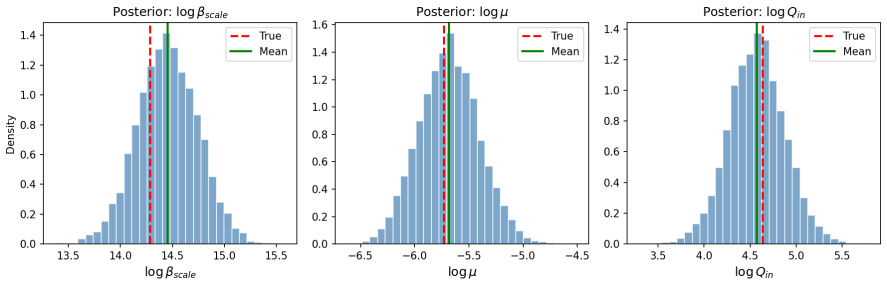
Summary. The manuscript proposes Tokenised Flow Matching for Posterior Estimation (TFMPE) for hierarchical simulation-based inference. It introduces likelihood factorisation (LF) to train a per-site neural surrogate of the simulator from single-site simulations only, then assembles synthetic multi-site observations to amortise the full hierarchical posterior. TFMPE combines this with a tokenised flow-matching posterior estimator that handles function-valued observations. A new benchmark for hierarchical SBI is presented, and the method is evaluated on this benchmark plus infectious-disease and computational-fluid-dynamics models, with the claim that it produces well-calibrated posteriors at reduced computational cost.
Significance. If the central claims hold, the work offers a practical route to lower the simulation burden in hierarchical SBI by exploiting exchangeable site structure. The introduction of a dedicated benchmark is a constructive contribution that could facilitate future comparisons. The technical choice of tokenised flow matching for function-valued data is novel within the SBI literature and, if shown to be robust, could influence amortised inference methods more broadly.
major comments (2)
- [Abstract and §4] Abstract and §4 (validation experiments): the claim that TFMPE 'yields well-calibrated posteriors' is not accompanied by any description of the calibration diagnostics employed (coverage, PIT histograms, or posterior predictive checks), surrogate accuracy metrics, or controls for bias introduced by assembling synthetic multi-site data from per-site surrogates. Because the LF procedure relies on the surrogate reproducing not only marginals but also the dependence structure induced by shared global parameters, the absence of an ablation isolating this effect makes the calibration claim load-bearing and currently unsupported.
- [§3] §3 (likelihood factorisation and TFMPE): the statement that synthetic multi-site observations assembled from the per-site surrogate are 'distributionally sufficient' for amortised posterior inference is presented without a formal argument or empirical test showing that cross-site correlations are preserved. Any systematic under-dispersion or missing global-site dependence in the surrogate would directly bias the flow-matching target and produce miscalibrated hierarchical posteriors, yet no such diagnostic is reported.
minor comments (2)
- [§3] The notation distinguishing the per-site surrogate parameters from the tokenised flow-matching parameters is introduced without an explicit table or equation reference, making it difficult to track which quantities are learned in each stage.
- [§4] Figure captions for the benchmark results should explicitly state the number of independent runs and the precise definition of 'computational cost' (wall-clock time, number of simulator calls, or both) to allow direct comparison with baselines.
Simulated Author's Rebuttal
We thank the referee for their constructive and detailed review. The comments highlight important gaps in the presentation of calibration evidence and the justification for likelihood factorisation. We address each point below and will revise the manuscript accordingly to strengthen the supporting evidence.
read point-by-point responses
-
Referee: [Abstract and §4] Abstract and §4 (validation experiments): the claim that TFMPE 'yields well-calibrated posteriors' is not accompanied by any description of the calibration diagnostics employed (coverage, PIT histograms, or posterior predictive checks), surrogate accuracy metrics, or controls for bias introduced by assembling synthetic multi-site data from per-site surrogates. Because the LF procedure relies on the surrogate reproducing not only marginals but also the dependence structure induced by shared global parameters, the absence of an ablation isolating this effect makes the calibration claim load-bearing and currently unsupported.
Authors: We agree that the original manuscript provided insufficient detail on calibration diagnostics and lacked explicit controls for potential bias from synthetic data assembly. In the revision we will add a new subsection to §4 that reports: (i) coverage probabilities at 50%, 90% and 95% credible levels, (ii) PIT histograms for both global and site-level parameters, and (iii) posterior predictive checks on held-out multi-site observations. We will also report surrogate accuracy via MSE and log-likelihood on single-site test simulations. Finally, we will include an ablation that compares posteriors obtained from true multi-site simulations against those obtained from LF-assembled synthetic observations, thereby isolating any effect on dependence structure. These additions will make the calibration claims fully supported. revision: yes
-
Referee: [§3] §3 (likelihood factorisation and TFMPE): the statement that synthetic multi-site observations assembled from the per-site surrogate are 'distributionally sufficient' for amortised posterior inference is presented without a formal argument or empirical test showing that cross-site correlations are preserved. Any systematic under-dispersion or missing global-site dependence in the surrogate would directly bias the flow-matching target and produce miscalibrated hierarchical posteriors, yet no such diagnostic is reported.
Authors: We accept that the manuscript did not supply a formal argument or explicit empirical test for preservation of cross-site dependence under likelihood factorisation. The LF construction relies on the conditional independence of sites given the global parameters, which in principle induces the correct joint distribution once the surrogate is conditioned on the shared globals; however, we will revise §3 to state this assumption explicitly and to note its limitations. In addition, we will add empirical diagnostics in the revised §4 (and in the new benchmark section) that compare the empirical covariance and dispersion of synthetic versus real multi-site observations, including a quantitative check on cross-site correlation recovery. These tests will directly address the concern about under-dispersion or missing dependence. revision: yes
Circularity Check
No significant circularity; forward methodological proposal
full rationale
The paper introduces likelihood factorisation (LF) to train per-site neural surrogates from single-site simulations, then assembles synthetic multi-site data for amortised hierarchical posterior inference via tokenised flow matching (TFMPE). No equations or claims reduce the reported posterior calibration or efficiency gains to quantities defined by the fitted parameters themselves, nor do they rely on self-citation chains for uniqueness theorems, ansatzes, or renamings of known results. Validation uses an introduced benchmark plus external infectious-disease and CFD models, keeping the derivation chain self-contained and externally falsifiable.
Axiom & Free-Parameter Ledger
free parameters (2)
- Neural network parameters for per-site simulator surrogate
- Parameters of the tokenised flow matching posterior estimator
axioms (2)
- domain assumption The likelihood of hierarchical observations factorises across sites
- ad hoc to paper Synthetic multi-site observations assembled from per-site surrogates are distributionally sufficient for amortised posterior inference
invented entities (1)
-
Tokenised Flow Matching for Posterior Estimation (TFMPE)
no independent evidence
Reference graph
Works this paper leans on
-
[1]
doi: 10.1007/s10439-021-02841-9
ISSN 0090-6964. doi: 10.1007/s10439-021-02841-9. URLhttps://pmc.ncbi.nlm.nih.gov/articles/PMC8671284/. Arruda, J., Pandey, V., Sherry, C., Barroso, M., Intes, X., Hasenauer, J., and Radev, S. T. Compositional amortized inference for large-scale hierarchical bayesian models. 5
-
[2]
Compositional amortized inference for large-scale hierarchical Bayesian models
doi: 10.48550/arXiv.2505.14429. URLhttp://arxiv.org/abs/2505.14429. Blanco, P. J. and Müller, L. O. One-dimensional blood flow modeling in the cardiovascular system. from the conventional physiological setting to real-life hemodynamics.International Journal for Numerical Methods in Biomedical Engineering, 41(3):e70020,
work page internal anchor Pith review Pith/arXiv arXiv doi:10.48550/arxiv.2505.14429
-
[3]
ISSN 2040-7939. doi: 10.1002/cnm.70020. URLhttps://europepmc.org/article/med/40077955. Boelts, J., Deistler, M., Gloeckler, M., Tejero-Cantero, Á., Lueckmann, J.-M., Moss, G., Steinbach, P., Moreau, T., Muratore, F., Linhart, J., Durkan, C., Vetter, J., Miller, B. K., Herold, M., Ziaeemehr, A., Pals, M., Gruner, T., Bischoff, S., Krouglova, N., Gao, R., L...
-
[4]
URL https://arxiv.org/abs/2411.17337v1
doi: 10.48550/arXiv.2411.17337. URL https://arxiv.org/abs/2411.17337v1. Chen, R. T. Q., Rubanova, Y., Bettencourt, J., and Duvenaud, D. Neural ordinary differential equations.arXiv:1806.07366 [cs, stat], 12
-
[5]
https://arxiv.org/abs/1806.07366
URLhttp://arxiv.org/abs/1806.07366. Dax, M., Wildberger, J., Buchholz, S., Green, S. R., Macke, J. H., and Schölkopf, B. Flow matching for scalable simulation-based inference. 10
-
[6]
URLhttp://arxiv.org/abs/2305.17161. Deistler, M., Goncalves, P. J., and Macke, J. H. Truncated proposals for scalable and hassle-free simulation-based inference.arXiv, October
-
[7]
doi: 10.48550/arXiv.2210.04815. Dillon, J. V., Langmore, I., Tran, D., Brevdo, E., Vasudevan, S., Moore, D., Patton, B., Alemi, A., Hoffman, M., and Saurous, R. A. TensorFlow Distributions.arXiv, November
-
[8]
doi: 10.48550/arXiv.1711.10604. Dormand, J. R., El-Mikkawy, M. E. A., and Prince, P. J. High-Order Embedded Runge-Kutta- Nystrom Formulae.IMA J. Numer. Anal., 7(4):423–430, October
-
[9]
ISSN 0272-4979. doi: 10.1093/imanum/7.4.423. Durkan, C., Bekasov, A., Murray, I., and Papamakarios, G. Neural Spline Flows.arXiv, June
-
[10]
doi: 10.48550/arXiv.1906.04032. Flaxman, S., Mishra, S., Gandy, A., Unwin, H. J. T., Mellan, T. A., Coupland, H., Whittaker, C., Zhu, H., Berah, T., Eaton, J. W., Monod, M., Ghani, A. C., Donnelly, C. A., Riley, S., Vollmer, M. A. C., Ferguson, N. M., Okell, L. C., and Bhatt, S. Estimating the effects of non-pharmaceutical interventions on COVID-19 in Eur...
-
[11]
ISSN 1476-4687. doi: 10.1038/s41586-020-2405-7. Geffner, T., Papamakarios, G., and Mnih, A. Compositional score modeling for simulation-based inference
-
[12]
B., Stern, H
15 Gelman, A., Carlin, J. B., Stern, H. S., Dunson, D. B., Vehtari, A., and Rubin, D. B. Bayesian data analysis third edition (with errors fixed as of 15 february 2021)
2021
-
[13]
Accessed: 2026-01-27
URL https://gadm.org/. Accessed: 2026-01-27. Gloeckler, M., Deistler, M., Weilbach, C., Wood, F., and Macke, J. H. All-in-one simulation-based inference. 7
2026
-
[14]
doi: 10.48550/arXiv.2404.09636. URLhttp://arxiv.org/abs/2404.09636. Habermann, D., Bürkner, P.-C., Radev, S. T., Bulling, A., Kühmichel, L., and Schmitt, M. Amortized bayesian multilevel models. 8
-
[15]
Heinrich, L., Mishra-Sharma, S., Pollard, C., and Windischhofer, P
URLhttp://arxiv.org/abs/2408.13230. Heinrich, L., Mishra-Sharma, S., Pollard, C., and Windischhofer, P. Hierarchical neural simulation- based inference over event ensembles. 2
-
[16]
Hierarchical Neural Simulation-Based Inference Over Event Ensembles
doi: 10.48550/arXiv.2306.12584. URL http: //arxiv.org/abs/2306.12584. Hermans, J., Begy, V., and Louppe, G. Likelihood-free mcmc with amortized approximate ratio estimators
-
[17]
URLhttp://arxiv.org/abs/1111.4246v1. Kidger, P.On Neural Differential Equations. PhD thesis, University of Oxford,
-
[18]
doi: 10.48550/arXiv.2302.03026. Linhart, J., Gramfort, A., and Rodrigues, P. L. C. L-c2st: Local diagnostics for posterior approxi- mations in simulation-based inference. 6
-
[19]
URLhttp://arxiv.org/abs/2306.03580v2. Lipman, Y., Chen, R. T. Q., Ben-Hamu, H., Nickel, M., and Le, M. Flow matching for generative modeling. 10
-
[20]
Flow Matching for Generative Modeling
URLhttp://arxiv.org/abs/2210.02747v2. Lueckmann, J.-M., Boelts, J., Greenberg, D. S., Gonçalves, P. J., and Macke, J. H. Benchmarking simulation-based inference. 4
work page internal anchor Pith review Pith/arXiv arXiv
-
[21]
Papamakarios, G., Sterratt, D
URLhttps://proceedings.neurips.cc/paper_files/paper/2016/file/ 6aca97005c68f1206823815f66102863-Paper.pdf. Papamakarios, G., Sterratt, D. C., and Murray, I. Sequential neural likelihood: Fast likelihood-free inference with autoregressive flows. 1
2016
-
[22]
URLhttp://arxiv.org/abs/1805.07226. Pfaller, M. R., Pham, J., Verma, A., Pegolotti, L., Wilson, N. M., Parker, D. W., Yang, W., and Marsden, A. L. Automated generation of 0d and 1d reduced-order models of patient-specific blood flow.International Journal for Numerical Methods in Biomedical Engineering, 38(10): e3639,
-
[23]
ISSN 2040-7939. doi: 10.1002/cnm.3639. URLhttps://pmc.ncbi.nlm.nih.gov/ articles/PMC9561079/. 16 Radev, S. T., Schmitt, M., Pratz, V., Picchini, U., Köthe, U., and Bürkner, P.-C. Jana: Jointly amortized neural approximation of complex bayesian models. 6
-
[24]
URLhttp://arxiv.org/ abs/2302.09125. Rodrigues, P. L., Moreau, T., Louppe, G., and Gramfort, A. Hnpe: Leveraging global parameters for neural posterior estimation. 2
-
[25]
URLhttp://arxiv.org/abs/2102.06477. Taylor-LaPole, A. M., Paun, L. M., Lior, D., Weigand, J. D., Puelz, C., and Olufsen, M. S. Parameter selection and optimization of a computational network model of blood flow in single-ventricle patients.Journal of the Royal Society Interface, 22(223):20240663,
-
[26]
ISSN 1742-5689. doi: 10.1098/rsif.2024.0663. URL https://royalsocietypublishing.org/rsif/article/22/223/ 20240663/90759/Parameter-selection-and-optimization-of-a. Zaheer, M., Kottur, S., Ravanbhakhsh, S., Poczós, B., Salakhutdinov, R. R., and Smola, A. J. Deep sets.Advances in Neural Information Processing Systems, 3
-
[27]
doi: 10.48550/arXiv.1703.06114. URLhttp://arxiv.org/abs/1703.06114. 17 A Appendix A.1 Derivation of the Compositional Posterior Factorisation We derive the factorisationp(θ|y) ∝p (θ)1−ns Qns s=1 p(θ|ys)for i.i.d. observations y = (y1, . . . , yns). Applying Bayes’ rule to the full posterior and using conditional independence: p(θ|y)∝p(θ) nsY s=1 p(ys|θ).(...
-
[28]
Direct" experiment revealed that little inconsistency is due to surrogate approximation error, as its metrics closely track TFMPE’s. The
while keeping the TFMPE tokenised flow-matching backbone, group embeddings, optimiser, and schedule fixed. Two TFMPE estimators are trained sequentially: a global estimatorqϕg(θg |y )on simulations with variable site countsn∈ { 1, . . . , ns} (drawn via stick-breaking so the simulation budget is spent exactly), and a local estimatorqϕl(ηs |θ g, ys)on sing...
2024
-
[29]
Terminal outlets use RCR (Windkessel) boundary conditions
24 where A0 is the reference area andβ is a vessel stiffness parameter. Terminal outlets use RCR (Windkessel) boundary conditions. Hierarchical parameters.Global parameters are θg = (logβ scale,logµ,logQ in), where βscale rescales a baseline stiffness profile,µ is blood viscosity, andQin sets inflow amplitude. We treat each patientas a site s∈ { 1, . . . ...
1918
discussion (0)
Sign in with ORCID, Apple, or X to comment. Anyone can read and Pith papers without signing in.