Recognition: unknown
Fast Bayesian equipment condition monitoring via simulation based inference: applications to heat exchanger health
Pith reviewed 2026-05-10 00:41 UTC · model grok-4.3
The pith
Simulation-based inference matches MCMC accuracy for heat exchanger degradation but infers parameters 82 times faster.
A machine-rendered reading of the paper's core claim, the machinery that carries it, and where it could break.
Core claim
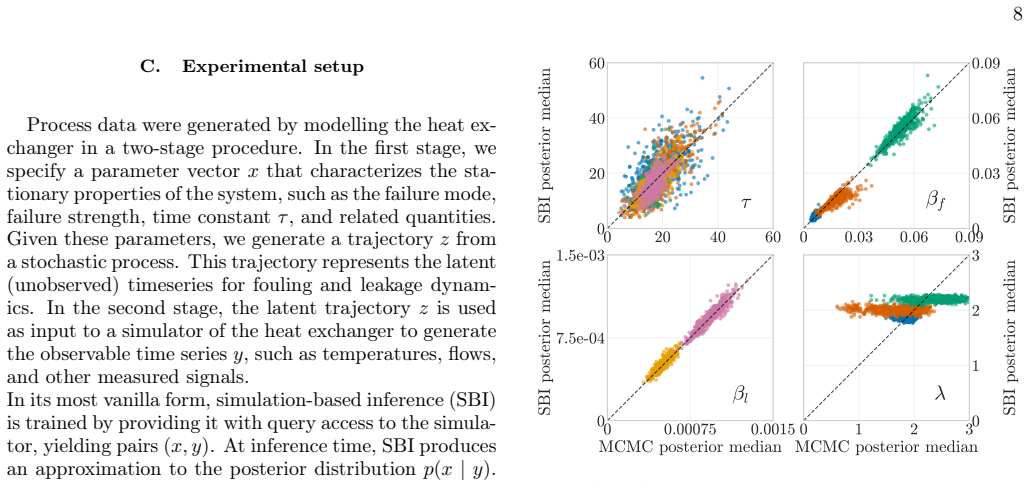
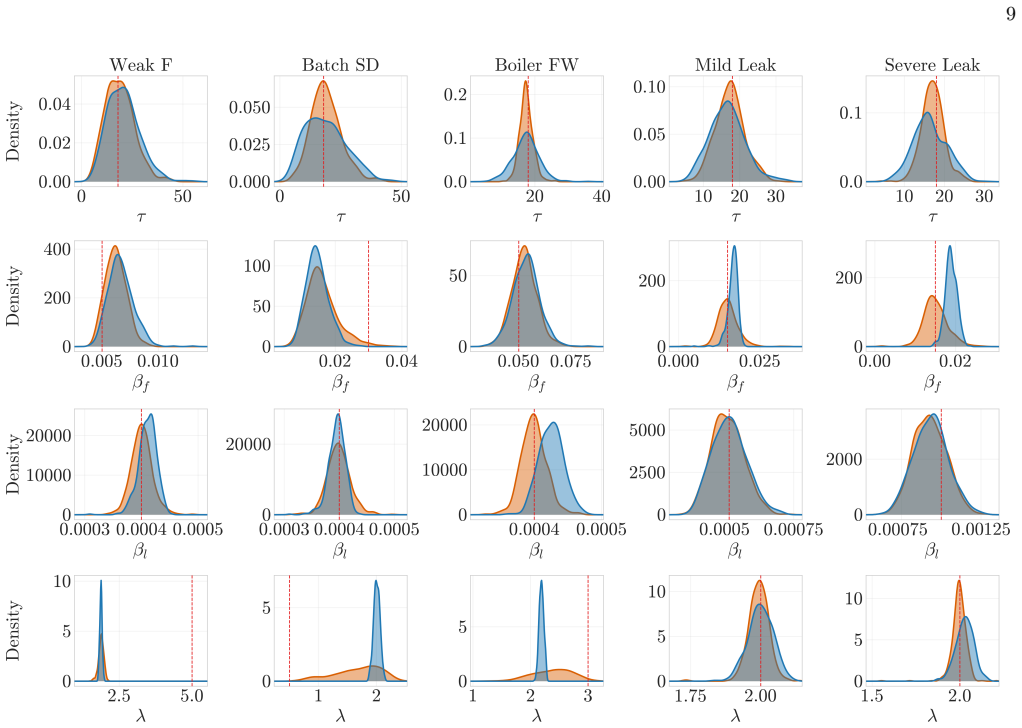
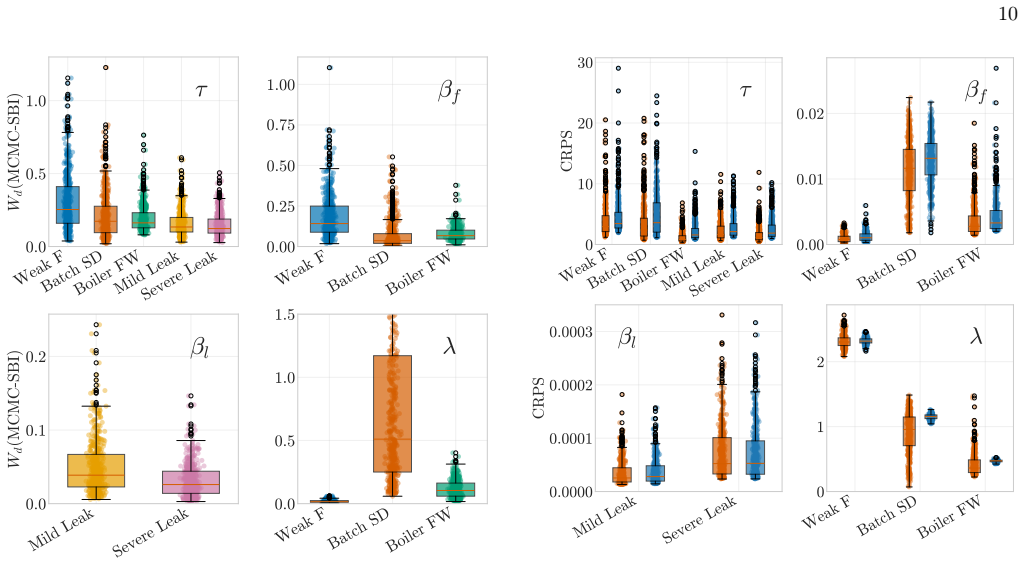
Training neural density estimators on a simulated dataset of thermal-fluid observations yields a likelihood-free mapping from measurements to the posterior over degradation parameters; across synthetic fouling and leakage cases the resulting posteriors match the accuracy and calibration of MCMC while reducing inference time by a factor of 82.
What carries the argument
Amortized neural posterior estimation, which learns a direct mapping from observations to posterior distributions after a single training phase on simulations.
If this is right
- Real-time probabilistic fault diagnosis becomes feasible for process-control loops that must act within seconds.
- Digital-twin models can update their internal degradation state estimates continuously rather than in batch.
- Low-probability sparse failure events can still be diagnosed with quantified uncertainty without prohibitive compute cost.
- The same trained network can be reused across many units or operating conditions once the initial simulation training is complete.
Where Pith is reading between the lines
- The approach could be applied to other sensor-rich equipment such as pumps or turbines if equivalent high-fidelity simulators exist.
- Online retraining or domain-adaptation layers might allow the network to track gradual changes in system behavior without full re-simulation.
- Integration with control systems could enable proactive maintenance scheduling driven by the full posterior rather than point estimates.
Load-bearing premise
The simulated thermal-fluid data and failure modes must be representative enough that the trained network produces accurate posteriors when applied to real sensor readings.
What would settle it
Apply the trained network to real heat-exchanger sensor streams whose true degradation levels are independently measured or known, then check whether the predicted posteriors are calibrated and contain the true parameter values at the reported credible intervals.
Figures




read the original abstract
Accurate condition monitoring of industrial equipment requires inferring latent degradation parameters from indirect sensor measurements under uncertainty. While traditional Bayesian methods like Markov Chain Monte Carlo (MCMC) provide rigorous uncertainty quantification, their heavy computational bottlenecks render them impractical for real-time process control. To overcome this limitation, we propose an AI-driven framework utilizing Simulation-Based Inference (SBI) powered by amortized neural posterior estimation to diagnose complex failure modes in heat exchangers. By training neural density estimators on a simulated dataset, our approach learns a direct, likelihood-free mapping from thermal-fluid observations to the full posterior distribution of degradation parameters. We benchmark this framework against an MCMC baseline across various synthetic fouling and leakage scenarios, including challenging low-probability, sparse-event failures. The results show that SBI achieves comparable diagnostic accuracy and reliable uncertainty quantification, while accelerating inference time by a factor of82$\times$ compared to traditional sampling. The amortized nature of the neural network enables near-instantaneous inference, establishing SBI as a highly scalable, real-time alternative for probabilistic fault diagnosis and digital twin realization in complex engineering systems.
Editorial analysis
A structured set of objections, weighed in public.
Referee Report
Summary. The manuscript proposes an amortized simulation-based inference (SBI) framework using neural posterior estimation to perform fast Bayesian inference of latent degradation parameters (e.g., fouling factors, leakage rates) in heat exchangers from indirect thermal-fluid sensor observations. It benchmarks the approach against MCMC on synthetic datasets simulating fouling and leakage scenarios, claiming comparable diagnostic accuracy and uncertainty quantification with an 82× inference-time speedup.
Significance. If the central claims hold, the work would demonstrate a practical route to real-time probabilistic condition monitoring via amortization, addressing the computational barrier that has limited Bayesian methods in industrial digital-twin applications. The use of synthetic data with known ground-truth parameters enables direct, falsifiable evaluation of posterior recovery and calibration, which is a methodological strength. The focus on low-probability sparse-event failures further strengthens the relevance for safety-critical equipment.
major comments (3)
- [§4] §4 (Neural Posterior Estimation): The specific neural density estimator (e.g., SNPE-C, MAF, or MDN), its architecture (layers, hidden units, activation), and training procedure (number of simulations, prior specification, loss function, optimizer schedule) are not described in sufficient detail to allow reproduction or to diagnose the source of the reported accuracy.
- [§5.2] §5.2 and Table 2: The quantitative metrics underlying the claim of 'comparable diagnostic accuracy' (posterior mean error, credible-interval coverage, or calibration error) are not defined or tabulated against the MCMC baseline, making it impossible to judge whether the posteriors are statistically equivalent or merely qualitatively similar.
- [§5.3] §5.3 (Timing Experiments): The 82× speedup is stated without reporting MCMC implementation details (number of chains, samples, thinning, convergence diagnostics such as R-hat), hardware platform, or whether the one-time neural-network training cost is excluded from the comparison; this undermines the load-bearing performance claim.
minor comments (3)
- [Abstract] Abstract: the inline LaTeX '82$×$' renders incorrectly in plain text; use consistent notation throughout.
- [§2] The manuscript should add a short related-work subsection contrasting the proposed amortized SBI approach with existing surrogate-model or reduced-order Bayesian methods already used in heat-exchanger monitoring.
- [Figures] Figure captions for posterior visualizations should explicitly state the number of held-out test cases and the exact coverage probability shown.
Simulated Author's Rebuttal
We thank the referee for their constructive comments, which have helped us strengthen the reproducibility and clarity of the manuscript. We address each major comment below and have revised the paper accordingly.
read point-by-point responses
-
Referee: [§4] §4 (Neural Posterior Estimation): The specific neural density estimator (e.g., SNPE-C, MAF, or MDN), its architecture (layers, hidden units, activation), and training procedure (number of simulations, prior specification, loss function, optimizer schedule) are not described in sufficient detail to allow reproduction or to diagnose the source of the reported accuracy.
Authors: We agree that the original manuscript did not provide sufficient implementation details for reproducibility. In the revised version, Section 4 has been expanded to fully specify the neural density estimator (SNPE-C with MAF), its architecture, the number of simulations used for training, the prior distributions, the loss function, and the optimizer schedule. These additions enable readers to reproduce the experiments and assess the source of the reported performance. revision: yes
-
Referee: [§5.2] §5.2 and Table 2: The quantitative metrics underlying the claim of 'comparable diagnostic accuracy' (posterior mean error, credible-interval coverage, or calibration error) are not defined or tabulated against the MCMC baseline, making it impossible to judge whether the posteriors are statistically equivalent or merely qualitatively similar.
Authors: We acknowledge that the metrics supporting the accuracy claim were not explicitly defined or compared quantitatively. The revised Section 5.2 now defines the evaluation metrics (posterior mean error, credible-interval coverage, and calibration error), and Table 2 has been updated to report these values for both SBI and MCMC across all scenarios. This allows a direct, quantitative judgment of whether the posteriors are statistically comparable. revision: yes
-
Referee: [§5.3] §5.3 (Timing Experiments): The 82× speedup is stated without reporting MCMC implementation details (number of chains, samples, thinning, convergence diagnostics such as R-hat), hardware platform, or whether the one-time neural-network training cost is excluded from the comparison; this undermines the load-bearing performance claim.
Authors: We agree that the timing comparison lacked necessary context. The revised Section 5.3 now reports the MCMC implementation details (number of chains, samples, thinning, and R-hat convergence diagnostics), the hardware platform used for both methods, and explicitly states that the 82× factor measures only amortized inference time, excluding the one-time training cost. These clarifications support the performance claim with full transparency. revision: yes
Circularity Check
No significant circularity in derivation chain
full rationale
The paper trains neural density estimators on synthetic data from a thermal-fluid simulator and benchmarks posterior recovery and inference speed directly against MCMC on held-out synthetic fouling/leakage cases. Ground-truth parameters are known by construction in this controlled setting, so the reported 82× speedup and comparable accuracy follow from amortization and explicit comparison rather than any self-referential fit, self-citation load-bearing premise, or renaming of inputs as predictions. No equations or claims reduce to their own inputs by definition; the validation is external to the fitted network within the synthetic benchmark.
Axiom & Free-Parameter Ledger
axioms (1)
- domain assumption Simulated thermal-fluid observations and degradation scenarios are sufficiently representative of real heat exchanger behavior
Reference graph
Works this paper leans on
-
[1]
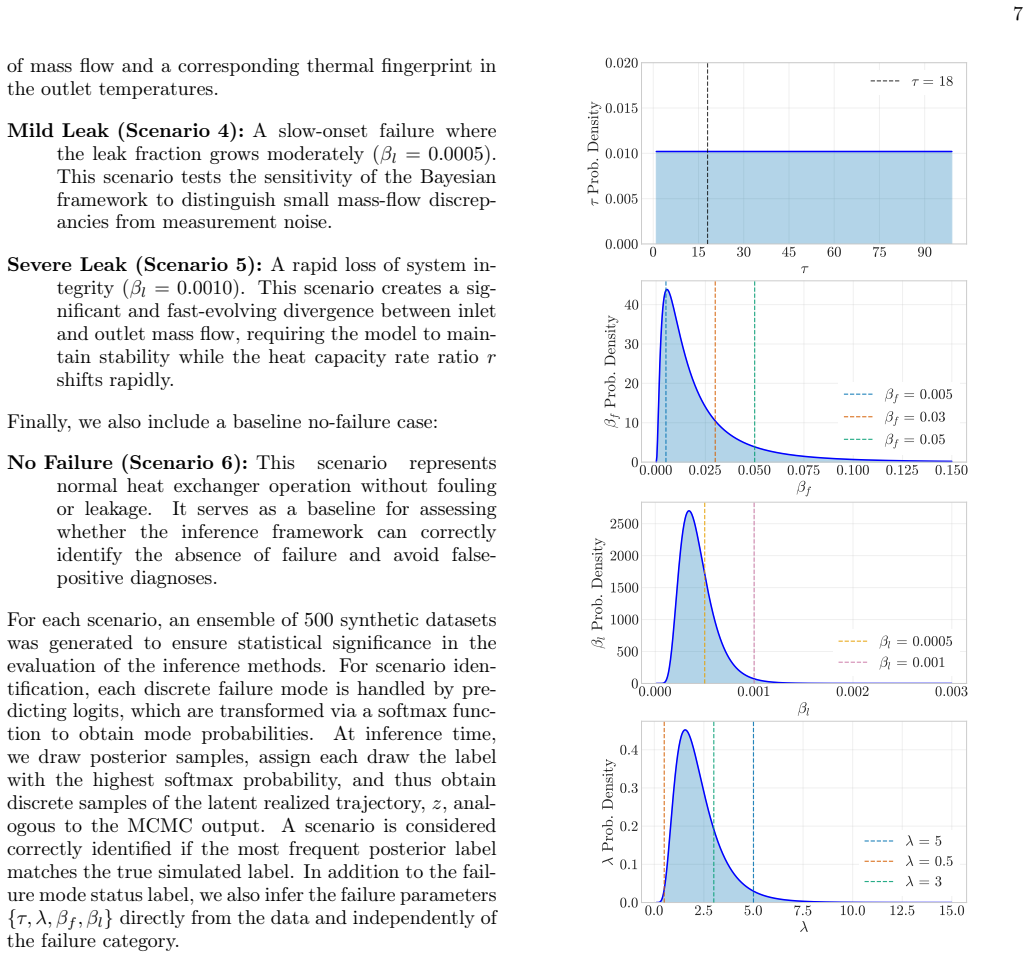
2: Fouling and Leakage evolution in time with the effect of the failure parameters (λ, βf , βl) over the trajectories at a fixed failure onset timeτ
T ube F ouling.In this work, grounded in recent analyses of physical deposition mechanisms [40], fouling is modeled as a reduction in the overall conductanceU A via a non-negative, dimensionless fouling factorR(t): U A(t) = U Aclean 1 +R(t) .(10) FIG. 2: Fouling and Leakage evolution in time with the effect of the failure parameters (λ, βf , βl) over the ...
-
[2]
Leakage with Fluid Loss.Internal leakage is modeled as a diversion of fluid from the primary hot- stream flow path, representing a shell-side bypass or a loss of integrity in the tube-to-header seals. We define a time-dependent leak fractionL(t)∈[0,1)that reduces the effective mass flow rate participating in the heat ex- change: ˙mhot,out(t) = ˙mhot,in(1−...
2000
-
[3]
Ahmed Murtaza, A
A. Ahmed Murtaza, A. Saher, M. Hamza Zafar, S. Ku- mayl Raza Moosavi, M. Faisal Aftab, and F. Sanfilippo, Results in Engineering24, 102935 (2024). 14
2024
-
[4]
Villa and C
L. Villa and C. Zanini Brusamarello, The Canadian Jour- nal of Chemical Engineering103, 1786 (2025)
2025
-
[5]
R.Qi, J.Zhang,andK.Spencer,Algorithms16,9(2022)
2022
-
[6]
A. Sahu, S. K. Palei, and A. Mishra, Expert Systems41, 10.1111/exsy.13360 (2023)
-
[7]
J. Zou, T. Hirokawa, J. An, L. Huang, and J. Camm, Frontiers in Energy Research11, 10.3389/fenrg.2023.1294531 (2023)
-
[8]
Sundar, M
S. Sundar, M. C. Rajagopal, H. Zhao, G. Kuntumalla, Y. Meng, H. C. Chang, C. Shao, P. Ferreira, N. Miljkovic, S. Sinha, and S. Salapaka, Intl. J. of Heat and Mass Transf.159, 120112 (2020)
2020
-
[9]
Z. Wu, B. Zhang, H. Yu, J. Ren, M. Pan, C. He, and Q. Chen, Chem. Eng. Sci.282, 119285 (2023)
2023
-
[10]
Jradi, C
R. Jradi, C. Marvillet, and M. R. Jeday, Sci. Rep12, 20437 (2022)
2022
-
[11]
Markowski and P
M. Markowski and P. Trzcinski, Sci. Rep15, 42078 (2025)
2025
-
[12]
A. A. Bash, H. Karah, and A. A. Khail, Engineering Ap- plications of Artificial Intelligence151, 110723 (2025)
2025
-
[13]
G. Hou, D. Zhang, Q. Yan, S. Wang, L. Ma, and M. Jiang, International Communications in Heat and Mass Transfer164, 108809 (2025)
2025
-
[14]
G. Hou, Z. An, D. Zhang, X. Du, Y. Ding, and J. Fu, In- ternational Communications in Heat and Mass Transfer 175, 111129 (2026)
2026
-
[15]
H. Xu, S. Yan, X. Qin, W. An, and J. Wang, Processes 13, 10.3390/pr13010219 (2025)
-
[16]
Hosseini, A
S. Hosseini, A. Khandakar, M. E. Chowdhury, M. A. Ayari, T. Rahman, M. H. Chowdhury, and B. Vaferi, En- ergy Reports8, 8767 (2022)
2022
-
[17]
Berce, M
J. Berce, M. Bucci, M. Zupančič, M. Može, and I. Golo- bič, Applied Thermal Engineering277, 126954 (2025)
2025
-
[18]
Aboul Khail and A
A. Aboul Khail and A. Karah Bash, Thermal Science and Engineering Progress71, 104565 (2026)
2026
-
[19]
R. Ben-Mansour, S. El-Ferik, M. Al-Naser, B. A. Qureshi, M. A. M. Eltoum, A. Abuelyamen, F. Al-Sunni, and R. Ben Mansour, Energies16, 10.3390/en16062812 (2023)
-
[20]
Etminan, K
A. Etminan, K. Pope, and K. Mashayekh, AI Thermal Fluids4, 100022 (2025)
2025
-
[21]
Gelman, J
A. Gelman, J. B. Carlin, H. S. Stern, and D. B. Rubin, Bayesian data analysis(Chapman and Hall/CRC, 1995)
1995
-
[22]
Moradi, S
R. Moradi, S. Cofre-Martel, E. Lopez Droguett, M. Modarres, and K. M. Groth, Reliability Engineering & System Safety222, 108433 (2022)
2022
-
[23]
M. E. Cholette, H. Yu, P. Borghesani, L. Ma, and G. Kent, Reliability Engineering & System Safety183, 184 (2019)
2019
-
[24]
Bardeeniz, C
S. Bardeeniz, C. Panjapornpon, P. Chomchai, and M. A. Hussain, Reliability Engineering & System Safety262, 111250 (2025)
2025
-
[25]
G. L. Jones and Q. Qin, Annual Review of Statistics and Its Application9, 557 (2021)
2021
-
[26]
Xiao and W
S. Xiao and W. Nowak, Reliability Engineering & System Safety266, 111718 (2026)
2026
-
[27]
Zio and G
E. Zio and G. Peloni, Reliability Engineering & System Safety96, 403 (2011)
2011
-
[28]
Nazemzadeh, J
N. Nazemzadeh, J. Loyola-Fuentes, G. Righetti, E. Diaz- Bejarano, S. Mancin, and F. Coletti, AI Thermal Fluids 5, 100030 (2026)
2026
-
[29]
Mo and W.-J
J. Mo and W.-J. Yan, Reliability Engineering & System Safety264, 111337 (2025)
2025
-
[30]
Dasgupta and E
A. Dasgupta and E. A. Johnson, Reliability Engineering & System Safety242, 109729 (2024)
2024
-
[31]
Cranmer, J
K. Cranmer, J. Brehmer, and G. Louppe, Proceedings of the National Academy of Sciences117, 30055 (2020)
2020
-
[32]
M. Deistler, J. Boelts, P. Steinbach, G. Moss, T. Moreau, M. Gloeckler, P. L. C. Rodrigues, J. Linhart, J. K. Lap- palainen, B. K. Miller, P. J. Gonçalves, J.-M. Lueck- mann, C. Schröder, and J. H. Macke, Simulation-based inference: A practical guide (2025), arXiv:2508.12939 [stat.ML]
-
[33]
Álvaro Tejero-Cantero, J. Boelts, M. Deistler, J.-M. Lueckmann, C. Durkan, P. J. Gonçalves, D. Green- berg, and J. H. Macke, arXiv 10.48550/arxiv.2007.09114 (2020)
-
[34]
Advances in neural information processing systems , year=
G. Papamakarios and I. Murray, Fastϵ-free inference of simulation models with bayesian conditional density es- timation (2018), arXiv:1605.06376 [stat.ML]
-
[35]
Papamakarios, D
G. Papamakarios, D. Sterratt, and I. Murray, inProceed- ings of the Twenty-Second International Conference on Artificial Intelligence and Statistics, Proceedings of Ma- chine Learning Research, Vol. 89, edited by K. Chaudhuri and M. Sugiyama (PMLR, 2019) pp. 837–848
2019
-
[36]
S. He, Y. Ye, M. Wang, J. Zhang, W. Tian, S. Qiu, and G. Su, Nuclear Engineering and Design432, 113759 (2025)
2025
-
[37]
J. Degrave, M. Hermans, J. Dambre, and F. Wyffels, A differentiable physics engine for deep learning in robotics (2018), arXiv:1611.01652 [cs.NE]
-
[38]
Majumdar, V
R. Majumdar, V. Jadhav, A. Deodhar, S. Karande, L. Vig, and V. Runkana, Numerical Heat Transfer, Part B: Fundamentals86, 1910 (2025)
1910
-
[39]
M. Shi, L. Sun, Z. Bi, and R. He, Computers & Chemical Engineering201, 109259 (2025)
2025
-
[40]
T. L. Bergman, A. S. Lavine, F. P. Incropera, and D. P. DeWitt,Fundamentals of heat and mass transfer(John Wiley & Sons, 2011)
2011
-
[41]
Zhang, J.-L
J.-X. Zhang, J.-L. Zhang, Z.-X. Zhang, T.-M. Li, and X.-S. Si, Reliability Engineering & System Safety250, 110223 (2024)
2024
-
[42]
P. Wang, Q. Liu, D. Xu, G. Jiang, W. Peng, F. Liu, and J. Hou, International Journal of Heat and Mass Transfer 256, 128183 (2026)
2026
-
[43]
Tankov and R
P. Tankov and R. Cont,Financial Modelling with Jump Processes(Chapman and Hall/CRC, Boca Raton, 2003)
2003
-
[44]
Ebert and C
W. Ebert and C. B. Panchal, inFouling mitigation in in- dustrial heat exchanger equipment, edited by C. B. Pan- chal, T. R. Bott, E. F. C. Somerscales, and S. Toyama (Begell House, 1997) pp. 451–460
1997
-
[45]
van Ravenzwaaij, P
D. van Ravenzwaaij, P. Cassey, and S. D. Brown, Psy- chonomic Bulletin & Review25, 143 (2018)
2018
-
[46]
D. M. Blei, A. Kucukelbir, and J. D. McAuliffe, Jour- nal of the American Statistical Association112, 859–877 (2017)
2017
-
[47]
M. D. Hoffman and A. Gelman, J. Mach. Learn. Res.15, 1593–1623 (2014)
2014
-
[48]
Sunnåker, A
M. Sunnåker, A. G. Busetto, E. Numminen, J. Corander, M. Foll, and C. Dessimoz, PLoS Computational Biology 9, e1002803 (2013)
2013
-
[49]
D. S. Greenberg, M. Nonnenmacher, and J. H. Macke, in International Conference on Machine Learning(2019)
2019
-
[50]
Boelts, M
J. Boelts, M. Deistler, M. Gloeckler, Álvaro Tejero- Cantero, J.-M. Lueckmann, G. Moss, P. Steinbach, T. Moreau, F. Muratore, J. Linhart, C. Durkan, J. Vet- ter, B. K. Miller, M. Herold, A. Ziaeemehr, M. Pals, 15 T. Gruner, S. Bischoff, N. Krouglova, R. Gao, J. K. Lappalainen, B. Mucsányi, F. Pei, A. Schulz, Z. Ste- fanidi, P. Rodrigues, C. Schröder, F. A...
2025
-
[51]
J. E. Matheson and R. L. Winkler, Management Science 22, 1087 (1976)
1976
-
[52]
C. Yang, M. Ai, Z. Tang, and Y. Xie, Engineering Appli- cations of Artificial Intelligence162, 112236 (2025)
2025
-
[53]
Chang and Y.-H
L. Chang and Y.-H. Lin, Engineering Applications of Ar- tificial Intelligence142, 109980 (2025)
2025
- [54]
-
[55]
Bingham, J
E. Bingham, J. P. Chen, M. Jankowiak, F. Obermeyer, N. Pradhan, T. Karaletsos, R. Singh, P. A. Szerlip, P. Horsfall, and N. D. Goodman, J. Mach. Learn. Res. 20, 28:1 (2019)
2019
-
[56]
Durkan, A
C. Durkan, A. Ivanov, A. Maddison, and G. Papamakar- ios, inAdvances in Neural Information Processing Sys- tems, Vol. 32 (2019) pp. 7511–7522
2019
-
[57]
A. Delaunoy, B. K. Miller, P. Forré, C. Weniger, and G. Louppe, Preprint (2023), arXiv:2304.10978 [stat.ML]
-
[58]
M. Falkiewicz, N. Takeishi, I. Shekhzadeh, A. Wehenkel, A. Delaunoy, G. Louppe, and A. Kalousis, Preprint (2023), arXiv:2310.13402 [stat.ML]
-
[59]
X. Xu, J. Zhou, X. Weng, Z. Zhang, H. He, F. Steyskal, and G. Brunauer, Reliability Engineering & System Safety250, 110250 (2024)
2024
discussion (0)
Sign in with ORCID, Apple, or X to comment. Anyone can read and Pith papers without signing in.