Recognition: unknown
How do sub-bandgap reflectors affect the performance of PV modules?
Pith reviewed 2026-05-09 22:24 UTC · model grok-4.3
The pith
An ideal sub-bandgap reflector increases the annual energy yield of silicon PV modules by 1.0 to 2.4 percent depending on mounting configuration.
A machine-rendered reading of the paper's core claim, the machinery that carries it, and where it could break.
Core claim
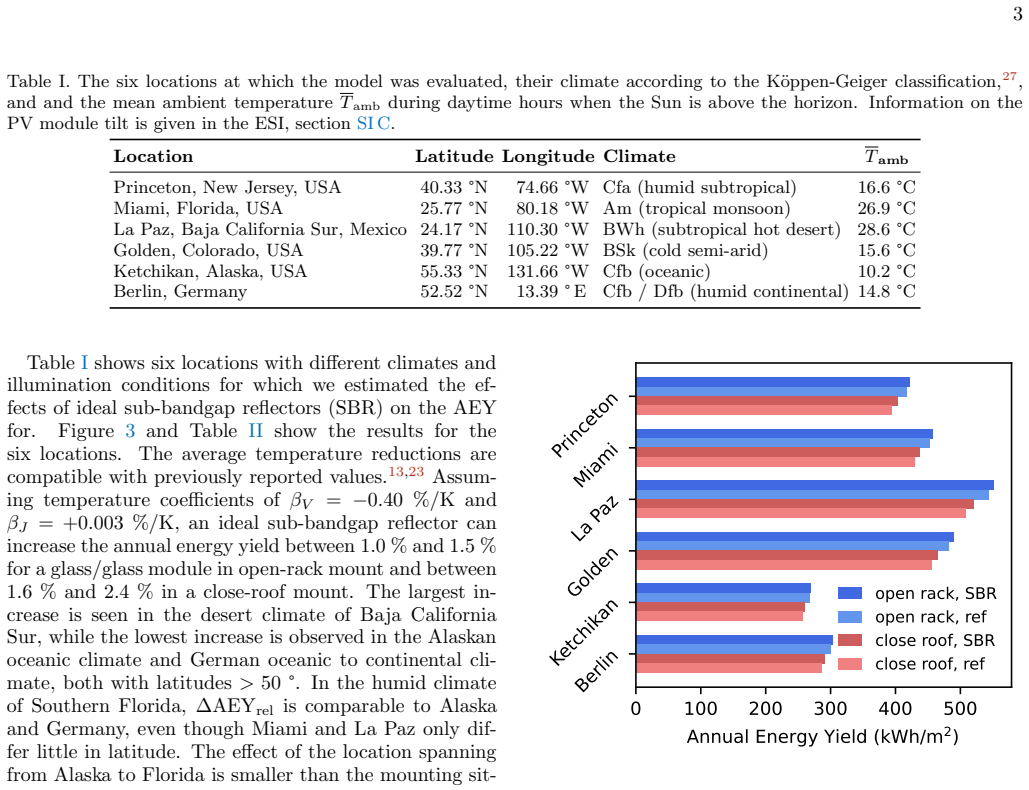
We consider an ideal SBR, which reflects 100 % of non-harvestable low-energy photons but does not alter the reflectivity of the PV module for usable high-energy photons, and estimate how reducing the module temperature with the SBR affects the annual and the cumulative energy yield of silicon PV modules for six locations in North America and Europe. An ideal SBR would increase the annual energy yield between 1.0 % and 1.5 % for open-rack mounted modules and between 1.6 % and 2.4 % for close-roof mounted PV modules. By describing degradation using a simple Arrhenius approach using typical activation energies between 0.4 eV and 0.8 eV, we find that an ideal SBR increases the cumulative energy
What carries the argument
Ideal sub-bandgap reflector that reflects all photons below the silicon bandgap without changing reflectivity for above-bandgap photons, thereby lowering module temperature.
If this is right
- Annual energy yield increases by 1.0-1.5% for open-rack mounted modules.
- Gains are larger, 1.6-2.4%, for close-roof mounted modules due to higher operating temperatures.
- Cumulative energy yield over 30 years rises by 2.2-4.0% when including reduced degradation.
- The benefit depends on location and the actual optical properties of the reflector coating.
- Non-ideal SBRs may not always provide a net positive effect.
Where Pith is reading between the lines
- Similar temperature-reduction strategies could be explored for other PV absorber materials with different bandgaps.
- The approach might combine with other passive cooling methods for additive effects.
- Real-world deployment would require durability testing of the reflector layer under weathering conditions.
- Economic modeling could assess if the yield gains offset any added manufacturing costs.
Load-bearing premise
A coating exists that perfectly reflects 100% of sub-bandgap photons while leaving the module's response to harvestable photons unchanged, and that module degradation follows a simple Arrhenius temperature dependence.
What would settle it
Outdoor testing of prototype modules with an actual SBR coating versus controls, tracking temperature, instantaneous power, annual yield, and degradation rates over multiple years.
Figures




read the original abstract
Sub-bandgap reflectors (SBR) can reduce the temperature of photovoltaic (PV) modules by reflecting the near-infrared region of the solar spectrum with photon energies smaller than the electronic bandgap of the solar cell absorber material. We consider an ideal SBR, which reflects 100 % of non-harvestable low-energy photons but does not alter the reflectivity of the PV module for usable high-energy photons, and estimate how reducing the module temperature with the SBR affects the annual and the cumulative energy yield of silicon PV modules for six locations in North America and Europe. An ideal SBR would increase the annual energy yield between 1.0 % and 1.5 % for open-rack mounted modules and between 1.6 % and 2.4 % for close-roof mounted PV modules. Whether a non-ideal SBR provides a benefit in actual deployments strongly depends on the location and the optical properties of the coating. Beyond effects on the instantaneous power conversion efficiency and hence the annual energy yield, reducing the temperature by a SBR might also reduce the degradation and increase the overall lifetime of the PV module. By describing degradation using a simple Arrhenius approach using typical activation energies between 0.4 eV and 0.8 eV, we find that an ideal SBR increases the cumulative energy yield over 30 years between 2.2 % and 4.0 % for an open-rack mounted PV module in Princeton, New Jersey, USA.
Editorial analysis
A structured set of objections, weighed in public.
Referee Report
Summary. The manuscript estimates the performance impact of ideal sub-bandgap reflectors (SBRs) on silicon PV modules. An ideal SBR reflects 100% of non-harvestable near-IR photons without changing high-energy reflectivity, thereby lowering module temperature. Using standard temperature-dependent efficiency relations from the literature, the authors calculate annual energy-yield gains of 1.0–1.5% for open-rack and 1.6–2.4% for close-roof mounted modules across six North American and European sites. Applying a simple Arrhenius degradation model with activation energies 0.4–0.8 eV to the temperature reduction, they further report a 2.2–4.0% increase in cumulative 30-year energy yield for an open-rack module in Princeton, NJ.
Significance. If the ideal-SBR optical assumption and the single-mechanism Arrhenius degradation model prove realistic, the reported yield improvements would be a useful quantitative benchmark for passive radiative-cooling coatings in PV. The work correctly separates instantaneous efficiency gains from lifetime-extension effects and supplies location-specific numbers that could guide coating development. However, the absence of sensitivity analysis, error propagation, or field-data validation for the degradation step limits the strength of the long-term claim.
major comments (2)
- [degradation analysis] Degradation analysis (final paragraph of abstract and corresponding modeling section): the 2.2–4.0% cumulative-yield increase is obtained by inserting the SBR-induced temperature drop into the Arrhenius rate k = A exp(−Ea/kBT) and integrating over 30 years for Ea = 0.4–0.8 eV. No sensitivity study is performed on the width of the Ea interval, on possible temperature-independent degradation channels, or on multi-mechanism kinetics; because the integrated benefit is exponentially sensitive to these choices, the headline cumulative number rests on an untested modeling assumption.
- [ideal-SBR optical model] Ideal-SBR optical model (abstract and methods): all quantitative results assume perfect (100%) reflection of sub-bandgap photons with zero change to above-bandgap reflectivity. The manuscript notes that real coatings will deviate but does not propagate plausible deviations (e.g., 80–95% sub-bandgap reflectance or a 1–2% increase in above-bandgap reflectance) through the temperature and yield calculations, leaving the reported 1.0–2.4% annual gains without quantified robustness bounds.
minor comments (2)
- The ranges given for annual and cumulative gains (e.g., 1.0–1.5%, 2.2–4.0%) are presented without explicit uncertainty budgets or Monte-Carlo propagation from the input temperature coefficients and activation energies.
- The six locations used for the annual-yield calculations are mentioned but not listed; adding a short table or footnote with the exact sites and their climate parameters would improve reproducibility.
Simulated Author's Rebuttal
We thank the referee for the constructive comments, which help clarify the scope and limitations of our modeling study. We address each major point below and will incorporate targeted revisions to strengthen the manuscript.
read point-by-point responses
-
Referee: [degradation analysis] Degradation analysis (final paragraph of abstract and corresponding modeling section): the 2.2–4.0% cumulative-yield increase is obtained by inserting the SBR-induced temperature drop into the Arrhenius rate k = A exp(−Ea/kBT) and integrating over 30 years for Ea = 0.4–0.8 eV. No sensitivity study is performed on the width of the Ea interval, on possible temperature-independent degradation channels, or on multi-mechanism kinetics; because the integrated benefit is exponentially sensitive to these choices, the headline cumulative number rests on an untested modeling assumption.
Authors: We agree that the single-mechanism Arrhenius model is a simplification and that the cumulative benefit is sensitive to modeling choices. In the revised manuscript we will add an explicit sensitivity analysis varying Ea over a wider interval (0.3–1.0 eV) and will include a short discussion of how a temperature-independent degradation channel would proportionally reduce the relative lifetime gain from the SBR. We will also state more clearly that the 2.2–4.0 % range is illustrative for the commonly cited Ea values in the PV literature rather than a comprehensive prediction. A full multi-mechanism kinetic treatment lies outside the present scope because it requires module-specific material data that are not available for a general benchmark study. revision: partial
-
Referee: [ideal-SBR optical model] Ideal-SBR optical model (abstract and methods): all quantitative results assume perfect (100%) reflection of sub-bandgap photons with zero change to above-bandgap reflectivity. The manuscript notes that real coatings will deviate but does not propagate plausible deviations (e.g., 80–95% sub-bandgap reflectance or a 1–2% increase in above-bandgap reflectance) through the temperature and yield calculations, leaving the reported 1.0–2.4% annual gains without quantified robustness bounds.
Authors: The ideal-SBR case is deliberately presented as an upper-bound benchmark. We will revise the manuscript to include a quantitative sensitivity study that propagates two representative non-ideal scenarios: (i) 90 % and 95 % sub-bandgap reflectance with unchanged above-bandgap optics, and (ii) 100 % sub-bandgap reflectance accompanied by a 1 % increase in above-bandgap reflectance. The resulting temperature reductions and annual energy-yield gains will be reported alongside the ideal values, thereby supplying the robustness bounds requested. revision: yes
- Field-data validation of the degradation predictions, which would require multi-year outdoor module testing not feasible within the modeling framework of this study.
Circularity Check
No circularity; all quantitative claims derive from external temperature-yield relations and literature Arrhenius parameters
full rationale
The paper's central estimates (1.0–1.5 % annual yield gain for open-rack modules, 2.2–4.0 % cumulative 30-year gain) are obtained by inserting a calculated temperature drop into pre-existing empirical efficiency-vs-temperature curves and a standard Arrhenius degradation rate law with Ea values taken from the literature (0.4–0.8 eV). No equation in the manuscript defines a quantity in terms of itself, renames a fitted parameter as a prediction, or relies on a uniqueness theorem or ansatz imported from the authors' prior work. The optical ideal-SBR assumption is stated explicitly as an input rather than derived, and the degradation step is presented as a simple external model without self-referential closure. The derivation chain therefore remains open to independent benchmarks and does not reduce to its own inputs by construction.
Axiom & Free-Parameter Ledger
free parameters (1)
- activation energy for degradation =
0.4-0.8 eV
axioms (2)
- domain assumption An ideal SBR reflects 100% of sub-bandgap photons while leaving above-bandgap reflectivity unchanged.
- domain assumption PV module power and degradation follow standard temperature-dependent models without additional unmodeled effects.
Reference graph
Works this paper leans on
-
[1]
Illumination model Irradiance on PV module Im Current density Jph
-
[2]
Optical model Weather dataPosition of Sun
-
[3]
Electrical model Electrical power density P
-
[4]
Flowchart illustrating the data sets and models required to calculate the electrical power density and hence energy yield of a PV module
Temperature model Solar-cell temperature Tc Figure 2. Flowchart illustrating the data sets and models required to calculate the electrical power density and hence energy yield of a PV module. Fig. 1(a), such an ideal SBR would reflect 100 % of the incident light below the bandgap of silicon (λ > λ g = 1100 nm) but would not alter the reflectivity of the P...
2024
-
[5]
ACKNOWLEDGEMENTS KJ thanks Princeton University to make this work pos- sible by allowing him to stay at the Andlinger Center for Energy and the Environment as a Gerhard R
Upon acceptance of the manuscript, a permanent archived version will be made available via Zenodo and referenced here with a DOI. ACKNOWLEDGEMENTS KJ thanks Princeton University to make this work pos- sible by allowing him to stay at the Andlinger Center for Energy and the Environment as a Gerhard R. Andlinger Visiting Fellow. Parts of the research were p...
2024
-
[6]
B. R. Paudyal and A. G. Imenes, Sol. Energy224, 425 (2021)
2021
-
[7]
A. Khan, P. Anand, S. Garshasbi, R. Khatun, S. Khorat, R. Hamdi, D. Niyogi, and M. Santamouris, Nature Cities 1, 780 (2024)
2024
-
[8]
Hosseini and E
E. Hosseini and E. Bou-Zeid, Energ Buildings347, 116354 (2025)
2025
-
[9]
Sato and N
D. Sato and N. Yamada, Renewable and Sustainable En- ergy Reviews104, 151 (2019)
2019
-
[10]
Dwivedi, K
P. Dwivedi, K. Sudhakar, A. Soni, E. Solomin, and I. Kir- pichnikova, Case Studies in Thermal Engineering21, 100674 (2020)
2020
-
[11]
Kozak-Jagie la, P
E. Kozak-Jagie la, P. Cisek, and P. Oc lo´ n, Scientiae Radices2, 47 (2023)
2023
-
[12]
H. Teo, P. Lee, and M. Hawlader, Appl. Energ.90, 309 (2012)
2012
-
[13]
Maz´ on-Hern´ andez, J
R. Maz´ on-Hern´ andez, J. R. Garc´ ıa-Cascales, F. Vera- Garc´ ıa, A. S. K´ aiser, and B. Zamora, Int. J. Photoenergy 2013, 1 (2013)
2013
-
[14]
Wu, Q.-L
S.-Y. Wu, Q.-L. Zhang, L. Xiao, and F.-H. Guo, Energ. Buildings43, 3558 (2011)
2011
-
[15]
Fakouriyan, Y
S. Fakouriyan, Y. Saboohi, and A. Fathi, Renew. Energ. 134, 1362 (2019)
2019
-
[16]
Arcuri, F
N. Arcuri, F. Reda, and M. De Simone, Sol. Energy105, 147 (2014)
2014
-
[17]
M. A. Bashir and H. M. Ali, Process Saf. Environ.195, 106749 (2025)
2025
-
[18]
J. C. Ortiz Lizcano, H. Ziar, C. de Mooij, M. P. Ver- heijen, C. van Nierop Sanchez, D. Ferlito, C. Connelli, A. Canino, M. Zeman, and O. Isabella, Sol. Energ. Mat. Sol. C.277, 113133 (2024)
2024
-
[19]
B. Zhao, M. Hu, X. Ao, and G. Pei, Sol. Energy176, 248 (2018)
2018
-
[20]
Akerboom, T
E. Akerboom, T. Veeken, C. Hecker, J. van de Groep, and A. Polman, ACS Photonics9, 3831 (2022)
2022
-
[21]
W. Li, Y. Shi, K. Chen, L. Zhu, and S. Fan, ACS Pho- tonics4, 774 (2017)
2017
-
[22]
Y. An, C. Sheng, and X. Li, Nanoscale11, 17073 (2019)
2019
-
[23]
X. Sun, T. J. Silverman, Z. Zhou, M. R. Khan, P. Bermel, and M. A. Alam, IEEE Journal of Photovoltaics7, 566 (2017)
2017
-
[24]
Perrakis, A
G. Perrakis, A. C. Tasolamprou, G. Kenanakis, E. N. Economou, S. Tzortzakis, and M. Kafesaki, Opt. Express 28, 18548 (2020)
2020
-
[25]
Z. Li, S. Ahmed, and T. Ma, Solar RRL5, 2000735 (2021)
2021
-
[26]
I. M. Slauch, M. G. Deceglie, T. J. Silverman, and V. E. Ferry, Cell Reports Physical Science2, 100430 (2021)
2021
-
[27]
B. M. Cote, I. M. Slauch, M. G. Deceglie, T. J. Silver- man, and V. E. Ferry, ACS Appl. Energy Mater.4, 5397 (2021)
2021
-
[28]
I. M. Slauch, M. G. Deceglie, T. J. Silverman, and V. E. Ferry, ACS Appl. Energy Mater.2, 3614 (2019)
2019
-
[29]
J. C. O. Lizcano, I. Kaaya, H. Ziar, P. S. da Silva, Y. Zhou, M. Zeman, and O. Isabella, Prog. Photovoltaics Res. Appl.32, 753 (2024)
2024
-
[30]
ASTM Standard G173-03,Standard Tables for Reference Solar Spectral Irradiances: Direct Normal and Hemi- spherical on 37°Tilted Surface(ASTM International, West Conshohocken, PA, USA, 2008)
2008
-
[31]
Subedi, T
I. Subedi, T. J. Silverman, M. G. Deceglie, and N. J. Podraza, Sol. Energ. Mat. Sol. C.215, 110655 (2020)
2020
-
[32]
M. C. Peel, B. L. Finlayson, and T. A. McMahon, Hydrol. Earth Syst. Sci.11, 1633 (2007)
2007
-
[33]
T. Moot, J. B. Patel, G. McAndrews, E. J. Wolf, D. Morales, I. E. Gould, B. A. Rosales, C. C. Boyd, L. M. Wheeler, P. A. Parilla, S. W. Johnston, L. T. Schelhas, M. D. McGehee, and J. M. Luther, ACS Energy Lett.6, 2038 (2021)
2038
-
[34]
Joˇ st, B
M. Joˇ st, B. Lipovˇ sek, B. Glaˇ zar, A. Al-Ashouri, K. Brecl, G. Matiˇ c, A. Magomedov, V. Getautis, M. Topiˇ c, and S. Albrecht, Adv. Energy Mater.10, 2000454 (2020)
2020
-
[35]
Lindig, I
S. Lindig, I. Kaaya, K.-A. Weiss, D. Moser, and M. Topic, IEEE J. Photovolt.8, 1773 (2018)
2018
-
[36]
Hukins, A
D. Hukins, A. Mahomed, and S. Kukureka, Med. Eng. Phys.30, 1270 (2008)
2008
-
[37]
Bala Subramaniyan, R
A. Bala Subramaniyan, R. Pan, J. Kuitche, and G. TamizhMani, IEEE J. Photovolt.8, 1289 (2018)
2018
-
[38]
Kaaya, M
I. Kaaya, M. Koehl, A. P. Mehilli, S. de Cardona Mari- ano, and K. A. Weiss, IEEE J. Photovolt.9, 1105 (2019)
2019
-
[39]
Kaaya, J
I. Kaaya, J. Ascencio-V´ asquez, K.-A. Weiss, and M. Topiˇ c, Sol. Energy218, 354 (2021)
2021
-
[40]
Kaaya, A
I. Kaaya, A. Alzade, S. Bouguerra, N. Kyranaki, A. Bakovasilis, S. Ramesh, D. Saelens, M. Daenen, and A. Morlier, Sol. Energy277, 112730 (2024)
2024
-
[41]
Y. Blom, R. Santbergen, O. Isabella, and M. R. Vogt, Sol. Energ. Mat. Sol. C.299, 114169 (2026)
2026
-
[42]
Y. Tang, S. Poddar, M. Kay, and F. E. Rougieux, IEEE J. Photovolt.16, 150 (2026)
2026
-
[43]
Jiang, R
Q. Jiang, R. Tirawat, R. A. Kerner, E. A. Gaulding, Y. Xian, X. Wang, J. M. Newkirk, Y. Yan, J. J. Berry, and K. Zhu, Nature623, 313 (2023)
2023
-
[44]
L. Wu, S. Hu, F. Yang, G. Li, J. Wang, W. Zuo, J. J. Jer´ onimo-Rendon, S.-H. Turren-Cruz, M. Saba, M. Sal- iba, M. K. Nazeeruddin, J. Pascual, M. Li, and A. Abate, Nat. Rev. Mater.10, 536–549 (2025)
2025
-
[45]
Sengupta, Y
M. Sengupta, Y. Xie, A. Lopez, A. Habte, G. Maclaurin, and J. Shelby, Renewable Sustainable Energy Rev.89, 51 (2018)
2018
-
[46]
J¨ ager, P
K. J¨ ager, P. Tillmann, and C. Becker, Optics Express28, 4751 (2020)
2020
-
[47]
Virtanen, R
P. Virtanen, R. Gommers, T. E. Oliphant, M. Haberland, T. Reddy, D. Cournapeau, E. Burovski, P. Peterson, W. Weckesser, J. Bright, S. J. van der Walt, M. Brett, J. Wilson, K. J. Millman, N. Mayorov, A. R. J. Nelson, E. Jones, R. Kern, E. Larson, C. Carey, ˙I. Polat, Y. Feng, E. W. Moore, J. VanderPlas, D. Laxalde, J. Perktold, R. Cimrman, I. Henriksen, E....
2020
-
[48]
Wilcox and W
S. Wilcox and W. Marion,Users manual for TMY3 data sets, Tech. Rep. NREL/TP-581-43156 (National Renew- able Energy Laborator, 2008)
2008
-
[49]
D. L. King, W. E. Boyson, and J. A. Kratochvil,Pho- tovoltaic Array Performance Model, Tech. Rep. (Sandia National Laboratory, Albuquerque, New Mexico, USA, 2004)
2004
-
[50]
Tillmann, K
P. Tillmann, K. J¨ ager, A. Karsenti, L. Kreinin, and C. Becker, Solar RRL6, 2200079 (2022)
2022
discussion (0)
Sign in with ORCID, Apple, or X to comment. Anyone can read and Pith papers without signing in.