Recognition: unknown
Spontaneous Baryogenesis from Axions on Induced Electroweak Walls
Pith reviewed 2026-05-09 23:55 UTC · model grok-4.3
The pith
An axion-like particle coupled to the Higgs field can induce moving electroweak phase boundaries that generate the observed baryon asymmetry.
A machine-rendered reading of the paper's core claim, the machinery that carries it, and where it could break.
Core claim
A wall-like configuration of a scalar field, such as an axion, coupled to the Higgs and the SU(2) Chern-Simons density induces an electroweak phase boundary. The motion of this boundary generates a local effective chemical potential for B+L, which, with unsuppressed sphalerons in front, biases the plasma to produce a net baryon asymmetry.
What carries the argument
The induced electroweak wall, formed when the scalar field value alters the Higgs mass parameter to locally separate the symmetric and broken electroweak phases, with the axion coupling to the Chern-Simons term providing the time-dependent bias.
Load-bearing premise
The Higgs mass parameter must depend on the scalar field value such that a wall-like configuration locally separates the electroweak symmetric and broken phases, with sphaleron transitions remaining unsuppressed ahead of the wall.
What would settle it
Observation of axion couplings to gauge fields stronger than the weak strength required here, or lack of expected gravitational wave backgrounds from early universe wall motions.
Figures


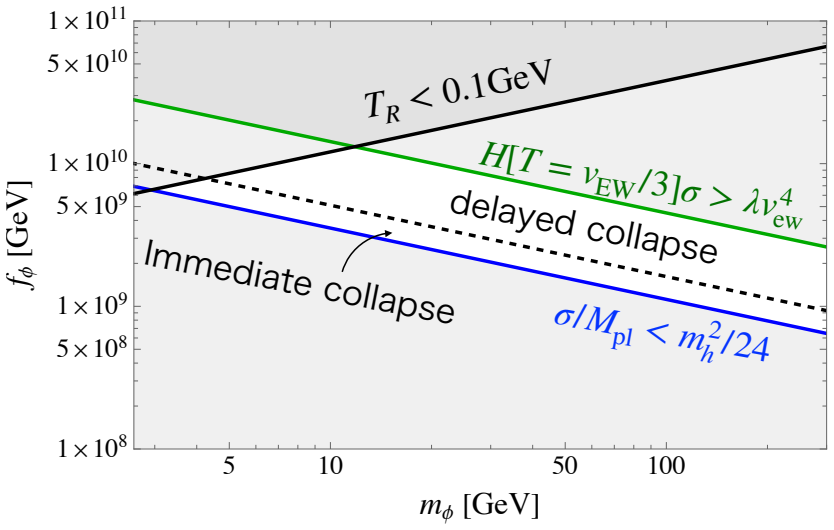


read the original abstract
We propose a baryogenesis mechanism in which an electroweak phase boundary is induced by a wall-like configuration of a scalar field, such as a domain wall or a shock wave, coupled to the Higgs field. If the Higgs mass parameter depends on the scalar field value, the wall locally separates the electroweak-symmetric and broken phases, thereby providing an induced electroweak wall. We focus on the case where the scalar field is an axion-like particle coupled to the SU(2) Chern--Simons density. The motion of the wall then generates a local effective chemical potential for B+L, realizing a spontaneous baryogenesis mechanism. In the presence of unsuppressed sphaleron transitions in front of the wall, this biases the plasma and leads to baryon asymmetry generation. We discuss the parametric conditions for the induced wall, cosmological realizations based on domain walls and shock waves, and the associated implications for baryon inhomogeneities and gravitational waves. The axion coupling is predicted to be sufficiently weak to evade current experimental and observational bounds.
Editorial analysis
A structured set of objections, weighed in public.
Referee Report
Summary. The paper proposes a baryogenesis mechanism in which an axion-like scalar induces an electroweak phase boundary via its coupling to the Higgs mass parameter, creating a moving 'induced electroweak wall' that separates symmetric and broken phases. The axion's coupling to the SU(2) Chern-Simons density generates a local effective chemical potential for B+L as the wall moves; unsuppressed sphalerons ahead of the wall convert this bias into a net baryon asymmetry. The authors outline parametric conditions for the wall, cosmological realizations (domain walls or shock waves), and possible signatures in baryon inhomogeneities and gravitational waves, while stating that the required axion coupling is weak enough to evade current bounds.
Significance. If the mechanism can be shown to quantitatively reproduce the observed baryon asymmetry, it would constitute a novel link between axion physics and electroweak-scale baryogenesis that does not require a strong first-order phase transition or high-scale CP violation. The approach re-uses the spontaneous-baryogenesis idea but sources the chemical potential from wall motion rather than a rolling axion, and the discussion of induced walls, inhomogeneities, and GW signals offers potential observational handles. The conceptual framework is coherent and the authors correctly flag the need for parametric control over the wall profile and sphaleron activity.
major comments (2)
- [mechanism section (discussion of sphaleron transitions ahead of the wall)] The central assumption that sphaleron transitions remain unsuppressed immediately in front of the moving induced wall (stated in the abstract and developed in the mechanism discussion) is load-bearing for the asymmetry yield. Because the Higgs vev rises continuously across the finite-width wall, the sphaleron rate Γ_sph ∝ exp(−E_sph/T) with E_sph ∼ 4πv(T)/g² becomes exponentially suppressed in the same spatial region where the axion-induced chemical potential μ ∼ θ̇/f_a is active. A quantitative integration of the source term over the wall profile is required to demonstrate that net baryon production reaches η_B ∼ 6×10^{-10} before the broken phase freezes the asymmetry.
- [parametric conditions and asymmetry yield] The assertion that the axion-SU(2) coupling is 'sufficiently weak to evade current experimental and observational bounds' is presented as a derived prediction, yet the observed asymmetry typically requires a minimum bias strength set by wall velocity and coupling scale. The manuscript should supply the explicit expression for the generated η_B (likely in the parametric-conditions or asymmetry-calculation section) in terms of the Chern-Simons coupling constant to show that the viable window is non-empty and does not reintroduce tension with bounds.
minor comments (2)
- The abstract and introduction would benefit from an explicit one-sentence contrast with existing spontaneous-baryogenesis or domain-wall baryogenesis scenarios to clarify the novelty of the 'induced electroweak wall' construction.
- [implications for baryon inhomogeneities and gravitational waves] Quantitative estimates for the gravitational-wave spectrum or the comoving scale of baryon inhomogeneities are mentioned in the implications discussion but lack explicit formulas, benchmark parameter choices, or figures that would allow readers to assess detectability.
Simulated Author's Rebuttal
We thank the referee for their careful reading of the manuscript and for the constructive comments. The points raised highlight the need for greater quantitative detail on the asymmetry generation, which we will address in the revision.
read point-by-point responses
-
Referee: [mechanism section (discussion of sphaleron transitions ahead of the wall)] The central assumption that sphaleron transitions remain unsuppressed immediately in front of the moving induced wall (stated in the abstract and developed in the mechanism discussion) is load-bearing for the asymmetry yield. Because the Higgs vev rises continuously across the finite-width wall, the sphaleron rate Γ_sph ∝ exp(−E_sph/T) with E_sph ∼ 4πv(T)/g² becomes exponentially suppressed in the same spatial region where the axion-induced chemical potential μ ∼ θ̇/f_a is active. A quantitative integration of the source term over the wall profile is required to demonstrate that net baryon production reaches η_B ∼ 6×10^{-10} before the broken phase freezes the asymmetry.
Authors: We agree that the finite width of the induced wall necessitates a quantitative integration of the source term to confirm the net yield. The chemical potential is generated by the axion motion across the wall, but sphaleron activity is suppressed as the Higgs vev rises. In the revised manuscript we will add an explicit integration over the wall profile, showing that the dominant baryon production occurs in the symmetric region immediately ahead of the wall (where v is negligible) and that the integrated asymmetry reaches the observed value for the parametric regime already identified in the paper. revision: yes
-
Referee: [parametric conditions and asymmetry yield] The assertion that the axion-SU(2) coupling is 'sufficiently weak to evade current experimental and observational bounds' is presented as a derived prediction, yet the observed asymmetry typically requires a minimum bias strength set by wall velocity and coupling scale. The manuscript should supply the explicit expression for the generated η_B (likely in the parametric-conditions or asymmetry-calculation section) in terms of the Chern-Simons coupling constant to show that the viable window is non-empty and does not reintroduce tension with bounds.
Authors: We will supply the explicit parametric expression for the generated baryon asymmetry η_B in terms of the Chern-Simons coupling, wall velocity, temperature, and other parameters. This expression will be added to the parametric-conditions section, allowing us to demonstrate that the coupling strength required to produce η_B ∼ 6×10^{-10} remains weak enough to satisfy existing bounds while leaving a non-empty viable window. revision: yes
Circularity Check
No significant circularity; derivation is self-contained.
full rationale
The paper's central chain—from scalar-induced electroweak phase separation, axion-Chern-Simons coupling generating a local B+L chemical potential via wall motion, to sphaleron biasing in the symmetric phase ahead of the wall—relies on standard model inputs and parametric conditions rather than reducing to a self-fit or self-citation. The claim that the axion coupling is 'predicted to be sufficiently weak to evade bounds' is framed as a consistency requirement for viable asymmetry production, not a parameter fitted to data and then relabeled as output. No equations or steps in the provided text exhibit self-definitional closure, fitted-input renaming, or load-bearing self-citation chains that force the result by construction. The mechanism remains falsifiable against external sphaleron rates, wall velocities, and observational bounds.
Axiom & Free-Parameter Ledger
axioms (2)
- domain assumption Sphaleron transitions are unsuppressed in the electroweak-symmetric phase in front of the wall
- domain assumption The scalar field couples to both the Higgs mass parameter and the SU(2) Chern-Simons density
invented entities (1)
-
Induced electroweak wall
no independent evidence
Forward citations
Cited by 1 Pith paper
-
Electroweak Baryogenesis from Collapsing Domain Walls
Collapsing axion-like domain walls generate the baryon asymmetry by acting as an effective chemical potential through coupling to the electroweak topological term, with the asymmetry produced via sphaleron processes.
Reference graph
Works this paper leans on
-
[1]
A. G. Cohen, D. B. Kaplan, and A. E. Nelson, Phys. Lett. B245, 561 (1990)
1990
- [2]
-
[3]
M. Dine, P. Huet, R. L. Singleton, Jr, and L. Susskind, Phys. Lett. B257, 351 (1991)
1991
- [4]
- [5]
- [6]
- [7]
- [8]
-
[9]
A. G. Cohen and D. B. Kaplan, Phys. Lett. B199, 251 (1987)
1987
- [10]
- [11]
- [12]
- [13]
- [14]
- [15]
-
[16]
Y. Narita and W. Yin, JHEP01, 132 (2026), arXiv:2507.03157 [hep-ph]
-
[17]
T. Sugeno and W. Yin, JHEP04, 108 (2026), arXiv:2511.19429 [hep-ph]
-
[18]
H. Masubuchi, Y. Narita, and W. Yin, (2026), arXiv:2602.15825 [hep-ph]. 29
- [19]
-
[20]
A. Mariotti, X. Nagels, A. Rase, and M. Vanvlasselaer, JHEP03, 199 (2025), arXiv:2411.13494 [hep-ph]
- [21]
-
[22]
T. Schr¨ oder and R. Brandenberger, Phys. Rev. D110, 043516 (2024), arXiv:2404.13035 [hep-ph]
- [23]
- [24]
- [25]
-
[26]
Baryon Asymmetry from Electroweak-Symmetric Domain Walls
J. Azzola, O. Matsedonskyi, and A. Weiler, (2026), arXiv:2604.16603 [hep-ph]
work page internal anchor Pith review Pith/arXiv arXiv 2026
-
[27]
H. Bagherian, M. Ekhterachian, and S. Stelzl, JHEP01, 068 (2026), arXiv:2505.15904 [hep-ph]
-
[28]
Bounds from D/H on baryogenesis models
A. Azatov and B. Missoni, (2026), arXiv:2604.11203 [hep-ph]
work page internal anchor Pith review Pith/arXiv arXiv 2026
- [29]
- [30]
-
[31]
J. Jaeckel and W. Yin, Phys. Rev. D107, 015001 (2023), arXiv:2206.06376 [hep-ph]
- [32]
- [33]
-
[34]
Planck 2018 results. VI. Cosmological parameters
N. Aghanimet al.(Planck), Astron. Astrophys.641, A6 (2020), [Erratum: Astron.Astrophys. 652, C4 (2021)], arXiv:1807.06209 [astro-ph.CO]
work page internal anchor Pith review arXiv 2020
- [35]
- [36]
-
[37]
D. Gonzalez, N. Kitajima, F. Takahashi, and W. Yin, Phys. Lett. B843, 137990 (2023), arXiv:2211.06849 [hep-ph]
-
[38]
M. Miyazaki, Y. Narita, D. Song, N. Yaginuma, and W. Yin, (2025), arXiv:2509.13292 [hep-ph]
-
[39]
P. W. Graham, D. E. Kaplan, and S. Rajendran, Phys. Rev. Lett.115, 221801 (2015), arXiv:1504.07551 [hep-ph]
work page Pith review arXiv 2015
-
[40]
e. a. Albanese, R (SHiP),BDF/SHiP at the ECN3 high-intensity beam facility, Tech. Rep. (CERN, Geneva, 2023). 30
2023
-
[41]
Low-Energy Supernovae Severely Constrain Radiative Particle Decays,
A. Caputo, H.-T. Janka, G. Raffelt, and E. Vitagliano, Phys. Rev. Lett.128, 221103 (2022), arXiv:2201.09890 [astro-ph.HE]
- [42]
-
[43]
M. Lewicki, M. Merchand, and M. Zych, JHEP02, 017 (2022), arXiv:2111.02393 [astro-ph.CO]
- [44]
-
[45]
N. Kitajima, J. Lee, K. Murai, F. Takahashi, and W. Yin, Phys. Lett. B851, 138586 (2024), arXiv:2306.17146 [hep-ph]
- [46]
-
[47]
Konstandin, JCAP03, 047 (2018), arXiv:1712.06869 [astro-ph.CO]
T. Konstandin, JCAP03, 047 (2018), arXiv:1712.06869 [astro-ph.CO]
-
[48]
C. Caprini, D. G. Figueroa, R. Flauger, G. Nardini, M. Peloso, M. Pieroni, A. Ricciardone, and G. Tasinato, JCAP11, 017 (2019), arXiv:1906.09244 [astro-ph.CO]
-
[49]
R. Flauger, N. Karnesis, G. Nardini, M. Pieroni, A. Ricciardone, and J. Torrado, JCAP01, 059 (2021), arXiv:2009.11845 [astro-ph.CO]
-
[50]
G. Boileau, N. Christensen, R. Meyer, and N. J. Cornish, Phys. Rev. D103, 103529 (2021), arXiv:2011.05055 [gr-qc]
-
[51]
K. Martinovic, P. M. Meyers, M. Sakellariadou, and N. Christensen, Phys. Rev. D103, 043023 (2021), arXiv:2011.05697 [gr-qc]
-
[52]
Barni, (2025), arXiv:2510.21915 [hep-ph]
G. Barni, (2025), arXiv:2510.21915 [hep-ph]
-
[53]
J. R. Espinosa, T. Konstandin, and F. Riva, Nucl. Phys. B854, 592 (2012), arXiv:1107.5441 [hep-ph]
work page Pith review arXiv 2012
-
[54]
D. Bodeker and W. Buchmuller, Rev. Mod. Phys.93, 035004 (2021), arXiv:2009.07294 [hep-ph]
-
[55]
Andreevet al.(ACME), Nature562, 355 (2018)
V. Andreevet al.(ACME), Nature562, 355 (2018). 31
2018
discussion (0)
Sign in with ORCID, Apple, or X to comment. Anyone can read and Pith papers without signing in.