Recognition: unknown
The Pc1 geomagnetic pulsations in light of the Cepheid theory
Pith reviewed 2026-05-09 22:03 UTC · model grok-4.3
The pith
Pc1 geomagnetic pulsations known as pearls are generated by a Q-modulated ion cyclotron resonator in the outer radiation belt rather than by repeated ionospheric echoes.
A machine-rendered reading of the paper's core claim, the machinery that carries it, and where it could break.
Core claim
It is assumed that high above the Earth in the narrow equatorial zone of the outer radiation belt there is a pulsed generator of ion-cyclotron waves. The generator is a Q-modulated ion cyclotron resonator with active filling. The presence of opacity domains adjacent to the resonator's end faces is reminiscent of the opacity layer in the atmosphere of a Cepheid. This association was strengthened by the fact that in both cases the formation of opaque layers is associated with the presence in the medium of ions with different charge-to-mass ratios. Based on this association, the idea of a ponderomotive valve arose, periodically changing the width of the opacity domains, thereby forming a period
What carries the argument
The Q-modulated ion cyclotron resonator with active filling, whose opacity domains are periodically adjusted by a ponderomotive valve to release discrete wave packets.
If this is right
- Observed pearl sequences arise directly from periodic modulation inside the resonator rather than from multiple reflections between conjugate ionospheres.
- The timing and amplitude of pearls are controlled by the width of the opacity domains and the strength of the ponderomotive force.
- Ground and spacecraft records of Pc1 events should show consistent spectral and temporal features independent of ionospheric reflection properties.
- The same valve-like modulation may operate in other cyclotron-wave phenomena within the radiation belts.
- Pearl occurrence rates could be linked to local plasma composition and density variations rather than to global propagation paths.
Where Pith is reading between the lines
- The analogy raises the possibility that similar ponderomotive modulation could be searched for in laboratory plasma devices that contain mixed ion species.
- Future multi-point observations could test whether the predicted opacity domains move or change size in step with pearl repetition periods.
- If confirmed, the model would redirect attention from ionospheric boundary conditions toward local wave-particle instabilities when forecasting Pc1 activity during geomagnetic disturbances.
- The framework invites quantitative modeling of how charge-to-mass separation creates the opacity layers and how the resulting valve operates under varying radiation-belt conditions.
Load-bearing premise
A pulsed generator containing opacity domains formed by ions of differing charge-to-mass ratios exists in the narrow equatorial zone of the outer radiation belt and can be modulated by a ponderomotive valve to emit the observed pearl sequences.
What would settle it
Satellite measurements inside the outer radiation belt that find no localized source of periodically modulated ion-cyclotron waves or no corresponding opacity domains at the predicted equatorial site would falsify the generator model.
Figures

read the original abstract
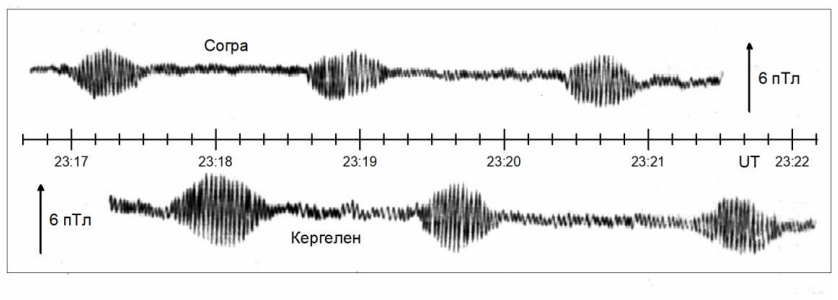
It has been 90 years since the discovery of geomagnetic pulsations in the Pc1 range (0.2-5 Hz), widely known as pearls. In the second half of the last century, the concept of pearls as multiple echoes of a wave packet that propagates along the lines of the geomagnetic field, periodically reflecting off the ionosphere at magnetically conjugate points emerged. This paper proposes an alternative interpretation of the pearls. It is assumed that high above the Earth in the narrow equatorial zone of the outer radiation belt there is a pulsed generator of ion-cyclotron waves. The generator excites a discrete sequence of wave packets, which are recorded in the magnetosphere and on the Earth's surface as a series of pearls. The generator is a Q-modulated ion cyclotron resonator with active filling. The presence of opacity domains adjacent to the resonator's end faces is reminiscent of the opacity layer in the atmosphere of a Cepheid. This association was strengthened by the fact that in both cases the formation of opaque layers is associated with the presence in the medium of ions with different charge-to-mass ratios. Based on this association, the idea of a ponderomotive valve arose, periodically changing the width of the opacity domains, thereby forming a periodic sequence of pearls. The ponderomotive valve in pearl theory is analogous to the Eddington valve in Cepheid theory.
Editorial analysis
A structured set of objections, weighed in public.
Referee Report
Summary. The paper proposes an alternative to the standard echo model of Pc1 geomagnetic pulsations (pearls). It posits that pearls arise from a pulsed generator consisting of a Q-modulated ion cyclotron resonator with active filling located in the narrow equatorial zone of the outer radiation belt. Opacity domains adjacent to the resonator end faces, formed by ions of differing charge-to-mass ratios, are modulated by a ponderomotive valve analogous to the Eddington valve in Cepheid stars, thereby producing the observed discrete pearl sequences.
Significance. If the model were quantitatively developed and shown to reproduce observed Pc1 periods, fine structure, and occurrence statistics, it would introduce a new plasma-based generation mechanism for Pc1 waves and establish a cross-disciplinary parallel between magnetospheric resonators and stellar pulsations. At present the manuscript supplies only a qualitative analogy without derivations, parameter mappings, or observational tests, so its potential impact remains speculative.
major comments (3)
- [Abstract] Abstract: The central claim that a Q-modulated ion cyclotron resonator with active filling exists and operates in the outer radiation belt is asserted without any derivation of the required plasma density, temperature, or magnetic-field conditions at L-shells ~4–6 that would permit Q-modulation or the formation of opacity domains.
- [Abstract] Abstract: The ponderomotive valve is introduced solely by analogy to the Eddington valve; no governing equations are mapped between the stellar opacity layer and the magnetospheric ion populations, nor are dimensionless parameters (e.g., optical depth, pulsation period scaling) shown to be comparable.
- [Abstract] Abstract: No quantitative prediction is given for the pearl repetition rate or fine-structure spacing that would result from periodic modulation of the opacity domains, preventing any direct comparison with the observed Pc1 pearl periods or with the predictions of the echo model.
minor comments (1)
- [Abstract] The abstract would benefit from a concise statement of how the proposed repetition mechanism differs quantitatively from the ionospheric-reflection echo model.
Simulated Author's Rebuttal
We thank the referee for the constructive comments on our manuscript, which proposes a qualitative alternative to the echo model for Pc1 pearls by analogy to Cepheid pulsations. The work is conceptual in nature and does not aim to deliver a fully quantitative model. We respond point by point to the major comments below.
read point-by-point responses
-
Referee: [Abstract] Abstract: The central claim that a Q-modulated ion cyclotron resonator with active filling exists and operates in the outer radiation belt is asserted without any derivation of the required plasma density, temperature, or magnetic-field conditions at L-shells ~4–6 that would permit Q-modulation or the formation of opacity domains.
Authors: We agree that the manuscript asserts the existence of the Q-modulated resonator without providing explicit derivations of the plasma parameters at L~4-6. The proposal rests on established observational evidence for ion cyclotron waves and multi-species ion populations in the outer radiation belt. Detailed calculations of the precise density, temperature, and field thresholds for Q-modulation are not derived here, as the focus remains on the conceptual framework and the Cepheid analogy. We will partially revise the abstract and discussion to include references to typical radiation-belt plasma parameters from spacecraft observations, thereby supporting the plausibility of the proposed conditions without performing new derivations. revision: partial
-
Referee: [Abstract] Abstract: The ponderomotive valve is introduced solely by analogy to the Eddington valve; no governing equations are mapped between the stellar opacity layer and the magnetospheric ion populations, nor are dimensionless parameters (e.g., optical depth, pulsation period scaling) shown to be comparable.
Authors: The ponderomotive valve is indeed presented through analogy, motivated by the shared role of ions with differing charge-to-mass ratios in forming opacity domains in both systems. We do not map governing equations or compare dimensionless parameters because the physical environments differ substantially and the manuscript is not intended as a quantitative cross-disciplinary equivalence. The analogy highlights how ponderomotive forces could periodically modulate opacity domains in a manner reminiscent of the Eddington valve. We will partially revise the text to clarify the physical basis of this analogy while preserving its qualitative character. revision: partial
-
Referee: [Abstract] Abstract: No quantitative prediction is given for the pearl repetition rate or fine-structure spacing that would result from periodic modulation of the opacity domains, preventing any direct comparison with the observed Pc1 pearl periods or with the predictions of the echo model.
Authors: The manuscript provides no quantitative predictions for pearl repetition rates or fine-structure spacing. The description of periodic modulation by the ponderomotive valve is kept at a conceptual level, without solving the time-dependent dynamics that would yield specific periods or spacings. Such predictions would require a dedicated numerical model of the valve and resonator, which lies beyond the scope of this initial proposal. We therefore do not intend to add quantitative predictions during revision. revision: no
Circularity Check
No significant circularity; proposal rests on explicit assumption and analogy without closed derivation loop.
full rationale
The paper explicitly states that it 'assumes' the existence of a Q-modulated ion cyclotron resonator with opacity domains in the outer radiation belt and introduces the ponderomotive valve via a qualitative analogy to Cepheid opacity layers and the Eddington valve. No equations, fitted parameters, self-citations, or uniqueness theorems are invoked that would reduce any claimed prediction or first-principles result back to the inputs by construction. The text presents a conceptual reinterpretation rather than a derivation chain, so no load-bearing steps qualify under the enumerated circularity patterns.
Axiom & Free-Parameter Ledger
axioms (1)
- domain assumption Ion-cyclotron waves propagate and reflect in the magnetosphere according to standard cold-plasma dispersion relations.
invented entities (2)
-
Q-modulated ion cyclotron resonator with active filling
no independent evidence
-
Ponderomotive valve
no independent evidence
Reference graph
Works this paper leans on
-
[1]
No. 8. P. 825–826. Kangas J., Guglielmi A., Pokhotelov O. Morphology and physics of short-period magnetic pulsations (A Review). Space Sci. Rev. 1998. Vol. 83. P. 435–512. https://doi.org/10.1023/A:1005063911643. Klimushkin D.Yu., Mager P.N., Marilovtseva O.S. Parallel structure of Pc1 ULF oscillations in multi-ion magnetospheric plasma at finite ion gyro...
-
[2]
No. 1–4. P. 1–116. https://doi.org/10.1007/s11214-006-8314-8. Matveeva E.T., Troitskaya V.A. General features of the oscillation regime of pearl type pulsations. Geomagnetism and Aeronomy. 1965, vol. 5, pp.1078–1083. (In Russian). Mikhailova O.S. The spatial structure of ULF-waves in the equatorial resonator localized at the plasmapause with the admixture...
-
[3]
Ed. by M.A. Leontovich. New York: Springer, 1963. 157 p. 23 Sucksdorff E. Occurrences of rapid micropulsations at Sodankylä during 1932 to
1963
-
[4]
Terrest. Magn. Atmos. Electricity. 1936. Vol. 41. No. 4. P. 337–344. Tepley L. Regular oscillations near 1 c/s observed simultaneously at middle and low latitudes. Radio Sci. 1965. Vol. 69D. P. 1089–1105. Troitskaya V.A. Pulsation of the Earth’s electromagnetic field with periods of 1 to 5 seconds and their connection with phenomena in the high atmosphere...
1936
discussion (0)
Sign in with ORCID, Apple, or X to comment. Anyone can read and Pith papers without signing in.