Recognition: unknown
Machine Learning-Based Characterization of Solar p-Mode Frequency Shifts during Solar Cycle 25
Pith reviewed 2026-05-09 22:42 UTC · model grok-4.3
The pith
Machine learning methods can characterize p-mode frequency shifts for the remaining solar cycle 25 by matching them to established solar activity proxies.
A machine-rendered reading of the paper's core claim, the machinery that carries it, and where it could break.
Core claim
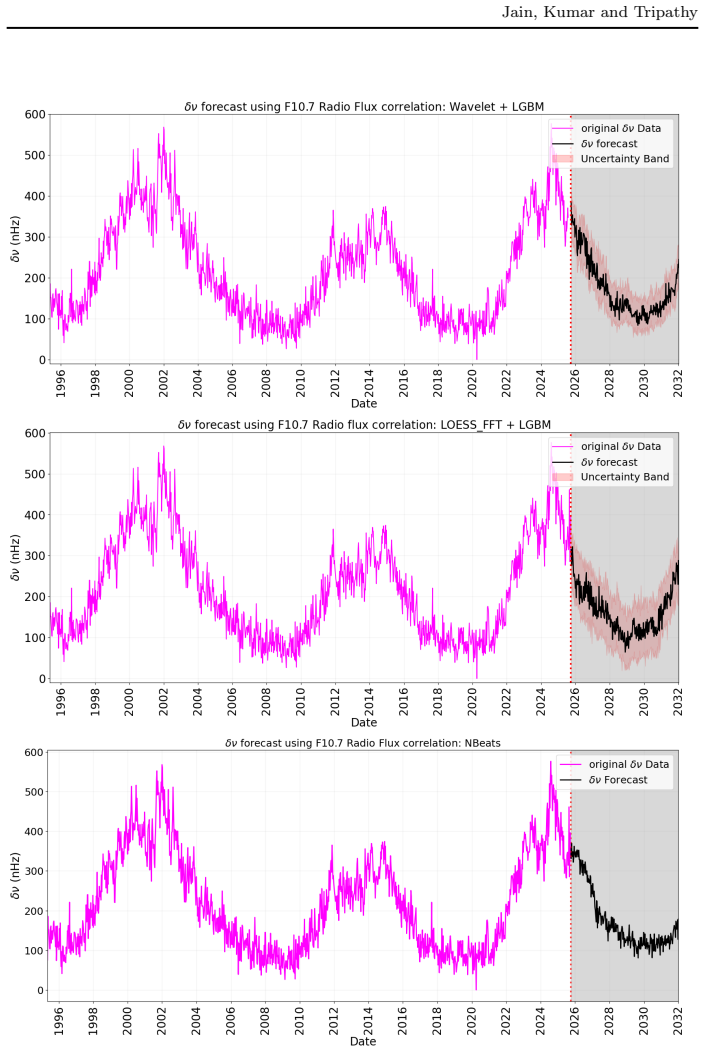
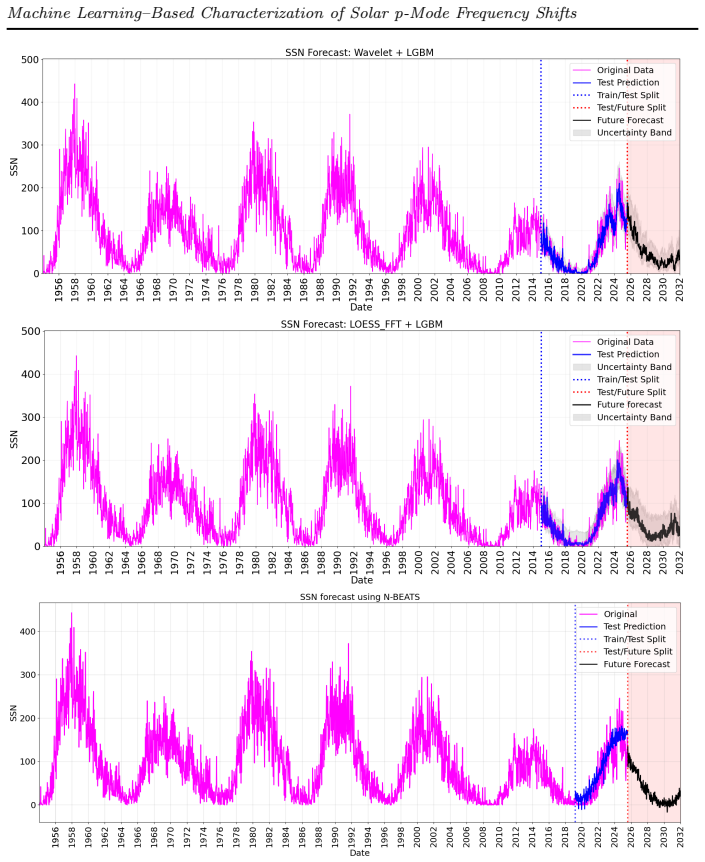
The frequencies of these p-modes measured in the last three decades show long term variation similar to the 11 year cyclic behaviour exhibited by 10.7 cm radio flux, sunspot numbers and other solar activity indices. In this article, we develop and apply the standard time-series analysis and machine-learning based methods to characterise p-mode frequency shifts for the remaining solar cycle 25. Developing a comparable method for forecasting p-mode frequency shifts is therefore of interest for two reasons: it will facilitate future investigations into its potential role in tracing energy drivers from the Sun's interior to the geospace response by improving models of solar interior dynamics to
What carries the argument
Machine-learning models applied to time series of p-mode frequency shifts, treating their cyclic variations as analogous to those of established solar proxies such as sunspot numbers and 10.7 cm radio flux.
If this is right
- It supplies an independent early indicator of ascending and descending phases of solar activity that could aid space-weather forecasting.
- It improves models that trace energy drivers from the Sun's interior through coronal and heliospheric plasma conditions.
- It establishes a more robust quantitative link between the Sun's interior and its exterior environment.
- It extends existing machine-learning forecasting techniques from traditional solar indices to a new helioseismic observable.
Where Pith is reading between the lines
- As cycle 25 progresses, new frequency measurements can be compared directly against the model's output to test the similarity assumption.
- The same framework might later incorporate additional helioseismic parameters to refine subsurface magnetic-field diagnostics.
- If the characterization holds, it could serve as a cross-check on whether p-mode shifts capture interior processes not fully reflected in surface proxies.
Load-bearing premise
That the cyclic behavior of p-mode frequency shifts is sufficiently similar to that of solar proxies like 10.7 cm radio flux and sunspot numbers for standard machine-learning methods to characterize them accurately.
What would settle it
Direct observations of p-mode frequencies during the ascending or peak phase of cycle 25 that deviate substantially from the machine-learning predictions trained on historical proxy correlations.
Figures



read the original abstract
The solar interior is probed by the properties of the Sun's acoustic oscillations (p-modes) observed on the solar surface. The frequencies of these p-modes measured in the last three decades show long term variation similar to the 11 year cyclic behaviour exhibited by 10.7 cm radio flux, sunspot numbers and other solar activity indices. It is also now established that the cyclic behavior of some of the solar proxies are connected with geomagnetic activities and have implications for space weather. Hence, in recent years efforts have been made using machine-learning methods to forecast these solar proxies with a view to improve our understanding of space weather. Developing a comparable method for forecasting p-mode frequency shifts is therefore of interest for two reasons. Firstly, it will facilitate future investigations into its potential role in tracing energy drivers from the Sun's interior to the geospace response by improving models of solar interior dynamics to coronal and heliospheric plasma conditions. In other words, it will help establish a more robust and quantitative link between the Sun's interior and its exterior. Secondly, it may provide us with an independent indicator or an early indicator of ascending and descending phase of solar activity which might be useful for space weather forecasting. In this article, we develop and apply the standard time-series analysis and machine-learning based methods to characterise p-mode frequency shifts for the remaining solar cycle 25.
Editorial analysis
A structured set of objections, weighed in public.
Referee Report
Summary. The manuscript claims that solar p-mode frequency shifts exhibit long-term cyclic variations similar to those of established solar activity proxies such as the 10.7 cm radio flux and sunspot numbers. It states that standard time-series analysis and machine-learning methods are developed and applied to characterize these shifts for the remaining portion of solar cycle 25, with the goals of strengthening links between solar interior dynamics and geospace conditions and providing an independent indicator for ascending/descending phases of solar activity useful for space weather forecasting.
Significance. If the proposed characterization were demonstrated with validated methods and quantitative results, it could provide a novel helioseismic input for solar activity models and space weather applications. However, the manuscript supplies no specific algorithms, datasets, validation procedures, error estimates, or outcomes, so the significance cannot be assessed beyond the conceptual motivation.
major comments (2)
- [Abstract] Abstract: The statement that the authors 'develop and apply the standard time-series analysis and machine-learning based methods' is unsupported because the manuscript contains no description of the chosen time-series techniques, ML architectures, training/validation splits, loss functions, or any performance metrics.
- [Abstract] Abstract: The central assumption that p-mode frequency shifts possess statistical properties (periodicity, amplitude modulation, noise structure) sufficiently similar to those of 10.7 cm flux and sunspot numbers to permit direct use of off-the-shelf ML methods is not tested; no power-spectrum comparisons, cross-correlation analysis, or ablation studies are provided to address possible additional stochasticity or phase jitter arising from interior processes.
Simulated Author's Rebuttal
We thank the referee for their detailed and constructive comments on our manuscript. We appreciate the feedback highlighting areas where additional clarity and analysis are needed. We will revise the manuscript accordingly to strengthen the presentation of our methods and supporting analyses.
read point-by-point responses
-
Referee: [Abstract] Abstract: The statement that the authors 'develop and apply the standard time-series analysis and machine-learning based methods' is unsupported because the manuscript contains no description of the chosen time-series techniques, ML architectures, training/validation splits, loss functions, or any performance metrics.
Authors: We agree with the referee that the abstract does not provide sufficient detail on the methods employed. The manuscript as submitted focuses on the motivation and high-level description but omits the specific implementation details. In the revised version, we will expand the methods section to fully describe the time-series analysis techniques (including specific algorithms like Fourier transforms and ARMA models), the machine learning architectures (e.g., recurrent neural networks with defined layers and hyperparameters), the training and validation procedures (including data splits and cross-validation), loss functions, and all performance metrics. We will also update the abstract to include a concise summary of these elements. This will make the work reproducible and allow proper assessment of its significance. revision: yes
-
Referee: [Abstract] Abstract: The central assumption that p-mode frequency shifts possess statistical properties (periodicity, amplitude modulation, noise structure) sufficiently similar to those of 10.7 cm flux and sunspot numbers to permit direct use of off-the-shelf ML methods is not tested; no power-spectrum comparisons, cross-correlation analysis, or ablation studies are provided to address possible additional stochasticity or phase jitter arising from interior processes.
Authors: The referee correctly notes that the similarity in statistical properties is assumed rather than rigorously demonstrated in the provided text. While the manuscript illustrates the long-term cyclic variations through figures, it does not include quantitative tests such as power spectra, cross-correlations, or ablation studies. We will add these in the revision: power spectral density comparisons to confirm the ~11-year periodicity, cross-correlation analysis between p-mode frequency shifts and the 10.7 cm flux/sunspot numbers to quantify similarity (and any phase differences or jitter), and ablation studies on the ML models to assess sensitivity to noise structure. This will either validate the use of standard methods or highlight the need for adaptations to account for interior-specific stochasticity. revision: yes
Axiom & Free-Parameter Ledger
axioms (1)
- domain assumption Cyclic behavior of p-mode frequency shifts is connected with geomagnetic activities in a manner similar to other solar proxies
Reference graph
Works this paper leans on
-
[1]
Baker, D.N.: 2000, Effects of the Sun on the Earth’s environment.Journal of Atmospheric and Solar-Terrestrial Physics62,
2000
-
[2]
DOI. ADS. Basu, S.: 2021, Evidence of Solar-cycle-related Structural Changes in the Solar Convection Zone.Astrophys. J.917,
2021
-
[3]
DOI. ADS. Bazilevskaya, G., Broomhall, A.-M., Elsworth, Y., Nakariakov, V.M.: 2014, A Combined Analy- sis of the Observational Aspects of the Quasi-biennial Oscillation in Solar Magnetic Activity. Space Sci. Rev.186,
2014
-
[4]
DOI. ADS. Benevolenskaya, E.E.: 1998, A Model of the Double Magnetic Cycle of the Sun.Astrophys. J. Lett.509, L49. DOI. ADS. Chaplin, W.J., Elsworth, Y., Miller, B.A., Verner, G.A., New, R.: 2007, Solar p-Mode Frequencies over Three Solar Cycles.Astrophys. J.659,
1998
-
[5]
DOI. ADS. Charbonneau, P.: 2020, Dynamo models of the solar cycle.Living Reviews in Solar Physics 17,
2020
-
[6]
DOI. ADS. Chen, J., Liu, Y., Wang, Z., Wang, C.: 2019, The Promotion Effect of LOESS Smoothing Technique in Short-term Traffic Volume Clustering. In:Proceedings of the 2019 Inter- national Conference on Modeling, Analysis, Simulation Technologies and Applications (MASTA 2019), Atlantis Press,
2019
-
[7]
ISBN 978-94-6252-761-4. DOI. https://doi.org/10. 2991/masta-19.2019.65. Christensen-Dalsgaard, J., Berthomieu, G.: 1991, Theory of solar oscillations. In: Cox, A.N., Livingston, W.C., Matthews, M.S. (eds.)Solar Interior and Atmosphere,
2019
-
[8]
Clette, F., Lef` evre, L.: 2015,SILSO Sunspot Number V2.0, https://doi.org/10.24414/qnza- ac80
ADS. Clette, F., Lef` evre, L.: 2015,SILSO Sunspot Number V2.0, https://doi.org/10.24414/qnza- ac80. Published by WDC SILSO - Royal Observatory of Belgium (ROB). DOI. Covington, A.E.: 1947, Micro-Wave Solar Noise Observations During the Partial Eclipse of November 23, 1946.Nature159,
-
[9]
DOI. ADS. Covington, A.E.: 1969, Solar Radio Emission at 10.7 cm, 1947-1968.J. R. Astron. Soc. Can. 63,
1969
-
[10]
Elsworth, Y., Howe, R., Isaak, G.R., McLeod, C.P., New, R.: 1990, Variation of low-order acoustic solar oscillations over the solar cycle.Nature345,
ADS. Elsworth, Y., Howe, R., Isaak, G.R., McLeod, C.P., New, R.: 1990, Variation of low-order acoustic solar oscillations over the solar cycle.Nature345,
1990
-
[11]
DOI. ADS. Fletcher, S.T., Broomhall, A.-M., Salabert, D., Basu, S., Chaplin, W.J., Elsworth, Y., Garcia, R.A., New, R.: 2010, A Seismic Signature of a Second Dynamo?Astrophys. J. Lett.718, L19. DOI. ADS. Goldreich, P., Murray, N., Willette, G., Kumar, P.: 1991, Implications of Solar p-Mode Frequency Shifts.Astrophys. J.370,
2010
-
[12]
DOI. ADS. Gonz´ alez Hern´ andez, I., Komm, R., Pevtsov, A., Leibacher, J.: 2014, Solar Origins of Space Weather and Space Climate: Preface.Sol. Phys.289,
2014
-
[13]
DOI. ADS. Hajra, R., Marques de Souza Franco, A., Echer, E., Jos´ e Alves Bolzan, M.: 2021, Long Term Variations of the Geomagnetic Activity: A Comparison Between the Strong and Weak Solar Activity Cycles and Implications for the Space Climate.Journal of Geophysical Research (Space Physics)126, e28695. DOI. ADS. Harvey, J.W., Hill, F., Hubbard, R.P., Kenn...
2021
-
[14]
DOI. ADS. Howard, R., Labonte, B.J.: 1980, The sun is observed to be a torsional oscillator with a period of 11 years.Astrophys. J. Lett.239, L33. DOI. ADS. Howe, R., Hill, F., Komm, R., Chaplin, W.J., Elsworth, Y., Davies, G.R., Schou, J., Thompson, M.J.: 2018, Signatures of Solar Cycle 25 in Subsurface Zonal Flows.Astrophys. J. Lett.862, L5. DOI. ADS. J...
1980
-
[15]
DOI. ADS. Jain, K., Tripathy, S.C., Hill, F.: 2009, Solar Activity Phases and Intermediate-Degree Mode Frequencies.Astrophys. J.695,
2009
-
[16]
DOI. ADS. SOLA: main.tex; 23 April 2026; 1:16; p. 17 Jain, Kumar and Tripathy Jain, K., Jain, N., Tripathy, S.C., Dikpati, M.: 2022, What Seismic Minimum Reveals about Solar Magnetism below the Surface.Astrophys. J. Lett.924, L20. DOI. ADS. Jain, R., Roberts, B.: 1993, Do p-Mode Frequency Shifts Suggest a Hotter Chromosphere at Solar Maximum?Astrophys. J.414,
2026
-
[17]
DOI. ADS. Jain, R., Roberts, B.: 1996, Discrete High-Frequency p-Modes.Astrophys. J.456,
1996
-
[18]
DOI. ADS. Kehinde, O.J., Ayinde, K., Lukman, A.F.: 2020, A hybrid model of LOESS and ARIMA for improved time series forecasting.Journal of Applied Statistics47,
2020
-
[19]
Phys.293,
Kiefer, R., Komm, R., Hill, F., Broomhall, A.-M., Roth, M.: 2018, GONG p-Mode Parameters Through Two Solar Cycles.Sol. Phys.293,
2018
-
[20]
DOI. ADS. Kosovichev, A.G., Pipin, V.V.: 2019, Dynamo Wave Patterns inside of the Sun Revealed by Torsional Oscillations.Astrophys. J. Lett.871, L20. DOI. ADS. Larson, T.P., Schou, J.: 2018, Global-Mode Analysis of Full-Disk Data from the Michelson Doppler Imager and the Helioseismic and Magnetic Imager.Sol. Phys.293,
2019
-
[21]
DOI. ADS. Leighton, R.B., Noyes, R.W., Simon, G.W.: 1962, Velocity Fields in the Solar Atmosphere. I. Preliminary Report.Astrophys. J.135,
1962
-
[22]
DOI. ADS. Libbrecht, K.G., Woodard, M.F.: 1990, Solar-cycle effects on solar oscillation frequencies. Nature345,
1990
-
[23]
DOI. ADS. Mandal, K., Kosovichev, A.G., Pipin, V.V.: 2024, Helioseismic Properties of Dynamo Waves in the Variation of Solar Differential Rotation.Astrophys. J.973,
2024
-
[24]
DOI. ADS. Mehta, T., Jain, K., Tripathy, S.C., Kiefer, R., Kolotkov, D., Broomhall, A.-M.: 2022, Cycle dependence of a quasi-biennial variability in the solar interior.Mon. Not. R. Astron. Soc. 515,
2022
-
[25]
DOI. ADS. Mursula, K., Usoskin, I.G., Maris, G.: 2007, Introduction to Space Climate.Advances in Space Research40,
2007
-
[26]
DOI. ADS. Oreshkin, B.N., Carpov, D., Chapados, N., Bengio, Y.: 2019, N-BEATS: Neural basis expansion analysis for interpretable time series forecasting.arXiv e-prints, arXiv:1905.10437. DOI. ADS. Rabello Soares, M.C.: 2019, On the saturation of acoustic mode frequencies at high solar activity.Mon. Not. R. Astron. Soc.486,
-
[27]
DOI. ADS. Rabello-Soares, M.C., Korzennik, S.G., Schou, J.: 2006, High-degree mode frequencies: changes with solar cycle. In: Fletcher, K., Thompson, M. (eds.)Proceedings of SOHO 18/GONG 2006/HELAS I, Beyond the spherical Sun,ESA Special Publication624,
2006
-
[28]
Rhodes, E.J., Cacciani, A., Korzennik, S.G.: 1991, Observations of intermediate- and high- degree p-mode oscillations during sunspot cycles 21 and 22.Advances in Space Research 11,
ADS. Rhodes, E.J., Cacciani, A., Korzennik, S.G.: 1991, Observations of intermediate- and high- degree p-mode oscillations during sunspot cycles 21 and 22.Advances in Space Research 11,
1991
-
[29]
DOI. ADS. Rhodes, E.J. Jr., Reiter, J., Schou, J.: 2002, Solar cycle variability of high-frequency and high- degree p-mode oscillation frequencies. In: Wilson, A. (ed.)From Solar Min to Max: Half a Solar Cycle with SOHO,ESA Special Publication508,
2002
-
[30]
Salabert, D., Fossat, E., Gelly, B., Kholikov, S., Grec, G., Lazrek, M., Schmider, F.X.: 2004, Solar p modes in 10 years of the IRIS network.Astron
ADS. Salabert, D., Fossat, E., Gelly, B., Kholikov, S., Grec, G., Lazrek, M., Schmider, F.X.: 2004, Solar p modes in 10 years of the IRIS network.Astron. Astrophys.413,
2004
-
[31]
Shao, Z., Chao, F., Yang, S.-L., Zhou, K.-L.: 2017, A review of the decomposition method- ology for extracting and identifying the fluctuation characteristics in electricity demand forecasting.Renew. Sustain. Energy Rev.75,
2017
-
[32]
Su, X., Liang, B., Feng, S., Dai, W., Yang, Y.: 2023, Solar Cycle 25 Prediction Using N-BEATS
DOI. Su, X., Liang, B., Feng, S., Dai, W., Yang, Y.: 2023, Solar Cycle 25 Prediction Using N-BEATS. Astrophys. J.947,
2023
-
[33]
DOI. ADS. Tapping, K.F.: 2013, The 10.7 cm solar radio flux (F10.7).Space Weather11,
2013
-
[34]
DOI. ADS. Tripathy, S.C., Hill, F., Jain, K., Leibacher, J.W.: 2007, Solar Oscillation Frequency Changes on Time Scales of Nine Days.Sol. Phys.243,
2007
-
[35]
DOI. ADS. Ulrich, R.K.: 1970, The Five-Minute Oscillations on the Solar Surface.Astrophys. J.162,
1970
-
[36]
DOI. ADS. Wasilewski, F.: 2012,PyWavelets Documentation, https://pywavelets.readthedocs.io/ /downloads/en/0.2.0/pdf/#:∼:text=decomposition%20using%20wavedec-,pywt. Accessed: 2026-02-05. Woodard, M.F., Noyes, R.W.: 1985, Change of solar oscillation eigenfrequencies with the solar cycle.Nature318,
2012
-
[37]
DOI. ADS. Woodard, M.F., Kuhn, J.R., Murray, N., Libbrecht, K.G.: 1991, Short-Term Changes in Solar Oscillation Frequencies and Solar Activity.Astrophys. J. Lett.373, L81. DOI. ADS. SOLA: main.tex; 23 April 2026; 1:16; p. 18 Machine Learning–Based Characterization of Solar p-Mode Frequency Shifts Xu, Q., Jain, R., Xing, W.: 2024, Data-Driven Forecasting o...
1991
-
[38]
DOI. ADS. Yuan, F., Fan, Y., Bing, X., Tian, C., Yuan, Z., Li, Y.: 2025, A Decomposition-Driven Hybrid Framework Based on STL for Accurate Traffic Flow Forecasting.Renew. Sustain. Energy Rev.xx, x. DOI. Zhang, X., Li, R.: 2021, A Novel Decomposition and Combination Technique for Forecasting Monthly Electricity Consumption.Frontiers in Energy Research9, 79...
2025
discussion (0)
Sign in with ORCID, Apple, or X to comment. Anyone can read and Pith papers without signing in.