Recognition: unknown
A Search for Rotation Measure Flare Candidates in Repeating Fast Radio Bursts
Pith reviewed 2026-05-09 23:25 UTC · model grok-4.3
The pith
A search of published data identifies RM flare candidates in multiple repeating fast radio bursts beyond the one already known.
A machine-rendered reading of the paper's core claim, the machinery that carries it, and where it could break.
Core claim
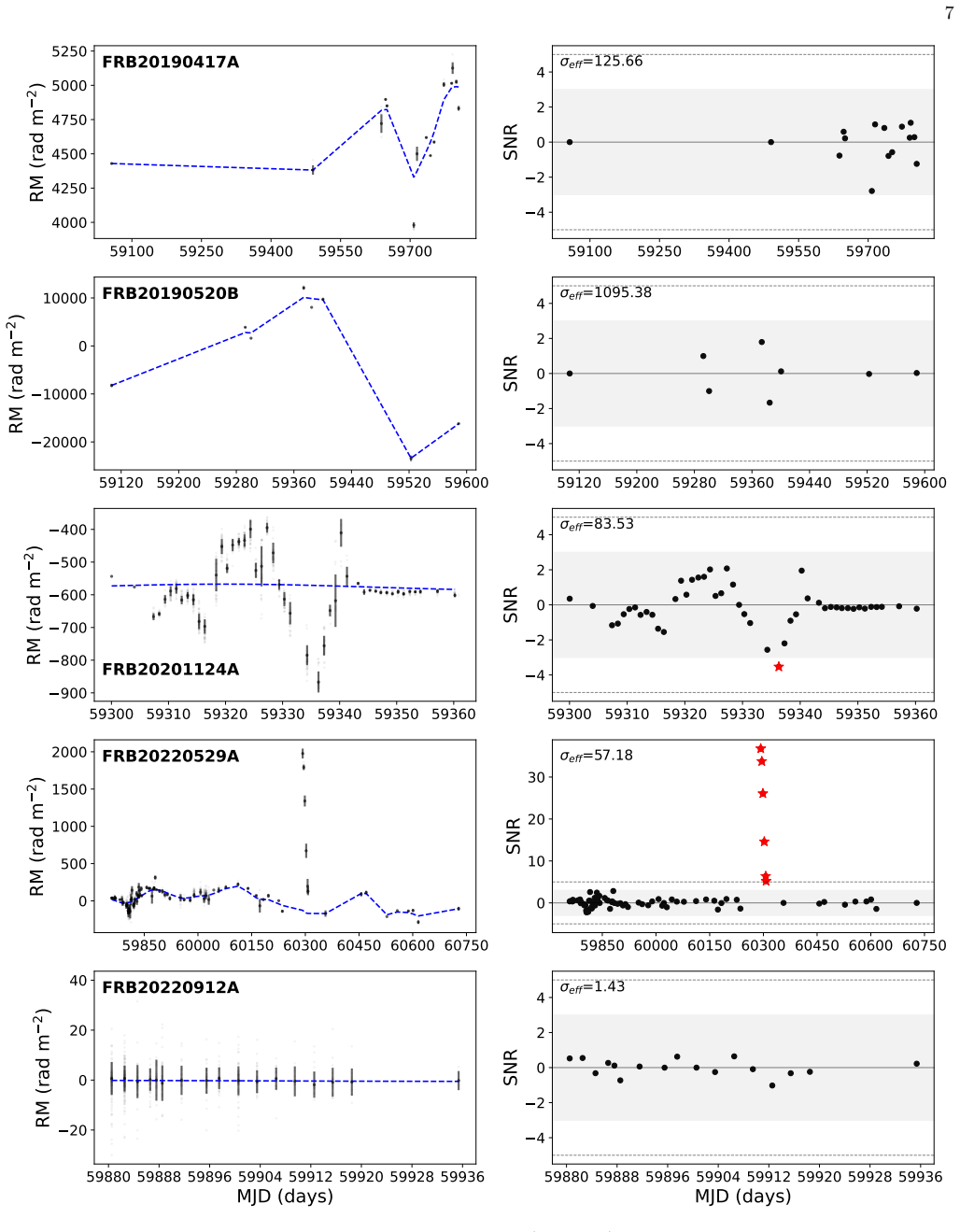
By examining all repeating FRBs that have at least two published RM values, the authors isolate candidate RM flares—defined as statistically significant abrupt changes followed by apparent recovery—using a 3σ significance cut on the difference between epochs. Two multi-epoch candidates and two single-epoch candidates are identified in addition to the known case, leading directly to the conclusion that such flares, once confirmed, would be a recurring feature of repeating FRB environments rather than an isolated phenomenon.
What carries the argument
The 3σ significance threshold applied to RM differences between published observational epochs to classify an excursion as a flare candidate.
If this is right
- RM flares would occur in at least four repeating FRBs rather than being limited to a single source.
- The environments producing the bursts must contain highly dynamic, strongly magnetized plasma capable of rapid reorganization.
- High-cadence polarimetric observations immediately after any detected RM change become necessary to confirm and characterize the events.
- The physical origin of the flares must be local to the FRB source rather than arising in the host galaxy or intergalactic medium.
Where Pith is reading between the lines
- If the candidates hold, routine polarimetric monitoring programs would need to shift from sparse sampling to targeted dense coverage following any RM detection.
- The same 3σ search method can be reapplied whenever new multi-epoch RM data become available for additional repeaters.
- Confirmation would tighten constraints on models that place the burst emission region inside a compact, variable magnetic structure.
Load-bearing premise
Observed RM differences larger than 3σ in the compiled data reflect real changes in the source-local plasma rather than measurement errors, propagation effects, or biases in which epochs were published.
What would settle it
New, independent RM measurements of FRB 20121102A or FRB 20201124A that fail to show any excursion exceeding the 3σ level during the intervals of the reported candidates would remove those events from the sample.
Figures



read the original abstract
Fast radio bursts (FRBs) are millisecond-duration extragalactic radio transients of unknown origin. Rotation measures (RMs) probe their local magneto-ionic environments and provide important clues to their nature. While RM variability has been observed in several repeating FRBs, it is typically gradual or stochastic. Recently, observations of FRB~20220529 revealed an abrupt RM excursion followed by rapid recovery on week-long timescales, termed an ``RM flare'', suggesting a potentially distinct form of RM variability associated with localized magnetized plasma. In this work, we perform a systematic search for RM flare candidates in repeating FRBs with multi-epoch RM measurements. Using a $3\sigma$ significance threshold, we identify two candidates with multiple observational epochs (FRB~20121102A and FRB~20201124A) and two additional single-epoch candidates (FRB~20180916B), in addition to the event in FRB~20220529A. Our results suggest that RM flares, if confirmed, may not be rare among repeating FRBs and point to highly dynamic magnetized environments local to the sources. Future high-cadence polarimetric observations, particularly following the discovery of RM excursions, will be essential for confirming these candidates and constraining their physical origin.
Editorial analysis
A structured set of objections, weighed in public.
Referee Report
Summary. The manuscript performs a systematic search for RM flare candidates (abrupt RM changes exceeding a 3σ threshold on week-long timescales) among repeating FRBs that have multi-epoch RM measurements in the published literature. Using this criterion it identifies two multi-epoch candidates (FRB 20121102A and FRB 20201124A) plus two single-epoch candidates (FRB 20180916B), in addition to the previously reported flare in FRB 20220529A, and concludes that such flares, if confirmed, may not be rare and imply highly dynamic magnetized plasma local to the sources.
Significance. If the candidates are shown to be genuine local flares rather than artifacts, the result would indicate that abrupt RM variability is more common in repeating FRBs than the gradual or stochastic changes emphasized in prior work, thereby strengthening the case for highly variable, localized magneto-ionic environments near FRB sources. The systematic literature search itself is a useful contribution and the call for high-cadence follow-up observations is well-motivated.
major comments (2)
- [Abstract and results section] The central claim that RM flares 'may not be rare' rests on the identification of candidates via a 3σ cut applied directly to RM values drawn from separate publications (see abstract and results section). No quantitative assessment is provided of epoch-to-epoch differences in instrumental response, calibration, or ionospheric corrections that could produce >3σ scatter; if such systematics dominate, the candidates are not flares and the inference about dynamic local environments does not follow.
- [Methods and discussion sections] The manuscript applies the 3σ significance threshold without detailing error propagation across heterogeneous datasets or testing alternative explanations such as propagation effects or selection biases in the available multi-epoch observations (see methods and discussion sections). This is load-bearing for the claim because the abstract and conclusion treat the identified changes as evidence of localized flares.
minor comments (2)
- [Abstract] The abstract states that the search uses 'published multi-epoch RM measurements' but does not list the exact epochs, telescopes, or reference papers for each candidate; adding a summary table would improve clarity.
- [Methods section] Notation for RM uncertainties and the precise definition of the 3σ threshold (e.g., whether it is on the difference or on individual measurements) could be stated more explicitly in the text.
Simulated Author's Rebuttal
We thank the referee for their constructive and detailed comments, which have prompted us to clarify several important aspects of our analysis. We address each major comment below and outline the revisions we will make to the manuscript.
read point-by-point responses
-
Referee: [Abstract and results section] The central claim that RM flares 'may not be rare' rests on the identification of candidates via a 3σ cut applied directly to RM values drawn from separate publications (see abstract and results section). No quantitative assessment is provided of epoch-to-epoch differences in instrumental response, calibration, or ionospheric corrections that could produce >3σ scatter; if such systematics dominate, the candidates are not flares and the inference about dynamic local environments does not follow.
Authors: We acknowledge that our literature-based search relies on RM values and uncertainties as published, without performing a full cross-calibration or quantitative propagation of all possible systematics between studies. The original papers typically apply standard ionospheric corrections and instrumental calibrations, but residual differences could contribute to apparent scatter. To address this, we will add a new paragraph in the Methods section explicitly discussing these limitations and the conservative nature of the 3σ threshold based on reported errors. We will also revise the abstract, results, and conclusions to more prominently qualify the candidates as tentative and emphasize the need for confirmation via simultaneous multi-telescope observations. This strengthens the manuscript by making the caveats load-bearing rather than implicit. revision: partial
-
Referee: [Methods and discussion sections] The manuscript applies the 3σ significance threshold without detailing error propagation across heterogeneous datasets or testing alternative explanations such as propagation effects or selection biases in the available multi-epoch observations (see methods and discussion sections). This is load-bearing for the claim because the abstract and conclusion treat the identified changes as evidence of localized flares.
Authors: We will expand the Methods section to include a detailed description of our data compilation process, the direct use of published 1σ uncertainties for the 3σ threshold, and the assumptions involved in treating measurements from different instruments and epochs as comparable. In the Discussion, we will add a subsection addressing alternative explanations, including possible contributions from interstellar or intergalactic propagation effects and selection biases arising from the limited availability of multi-epoch RM data. We will clarify that while the observed changes exceed the reported errors, our conclusions remain suggestive and do not claim definitive proof of localized flares without further verification. These additions will ensure the interpretation is appropriately caveated. revision: yes
- A complete quantitative assessment of all epoch-to-epoch systematics (instrumental response, calibration pipelines, and ionospheric corrections) across the heterogeneous published datasets would require reprocessing of the original raw data from multiple telescopes and instruments, which is not feasible within the scope of this literature survey.
Circularity Check
No significant circularity in observational search applying external threshold to literature RM data
full rationale
This paper conducts an observational search for RM flare candidates by applying a fixed 3σ threshold to multi-epoch RM values drawn from independent published literature on repeating FRBs. No mathematical derivation, parameter fitting, or self-referential chain exists that would reduce the central claim (RM flares may not be rare) to its inputs by construction. The analysis uses external data sources and a pre-defined significance criterion without re-deriving or fitting quantities from the same dataset in a looped manner, rendering the result self-contained against external benchmarks with no load-bearing self-citation or ansatz smuggling.
Axiom & Free-Parameter Ledger
free parameters (1)
- 3 sigma significance threshold
axioms (1)
- domain assumption Published RM values from different epochs are directly comparable and free of unaccounted systematics
Reference graph
Works this paper leans on
-
[1]
Spectropolarimetric variability in the repeating fast radio burst source FRB 20180301A. , keywords =. doi:10.1093/mnras/stad2969 , archivePrefix =. 2304.01763 , primaryClass =
-
[2]
Science China Physics, Mechanics, and Astronomy , keywords =
Multi-year polarimetric monitoring of four CHIME-discovered repeating fast radio bursts with FAST. Science China Physics, Mechanics, and Astronomy , keywords =. doi:10.1007/s11433-024-2668-5 , archivePrefix =. 2507.02355 , primaryClass =
-
[3]
The Astronomer's Telegram , keywords =
Detection of high activity from repeating FRB 20121102A at L-band with FAST. The Astronomer's Telegram , keywords =
-
[4]
Decadal evolution of a repeating fast radio burst source. arXiv e-prints , keywords =. doi:10.48550/arXiv.2507.15790 , archivePrefix =. 2507.15790 , primaryClass =
-
[5]
FRB 121102: Drastic changes in the burst polarization contrasts with the stability of the persistent emission. , keywords =. doi:10.1093/mnras/stac500 , archivePrefix =. 2202.10519 , primaryClass =
-
[6]
2025, ApJ, 982, 154, doi: 10.3847/1538-4357/adb0bc
Polarization Properties of 28 Repeating Fast Radio Burst Sources with CHIME/FRB. , keywords =. doi:10.3847/1538-4357/adb0bc , archivePrefix =. 2411.09045 , primaryClass =
-
[7]
High frequency study of FRB 20180916B using the 100-m Effelsberg radio telescope. , keywords =. doi:10.1093/mnras/stad2009 , archivePrefix =. 2207.13669 , primaryClass =
-
[8]
W., van Straten W., Manchester R
PSRCHIVE and PSRFITS: An Open Approach to Radio Pulsar Data Storage and Analysis. , keywords =. doi:10.1071/AS04022 , archivePrefix =. astro-ph/0404549 , primaryClass =
-
[9]
Heimdall: GPU accelerated transient detection pipeline for radio astronomy
-
[10]
The Astronomical Journal , author =
The Astropy Project: Building an Open-science Project and Status of the v2.0 Core Package. , archivePrefix = "arXiv", eprint =. doi:10.3847/1538-3881/aabc4f , adsurl =
-
[11]
Astronomy and Astrophysics , author =
Astropy: A community Python package for astronomy. , keywords =. doi:10.1051/0004-6361/201322068 , adsurl =
-
[12]
New search techniques for binary pulsars
-
[13]
Fourier Techniques for Very Long Astrophysical Time-Series Analysis. , keywords =. doi:10.1086/342285 , archivePrefix =. astro-ph/0204349 , primaryClass =
-
[14]
A New Search Technique for Short Orbital Period Binary Pulsars. , keywords =. doi:10.1086/374806 , archivePrefix =. astro-ph/0210010 , primaryClass =
-
[15]
A Fourier Domain Jerk Search for Binary Pulsars. , keywords =. doi:10.3847/2041-8213/aad59f , archivePrefix =. 1807.07900 , primaryClass =
-
[16]
PRESTO: PulsaR Exploration and Search TOolkit
-
[17]
S.-B. Zhang and G. Hobbs and C. J. Russell and L. Toomey and S. Dai and J. Dempsey and R. N. Manchester and S. Johnston and L. Staveley-Smith , title =. doi:10.25919/5E33A52C18A17 , url =
-
[18]
Handbook of Pulsar Astronomy
-
[19]
Testing a Predictive Theoretical Model for the Mass Loss Rates of Cool Stars. , keywords =. doi:10.1088/0004-637X/741/1/54 , archivePrefix =. 1108.4369 , primaryClass =
-
[20]
arXiv e-prints , keywords =
Magnetars in Binaries as the Engine of Actively Repeating Fast Radio Bursts. arXiv e-prints , keywords =
-
[21]
Stellar winds and mass-loss rates from Be stars. , keywords =. doi:10.1086/159448 , adsurl =
-
[22]
New Observational Constraints on the Winds of M dwarf Stars. , keywords =. doi:10.3847/1538-4357/abfda5 , archivePrefix =. 2105.00019 , primaryClass =
-
[23]
, archivePrefix = "arXiv", eprint =
The empirical metallicity dependence of the mass-loss rate of O- and early B-type stars. , keywords =. doi:10.1051/0004-6361:20077545 , archivePrefix =. 0708.2042 , primaryClass =
-
[24]
Measured Mass-Loss Rates of Solar-like Stars as a Function of Age and Activity. , keywords =. doi:10.1086/340797 , archivePrefix =. astro-ph/0203437 , primaryClass =
-
[25]
, keywords =
Mass loss rates in the Hertzsprung-Russell diagram. , keywords =
-
[26]
Diverse polarization angle swings from a repeating fast radio burst source. , keywords =. doi:10.1038/s41586-020-2827-2 , archivePrefix =. 2011.00171 , primaryClass =
-
[27]
Binary Comb Models for FRB 121102. , keywords =. doi:10.3847/1538-4357/ac127a , archivePrefix =. 2105.14480 , primaryClass =
-
[28]
Levin, Yuri and Beloborodov, Andrei M. and Bransgrove, Ashley , title =. 2020 , month =. doi:10.3847/2041-8213/ab8c4c , url =
-
[29]
Bright bursts with sub-millisecond structures of FRB 20230607A in a highly magnetized environment. arXiv e-prints , keywords =. doi:10.48550/arXiv.2504.11173 , archivePrefix =. 2504.11173 , primaryClass =
-
[30]
Fast Radio Bursts as Probes of Magnetic Fields in the Intergalactic Medium. , keywords =. doi:10.3847/0004-637X/824/2/105 , archivePrefix =. 1602.03235 , primaryClass =
-
[31]
2013, Science, 341, 53, doi: 10.1126/science.1236789
Thornton, D. and Stappers, B. and Bailes, M. and Barsdell, B. and Bates, S. and Bhat, N. D. R. and Burgay, M. and Burke-Spolaor, S. and Champion, D. J. and Coster, P. and D’Amico, N. and Jameson, A. and Johnston, S. and Keith, M. and Kramer, M. and Levin, L. and Milia, S. and Ng, C. and Possenti, A. and van Straten, W. , year=. A Population of Fast Radio ...
-
[32]
RMextract: Ionospheric Faraday Rotation calculator
-
[33]
2023 , eprint=
FAST Observations of FRB 20220912A: Burst Properties and Polarization Characteristics , author=. 2023 , eprint=
2023
-
[35]
Estimating extragalactic Faraday rotation. , keywords =. doi:10.1051/0004-6361/201423995 , archivePrefix =. 1404.3701 , primaryClass =
-
[36]
FRB 121102: A Repeatedly Combed Neutron Star by a Nearby Low-luminosity Accreting Supermassive Black Hole. , keywords =. doi:10.3847/2041-8213/aaadba , archivePrefix =. 1801.05436 , primaryClass =
-
[37]
2020, ApJL, 893, L26, doi: 10.3847/2041-8213/ab83fb
A Binary Comb Model for Periodic Fast Radio Bursts. , keywords =. doi:10.3847/2041-8213/ab83fb , archivePrefix =. 2002.08297 , primaryClass =
-
[38]
Zhou, D. J. and Han, J. L. and Zhang, B. and Lee, K. J. and Zhu, W. W. and Li, D. and Jing, W. C. and Wang, W. -Y. and Zhang, Y. K. and Jiang, J. C. and Niu, J. R. and Luo, R. and Xu, H. and Zhang, C. F. and Wang, B. J. and Xu, J. W. and Wang, P. and Yang, Z. L. and Feng, Y. , year=. FAST Observations of an Extremely Active Episode of FRB 20201124A: I. Bu...
-
[39]
2025 , eprint=
Periodic variation of magnetoionic environment of a fast radio burst source , author=. 2025 , eprint=
2025
-
[40]
Induced Scattering of Short Radio Pulses. , keywords =. doi:10.1086/589435 , archivePrefix =. 0804.2069 , primaryClass =
-
[41]
Periodic Fast Radio Bursts from Luminous X-ray Binaries. , keywords =. doi:10.3847/1538-4357/ac0140 , archivePrefix =. 2102.06138 , primaryClass =
-
[42]
2023, Science, 380, 599, doi: 10.1126/science.abo6526
Magnetic field reversal in the turbulent environment around a repeating fast radio burst. Science , keywords =. doi:10.1126/science.abo6526 , archivePrefix =. 2202.11112 , primaryClass =
-
[43]
2023, MNRAS, 520, 2039, doi: 10.1093/mnras/stad168
Faraday rotation measure variations of repeating fast radio burst sources. , keywords =. doi:10.1093/mnras/stad168 , archivePrefix =. 2208.08712 , primaryClass =
-
[44]
Structure Functions of Rotation Measures Revealing the Origin of Fast Radio Bursts. , keywords =. doi:10.3847/2041-8213/adabc2 , archivePrefix =. 2411.15546 , primaryClass =
-
[45]
Rotation Measure study of FRB 20180916B with the uGMRT. , keywords =. doi:10.1051/0004-6361/202452221 , archivePrefix =. 2409.12584 , primaryClass =
-
[47]
FRB 20121102A monitoring: Updated periodicity in the L band. , keywords =. doi:10.1051/0004-6361/202451905 , archivePrefix =. 2408.12567 , primaryClass =
-
[48]
2021, Nature, 596, 505, doi: 10.1038/s41586-021-03724-8
Chromatic periodic activity down to 120 megahertz in a fast radio burst. , keywords =. doi:10.1038/s41586-021-03724-8 , archivePrefix =. 2012.08348 , primaryClass =
-
[49]
Least-Squares Frequency Analysis of Unequally Spaced Data. , keywords =. doi:10.1007/BF00648343 , adsurl =
-
[50]
Studies in astronomical time series analysis. II. Statistical aspects of spectral analysis of unevenly spaced data. , keywords =. doi:10.1086/160554 , adsurl =
-
[51]
Understanding the Lomb-Scargle Periodogram. , keywords =. doi:10.3847/1538-4365/aab766 , archivePrefix =. 1703.09824 , primaryClass =
work page internal anchor Pith review Pith/arXiv arXiv doi:10.3847/1538-4365/aab766
-
[52]
Spitler, L. G. and Cordes, J. M. and Hessels, J. W. T. and Lorimer, D. R. and McLaughlin, M. A. and Chatterjee, S. and Crawford, F. and Deneva, J. S. and Kaspi, V. M. and Wharton, R. S. and Allen, B. and Bogdanov, S. and Brazier, A. and Camilo, F. and Freire, P. C. C. and Jenet, F. A. and Karako-Argaman, C. and Knispel, B. and Lazarus, P. and Lee, K. J. a...
-
[53]
Rajwade, K M and Mickaliger, M B and Stappers, B W and Morello, V and Agarwal, D and Bassa, C G and Breton, R P and Caleb, M and Karastergiou, A and Keane, E F and Lorimer, D R , title =. Monthly Notices of the Royal Astronomical Society , volume =. 2020 , month =. doi:10.1093/mnras/staa1237 , url =
-
[54]
GRB Coordinates Network , year = 2006, month = jun, volume =
GRB 060502B: a bright early-type galaxy as putative host of the short burst. GRB Coordinates Network , year = 2006, month = jun, volume =
2006
-
[55]
2020, Nature, 582, 351–355, doi: 10.1038/s41586-020-2398-2
Amiri, M. and Andersen, B. C. and Bandura, K. M. and Bhardwaj, M. and Boyle, P. J. and Brar, C. and Chawla, P. and Chen, T. and Cliche, J. F. and Cubranic, D. and Deng, M. and Denman, N. T. and Dobbs, M. and Dong, F. Q. and Fandino, M. and Fonseca, E. and Gaensler, B. M. and Giri, U. and Good, D. C. and Halpern, M. and Hessels, J. W. T. and Hill, A. S. an...
-
[56]
GRB Coordinates Network , year = 2006, month = jan, volume =
GRB 061201: magellan redshift of nearby galaxy. GRB Coordinates Network , year = 2006, month = jan, volume =
2006
-
[57]
Cruces, M and Spitler, L G and Scholz, P and Lynch, R and Seymour, A and Hessels, J W T and Gouiffés, C and Hilmarsson, G H and Kramer, M and Munjal, S , year=. Repeating behaviour of FRB 121102: periodicity, waiting times, and energy distribution , volume=. Monthly Notices of the Royal Astronomical Society , publisher=. doi:10.1093/mnras/staa3223 , number=
-
[58]
A Possible Four Month Periodicity in the Activity of FRB 20240209A. , keywords =. doi:10.3847/2041-8213/adc386 , archivePrefix =. 2502.11215 , primaryClass =
-
[59]
A sudden change and recovery in the magnetic environment around a repeating fast radio burst. Science , keywords =. doi:10.1126/science.adq3225 , archivePrefix =. 2503.04727 , primaryClass =
-
[60]
Petroff, E. and Keane, E. F. and Barr, E. D. and Reynolds, J. E. and Sarkissian, J. and Edwards, P. G. and Stevens, J. and Brem, C. and Jameson, A. and Burke-Spolaor, S. and Johnston, S. and Bhat, N. D. R. and Kudale, P. Chandra S. and Bhandari, S. , year=. Identifying the source of perytons at the Parkes radio telescope , volume=. Monthly Notices of the ...
-
[61]
Aghanim, N. and Akrami, Y. and Ashdown, M. and Aumont, J. and Baccigalupi, C. and Ballardini, M. and Banday, A. J. and Barreiro, R. B. and Bartolo, N. and Basak, S. and Battye, R. and Benabed, K. and Bernard, J.-P. and Bersanelli, M. and Bielewicz, P. and Bock, J. J. and Bond, J. R. and Borrill, J. and Bouchet, F. R. and Boulanger, F. and Bucher, M. and B...
-
[62]
Zhao, Z. Y. and Zhang, G. Q. and Wang, F. Y. and Dai, Z. G. , year=. Rotation Measure Variations and Reversals of Repeating FRBs in Massive Binary Systems , volume=. The Astrophysical Journal , publisher=. doi:10.3847/1538-4357/aca66b , number=
-
[63]
Mckinven, R. and Gaensler, B. M. and Michilli, D. and Masui, K. and Kaspi, V. M. and Bhardwaj, M. and Cassanelli, T. and Chawla, P. and Dong, F. (Adam) and Fonseca, E. and Leung, C. and Li, D. Z. and Ng, C. and Patel, C. and Petroff, E. and Pearlman, A. B. and Pleunis, Z. and Rafiei-Ravandi, M. and Rahman, M. and Sand, K. R. and Shin, K. and Scholz, P. an...
-
[65]
, title =
Huber, Peter J. , title =. The Annals of Mathematical Statistics , volume =. 1964 , doi =
1964
-
[66]
2022, Science, 375, 1266, doi: 10.1126/science.abl7759
Frequency-dependent polarization of repeating fast radio bursts implications for their origin. Science , keywords =. doi:10.1126/science.abl7759 , archivePrefix =. 2202.09601 , primaryClass =
-
[67]
Radio observations of PSR B1259-63 around periastron. , keywords =. doi:10.1093/mnras/279.3.1026 , adsurl =
-
[68]
VLA Measurements of Faraday Rotation through Coronal Mass Ejections. , keywords =. doi:10.1007/s11207-017-1074-7 , archivePrefix =. 1611.01445 , primaryClass =
-
[69]
, title =
Cleveland, William S. , title =. Journal of the American Statistical Association , volume =. 1979 , doi =
1979
-
[70]
Hilmarsson, G. H. and Michilli, D. and Spitler, L. G. and Wharton, R. S. and Demorest, P. and Desvignes, G. and Gourdji, K. and Hackstein, S. and Hessels, J. W. T. and Nimmo, K. and Seymour, A. D. and Kramer, M. and Mckinven, R. , year=. Rotation Measure Evolution of the Repeating Fast Radio Burst Source FRB 121102 , volume=. The Astrophysical Journal Let...
-
[71]
Zhao, Z. Y. and Wang, F. Y. , year=. FRB 190520B Embedded in a Magnetar Wind Nebula and Supernova Remnant: A Luminous Persistent Radio Source, Decreasing Dispersion Measure, and Large Rotation Measure , volume=. The Astrophysical Journal Letters , publisher=. doi:10.3847/2041-8213/ac3f2f , number=
-
[72]
Xu, H. and Niu, J. R. and Chen, P. and Lee, K. J. and Zhu, W. W. and Dong, S. and Zhang, B. and Jiang, J. C. and Wang, B. J. and Xu, J. W. and Zhang, C. F. and Fu, H. and Filippenko, A. V. and Peng, E. W. and Zhou, D. J. and Zhang, Y. K. and Wang, P. and Feng, Y. and Li, Y. and Brink, T. G. and Li, D. Z. and Lu, W. and Yang, Y. P. and Caballero, R. N. and...
-
[73]
Wang, F. Y. and Zhang, G. Q. and Dai, Z. G. and Cheng, K. S. , year=. Repeating fast radio burst 20201124A originates from a magnetar/Be star binary , volume=. Nature Communications , publisher=. doi:10.1038/s41467-022-31923-y , number=
-
[74]
Temporal Scattering, Depolarization, and Persistent Radio Emission from Magnetized Inhomogeneous Environments near Repeating Fast Radio Burst Sources. , keywords =. doi:10.3847/2041-8213/ac5f46 , archivePrefix =. 2202.09602 , primaryClass =
-
[75]
A New Population of High-Redshift Short-Duration Gamma-Ray Bursts. , keywords =. doi:10.1086/518762 , archivePrefix =. astro-ph/0611128 , primaryClass =
-
[76]
The Host Galaxies of Short-Duration Gamma-Ray Bursts: Luminosities, Metallicities, and Star-Formation Rates. , keywords =. doi:10.1088/0004-637X/690/1/231 , archivePrefix =. 0805.0306 , primaryClass =
-
[77]
M., Macquart, J.-P., Bannister, K
The dispersion-brightness relation for fast radio bursts from a wide-field survey. , year = 2018, month = oct, volume =. doi:10.1038/s41586-018-0588-y , adsurl =
-
[79]
The Stellar Ages and Masses of Short Gamma-ray Burst Host Galaxies: Investigating the Progenitor Delay Time Distribution and the Role of Mass and Star Formation in the Short Gamma-ray Burst Rate. , keywords =. doi:10.1088/0004-637X/725/1/1202 , archivePrefix =. 1009.1147 , primaryClass =
-
[80]
The Optical Afterglow and z = 0.92 Early-type Host Galaxy of the Short GRB 100117A. , keywords =. doi:10.1088/0004-637X/730/1/26 , archivePrefix =. 1012.4009 , primaryClass =
-
[81]
The Luminous Infrared Host Galaxy of Short-duration GRB 100206A. , keywords =. doi:10.1088/0004-637X/758/2/122 , archivePrefix =. 1112.3963 , primaryClass =
-
[82]
2013, ApJ, 769, 56, doi: 10.1088/0004-637X/769/1/56
Demographics of the Galaxies Hosting Short-duration Gamma-Ray Bursts. , keywords =. doi:10.1088/0004-637X/769/1/56 , archivePrefix =. 1302.3221 , primaryClass =
-
[83]
2013b, ApJ, 776, 18, doi: 10.1088/0004-637X/776/1/18
The Locations of Short Gamma-Ray Bursts as Evidence for Compact Object Binary Progenitors. , keywords =. doi:10.1088/0004-637X/776/1/18 , archivePrefix =. 1307.0819 , primaryClass =
-
[84]
VLT/X-Shooter emission-line spectroscopy of 96 -ray-burst-selected galaxies at 0.1 <z < 3.6
GRB hosts through cosmic time. VLT/X-Shooter emission-line spectroscopy of 96 -ray-burst-selected galaxies at 0.1 <z < 3.6. , keywords =. doi:10.1051/0004-6361/201425561 , archivePrefix =. 1505.06743 , primaryClass =
discussion (0)
Sign in with ORCID, Apple, or X to comment. Anyone can read and Pith papers without signing in.