Recognition: unknown
Topologically protected interface modes in multi-band damped lattice models
Pith reviewed 2026-05-09 22:30 UTC · model grok-4.3
The pith
Tridiagonal k-Toeplitz operators connect Coburn's lemma to the existence of topologically protected interface modes via eigenvalues of the symbol's leading principal submatrix.
A machine-rendered reading of the paper's core claim, the machinery that carries it, and where it could break.
Core claim
A fundamental connection is obtained between Coburn's lemma for tridiagonal k-Toeplitz operators and the existence of edge modes. Topological edge modes are characterised by the eigenvalues of the leading principal submatrix of the symbol function. A complete analysis of tridiagonal interface operators satisfying global inversion symmetry is presented. These results are applied to finite one-dimensional k-periodic chains of damped resonators that satisfy both local and global inversion symmetry, and disordered tight-binding interface operators are shown to support a topologically robust zero-energy interface state.
What carries the argument
The tridiagonal k-Toeplitz operator whose symbol function's leading principal submatrix eigenvalues, through Coburn's lemma, determine the existence and protection of interface modes.
If this is right
- Protected interface modes appear exactly when the symbol satisfies the eigenvalue condition supplied by Coburn's lemma.
- Disordered tight-binding interfaces still host a topologically robust zero-energy state.
- Finite damped-resonator chains exhibit the predicted modes once local and global inversion symmetries are imposed.
- The interface between two distinct k-periodic chains supports modes whose locations are fixed by the joint symbol analysis.
Where Pith is reading between the lines
- The same submatrix criterion may be used to engineer the number and location of protected states in larger metamaterial designs.
- The operator-theoretic view suggests that other classical Toeplitz results could be imported to classify modes in related periodic systems.
- Numerical verification on small chains could immediately test whether the predicted eigenvalue condition holds in the presence of weak disorder.
Load-bearing premise
The physical damped-resonator and tight-binding systems are exactly represented by tridiagonal k-Toeplitz operators that obey global inversion symmetry.
What would settle it
A concrete lattice or numerical realization in which an interface mode appears or vanishes while the eigenvalues of the leading principal submatrix of the symbol remain unchanged.
Figures





read the original abstract
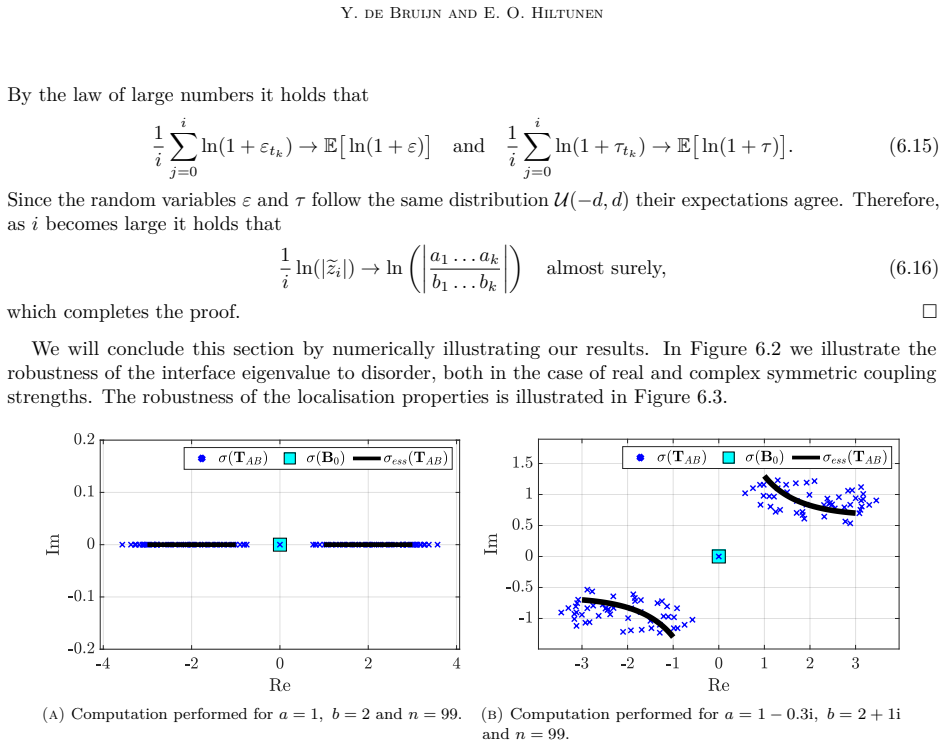
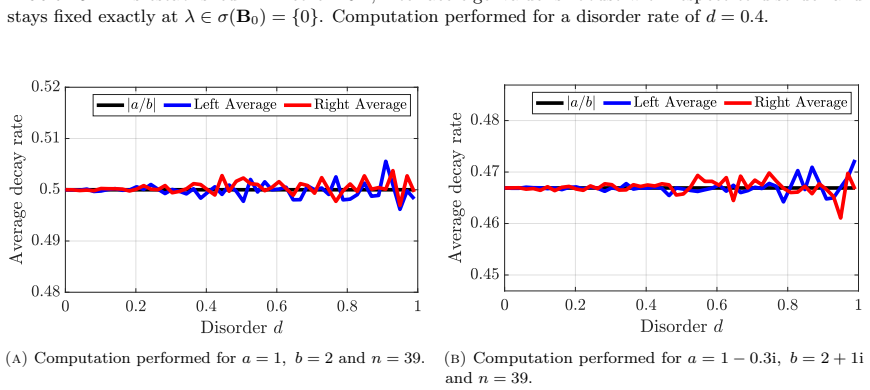
Tridiagonal $k$-Toeplitz operators provide a natural framework for modelling one-dimensional $k$-periodic lattice systems. A fundamental connection is obtained between Coburn's lemma for tridiagonal $k$-Toeplitz operators and the existence of edge modes. We reveal that topological edge modes are characterised by the eigenvalues of the leading principal submatrix of the symbol function. A complete analysis of tridiagonal interface operators satisfying global inversion symmetry is then presented. These results are applied to finite one-dimensional $k$-periodic chains of damped resonators that satisfy both local and global inversion symmetry. Additionally, disordered tight-binding interface operators are shown to support a topologically robust zero-energy interface state. Numerical simulations are conducted to illustrate the theoretical findings.
Editorial analysis
A structured set of objections, weighed in public.
Referee Report
Summary. The paper claims that tridiagonal k-Toeplitz operators provide a framework for one-dimensional k-periodic lattice systems, establishing a direct link via Coburn's lemma between these operators and the existence of edge modes. Topological edge modes are characterized by the eigenvalues of the leading principal submatrix of the symbol function. A full analysis is given for tridiagonal interface operators under global inversion symmetry, with applications to damped resonator chains (local and global inversion symmetry) and disordered tight-binding models supporting a robust zero-energy interface state, illustrated by numerical simulations.
Significance. If the derivations hold, the work supplies a parameter-free operator-theoretic explanation for topologically protected interface modes in damped and disordered multi-band lattices, extending established results on Toeplitz operators to physically relevant settings with dissipation. The explicit characterization via principal submatrix eigenvalues and the handling of global inversion symmetry are notable strengths that could aid modeling in phononic or photonic systems.
minor comments (3)
- [§2] §2 (symbol function definition): the precise definition of the leading principal submatrix and its relation to the symbol should be stated explicitly before the characterization theorem, to avoid ambiguity in the multi-band case.
- [Numerical simulations] Numerical section: the discretization parameters, system sizes, and damping values used in the simulations for the damped resonator chains should be tabulated or listed to allow reproducibility of the interface mode plots.
- [Analysis of interface operators] The statement of global inversion symmetry for the interface operators would benefit from an explicit matrix form or equation reference early in the analysis section.
Simulated Author's Rebuttal
We thank the referee for their positive assessment of our work, the detailed summary, and the recommendation for minor revision. No specific major comments were raised in the report.
Circularity Check
No significant circularity detected
full rationale
The paper's central derivation applies Coburn's lemma and standard properties of tridiagonal k-Toeplitz operators (external results from operator theory) to establish a connection with edge modes and to characterize them via eigenvalues of the leading principal submatrix of the symbol under global inversion symmetry. These steps are presented as consequences of the spectral analysis rather than redefinitions or fits to the target quantities. Applications to damped resonators and disordered tight-binding chains follow directly once the modeling assumptions hold, with no load-bearing claim reducing to a self-citation chain, fitted parameter renamed as prediction, or ansatz smuggled via prior work by the same authors. The derivation remains self-contained against external benchmarks in spectral theory.
Axiom & Free-Parameter Ledger
axioms (2)
- standard math Coburn's lemma and the spectral properties of tridiagonal k-Toeplitz operators hold as previously established in operator theory.
- domain assumption The physical lattice systems are faithfully represented by tridiagonal k-Toeplitz operators with the stated symmetries.
Reference graph
Works this paper leans on
-
[1]
IEEE Transactions on Antennas and Propagation , volume=
1-D periodic lattice sums for complex and leaky waves in 2-D structures using higher order Ewald formulation , author=. IEEE Transactions on Antennas and Propagation , volume=. 2019 , publisher=
2019
-
[2]
Soviet Physics Journal , volume=
Application of a complex band structure to compute the surface states by the Green's function method , author=. Soviet Physics Journal , volume=. 1975 , publisher=
1975
-
[3]
doi:10.1088/1751-8121/add5ab , year =
Ammari, Habib and Barandun, Silvio and de Bruijn, Yannick and Liu, Ping and Thalhammer, Clemens , title =. doi:10.1088/1751-8121/add5ab , year =
-
[4]
Journal de Math
Topologically protected edge modes in one-dimensional chains of subwavelength resonators , author=. Journal de Math. 2020 , publisher=
2020
-
[5]
SIAM Journal on Applied Mathematics , volume=
Generalized Honeycomb-Structured Materials in the Subwavelength Regime , author=. SIAM Journal on Applied Mathematics , volume=. 2024 , publisher=
2024
-
[6]
2023 , eprint=
Nonlocal PDEs and quantum optics: band structure of periodic atomic sytems , author=. 2023 , eprint=
2023
-
[7]
SIAM Journal on Mathematical Analysis , pages=
Nonlocal PDEs and Quantum Optics: Bound States and Resonances , author=. SIAM Journal on Mathematical Analysis , pages=
-
[8]
Proceedings of the Royal Society of Edinburgh: Section A Mathematics , year=
On the spectrum of two different fractional operators , author=. Proceedings of the Royal Society of Edinburgh: Section A Mathematics , year=
-
[9]
Mathematical and Computational Methods in Photonics and Phononics , author =. doi:10.1090/surv/235 , isbn =
-
[10]
Multiscale Modeling & Simulation , volume =
Ammari, Habib and Barandun, Silvio and Cao, Jinghao and Feppon, Florian , title =. Multiscale Modeling & Simulation , volume =. 2023 , doi =
2023
-
[11]
2018 , eprint=
Bloch waves in bubbly crystal near the first band gap: a high-frequency homogenization approach , author=. 2018 , eprint=
2018
-
[12]
SIAM Journal on Applied Mathematics , volume =
Ammari, Habib and Fitzpatrick, Brian and Gontier, David and Lee, Hyundae and Zhang, Hai , title =. SIAM Journal on Applied Mathematics , volume =. 2017 , doi =
2017
-
[13]
Mathematical analysis of plasmonic resonances for nanoparticles: the full
Ammari, Habib and Ruiz, Matias and Yu, Sanghyeon and Zhang, Hai , journal=. Mathematical analysis of plasmonic resonances for nanoparticles: the full. 2016 , publisher=
2016
-
[14]
Minnaert resonances for acoustic waves in bubbly media , author=. Ann. I. H. Poincar. 2018 , doi=
2018
-
[15]
Asymptotic analysis of resonances of small volume high contrast linear and nonlinear scatterers , author=. J. Math. Phys. , volume=. 2018 , publisher=
2018
-
[16]
Subwavelength resonant dielectric nanoparticles with high refractive indices , author=. Math. Meth. Appl. Sci. , volume=. 2019 , publisher=
2019
-
[17]
Transactions of the American Mathematical Society , volume=
Mathematical analysis of electromagnetic scattering by dielectric nanoparticles with high refractive indices , author=. Transactions of the American Mathematical Society , volume=. 2023 , doi=
2023
-
[18]
A mathematical theory of super-resolution by using a system of sub-wavelength
Ammari, Habib and Zhang, Hai , journal=. A mathematical theory of super-resolution by using a system of sub-wavelength. 2015 , publisher=
2015
-
[19]
Mathematical analysis of plasmonic nanoparticles: the scalar case , author=. Arch. Rational Mech. Anal. , volume=. 2017 , publisher=
2017
-
[20]
SIAM review , volume=
Lattice sums for the Helmholtz equation , author=. SIAM review , volume=. 2010 , publisher=
2010
-
[21]
Computer physics communications , volume=
Ewald summation techniques in perspective: a survey , author=. Computer physics communications , volume=. 1996 , publisher=
1996
-
[22]
Physical Review B , volume=
Subwavelength imaging in photonic crystals , author=. Physical Review B , volume=. 2003 , publisher=
2003
-
[23]
Journal of Physics A: Mathematical and Theoretical , volume=
Mathematical theory for topological photonic materials in one dimension , author=. Journal of Physics A: Mathematical and Theoretical , volume=. 2022 , publisher=
2022
-
[24]
and Sigal, E.I
Gohberg, I.C. and Sigal, E.I. , journal=. An operator generalization of the logarithmic residue theorem and the theorem of. 1971 , doi =
1971
-
[25]
the approximation of nearly free electrons , author=
Electronic states at the surfaces of crystals: I. the approximation of nearly free electrons , author=. Mathematical Proceedings of the Cambridge Philosophical Society , volume=. 1939 , organization=
1939
-
[26]
Physical Review B , volume=
Complex band structure of topologically protected edge states , author=. Physical Review B , volume=. 2014 , publisher=
2014
-
[27]
Physical Review B , volume=
Complex band structure, decay lengths, and Fermi level alignment in simple molecular electronic systems , author=. Physical Review B , volume=. 2002 , publisher=
2002
-
[28]
Physical Review B , volume=
Complex band structures of crystalline solids: An eigenvalue method , author=. Physical Review B , volume=. 1982 , publisher=
1982
-
[29]
Journal of Physics: Condensed Matter , volume=
A unified perspective of complex band structure: interpretations, formulations, and applications , author=. Journal of Physics: Condensed Matter , volume=. 2016 , publisher=
2016
-
[30]
Physical Review B—Condensed Matter and Materials Physics , volume=
Canalization of subwavelength images by electromagnetic crystals , author=. Physical Review B—Condensed Matter and Materials Physics , volume=. 2005 , publisher=
2005
-
[31]
Physical review letters , volume=
Experimental and theoretical evidence for subwavelength imaging in phononic crystals , author=. Physical review letters , volume=. 2009 , publisher=
2009
-
[32]
Studies in Applied Mathematics , volume=
Modal decompositions and point scatterer approximations near the Minnaert resonance frequencies , author=. Studies in Applied Mathematics , volume=. 2022 , publisher=
2022
-
[33]
Studies in Applied Mathematics , volume=
Transmission properties of space-time modulated metamaterials , author=. Studies in Applied Mathematics , volume=. 2023 , publisher=
2023
-
[34]
Optics express , volume=
Diffracted evanescent wave model for enhanced and suppressed optical transmission through subwavelength hole arrays , author=. Optics express , volume=. 2004 , publisher=
2004
-
[35]
Physical review letters , volume=
Subwavelength structure of the evanescent field of an optical bloch wave , author=. Physical review letters , volume=. 2009 , publisher=
2009
-
[36]
Solitons in Polyacetylene , author =. Phys. Rev. Lett. , volume =. 1979 , publisher =. doi:10.1103/PhysRevLett.42.1698 , url =
-
[37]
Proceedings of the Royal Society A: Mathematical, Physical and Engineering Sciences , volume=
Band gap Green's functions and localized oscillations , author=. Proceedings of the Royal Society A: Mathematical, Physical and Engineering Sciences , volume=. 2007 , publisher=
2007
-
[38]
Subwavelength localized modes for acoustic waves in bubbly crystals with a defect , author=. SIAM J. Appl. Math. , volume=. 2018 , publisher=
2018
-
[39]
Crystals , VOLUME =
Lemoult, Fabrice and Kaina, Nadège and Fink, Mathias and Lerosey, Geoffroy , TITLE =. Crystals , VOLUME =. 2016 , NUMBER =
2016
-
[40]
Yves, Simon and Fleury, Romain and Berthelot, Thomas and Fink, Mathias and Lemoult, Fabrice and Lerosey, Geoffroy , title=. Nat. Commun. , year=
-
[41]
Fefferman, Charles L. and Lee-Thorp, James P. and Weinstein, Michael I. , journal =. Topologically protected states in one-dimensional continuous systems and. 2014 , issn =. doi:10.1073/pnas.1407391111 , publisher =
-
[42]
and Lee-Thorp, James P
Fefferman, Charles L. and Lee-Thorp, James P. and Weinstein, Michael I. , journal =. Honeycomb. 2018 , number =
2018
-
[43]
Minnaert, Marcel , title =. Philos. Mag. , year=
-
[45]
Band structure of evanescent waves in phononic crystals , year=
Laude, Vincent and Aoubiza, Boujemaa and Achaoui, Younes and Benchabane, Sarah and Khelif, Abdelkrim , booktitle=. Band structure of evanescent waves in phononic crystals , year=. doi:10.1109/ULTSYM.2008.0061 , ISSN=
-
[46]
American Journal of Physics , keywords =
Waves in locally periodic media. American Journal of Physics , keywords =. doi:10.1119/1.1308266 , adsurl =
-
[47]
SIAM Journal on Applied Mathematics , volume =
Feppon, Florian and Cheng, Zijian and Ammari, Habib , title =. SIAM Journal on Applied Mathematics , volume =. 2023 , doi =
2023
-
[48]
Pure and Applied Analysis , volume=
Functional analytic methods for discrete approximations of subwavelength resonator systems , author=. Pure and Applied Analysis , volume=. 2024 , publisher=
2024
-
[49]
Studies in Applied Mathematics , volume =
Ammari, Habib and Barandun, Silvio and Davies, Bryn and Hiltunen, Erik Orvehed and Kosche, Thea and Liu, Ping , title =. Studies in Applied Mathematics , volume =. doi:10.1111/sapm.12765 , year =
-
[50]
2023 , journal=
Spectral convergence in large finite resonator arrays: the essential spectrum and band structure , author=. 2023 , journal=
2023
-
[51]
Journal of the European Mathematical Society (JEMS) , volume =
Habib Ammari and Erik Orvehed Hiltunen and Sanghyeon Yu , title =. Journal of the European Mathematical Society (JEMS) , volume =. 2022 , doi =
2022
-
[52]
SIAM Review , volume =
Yu, Sanghyeon and Ammari, Habib , title =. SIAM Review , volume =. 2018 , doi =
2018
-
[53]
Proceedings of the National Academy of Sciences , volume =
Sanghyeon Yu and Habib Ammari , title =. Proceedings of the National Academy of Sciences , volume =. 2019 , doi =
2019
-
[54]
da Fonseca and J
C.M. da Fonseca and J. Petronilho , title =. Numerische Mathematik , volume =. 2005 , doi =
2005
-
[55]
2026 , journal =
Complex Brillouin Zone for Localised Modes in Hermitian and Non-Hermitian Problems , author=. 2026 , journal =
2026
-
[56]
Studies in Applied Mathematics , volume =
de Bruijn, Yannick and Hiltunen, Erik Orvehed , title =. Studies in Applied Mathematics , volume =. doi:10.1111/sapm.70022 , abstract =
-
[57]
Mathematical Foundations of the Non-Hermitian Skin Effect , volume =
Ammari, Habib and Barandun, Silvio and Cao, Jinghao and Davies, Bryn and Hiltunen, Erik Orvehed , date =. Mathematical Foundations of the Non-Hermitian Skin Effect , volume =. Archive for Rational Mechanics and Analysis , number =. doi:10.1007/s00205-024-01976-y , id =
-
[58]
Generalised Brillouin Zone for Non-Reciprocal Systems , author=. Proc. R. Soc. A , volume=. 2025 , pages=
2025
-
[59]
SIAM Journal on Matrix Analysis and Applications , volume =
Nabben, Reinhard , title =. SIAM Journal on Matrix Analysis and Applications , volume =. 1999 , doi =
1999
-
[60]
Spectra and Pseudospectra , author =
-
[61]
Anderson Localization in the Subwavelength Regime , volume =
Ammari, Habib and Davies, Bryn and Hiltunen, Erik Orvehed , date =. Anderson Localization in the Subwavelength Regime , volume =. Communications in Mathematical Physics , number =. doi:10.1007/s00220-023-04880-w , id =
-
[62]
2024 , eprint=
Tunable Localisation in Parity-Time-Symmetric Resonator Arrays with Imaginary Gauge Potentials , author=. 2024 , eprint=
2024
-
[63]
SIAM Journal on Applied Mathematics , volume =
Ammari, Habib and Barandun, Silvio and Davies, Bryn and Hiltunen, Erik Orvehed and Liu, Ping , title =. SIAM Journal on Applied Mathematics , volume =. 2024 , doi =
2024
-
[64]
Eigenvalues and pseudo-eigenvalues of Toeplitz matrices , journal =. 1992 , issn =. doi:10.1016/0024-3795(92)90374-J , author =
-
[65]
Perturbed block Toeplitz matrices and the non-Hermitian skin effect in dimer systems of subwavelength resonators , journal =. 2025 , issn =. doi:10.1016/j.matpur.2025.103658 , author =
-
[66]
Two-scale effective model for defect-induced localization transitions in non-Hermitian systems , author =. Phys. Rev. B , volume =. 2025 , publisher =
2025
-
[67]
Invisible tunneling through non-Hermitian barriers in nonreciprocal lattices , author =. Phys. Rev. B , volume =. 2025 , publisher =
2025
-
[68]
Physical Review X , volume=
Surface impedance and bulk band geometric phases in one-dimensional systems , author=. Physical Review X , volume=. 2014 , publisher=
2014
-
[69]
Journal of Mathematical Physics , volume=
Is the continuum SSH model topological? , author=. Journal of Mathematical Physics , volume=. 2022 , publisher=
2022
-
[70]
Subwavelength phononic bandgap opening in bubbly media , journal =. 2017 , issn =. doi:10.1016/j.jde.2017.06.025 , author =
-
[71]
Non-Hermitian waves in a continuous periodic model and application to photonic crystals , author =. Phys. Rev. Res. , volume =. 2022 , month =. doi:10.1103/PhysRevResearch.4.023089 , url =
-
[72]
Green's functions of multiband non-Hermitian systems , author =. Phys. Rev. Res. , volume =. 2023 , month =. doi:10.1103/PhysRevResearch.5.043073 , url =
-
[73]
SIAM Journal on Applied Mathematics , volume=
Topological interface modes in systems with damping , author=. SIAM Journal on Applied Mathematics , volume=. 2025 , publisher=
2025
-
[74]
The Toeplitz Matrices of an Arbitrary Laurent Polynomial
Schmidt, Palle and Spitzer, Frank , year=. The Toeplitz Matrices of an Arbitrary Laurent Polynomial. , volume=. doi:10.7146/math.scand.a-10588 , journal=
-
[75]
Asymptotic behavior of block Toeplitz matrices and determinants , journal =. 1974 , issn =. doi:10.1016/0001-8708(74)90072-3 , author =
-
[76]
Introduction to Large Truncated Toeplitz Matrices , author =
-
[77]
Journal of Physics A: Mathematical and Theoretical , abstract =
Ammari, Habib and Barandun, Silvio and de Bruijn, Yannick and Liu, Ping and Thalhammer, Clemens , title =. Journal of Physics A: Mathematical and Theoretical , abstract =. 2026 , month =. doi:10.1088/1751-8121/ae442e , url =
-
[78]
2026 , eprint=
Mathematical Foundation for the Generalised Brillouin zone of m-banded Toeplitz operators , author=. 2026 , eprint=
2026
-
[79]
2024 , eprint=
On reality of eigenvalues of banded block Toeplitz matrices , author=. 2024 , eprint=
2024
-
[80]
Subwavelength Resonances in One-Dimensional High-Contrast Acoustic Media , author =
-
[81]
and Lombard, B
Coutant, A. and Lombard, B. , title =. Proceedings of the Royal Society A: Mathematical, Physical and Engineering Sciences , volume =. 2024 , month =
2024
discussion (0)
Sign in with ORCID, Apple, or X to comment. Anyone can read and Pith papers without signing in.