Recognition: unknown
Network exploration by random walks: A large deviation perspective
Pith reviewed 2026-05-09 22:48 UTC · model grok-4.3
The pith
At short times the distribution of distinct nodes visited by a random walk depends only on the waiting times between hops, not on network structure.
A machine-rendered reading of the paper's core claim, the machinery that carries it, and where it could break.
Core claim
Under the sole assumption that the waiting-time distribution ψ(τ) is analytic at small times, the large-deviation function governing P(S,t) at small t becomes independent of network topology and is fixed entirely by the characteristics of ψ(τ); the fully connected coupon-collector limit is recovered as a special case when waiting times are deterministic.
What carries the argument
The large-deviation rate function for P(S,t) obtained from the continuous-time random-walk representation, whose small-time behavior is insensitive to the adjacency matrix once ψ(τ) is analytic near the origin.
Load-bearing premise
The distribution of waiting times at nodes must be analytic at small times.
What would settle it
Compute or measure the small-t form of P(S,t) on two networks with different topologies but identical analytic waiting-time distributions; any statistically significant difference in the large-deviation rate would contradict the claim.
Figures
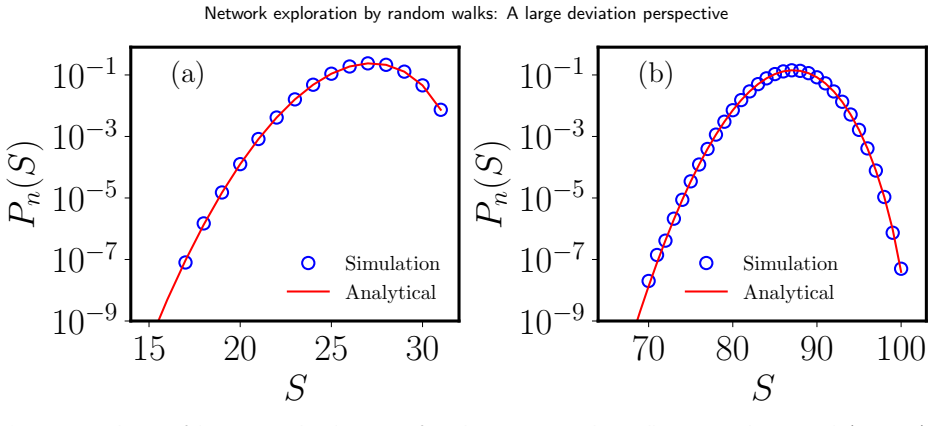


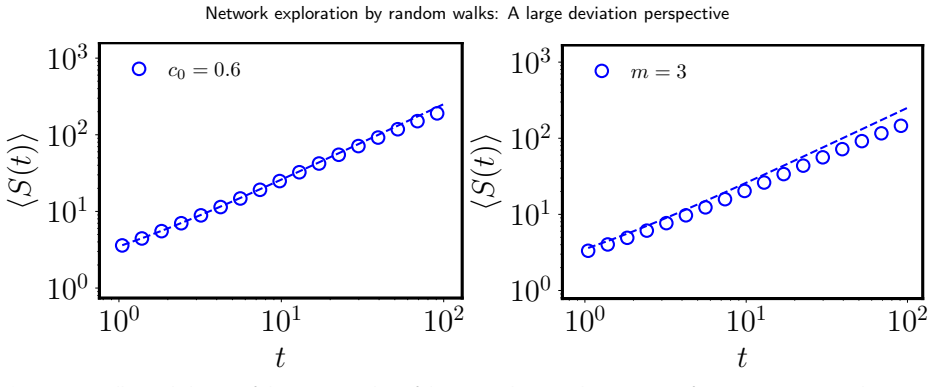
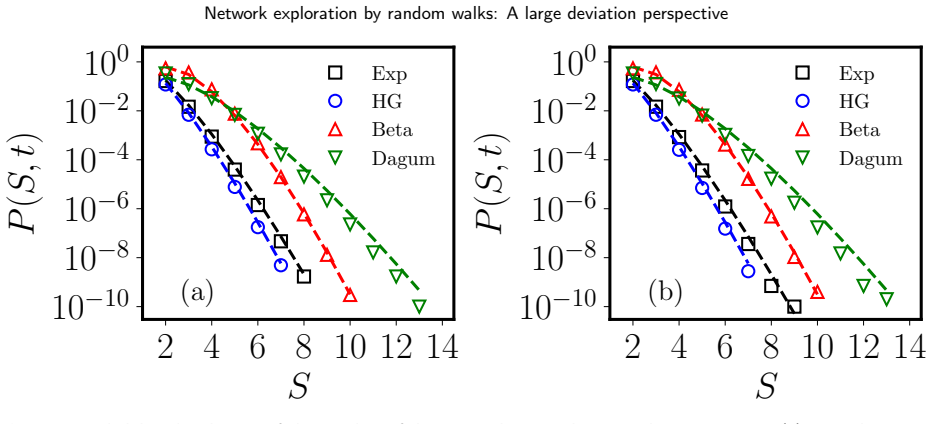
read the original abstract
We study exploration properties of a random walk on a network. For a fully connected network we find that the problem can be mapped to the well known coupon collector problem, thus allowing us to estimate form of $P(S,t)$: the distribution of number of distinct nodes $S$ visited by the random walk upto time $t$. From a practical point of view, however, both the fully connected network and hops taking place after fixed intervals are an idealization. We solve this problem by introducing the formalism of continuous time random walks wherein the random walk spends a random amount of time a node before hopping to its neighboring node. The formalism allows us to study the large deviation limit of $P(S,t)$ under very mild conditions that the distribution of waiting times $\psi(\tau)$ exhibits analyticity at small times. Furthermore, we find that at small times, the properties of $P(S,t)$ are largely independent of the network topology, and are governed solely by the waiting time characteristics.
Editorial analysis
A structured set of objections, weighed in public.
Referee Report
Summary. The manuscript examines the exploration of networks by random walks, focusing on the distribution P(S, t) of the number of distinct nodes visited by time t. It begins by mapping the problem on fully connected networks with deterministic waiting times to the coupon collector problem. The authors then introduce continuous-time random walks (CTRW) with general waiting time density ψ(τ) to handle more realistic scenarios. Under the assumption that ψ(τ) is analytic at small times, they derive the large-deviation limit for P(S, t) and conclude that for small t, this distribution's properties are independent of the network topology and determined solely by the waiting time characteristics.
Significance. If the large-deviation analysis and the topology-independence result are rigorously established, the work could offer valuable insights into short-time dynamics of random walks on complex networks, with potential applications in modeling diffusion processes where waiting times vary. The mapping to coupon collector and the use of CTRW formalism are standard tools, but their combination for large deviations under analyticity provides a novel perspective. However, the result's impact depends on whether the analyticity condition sufficiently decouples the graph structure from the small-t statistics.
major comments (2)
- The central claim that analyticity of ψ(τ) at small τ suffices for the large-deviation limit of P(S,t) to become independent of network topology (as stated in the abstract and likely derived in the main formalism section) requires explicit justification for interchanging the small-t limit with the rate function while restoring the graph-dependent first-return kernel; without this, the mapping from hop count N(t) to distinct sites S remains topology-dependent even for small numbers of steps.
- No error bounds, convergence rates, or restrictions on the network (e.g., bounded degree or regularity assumptions) are provided to guarantee that the claimed independence holds for arbitrary graphs once the renewal process defined by ψ is coupled to the adjacency structure.
minor comments (2)
- The abstract introduces the analyticity condition on ψ(τ) without specifying the precise class of functions (e.g., whether it includes power-law tails with cutoff or only exponential-like forms) or how it translates to the Laplace-transform representation used in the large-deviation analysis.
- Notation for the waiting-time density ψ(τ) and the propagator should be clarified with respect to normalization and moments to aid readability for readers unfamiliar with CTRW literature.
Simulated Author's Rebuttal
We thank the referee for their careful reading and constructive feedback on our manuscript. We address each major comment point by point below, providing clarifications on our derivations and indicating revisions to improve rigor and explicitness.
read point-by-point responses
-
Referee: The central claim that analyticity of ψ(τ) at small τ suffices for the large-deviation limit of P(S,t) to become independent of network topology (as stated in the abstract and likely derived in the main formalism section) requires explicit justification for interchanging the small-t limit with the rate function while restoring the graph-dependent first-return kernel; without this, the mapping from hop count N(t) to distinct sites S remains topology-dependent even for small numbers of steps.
Authors: We appreciate the referee's call for greater explicitness in the limit interchange. In our approach, N(t) is generated by a renewal process whose small-t statistics are fixed solely by the analytic expansion of ψ(τ) near zero; the large-deviation rate for atypical N(t) follows directly from this expansion. The mapping to S then proceeds via the occupation measure on the graph. While the first-return kernel is indeed graph-dependent, the analyticity condition ensures that the leading exponential cost in the small-t regime is incurred by the waiting-time tail rather than by return events, whose contribution remains sub-exponential for the relevant deviation scale. We will revise the formalism section (and add a short appendix) to spell out this interchange step by step, showing explicitly that the graph-dependent kernel factors out of the leading rate function I(s) for P(S,t) as t→0. revision: yes
-
Referee: No error bounds, convergence rates, or restrictions on the network (e.g., bounded degree or regularity assumptions) are provided to guarantee that the claimed independence holds for arbitrary graphs once the renewal process defined by ψ is coupled to the adjacency structure.
Authors: The referee is right that we have not supplied quantitative error bounds or uniform convergence statements. The result is an asymptotic large-deviation statement in the joint limit t→0 under the analyticity hypothesis on ψ(τ); for any fixed finite connected graph the topology independence emerges at leading order. We will add a dedicated paragraph (and a remark in the conclusions) stating the standing assumptions—finite undirected connected graph with bounded maximum degree—and noting that the rate of convergence to the topology-independent limit may depend on graph invariants such as diameter. Precise error bounds would require additional technical estimates on the remainder of the renewal expansion; we therefore mark this as a partial revision and will include a clear statement of the current scope. revision: partial
Circularity Check
No circularity; central claim rests on external analyticity assumption.
full rationale
The paper assumes analyticity of the waiting-time density ψ(τ) at small τ as a mild external condition to obtain the large-deviation limit of P(S,t) and the claimed topology independence at small t. This assumption is not derived from or fitted to any quantity inside the paper. The fully-connected case reduces to the standard coupon-collector problem (a known result, not a self-definition), and the CTRW extension does not rename fitted parameters as predictions or invoke self-citations whose content reduces to the target claim. No load-bearing step collapses by construction to the paper's own inputs.
Axiom & Free-Parameter Ledger
axioms (1)
- domain assumption The waiting-time distribution ψ(τ) is analytic at small times.
Reference graph
Works this paper leans on
-
[1]
Epidemicprocessesincomplexnetworks.Rev
R.Pastor-Satorras,C.Castellano,P.VanMieghem,andA.Vespignani. Epidemicprocessesincomplexnetworks.Rev. Mod. Phys.,87(3):925– 979, 2015
2015
-
[2]
Bisnik and A
N. Bisnik and A. A. Abouzeid. Optimizing random walk search algorithms in p2p networks.Computer Networks, 51(6):1499–1514, 2007
2007
-
[3]
N.Perra,A.Baronchelli,D.Mocanu,B.Gonçalves,R.Pastor-Satorras,andA.Vespignani.Randomwalksandsearchintime-varyingnetworks. Phys. Rev. Lett., 109(23):238701, 2012
2012
-
[4]
Sarkar and A
P. Sarkar and A. W. Moore. Random walks in social networks and their applications: a survey.Social Network Data Analytics, pages 43–77, 2011
2011
-
[5]
V. M. Lopez Millan, V. Cholvi, L. López, and A. Fernandez Anta. A model of self-avoiding random walks for searching complex networks. Networks, 60(2):71–85, 2012
2012
-
[6]
Gkantsidis, M
C. Gkantsidis, M. Mihail, and A. Saberi. Random walks in peer-to-peer networks. InIEEE INFOCOM 2004, volume 1. IEEE, 2004
2004
-
[7]
L. Lü, D. Chen, X.-L. Ren, Q.-M. Zhang, Y.-C. Zhang, and T. Zhou. Vital nodes identification in complex networks.Phys. Rep., 650:1–63, 2016
2016
-
[8]
Fortunato
S. Fortunato. Community detection in graphs.Phys. Rep., 486(3-5):75–174, 2010
2010
-
[9]
Ballal, W
A. Ballal, W. B. Kion-Crosby, and A. V. Morozov. Network community detection and clustering with random walks.Phys. Rev. Research, 4(4):043117, 2022
2022
-
[10]
Carletti, D
T. Carletti, D. Fanelli, and R. Lambiotte. Random walks and community detection in hypergraphs.J. Phys.: Complexity, 2(1):015011, 2021
2021
-
[11]
de Guzzi Bagnato, J
G. de Guzzi Bagnato, J. R. F. Ronqui, and G. Travieso. Community detection in networks using self-avoiding random walks.Physica A, 505:1046–1055, 2018
2018
-
[12]
Fortunato and A
S. Fortunato and A. Flammini. Random walks on directed networks: the case of pagerank.International J. Bifurcation and Chaos, 17(07):2343–2353, 2007
2007
-
[13]
Agarwal and S
A. Agarwal and S. Chakrabarti. Learning random walks to rank nodes in graphs. InProceedings of the 24th international conference on Machine learning, 2007
2007
-
[14]
Cambridge University Press, Cambridge, 2008
Alain Barrat, Marc Barthélemy, and Alessandro Vespignani.Dynamical Processes on Complex Networks. Cambridge University Press, Cambridge, 2008
2008
-
[15]
Anultrametricrandomwalkmodelfordiseasespreadtakingintoaccountsocialclusteringofthepopulation
A.KhrennikovandK.Oleschko. Anultrametricrandomwalkmodelfordiseasespreadtakingintoaccountsocialclusteringofthepopulation. Entropy, 22(9):931, 2020
2020
-
[16]
Draief and A
M. Draief and A. Ganesh. A random walk model for infection on graphs: spread of epidemics & rumours with mobile agents.Discrete Event Dynamic Systems, 21:41–61, 2011
2011
-
[17]
Iannelli, A
F. Iannelli, A. Koher, D. Brockmann, P. Hövel, and I. M. Sokolov. Effective distances for epidemics spreading on complex networks.Phys. Rev. E, 95(1):012313, 2017
2017
-
[18]
Deborah M. Gordon. The development of an ant colony’s foraging range.Animal Behaviour, 49(3):649–659, 1995
1995
-
[19]
Frank den Hollander and George H. Weiss. Aspects of trapping in transport processes. InContemporary Problems in Statistical Physics, pages 147–203. SIAM, 1994
1994
-
[20]
Kiefer, and George H
Shlomo Havlin, Menachem Dishon, James E. Kiefer, and George H. Weiss. Trapping of random walks in two and three dimensions.Phys. Rev. Lett., 53:407–410, Jul 1984
1984
-
[21]
The range of stable random walks.The Annals of Probability, 19(2):650–705, 1991
Jean-François Le Gall and Jay Rosen. The range of stable random walks.The Annals of Probability, 19(2):650–705, 1991
1991
-
[22]
Gillis and George H
Joseph E. Gillis and George H. Weiss. Expected number of distinct sites visited by a random walk with an infinite variance.Journal of Mathematical Physics, 11(4):1307–1312, 04 1970. Upadhyay et al.:Preprint submitted to ElsevierPage 8 of 10 Network exploration by random walks: A large deviation perspective
1970
-
[23]
Number of distinct sites visited by a resetting random walker.Journal of Physics A: Mathematical and Theoretical, 55(24):244001, may 2022
Marco Biroli, Francesco Mori, and Satya N Majumdar. Number of distinct sites visited by a resetting random walker.Journal of Physics A: Mathematical and Theoretical, 55(24):244001, may 2022
2022
-
[24]
Redner, and Olivier Bénichou
Léo Régnier, Maxim Dolgushev, S. Redner, and Olivier Bénichou. Complete visitation statistics of one-dimensional random walks.Phys. Rev. E, 105:064104, Jun 2022
2022
-
[25]
Noh and H
J.D. Noh and H. Rieger. Random walks on complex networks.Phys. Rev. Lett., 92(11):118701, 2004
2004
-
[26]
Masuda, M
N. Masuda, M. A. Porter, and R. Lambiotte. Random walks and diffusion on networks.Phys. Rep., 716:1–58, 2017
2017
-
[27]
Oxford University Press, 06 1996
Barry D Hughes.Random Walks and Random Environments. Oxford University Press, 06 1996
1996
-
[28]
Vineyard
George H. Vineyard. The number of distinct sites visited in a random walk on a lattice.Journal of Mathematical Physics, 4(9):1191–1193, 09 1963
1963
-
[29]
Eugene Stanley, and George H
Hernan Larralde, Paul Trunfio, Shlomo Havlin, H. Eugene Stanley, and George H. Weiss. Territory covered by n diffusing particles.Nature, 355(6359):423–426, Jan 1992
1992
-
[30]
Numberofdistinctsitesvisitedbynrandomwalkersonaeuclideanlattice.Phys
S.B.YusteandL.Acedo. Numberofdistinctsitesvisitedbynrandomwalkersonaeuclideanlattice.Phys. Rev. E,61:2340–2347,Mar2000
-
[31]
Records for the number of distinct sites visited by a random walk on the fully connected lattice.Journal of Physics A: Mathematical and Theoretical, 48(44):445001, oct 2015
Loïc Turban. Records for the number of distinct sites visited by a random walk on the fully connected lattice.Journal of Physics A: Mathematical and Theoretical, 48(44):445001, oct 2015
2015
-
[32]
Santhanam
Aanjaneya Kumar, Yagyik Goswami, and M.S. Santhanam. Distinct nodes visited by random walkers on scale-free networks.Physica A: Statistical Mechanics and its Applications, 532:121875, 2019
2019
-
[33]
Theaveragenumberofdistinctsitesvisitedbyarandomwalkeronrandomgraphs
CaterinaDeBacco,SatyaNMajumdar,andPeterSollich. Theaveragenumberofdistinctsitesvisitedbyarandomwalkeronrandomgraphs. Journal of Physics A: Mathematical and Theoretical, 48(20):205004, apr 2015
2015
-
[34]
Majumdar and Mikhail V
Satya N. Majumdar and Mikhail V. Tamm. Number of common sites visited by𝑛random walkers.Phys. Rev. E, 86:021135, Aug 2012
2012
-
[35]
Universalexplorationdynamicsofrandomwalks.Nature Communications, 14(1):618, Feb 2023
LéoRégnier,MaximDolgushev,S.Redner,andOlivierBénichou. Universalexplorationdynamicsofrandomwalks.Nature Communications, 14(1):618, Feb 2023
2023
-
[36]
Code-red:acasestudyonthespreadandvictimsofaninternetworm
DavidMoore,ColleenShannon,andKimberlyClaffy. Code-red:acasestudyonthespreadandvictimsofaninternetworm. pages273–284, 01 2002
2002
-
[37]
Ataxonomyofcomputerworms
NicholasWeaver,VernPaxson,StuartStaniford,andRobertCunningham. Ataxonomyofcomputerworms. InProceedings of the 2003 ACM Workshop on Rapid Malcode, WORM ’03, page 11–18, New York, NY, USA, 2003. Association for Computing Machinery
2003
-
[38]
Hethcote
Herbert W. Hethcote. The mathematics of infectious diseases.SIAM Review, 42(4):599–653, 2000
2000
-
[39]
Epidemicspreadinginscale-freenetworks.Phys
RomualdoPastor-SatorrasandAlessandroVespignani. Epidemicspreadinginscale-freenetworks.Phys. Rev. Lett.,86:3200–3203,Apr2001
-
[40]
Targeting metastasis.Nat Rev Cancer, 16(4):201–218, April 2016
Patricia S Steeg. Targeting metastasis.Nat Rev Cancer, 16(4):201–218, April 2016
2016
-
[41]
Isaiah J. Fidler. The pathogenesis of cancer metastasis: the ’seed and soil’ hypothesis revisited.Nature Reviews Cancer, 3(6):453–458, Jun 2003
2003
-
[42]
Updateontheenvironmentalandeconomiccostsassociatedwithalien-invasivespecies in the united states.Ecological Economics, 52:273–288, 02 2005
DavidPimentel,RodolfoZuniga,andDougMorrison. Updateontheenvironmentalandeconomiccostsassociatedwithalien-invasivespecies in the united states.Ecological Economics, 52:273–288, 02 2005
2005
-
[43]
Mack, Daniel Simberloff, W
Richard N. Mack, Daniel Simberloff, W. Mark Lonsdale, Harry Evans, Michael Clout, and Fakhri A. Bazzaz. Biotic invasions: Causes, epidemiology, global consequences, and control.Ecological Applications, 10(3):689–710, 2000
2000
-
[44]
The spread of true and false news online.Science, 359(6380):1146–1151, 2018
Soroush Vosoughi, Deb Roy, and Sinan Aral. The spread of true and false news online.Science, 359(6380):1146–1151, 2018
2018
-
[45]
Graham, Donald E
Ronald L. Graham, Donald E. Knuth, and Oren Patashnik.Concrete Mathematics: A Foundation for Computer Science. Addison-Wesley Longman Publishing Co., Inc., USA, 2nd edition, 1994
1994
-
[46]
Bagui and K
S. Bagui and K. L. Mehra. The stirling numbers of the second kind and their applications.Alabama Journal of Mathematics, 47(1):1–22,
-
[47]
Analytical results for the distribution of cover times of random walks on random regular graphs
Ido Tishby, Ofer Biham, and Eytan Katzav. Analytical results for the distribution of cover times of random walks on random regular graphs. Journal of Physics A: Mathematical and Theoretical, 55(1):015003, dec 2021
2021
-
[48]
David J. Aldous. On the time taken by random walks on finite groups to visit every state.Zeitschrift für Wahrscheinlichkeitstheorie und Verwandte Gebiete, 62(3):361–374, Sep 1983
1983
-
[49]
Herbert S. Wilf. The editor’s corner: The white screen problem.The American Mathematical Monthly, 96(8):704–707, 1989
1989
-
[50]
William Feller.An introduction to probability theory and its applications. Vol. I.Wiley, Oxford, England, 1950
1950
-
[51]
The coupon-collector’s problem revisited.Journal of Applied Probability, 40, 06 2003
Ilan Adler, Shmuel Oren, and Sheldon Ross. The coupon-collector’s problem revisited.Journal of Applied Probability, 40, 06 2003
2003
-
[52]
Marián Boguñá, Dmitri Krioukov, and K. C. Claffy. Navigability of complex networks.Nature Physics, 5(1):74–80, Jan 2009
2009
-
[53]
De Arcangelis, J
L. De Arcangelis, J. Koplik, S. Redner, and D. Wilkinson. Hydrodynamic dispersion in network models of porous media.Phys. Rev. Lett., 57(8):996, 1986
1986
-
[54]
M. Sahimi. Dispersion in porous media, continuous-time random walks, and percolation.Phys. Rev. E, 85(1):016316, 2012
2012
-
[55]
Varloteaux, S
C. Varloteaux, S. Békri, and P.M. Adler. Pore network modelling to determine the transport properties in presence of a reactive fluid: From pore to reservoir scale.Adv. Water Resources, 53:87–100, 2013
2013
-
[56]
Montroll and G.H
E.W. Montroll and G.H. Weiss. Random walks on lattices. II.J. Math. Phys., 6(2):167–181, 1965
1965
-
[57]
Therandomwalk’sguidetoanomalousdiffusion:afractionaldynamicsapproach.Physics Reports,339(1):1– 77, 2000
RalfMetzlerandJosephKlafter. Therandomwalk’sguidetoanomalousdiffusion:afractionaldynamicsapproach.Physics Reports,339(1):1– 77, 2000
2000
-
[58]
Packets of diffusing particles exhibit universal exponential tails.Phys
Eli Barkai and Stanislav Burov. Packets of diffusing particles exhibit universal exponential tails.Phys. Rev. Lett., 124:060603, Feb 2020
2020
-
[59]
Upadhyay and R
Sarvesh K. Upadhyay and R. K. Singh. Continuous time random walks on networks.Phys. Rev. E, 112:014313, Jul 2025
2025
-
[60]
Naftali R. Smith. Full distribution of the number of distinct sites visited by a random walker in dimension𝑑≥2, 2025
2025
-
[61]
Temporal networks.Physics Reports, 519(3):97–125, 2012
Petter Holme and Jari Saramäki. Temporal networks.Physics Reports, 519(3):97–125, 2012. Upadhyay et al.:Preprint submitted to ElsevierPage 9 of 10 Network exploration by random walks: A large deviation perspective Appendix Form of the rate function𝐼(𝑡∕𝑛) Starting from𝑄𝑡(𝑛)given in Ref. [58]: 𝑄𝑡(𝑛) large𝑛∕𝑡 ∼ [(𝐶𝐴Γ(𝐴+ 1)) 1∕(𝐴+1) 𝑡]𝑛(𝐴+1) Γ(𝑛(𝐴+ 1) + 1 ) e...
2012
discussion (0)
Sign in with ORCID, Apple, or X to comment. Anyone can read and Pith papers without signing in.