Recognition: unknown
Characterizing the GD-1 Stream with DESI DR2 Data: Thin Stream and Hot Cocoon
Pith reviewed 2026-05-09 23:27 UTC · model grok-4.3
The pith
DESI data on the GD-1 stream identifies a thin cold core and a hot cocoon with 30% of members whose dispersion is consistent with 11 Gyr of dark matter subhalo heating.
A machine-rendered reading of the paper's core claim, the machinery that carries it, and where it could break.
Core claim
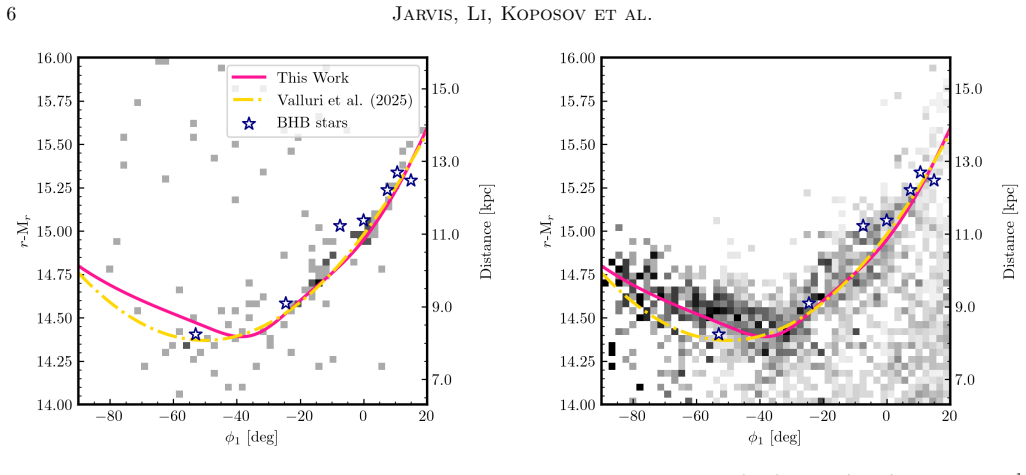
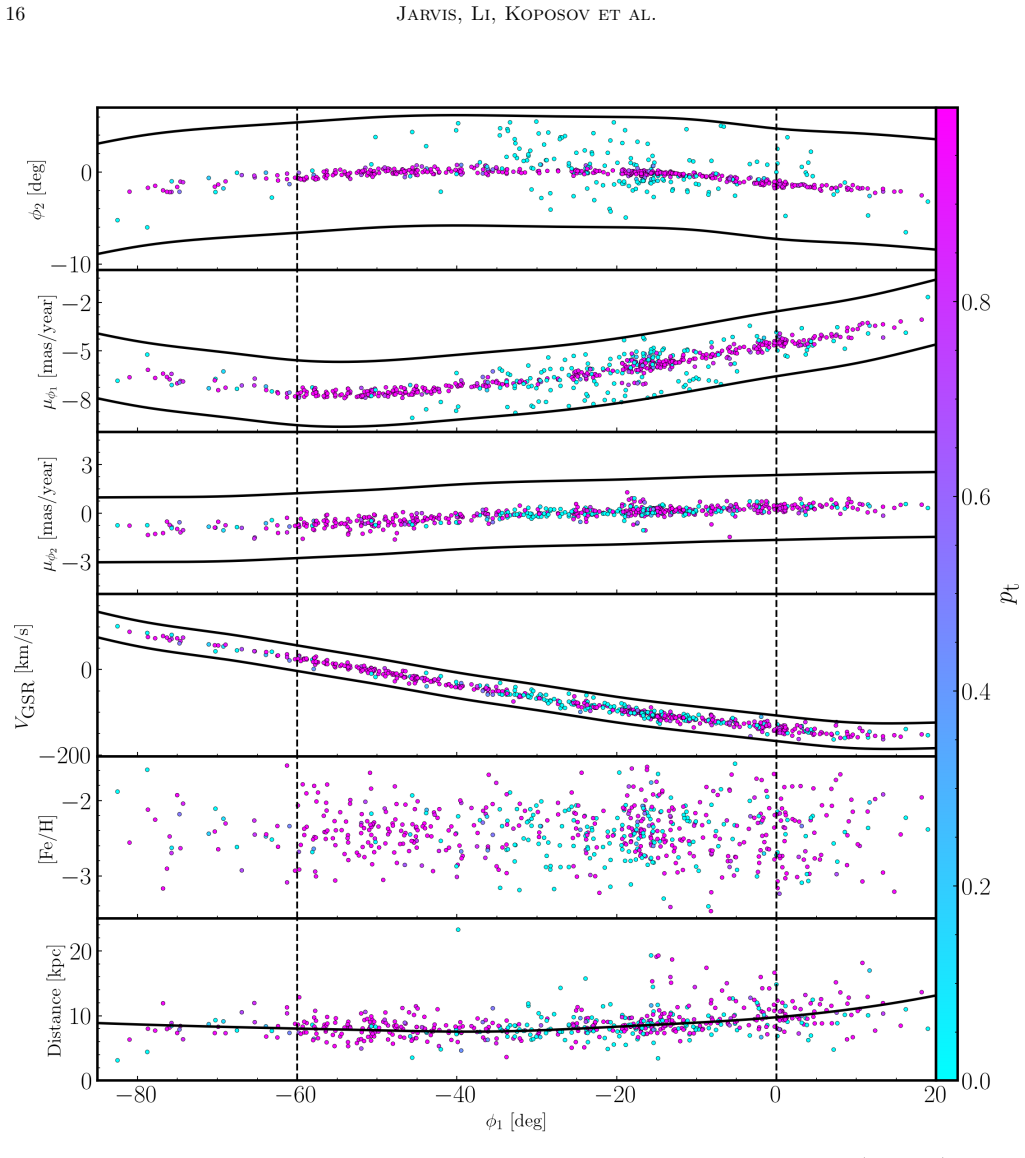
The cocoon contains ∼30% of members and its velocity dispersion is consistent with ∼11 Gyr of heating by cold dark matter subhalos. We also detect a large proper motion dispersion (41.36±4.98 km s−1) along the stream direction in the cocoon component.
Load-bearing premise
That the Gaussian mixture model cleanly separates a dynamically distinct hot cocoon whose properties arise primarily from dark matter subhalo heating rather than distance spreads, selection biases, or other dynamical effects, and that the 608-member sample is free of significant contamination.
Figures





read the original abstract
GD-1 is among the longest, coldest stellar streams in the Milky Way, making it an ideal target for probing dark matter substructure through dynamical heating. We present a catalog of 608 spectroscopically confirmed GD-1 members from the first three years of Dark Energy Spectroscopic Instrument (DESI) observations. This constitutes the largest homogeneous spectroscopic sample of GD-1, doubling the number of members previously available only through heterogeneous compilations combining multiple surveys with different systematics. Using these data, we derive updated stream tracks in sky position, proper motion, and radial velocity that extend over $100^\circ$ of the stream. We apply a Gaussian mixture model to decompose the stream into a dynamically cold thin component ($\sigma_V = 2.49\pm 0.28$ km s$^{-1}$, width $= 0.23\pm0.01^\circ$) and a kinematically hot cocoon ($\sigma_V = 6.13\pm0.75$ km s$^{-1}$, width $= 2.18\pm0.17^\circ$). The cocoon contains $\sim30\%$ of members and its velocity dispersion is consistent with $\sim11$ Gyr of heating by cold dark matter subhalos. We also detect a large proper motion dispersion ($41.36\pm4.98$ km s$^{-1}$) along the stream direction in the cocoon component. This feature indicates a significant line-of-sight distance spread in the cocoon, and its origin will be further explored in a forthcoming paper. These measurements demonstrate the power of DESI spectroscopy for characterizing the multi-component phase-space structure of stellar streams and constraining small-scale dark matter substructure.
Editorial analysis
A structured set of objections, weighed in public.
Referee Report
Summary. The paper presents a catalog of 608 spectroscopically confirmed GD-1 members from DESI DR2, doubling the previous homogeneous sample size. Updated stream tracks are derived over >100° in position, proper motion, and radial velocity. A Gaussian mixture model decomposes the sample into a cold thin stream component (σ_V = 2.49 ± 0.28 km s^{-1}, width 0.23 ± 0.01°) and a hot cocoon (σ_V = 6.13 ± 0.75 km s^{-1}, width 2.18 ± 0.17°), with the cocoon comprising ~30% of members whose dispersion is stated to be consistent with ~11 Gyr of CDM subhalo heating. A large cocoon proper-motion dispersion of 41.36 ± 4.98 km s^{-1} along the stream is also reported, indicating line-of-sight depth whose origin is deferred to a future paper.
Significance. If the decomposition holds, the homogeneous sample of 608 members is a substantial advance for characterizing the multi-component structure of a key cold stream and for placing empirical constraints on small-scale dark matter substructure via dynamical heating. The work highlights DESI's utility for stream science and provides concrete numbers (dispersions, widths, fractions) that can be compared to simulations.
major comments (3)
- [Abstract] Abstract and GMM decomposition: The central claim that the cocoon σ_V = 6.13 ± 0.75 km s^{-1} is consistent with ~11 Gyr of CDM subhalo heating is load-bearing for the dynamical interpretation, yet no quantitative comparison, heating-rate model, or reference is provided to support the match. The abstract simply states consistency without showing the calculation or the assumed subhalo population.
- [Results (GMM and PM dispersion)] GMM decomposition and proper-motion results: The reported cocoon proper-motion dispersion of 41.36 ± 4.98 km s^{-1} along the stream directly implies substantial line-of-sight depth. The Gaussian mixture model (which separates components using radial velocity, position, and proper motion) does not appear to incorporate distance-dependent velocity projections or a selection function that accounts for this depth; stars at different distances can therefore be misassigned, potentially inflating the cocoon dispersion and undermining the claim that it reflects purely dynamical heating.
- [Data and sample selection] Membership and sample characterization: The 608-member catalog and the ~30% cocoon fraction are central to all conclusions, but the abstract and methods provide no explicit membership selection criteria, contamination estimates, or robustness tests against alternative models or distance priors. This is required to evaluate whether the hot component is dynamically distinct or partly an artifact of selection biases.
minor comments (2)
- [Abstract] The abstract would benefit from a brief statement of the membership probability threshold or likelihood cut used in the GMM.
- [Results] Notation for velocity dispersions should be clarified (e.g., whether σ_V is the 1D radial-velocity dispersion or the full 3D value) when comparing to heating models.
Simulated Author's Rebuttal
We thank the referee for their constructive and detailed review, which highlights both the strengths of our DESI GD-1 catalog and areas where additional clarity would strengthen the manuscript. We address each major comment point by point below, providing clarifications based on the existing analysis and committing to revisions where they improve the presentation without altering the core results.
read point-by-point responses
-
Referee: [Abstract] Abstract and GMM decomposition: The central claim that the cocoon σ_V = 6.13 ± 0.75 km s^{-1} is consistent with ~11 Gyr of CDM subhalo heating is load-bearing for the dynamical interpretation, yet no quantitative comparison, heating-rate model, or reference is provided to support the match. The abstract simply states consistency without showing the calculation or the assumed subhalo population.
Authors: We agree that the abstract would benefit from more explicit support for this statement. The consistency with ~11 Gyr of heating is based on comparisons to published N-body simulations of subhalo-induced heating in cold streams (e.g., velocity dispersions of 5–7 km s^{-1} after 10–12 Gyr for GD-1-like orbits under standard CDM subhalo populations). In the revised manuscript we will add a brief supporting sentence to the abstract and a short paragraph in the results section with appropriate citations to the relevant heating-rate models and simulation suites. revision: yes
-
Referee: [Results (GMM and PM dispersion)] GMM decomposition and proper-motion results: The reported cocoon proper-motion dispersion of 41.36 ± 4.98 km s^{-1} along the stream directly implies substantial line-of-sight depth. The Gaussian mixture model (which separates components using radial velocity, position, and proper motion) does not appear to incorporate distance-dependent velocity projections or a selection function that accounts for this depth; stars at different distances can therefore be misassigned, potentially inflating the cocoon dispersion and undermining the claim that it reflects purely dynamical heating.
Authors: We acknowledge this as a legitimate methodological concern. The GMM was performed in observed sky, proper-motion, and radial-velocity coordinates without an explicit distance-dependent projection model, precisely because the large along-stream PM dispersion (which we report) signals the presence of significant line-of-sight depth whose detailed treatment is reserved for a follow-up paper. We did, however, verify that the two-component solution remains stable under changes in feature weighting and initialization. In revision we will add an explicit discussion of this limitation, estimate the size of projection effects given the observed depth, and clarify why the reported velocity dispersion is still interpreted as primarily dynamical rather than purely geometric. revision: partial
-
Referee: [Data and sample selection] Membership and sample characterization: The 608-member catalog and the ~30% cocoon fraction are central to all conclusions, but the abstract and methods provide no explicit membership selection criteria, contamination estimates, or robustness tests against alternative models or distance priors. This is required to evaluate whether the hot component is dynamically distinct or partly an artifact of selection biases.
Authors: The spectroscopic membership criteria, quality cuts, and kinematic matching procedure are described in Section 2 of the manuscript. To address the referee’s request we will expand that section to list the exact selection thresholds, provide contamination fractions derived from off-stream control fields and mock catalogs, and include additional robustness checks (varying GMM component number, distance priors, and initial conditions) that confirm the stability of the ~30 % cocoon fraction and the reported dispersions. revision: yes
Circularity Check
No circularity: results from new DESI spectroscopy and standard GMM decomposition; heating comparison is external model match
full rationale
The paper's core steps—assembling 608 spectroscopically confirmed members from DESI DR2, fitting updated stream tracks, and applying a Gaussian mixture model to separate thin and cocoon components—are direct applications of standard statistical methods to fresh observational data. The reported velocity dispersions (2.49 and 6.13 km s^{-1}) and widths emerge from the GMM likelihood on the observed phase-space coordinates; they are not redefined or fitted to match any prior result within the paper. The statement that the cocoon dispersion is 'consistent with ∼11 Gyr of heating by cold dark matter subhalos' is an external literature comparison, not a quantity derived from or forced by the paper's own fitted parameters. No self-citations, ansatzes, or uniqueness theorems are invoked to justify the decomposition or the heating claim. The noted proper-motion dispersion is reported as an independent detection and explicitly deferred to future work, avoiding any internal closure. The derivation chain therefore remains self-contained against external benchmarks.
Axiom & Free-Parameter Ledger
axioms (2)
- domain assumption Spectroscopic data from DESI can be used to confirm GD-1 members with high purity using standard criteria.
- domain assumption A two-component Gaussian mixture model accurately captures the phase-space structure of the stream without significant contamination from field stars or other structures.
Reference graph
Works this paper leans on
-
[1]
Akaike, H. 1974, IEEE Transactions on Automatic Control, 19, 716, doi: 10.1109/TAC.1974.1100705 Allende Prieto, C., Cooper, A. P., Dey, A., et al. 2020, Research Notes of the American Astronomical Society, 4, 188, doi: 10.3847/2515-5172/abc1dc
-
[2]
Banik, N., Bovy, J., Bertone, G., Erkal, D., & de Boer, T. J. L. 2021, MNRAS, 502, 2364, doi: 10.1093/mnras/stab210
-
[3]
2008, Galactic Dynamics: Second Edition
Binney, J., & Tremaine, S. 2008, Galactic Dynamics: Second Edition
2008
-
[4]
Bonaca, A., Hogg, D. W., Price-Whelan, A. M., & Conroy, C. 2019, ApJ, 880, 38, doi: 10.3847/1538-4357/ab2873
-
[5]
Bonaca, A., & Price-Whelan, A. M. 2025, New Astronomy Reviews, 100, 101713, doi: 10.1016/j.newar.2024.101713
-
[6]
Bonaca, A., Conroy, C., Hogg, D. W., et al. 2020, ApJL, 892, L37, doi: 10.3847/2041-8213/ab800c Bystr¨ om, A., Koposov, S. E., Lilleengen, S., et al. 2025, MNRAS, 542, 560, doi: 10.1093/mnras/staf1219
-
[7]
Carlberg, R. G. 2025, GD-1 and the Milky Way Starless Subhalos, doi: 10.48550/arXiv.2503.13290
-
[8]
Carlberg, R. G., & Agler, H. 2023, ApJ, 953, 99, doi: 10.3847/1538-4357/ace4be
-
[9]
Carlberg, R. G., & Grillmair, C. J. 2013, ApJ, 768, 171, doi: 10.1088/0004-637X/768/2/171
-
[10]
Carlberg, R. G., Jenkins, A., Frenk, C. S., & Cooper, A. P. 2024, ApJ, 975, 135, doi: 10.3847/1538-4357/ad7b35
-
[11]
Journal of Statistical Software , author=
Carpenter, B., Gelman, A., Hoffman, M. D., et al. 2017, Journal of Statistical Software, 76, 1–32, doi: 10.18637/jss.v076.i01
-
[12]
Collaboration, D., Adame, A. G., Aguilar, J., et al. 2024, arXiv e-prints, arXiv:2411.12022, doi: 10.48550/arXiv.2411.12022
-
[13]
Collaboration, D., Abdul-Karim, M., Aguilar, J., et al. 2025, Physical Review D, 112, 083515, doi: 10.1103/tr6y-kpc6
-
[14]
Collaboration, T. A., Price-Whelan, A. M., Lim, P. L., et al. 2022, The Astrophysical Journal, 935, 167, doi: 10.3847/1538-4357/ac7c74
work page internal anchor Pith review doi:10.3847/1538-4357/ac7c74 2022
-
[15]
Cooper, A. P., Koposov, S. E., Allende Prieto, C., et al. 2023, The Astrophysical Journal, 947, 37, doi: 10.3847/1538-4357/acb3c0 de Boer, T. J. L., Belokurov, V., Koposov, S. E., et al. 2018, MNRAS, 477, 1893, doi: 10.1093/mnras/sty677 de Boer, T. J. L., Erkal, D., & Gieles, M. 2020, MNRAS, 494, 5315, doi: 10.1093/mnras/staa917 DESI Collaboration, Aghamo...
-
[16]
Dey, A., Schlegel, D. J., Lang, D., et al. 2019, AJ, 157, 168, doi: 10.3847/1538-3881/ab089d 28Jarvis, Li, Koposov et al
-
[17]
Dey, A., Koposov, S. E., Najita, J. R., et al. 2025, arXiv e-prints, arXiv:2505.17230, doi: 10.48550/arXiv.2505.17230
-
[18]
Dillamore, A. M., & Sanders, J. L. 2025, MNRAS, 542, 1331, doi: 10.1093/mnras/staf1264
-
[19]
Doke, Y., & Hattori, K. 2022, ApJ, 941, 129, doi: 10.3847/1538-4357/aca090
-
[20]
2016, ApJS, 222, 8, doi: 10.3847/0067-0049/222/1/8 Ekstr¨ om, S., Georgy, C., Eggenberger, P., et al
Dotter, A. 2016, ApJS, 222, 8, doi: 10.3847/0067-0049/222/1/8
-
[21]
Erkal, D., Belokurov, V., Bovy, J., & Sanders, J. L. 2016, MNRAS, 463, 102, doi: 10.1093/mnras/stw1957
-
[22]
Erkal, D., Sanders, J. L., & Belokurov, V. 2016, Monthly Notices of the Royal Astronomical Society, 461, 1590–1604, doi: 10.1093/mnras/stw1400
-
[23]
and Lang, Dustin and Goodman, Jonathan , title =
Foreman-Mackey, D., Hogg, D. W., Lang, D., & Goodman, J. 2013, PASP, 125, 306, doi: 10.1086/670067 Gaia Collaboration, Vallenari, A., Brown, A. G. A., et al. 2023, A&A, 674, A1, doi: 10.1051/0004-6361/202243940
-
[24]
Grillmair, C. J., & Dionatos, O. 2006, ApJL, 643, L17, doi: 10.1086/505111
-
[25]
2023, AJ, 165, 144, doi: 10.3847/1538-3881/acb212 18
Guy, J., Bailey, S., Kremin, A., et al. 2023, AJ, 165, 144, doi: 10.3847/1538-3881/acb212
-
[26]
Hahn, C., Wilson, M. J., Ruiz-Macias, O., et al. 2023, AJ, 165, 253, doi: 10.3847/1538-3881/accff8
-
[27]
Holm-Hansen, C., Chen, Y., & Gnedin, O. Y. 2025, arXiv e-prints, arXiv:2510.09604, doi: 10.48550/arXiv.2510.09604
-
[28]
2020, ApJ, 891, 161, doi: 10.3847/1538-4357/ab7303
Ibata, R., Thomas, G., Famaey, B., et al. 2020, ApJ, 891, 161, doi: 10.3847/1538-4357/ab7303
-
[29]
2024, ApJ, 967, 89, doi: 10.3847/1538-4357/ad382d
Ibata, R., Malhan, K., Tenachi, W., et al. 2024, The Astrophysical Journal, 967, 89, doi: 10.3847/1538-4357/ad382d
-
[30]
Ibata, R. A., Lewis, G. F., Irwin, M. J., & Quinn, T. 2002, MNRAS, 332, 915, doi: 10.1046/j.1365-8711.2002.05358.x
-
[31]
Johnston, K. V., Spergel, D. N., & Haydn, C. 2002, ApJ, 570, 656, doi: 10.1086/339791
-
[32]
2024, segasai/stan-splines: Updated stan-splines, Zenodo
Koposov, S. 2024, segasai/stan-splines: Updated stan-splines, Zenodo
2024
-
[33]
Koposov, S., Li, T. S., Allende Prieto, C., et al. 2026, The Open Journal of Astrophysics, 9, 55260, doi: 10.33232/001c.155260
-
[34]
Koposov, S. E. 2019, RVSpecFit: Radial velocity and stellar atmospheric parameter fitting, Astrophysics Source Code Library, record ascl:1907.013
2019
-
[35]
Koposov, S. E., Rix, H.-W., & Hogg, D. W. 2010, ApJ, 712, 260, doi: 10.1088/0004-637X/712/1/260
-
[36]
Koposov, S. E., Erkal, D., Li, T. S., et al. 2023, MNRAS, 521, 4936, doi: 10.1093/mnras/stad551
-
[37]
Koposov, S. E., Allende Prieto, C., Cooper, A. P., et al. 2024, MNRAS, 533, 1012, doi: 10.1093/mnras/stae1842
-
[38]
Li, T. S., Koposov, S. E., Zucker, D. B., et al. 2019, MNRAS, 490, 3508, doi: 10.1093/mnras/stz2731
-
[39]
Li, T. S., Ji, A. P., Pace, A. B., et al. 2022, ApJ, 928, 30, doi: 10.3847/1538-4357/ac46d3
-
[40]
Lindegren, L., Klioner, S. A., Hern´ andez, J., et al. 2021a, A&A, 649, A2, doi: 10.1051/0004-6361/202039709
-
[41]
Parallax bias versus magnitude, colour, and position
Lindegren, L., Bastian, U., Biermann, M., et al. 2021b, A&A, 649, A4, doi: 10.1051/0004-6361/202039653
-
[42]
Lynden-Bell, D., & Lynden-Bell, R. M. 1995, MNRAS, 275, 429, doi: 10.1093/mnras/275.2.429
-
[43]
Malhan, K., & Ibata, R. A. 2019, Monthly Notices of the Royal Astronomical Society, 486, 2995–3005, doi: 10.1093/mnras/stz1035
-
[44]
2019, ApJ, 881, 106, doi: 10.3847/1538-4357/ab2e07
Freese, K. 2019, ApJ, 881, 106, doi: 10.3847/1538-4357/ab2e07
-
[45]
Malhan, K., Valluri, M., Freese, K., & Ibata, R. A. 2022, ApJL, 941, L38, doi: 10.3847/2041-8213/aca6e5
-
[46]
Mateu, C. 2023, MNRAS, 520, 5225, doi: 10.1093/mnras/stad321
-
[47]
N., Doel, P., Gutierrez, G., et al
Miller, T. N., Doel, P., Gutierrez, G., et al. 2024, AJ, 168, 95, doi: 10.3847/1538-3881/ad45fe
- [48]
-
[49]
Myers, A. D., Moustakas, J., Bailey, S., et al. 2023, AJ, 165, 50, doi: 10.3847/1538-3881/aca5f9
-
[50]
Nibauer, J., & Bonaca, A. 2025, ApJL, 985, L22, doi: 10.3847/2041-8213/add0a9
-
[51]
Nibauer, J., Bonaca, A., Price-Whelan, A. M., Spergel, D. N., & Greene, J. E. 2025, arXiv e-prints, arXiv:2510.02247, doi: 10.48550/arXiv.2510.02247
-
[52]
Pearson, S., Price-Whelan, A. M., & Johnston, K. V. 2017, Nature Astronomy, 1, 633, doi: 10.1038/s41550-017-0220-3
-
[53]
2024, AJ, 168, 245, doi: 10.3847/1538-3881/ad76a4
Poppett, C., Tyas, L., Aguilar, J., et al. 2024, AJ, 168, 245, doi: 10.3847/1538-3881/ad76a4
-
[54]
Press, W. H., & Schechter, P. 1974, ApJ, 187, 425, doi: 10.1086/152650
-
[55]
Price-Whelan, A. M., & Bonaca, A. 2018, ApJL, 863, L20, doi: 10.3847/2041-8213/aad7b5
-
[56]
Schlafly, E. F., Kirkby, D., Schlegel, D. J., et al. 2023, AJ, 166, 259, doi: 10.3847/1538-3881/ad0832
-
[57]
Maps of Dust IR Emission for Use in Estimation of Reddening and CMBR Foregrounds
Schlegel, D. J., Finkbeiner, D. P., & Davis, M. 1998, ApJ, 500, 525, doi: 10.1086/305772
-
[58]
1978, Annals of Statistics, 6, 461
Schwarz, G. 1978, Annals of Statistics, 6, 461
1978
-
[59]
Siegal-Gaskins, J. M., & Valluri, M. 2008, ApJ, 681, 40, doi: 10.1086/587450
-
[60]
2025, ApJ, 980, 253, doi: 10.3847/1538-4357/ad94f2 GD-1 in DESI DR229
Starkman, N., Nibauer, J., Bovy, J., et al. 2025, ApJ, 980, 253, doi: 10.3847/1538-4357/ad94f2 GD-1 in DESI DR229
-
[61]
Tavangar, K., & Price-Whelan, A. M. 2025, Inferring the density and membership of stellar streams with flexible models: The GD-1 stream in Gaia Data Release 3, doi: 10.48550/arXiv.2502.13236
-
[62]
, year = 1972, month = dec, volume =
Toomre, A., & Toomre, J. 1972, ApJ, 178, 623, doi: 10.1086/151823
-
[63]
Valluri, M., Fagrelius, P., Koposov, S. E., et al. 2025, The Astrophysical Journal, 980, 71, doi: 10.3847/1538-4357/ada690
-
[64]
White, S. D. M., & Rees, M. J. 1978, MNRAS, 183, 341, doi: 10.1093/mnras/183.3.341
discussion (0)
Sign in with ORCID, Apple, or X to comment. Anyone can read and Pith papers without signing in.