Recognition: unknown
Light, heavy, primordial: exploring the diversity of black hole seeding and growth mechanisms in the JWST era
Pith reviewed 2026-05-09 23:20 UTC · model grok-4.3
The pith
Primordial black holes and heavy seeds with limited accretion match JWST observations of early massive black holes in metal-poor hosts, while Eddington-limited light seeds are ruled out.
A machine-rendered reading of the paper's core claim, the machinery that carries it, and where it could break.
Core claim
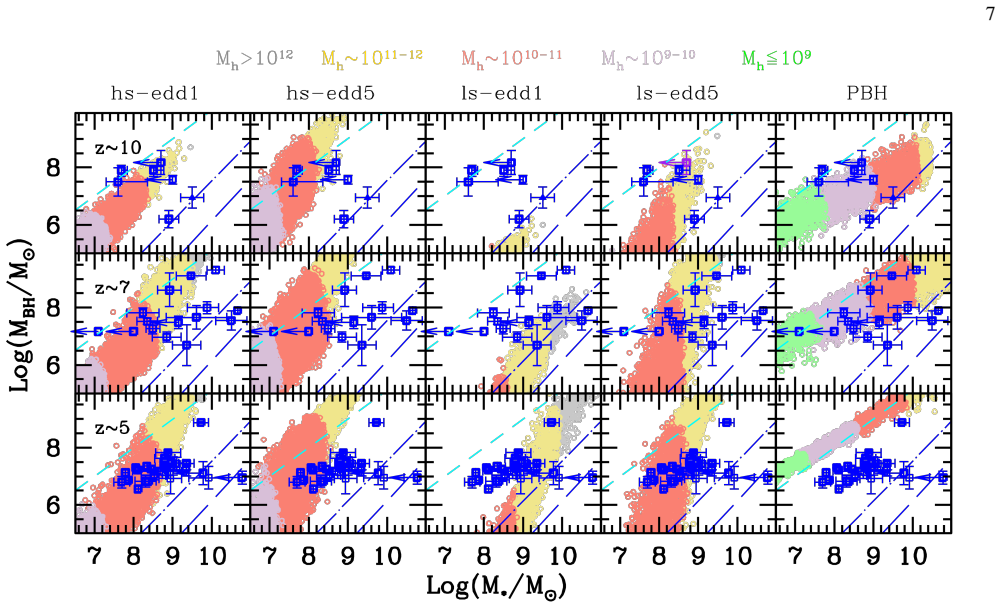
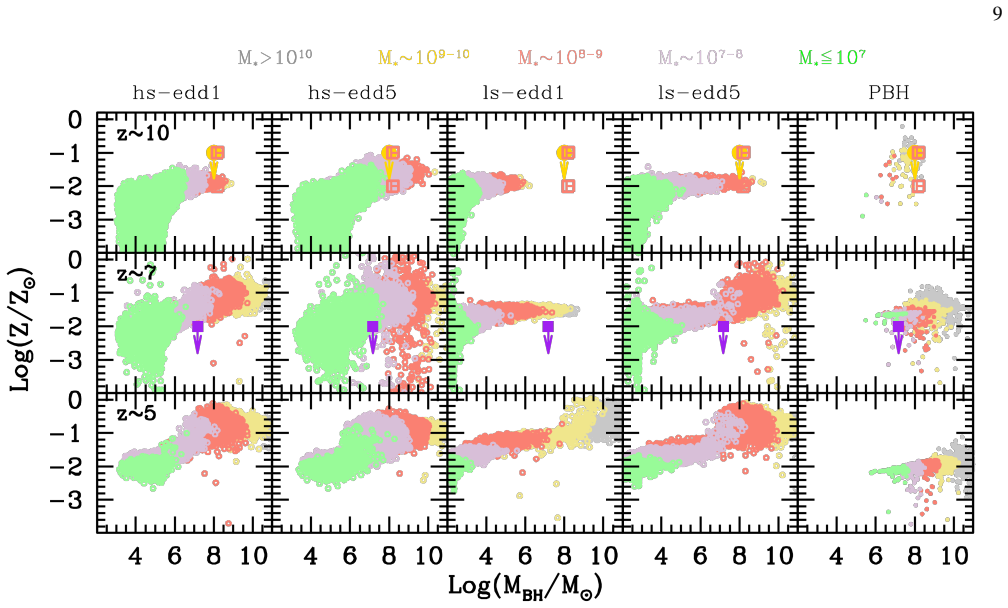
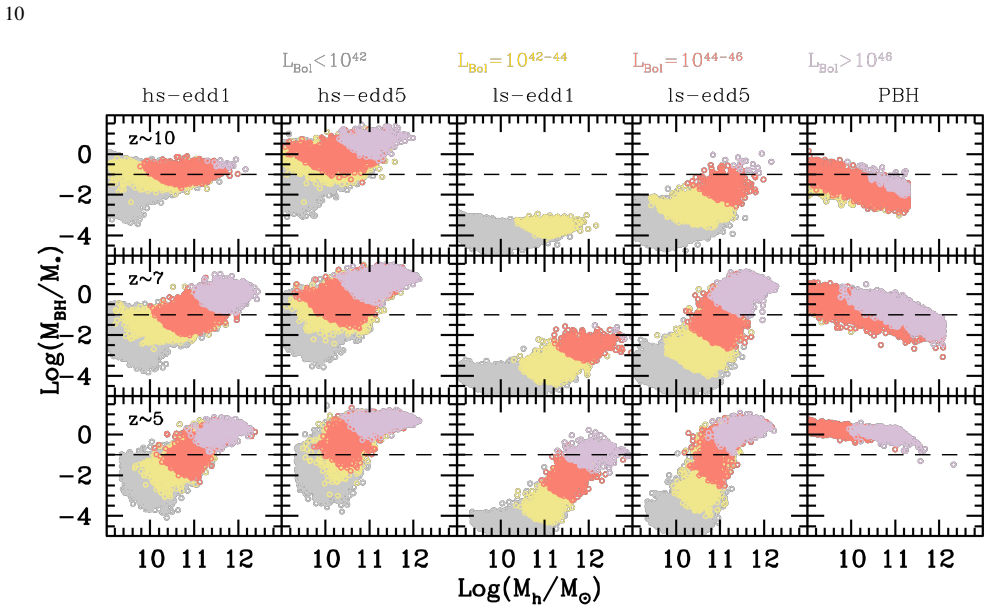
Comparing astrophysically-seeded black holes in the DELPHI semi-analytic model and cosmologically-seeded primordial black holes in the PHANES analytic model shows that the only scenario ruled out by z~5-10 data is Eddington-limited accretion onto light seeds. Both primordial black holes and Eddington-limited heavy seeds simultaneously match the observed black hole masses, stellar masses, and host metallicities Z ≤ 0.01 Z_⊙. Primordial black holes uniquely exhibit a decrease in the black hole-to-stellar mass ratio with increasing halo mass at all redshifts, in contrast to every astrophysical model.
What carries the argument
Side-by-side application of the DELPHI semi-analytic model (light and heavy astrophysical seeds with mergers plus Eddington or super-Eddington accretion) and the PHANES analytic model (primordial black holes growing only by sub-Eddington accretion) against JWST observables of black hole mass, stellar mass, metallicity, and halo mass at z~5-10.
If this is right
- Eddington-limited light seed models are excluded by the combination of high black hole masses and low host metallicities.
- Super-Eddington heavy seeds and primordial black holes both reproduce the observed over-massive black hole ratios of 0.3-1.
- Primordial black holes are the only channel that also matches the low metallicities while displaying a falling black hole-to-stellar mass ratio with halo mass.
- Systems at z~7 with black hole to stellar mass ratio above 0.1, bolometric luminosities 10^44-46 erg/s, and residing in 10^9-11 solar mass halos can serve as a clustering test for primordial black hole models.
Where Pith is reading between the lines
- Confirmation of the decreasing mass ratio trend would require galaxy formation models to treat primordial black holes as an additional, halo-mass-dependent growth channel separate from stellar or direct-collapse seeds.
- The same selection criteria could be applied to larger JWST or future X-ray surveys to map how the black hole occupation fraction changes with halo mass at fixed redshift.
- If primordial black holes dominate the early population, the merger rate of intermediate-mass black holes detectable by future gravitational-wave observatories would carry a distinct mass and redshift distribution.
Load-bearing premise
The semi-analytic DELPHI and analytic PHANES models accurately capture black hole growth, merger rates, and host galaxy metallicity evolution at z>5 without full hydrodynamic simulations or extra physics such as feedback or metal mixing.
What would settle it
A survey of z~7 systems showing that the black hole-to-stellar mass ratio does not decrease with increasing halo mass in the 10^9-11 solar mass range would rule out the primordial black hole seeding channel.
Figures


read the original abstract
The James Webb Space Telescope (JWST) has revealed a puzzling population of massive black holes in the first billion years, many of which are over-massive compared to their hosts (obese black holes), and reside in metal-poor hosts, posing a challenge for theoretical models at these early epochs. In this work, we compare the observational properties of astrophysically-seeded black holes using the DELPHI semi-analytic model and cosmologically-seeded primordial black holes (PBHs) using the PHANES analytic model. We explore the growth of light ($\sim 100 M_\odot$) and heavy ($\sim 10^{3-5}M_\odot$) seeds through mergers and accretion (both Eddington-limited and at super-Eddington rates) in the astrophysical scenario; PBHs (seeded between $10^{0.5-6}M_\odot$) only grow through accretion at sub-Eddington rates. Comparing to observables at $z \sim 5-10$, the only model that can be ruled out is the one where we allow Eddington-limited accretion onto light seeds. The observed high values of the black hole mass-stellar mass relation ($0.3-1$) can be reproduced by both PBHs and heavy seeds accreting at super-Eddington rates. However, only the PBH and Eddington-limited heavy seeding models can simultaneously reproduce the observed black hole masses (${\rm M_{bh}}$), stellar masses ($M_*$), and extremely low host metallicities ($Z \leq 0.01 Z_\odot$) inferred at $z \sim 7-10$. Crucially, we find PBHs show decrease in the black hole mass-stellar mass ratio with increasing halo mass at all redshifts, contrary to any astrophysical black hole model. Selecting systems at $z \sim 7$ with ${\rm M_{bh}}/M_* > 0.1$ and bolometric luminosities $\sim 10^{44-46} {\rm erg~s^{-1}}$ that show a negative black hole to stellar mass ratio and reside in $10^{9-11}M_\odot$ halos offer a promising clustering-based discriminant of PBH seeding models.
Editorial analysis
A structured set of objections, weighed in public.
Referee Report
Summary. The manuscript compares astrophysical black hole seeding scenarios (light seeds of ~100 M_⊙ and heavy seeds of 10^{3-5} M_⊙) using the DELPHI semi-analytic model, which includes mergers and both Eddington-limited and super-Eddington accretion, against primordial black hole (PBH) seeding (masses 10^{0.5-6} M_⊙) using the PHANES analytic model with only sub-Eddington accretion. It confronts these with JWST-inferred properties of massive black holes at z~5-10, including high M_bh/M_* ratios (0.3-1), low host metallicities (Z ≤ 0.01 Z_⊙), and bolometric luminosities, concluding that only PBHs and Eddington-limited heavy seeds simultaneously match all three observables while light-seed Eddington accretion is ruled out; PBHs are further distinguished by a decreasing M_bh/M_* trend with halo mass at all redshifts, offering a clustering-based test in 10^9-11 M_⊙ halos at z~7.
Significance. If the underlying model prescriptions hold, the work supplies a concrete, observationally testable discriminant between seeding channels via the sign of the M_bh/M_*–halo mass slope and the joint reproduction of M_bh, M_* and extremely low Z, which directly addresses the 'obese black hole' tension reported by JWST. The explicit enumeration of accretion modes and seed ranges across two independent frameworks is a strength that allows falsifiable predictions for future clustering measurements.
major comments (3)
- [Abstract and §3] Abstract and §3 (model descriptions): the claim that 'only the PBH and Eddington-limited heavy seeding models can simultaneously reproduce the observed black hole masses (M_bh), stellar masses (M_*), and extremely low host metallicities (Z ≤ 0.01 Z_⊙)' is load-bearing for the central conclusion, yet the manuscript provides no quantitative validation of DELPHI/PHANES metallicity evolution or BH growth rates against hydrodynamical simulations at z>5; without this, the exclusion of light-seed Eddington accretion and the uniqueness of the PBH signature cannot be assessed.
- [Abstract] Abstract: the reported 'decrease in the black hole mass-stellar mass ratio with increasing halo mass at all redshifts' for PBHs is presented as a unique discriminant, but the text does not quantify how sensitive this trend is to the adopted sub-Eddington accretion efficiency or the PBH mass range (10^{0.5-6} M_⊙); a modest change in either parameter could erase the negative slope and undermine the clustering test proposed for 10^9-11 M_⊙ halos.
- [Abstract and results section] Abstract and results section: no error bars, posterior distributions, or Monte-Carlo realizations are shown for the model outputs of M_bh, M_* and Z; the statement that certain models 'can be ruled out' therefore lacks a statistical threshold, making it impossible to judge whether the mismatch for light-seed Eddington accretion exceeds the model uncertainty.
minor comments (2)
- [Abstract] The abstract uses 'obese black holes' without a precise definition or reference to the specific observational papers that introduced the term.
- [Abstract] Notation for metallicities (Z ≤ 0.01 Z_⊙) and mass ratios (M_bh/M_*) is clear but would benefit from an explicit statement of the solar metallicity value adopted in DELPHI/PHANES.
Simulated Author's Rebuttal
We thank the referee for their careful reading and valuable comments, which have prompted us to strengthen the presentation of our results. We provide point-by-point responses to the major comments below, indicating the revisions we plan to make in the updated manuscript.
read point-by-point responses
-
Referee: [Abstract and §3] Abstract and §3 (model descriptions): the claim that 'only the PBH and Eddington-limited heavy seeding models can simultaneously reproduce the observed black hole masses (M_bh), stellar masses (M_*), and extremely low host metallicities (Z ≤ 0.01 Z_⊙)' is load-bearing for the central conclusion, yet the manuscript provides no quantitative validation of DELPHI/PHANES metallicity evolution or BH growth rates against hydrodynamical simulations at z>5; without this, the exclusion of light-seed Eddington accretion and the uniqueness of the PBH signature cannot be assessed.
Authors: We agree with the referee that quantitative validation against hydrodynamical simulations at z>5 would bolster confidence in the model predictions. While the current manuscript relies on the established frameworks of DELPHI and PHANES, which incorporate standard prescriptions for metallicity evolution and accretion, we have not performed new direct comparisons in this work. In the revised manuscript, we will include an expanded discussion in Section 3 on the model calibrations, citing relevant hydrodynamical simulation studies that validate similar approaches at high redshifts, and explicitly state the limitations of our semi-analytic approach. revision: yes
-
Referee: [Abstract] Abstract: the reported 'decrease in the black hole mass-stellar mass ratio with increasing halo mass at all redshifts' for PBHs is presented as a unique discriminant, but the text does not quantify how sensitive this trend is to the adopted sub-Eddington accretion efficiency or the PBH mass range (10^{0.5-6} M_⊙); a modest change in either parameter could erase the negative slope and undermine the clustering test proposed for 10^9-11 M_⊙ halos.
Authors: We concur that the sensitivity of the PBH M_bh/M_* trend to the sub-Eddington accretion efficiency and seed mass range should be quantified to support its use as a discriminant. We have conducted additional tests by varying these parameters within physically motivated ranges. The negative slope remains a robust feature of the PBH models. We will add a dedicated subsection or appendix in the revised version presenting these sensitivity analyses and updated figures to demonstrate the persistence of the trend. revision: yes
-
Referee: [Abstract and results section] Abstract and results section: no error bars, posterior distributions, or Monte-Carlo realizations are shown for the model outputs of M_bh, M_* and Z; the statement that certain models 'can be ruled out' therefore lacks a statistical threshold, making it impossible to judge whether the mismatch for light-seed Eddington accretion exceeds the model uncertainty.
Authors: The referee correctly points out the lack of uncertainty quantification in our model outputs. As the models are semi-analytic and analytic, we have now implemented Monte Carlo sampling over key uncertain parameters such as seed masses, accretion efficiencies, and halo merger rates to generate distributions for M_bh, M_*, and Z. The revised manuscript will feature error bars on the relevant plots and a statistical evaluation of how well each model matches the JWST observations, allowing a clearer assessment of which scenarios can be ruled out. revision: yes
Circularity Check
No significant circularity; model outputs compared to external JWST data
full rationale
The paper applies pre-existing DELPHI and PHANES models (with parameters drawn from prior literature) to generate outputs for different seeding/accretion scenarios and directly compares those outputs against independent JWST-inferred observables (M_BH, M_*, Z at z~7-10). No equation or claim in the provided text redefines model inputs in terms of the target results, renames a fit as a prediction, or reduces the central discriminant (PBH vs. astrophysical signatures) to a self-referential loop. The derivation chain remains self-contained against external benchmarks.
Axiom & Free-Parameter Ledger
free parameters (4)
- Light seed mass =
~100 M_sun
- Heavy seed mass range =
10^{3-5} M_sun
- PBH seed mass range =
10^{0.5-6} M_sun
- Accretion efficiency modes =
Eddington and super-Eddington
axioms (2)
- domain assumption Black hole growth occurs solely via mergers and gas accretion at the stated rates
- domain assumption Semi-analytic prescriptions for galaxy stellar mass and metallicity evolution remain valid at z>5
invented entities (1)
-
Primordial black holes as early seeds
no independent evidence
Reference graph
Works this paper leans on
-
[1]
Nelson, H. Atek, G. Brammer, K. I. Caputi, I. Chemerynska, S. E. Cutler, R. Feldmann, Y. Fudamoto, L. J. Furtak, A. D. Goulding, A. de Graaff, J. Leja, D. Marchesini, T. B. Miller, T. Nanayakkara, P. A. Oesch, R. Pan, S. H. Price, D. J. Setton, R. Smit, M. Stefanon, B. Wang, J. R. Weaver, K. E. Whitaker, C. C. Williams, and A. Zitrin, ApJ957, L7 (2023), a...
-
[2]
Kraft, ApJ965, L21 (2024), arXiv:2403.14745 [astro-ph.GA]. H. ¨Ubler, R. Maiolino, E. Curtis-Lake, P. G. P´erez-Gonz´alez, M. Curti, M. Perna, S. Arribas, S. Charlot, M. A. Marshall, F. D’Eugenio, J. Scholtz, A. Bunker, S. Carniani, P. Ferruit, P. Jakobsen, H.-W. Rix, B. Rodr´ıguez Del Pino, C. J. Willott, T. Boeker, G. Cresci, G. C. Jones, N. Kumari, and...
-
[3]
Holwerda, G. Illingworth, S. Juneau, J. S. Kartaltepe, A. M. Koekemoer, W. Li, R. A. Lucas, D. Magee, C. Mason, D. J. McLeod, R. J. McLure, L. Napolitano, C. Papovich, N. Pirzkal, G. Rodighiero, P. Santini, S. M. Wilkins, and L. Y. A. Yung, ApJ986, 126 (2025), arXiv:2404.03576 [astro-ph.GA]. I. Juodˇ zbalis, R. Maiolino, W. M. Baker, E. C. Lake, J. Scholt...
-
[4]
C., Übler, H., Maiolino, R., et al
Bunker, S. Carniani, S. Charlot, G. Cresci, P. Dayal, E. Egami, A. Fabian, K. Inayoshi, Y. Isobe, L. Ivey, G. C. Jones, S. Koudmani, N. Laporte, B. Liu, J. Lyu, G. Mazzolari, S. Monty, E. Parlanti, P. G. P´erez-Gonz´alez, M. Perna, B. Robertson, R. Schneider, D. Sijacki, S. Tacchella, A. Trinca, R. Valiante, M. Volonteri, J. Witstok, and S. Zhang, arXiv e...
-
[5]
Naidu, T. Nanayakkara, P. A. Oesch, R. Pan, C. Papovich, S. H. Price, P. van Dokkum, J. R. Weaver, K. E. Whitaker, and A. Zitrin, ApJ964, 39 (2024), arXiv:2309.05714 [astro-ph.GA]. D. J. Setton, J. E. Greene, A. de Graaff, Y. Ma, J. Leja, J. Matthee, R. Bezanson, L. A. Boogaard, N. J. Cleri, H. Katz, I. Labbe, M. V
-
[6]
Dokkum, B. Wang, A. Weibel, K. E. Whitaker, and C. C. Williams, ApJ 995, 118 (2025), arXiv:2411.03424 [astro-ph.GA]. J. E. Greene, D. J. Setton, L. J. Furtak, R. P. Naidu, M. Volonteri, P. Dayal, I. Labbe, P. van Dokkum, R. Bezanson, G. Brammer, S. E. Cutler, K. Glazebrook, A. de Graaff, M. Hirschmann, R. E. Hviding, V. Kokorev, J. Leja, H. Liu, Y. Ma, J....
- [7]
-
[8]
Eilers, A. de Graaff, K. E. Heintz, D. Kashino, M. V. Maseda, S. Tacchella, and A. Torralba, ApJ988, 246 (2025), arXiv:2412.02846 [astro-ph.GA]. R. Schneider, R. Valiante, A. Trinca, L. Graziani, M. Volonteri, and R. Maiolino, MNRAS526, 3250 (2023), arXiv:2305.12504 [astro-ph.GA]. M. Volonteri, M. Trebitsch, J. E. Greene, Y. Dubois, C. A. Dong-Paez, M. Ha...
-
[9]
Planck 2018 results. VI. Cosmological parameters
Tauber, D. Tavagnacco, M. Tenti, L. Toffolatti, M. Tomasi, T. Trombetti, L. Valenziano, J. Valiviita, B. Van Tent, L. Vibert, P. Vielva, F. Villa, N. Vittorio, B. D. Wandelt, I. K. Wehus, M. White, S. D. M. White, A. Zacchei, and A. Zonca, A&A641, A6 (2020), arXiv:1807.06209 [astro-ph.CO]. E. E. Salpeter, ApJ121, 161 (1955). J. B. Oke and J. E. Gunn, Astr...
work page Pith review arXiv 2020
-
[10]
Williams, L. J. Furtak, A. Zitrin, H. Atek, R. Bezanson, I. Chemerynska, R. Feldmann, K. Glazebrook, I. Labbe, T. Nanayakkara, P. A. Oesch, and J. R. Weaver, A&A697, A211 (2025), arXiv:2401.11242 [astro-ph.GA]. R. K. Sheth and G. Tormen, Monthly Notices of the Royal Astronomical Society329, 61 (2002). V. Mauerhofer, P. Dayal, M. G. Haehnelt, T. Kimm, J. R...
-
[11]
Rivera, M. Branchesi, G. Branduardi-Raymont, K. Burdge, S. Chakraborty, J. Cuadra, K. Dage, B. Davis, S. E. de Mink, R. Decarli, D. Doneva, S. Escoffier, P. Gandhi, F. Haardt, C. O. Lousto, S. Nissanke, J. Nordhaus, R. O’Shaughnessy, S. Portegies Zwart, A. Pound, F. Schussler, O. Sergijenko, A. Spallicci, D. Vernieri, and A. Vigna-G´omez, Living Reviews i...
-
[12]
2026, arXiv e-prints, arXiv:2602.12325 Förster Schreiber, N
Leung, J. Matthee, R. A. Meyer, R. P. Naidu, M. Onoue, P. G. P´erez-Gonz´alez, C. L. Steinhardt, F. Valentino, F. Walter, M. Xiao, and H. Zhang, arXiv e-prints , arXiv:2602.12325 (2026), arXiv:2602.12325 [astro-ph.GA]. S. Hawking, MNRAS152, 75 (1971). B. J. Carr and S. W. Hawking, MNRAS168, 399 (1974). B. J. Carr, arXiv e-prints , astro-ph/0511743 (2005),...
- [13]
-
[14]
McCracken, J. McKinney, M. Onoue, L. Paquereau, A. Renzini, J. Rhodes, B. E. Robertson, M. Shuntov, J. D. Silverman, T. S. Tanaka, S. Toft, B. Trakhtenbrot, F. Valentino, and J. Zavala, ApJ991, 37 (2025a), arXiv:2406.10341 [astro-ph.GA]. L. J. Furtak, I. Labb´e, A. Zitrin, J. E. Greene, P. Dayal, I. Chemerynska, V. Kokorev, T. B. Miller, A. D. Goulding, A...
-
[15]
Oesch, A. Plat, D. J. Setton, D. P. Stark, and C. C. Williams, Nature628, 57 (2024), arXiv:2308.05735 [astro-ph.GA]. I. Juodˇ zbalis, R. Maiolino, W. M. Baker, S. Tacchella, J. Scholtz, F. D’Eugenio, J. Witstok, R. Schneider, A. Trinca, R. Valiante, C. DeCoursey, M. Curti, S. Carniani, J. Chevallard, A. de Graaff, S. Arribas, J. S. Bennett, M. A. Bourne, ...
-
[16]
Wilkins, L. Y. A. Yung, and Ceers Team, ApJ953, L29 (2023), arXiv:2303.08918 [astro-ph.GA]. A. J. Taylor, V. Kokorev, D. D. Kocevski, H. B. Akins, F. Cullen, M. Dickinson, S. L. Finkelstein, P. Arrabal Haro, V. Bromm, M. Giavalisco, K. Inayoshi, S. Juneau, G. C. K. Leung, P. G. P´erez-Gonz´alez, R. S. Somerville, J. R. Trump, R. O. Amor´ın, G. Barro, D. B...
-
[17]
Wilkins, L. Y. A. Yung, and J. A. Zavala, ApJ989, L7 (2025b), arXiv:2505.04609 [astro-ph.GA]. A. E. Reines and M. Volonteri, ApJ813, 82 (2015), arXiv:1508.06274 [astro-ph.GA]. H. Suh, F. Civano, B. Trakhtenbrot, F. Shankar, G. Hasinger, D. B. Sanders, and V. Allevato, ApJ889, 32 (2020), arXiv:1912.02824 [astro-ph.GA]. A.-C. Eilers, R. Mackenzie, E. Pizzat...
-
[18]
Jun, M. Li, Z. Li, W. Liu, A. Lupi, J. Lyu, C. Mazzucchelli, M. Onoue, M. Pudoka, S. Rojas-Ruiz, J.-T. Schindler, Y. Shen, W. L. Tee, B. Trakhtenbrot, M. Trebitsch, M. Vestergaard, M. Volonteri, F. Walter, H. Zhang, and S. Zou, arXiv e-prints , arXiv:2602.04979 (2026), arXiv:2602.04979 [astro-ph.GA]. S. W. Davis and A. Tchekhovskoy, ARA&A58, 407 (2020), a...
discussion (0)
Sign in with ORCID, Apple, or X to comment. Anyone can read and Pith papers without signing in.